1
Define scope and covered employees
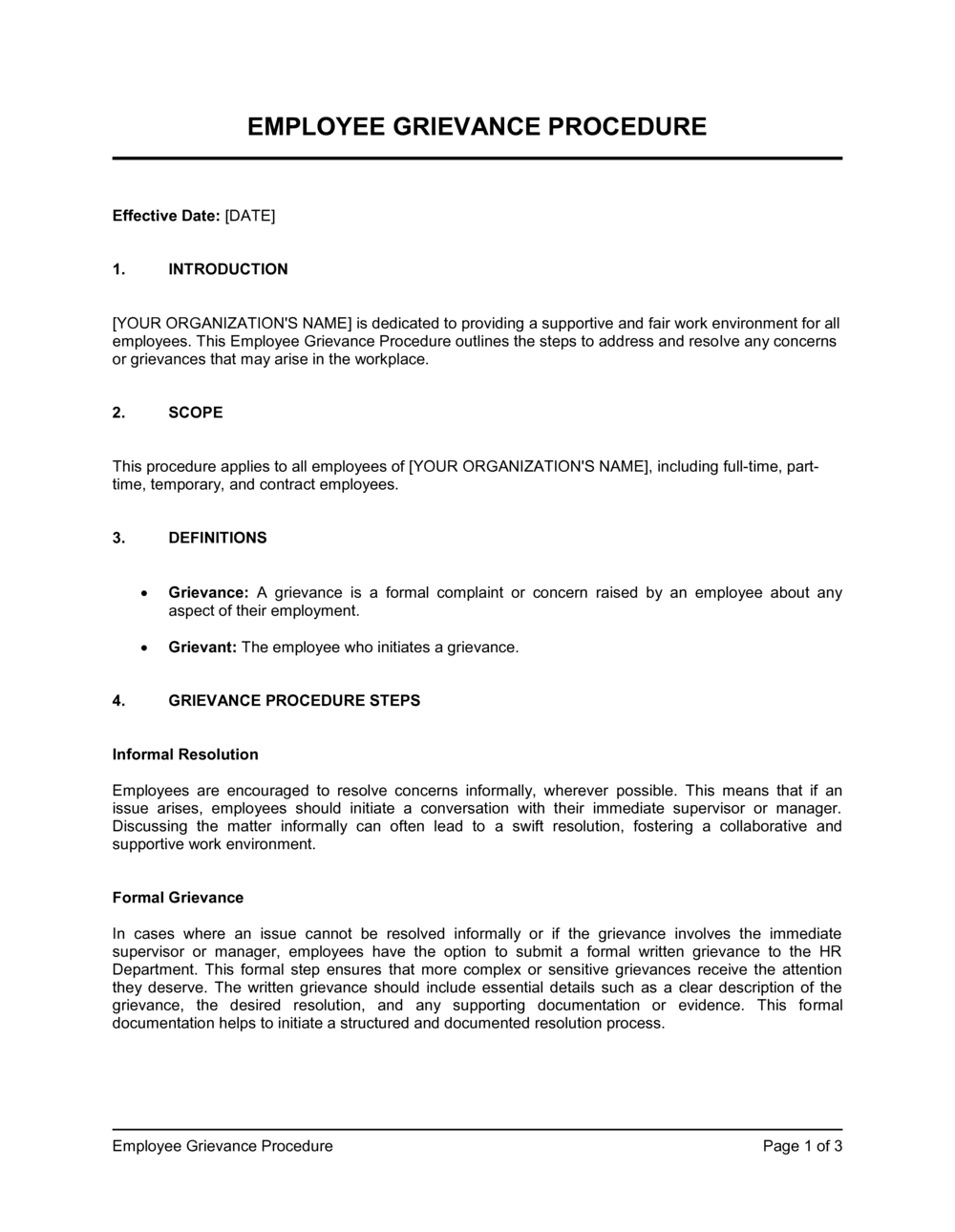
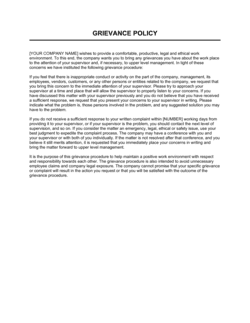
In the Purpose and Scope section, name your company's legal entity, list all locations this policy covers, and confirm which employment types are included — full-time, part-time, fixed-term, and any remote staff.
💡 If you have employees in multiple countries, create a jurisdiction-specific appendix rather than trying to accommodate every local law in the main body.
2
Set realistic timelines for each stage
Fill in the working-day windows for acknowledgment (typically 3 days), investigation completion (typically 15–20 days), outcome letter (typically 5 days), and appeal window (typically 5 days). Make sure the total process fits within any statutory timeframe applicable in your jurisdiction.
💡 Shorter timelines look employee-friendly but create compliance risk if your HR team cannot reliably meet them. Choose timeframes you can actually hit 95% of the time.
3
Name the investigating officer role — not a specific individual
Refer to the role title (HR Manager, Senior HR Business Partner) rather than a named person. Individuals change roles or leave; a policy tied to a specific name requires amendment every time personnel change.
💡 Add a secondary investigator role in case of conflicts of interest — you will need it more often than you expect.
4
Attach a grievance submission form as an appendix
Link or append a one-page form capturing the grievant's name, department, date of incident, description of the complaint, parties involved, and remedy sought. A structured form prevents incomplete submissions that delay the investigation.
💡 Include a field asking whether the employee attempted informal resolution first and what the outcome was — this creates an audit trail before the formal stage opens.
5
Specify companion representation rights
State clearly whether employees may bring a colleague, trade union representative, or support person to investigative meetings, and if so, what that person's role is (observer versus active participant).
💡 In the UK, the right to be accompanied at a formal grievance meeting is a statutory entitlement — if you operate there, confirm your policy matches or exceeds this standard.
6
Confirm the anti-retaliation escalation path
Name the specific role or channel employees should use to report suspected retaliation — typically an HR Director or an anonymous reporting line — so the protection clause has a practical mechanism.
💡 A general 'contact HR' instruction is insufficient if the HR manager is the alleged retaliator. Identify a named fallback, such as the CEO or an external ombudsperson.
7
Incorporate into your employee handbook and communicate at onboarding
Reference the grievance procedure in your employee handbook and present it during new-hire orientation. Employees who are unaware of the procedure at the time a complaint arises are more likely to go directly to external bodies.
💡 Have employees sign an acknowledgment confirming they have received and read the policy — store this with their personnel file.