Cease and Desist Letter Template

Free Word download • Edit online • Save & share with Drive • Export to PDF

1 page15–25 min to fillDifficulty: Standard
Learn more ↓
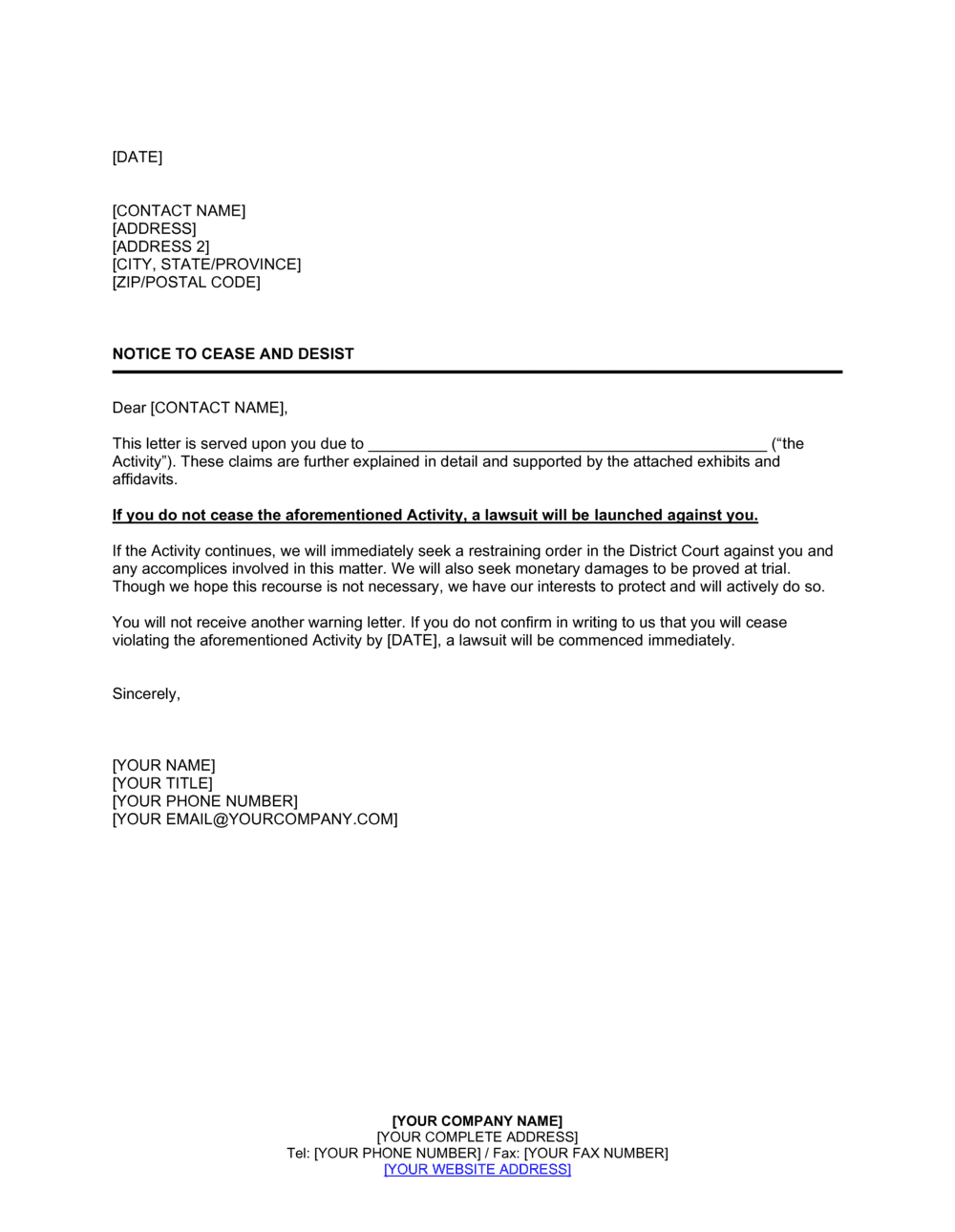
FreeCease and Desist Letter Template

At a glance

What it is
A Cease and Desist Letter is a formal written notice demanding that the recipient immediately stop a specific activity that infringes on your rights — such as copying your brand, using your copyrighted content, harassing you or your employees, or breaching a contract. This free Word download gives you a structured, professional template you can edit online and send without a lawyer in most routine situations.
When you need it
Use it when someone is engaging in conduct that harms your rights or business and you want to create a written record of your objection before escalating to legal action. It is typically the first formal step before filing a lawsuit or complaint.
What's inside
Sender and recipient identification, a clear description of the infringing or harmful conduct, the specific legal or contractual basis for the demand, a defined deadline to comply, and a statement of the consequences if the recipient fails to stop.

What is a Cease and Desist Letter?

A Cease and Desist Letter is a formal written notice sent to an individual or organization demanding that they immediately stop a specific activity that infringes on the sender's legal rights — and refrain from doing it again. Common triggers include trademark or copyright infringement, harassment, breach of a non-compete agreement, defamation, or tortious interference with a business relationship. Unlike a court order, a cease and desist letter is not legally binding on its own, but it creates an official written record that the recipient was put on notice and given a reasonable opportunity to stop before formal legal action was pursued.

Why You Need This Document

Without a written cease and desist letter on record, escalating a dispute to litigation is significantly harder. Courts typically expect evidence that you attempted to resolve the matter before filing, and a dated, delivered letter satisfies that requirement. Sending one also stops many infringers immediately — particularly smaller operators who realize the conduct carries real legal risk once it is formally named and documented. For trademark and copyright disputes, willful infringement after receiving a cease and desist notice can result in significantly higher statutory damages, giving the letter direct financial leverage. This template gives you a professionally structured notice you can complete in under 30 minutes, send today, and file as the opening record in any dispute.

Which variant fits your situation?

If your situation is…Use this template
Someone is using your trademark, logo, or business name without authorizationCease and Desist Letter (Trademark Infringement)
A third party is publishing or distributing your copyrighted contentCease and Desist Letter (Copyright Infringement)
A former employee is violating a non-compete or non-solicitation agreementCease and Desist Letter (Non-Compete Violation)
An individual is harassing you, your staff, or your customersCease and Desist Letter (Harassment)
A debtor has not responded to informal payment requestsDemand Letter for Payment
A party is breaching the terms of a signed contractBreach of Contract Demand Letter
Someone is spreading false or damaging statements about your businessCease and Desist Letter (Defamation)

Common mistakes to avoid

❌ Vague description of the infringing conduct

Why it matters: A recipient who cannot clearly identify what they are being asked to stop can claim good-faith confusion and continue the behavior, weakening your position in any later legal proceeding.

Fix: Include the specific date the conduct began, where it is occurring (URL, address, platform), and what exactly is being used or done without authorization.

❌ No legal or factual basis cited

Why it matters: A letter that simply says 'stop what you are doing' has no legal weight and is easily ignored or dismissed as an opinion rather than a notice.

Fix: Reference the specific statute, contract clause, or registered right being violated. Even a template letter should name the relevant law or agreement.

❌ Threatening consequences you will not pursue

Why it matters: If you threaten litigation repeatedly but never follow through, the recipient learns the threats are hollow and the letter loses all deterrent value.

Fix: Only state consequences you are genuinely prepared to act on. If litigation is unlikely, focus the consequences language on reporting to platforms, trade associations, or regulatory bodies.

❌ Sending without retaining evidence of delivery

Why it matters: If the matter escalates to court, you need to prove the recipient received the letter and was on notice of the demand.

Fix: Send by certified mail with return receipt or by email with delivery and read confirmation, and save all delivery records alongside the copy of the letter.

The 9 key clauses, explained

Sender and recipient identification

In plain language: Opens the letter by identifying who is sending it and who it is addressed to, including full legal names, business names, and addresses.

Sample language
This letter is sent on behalf of [YOUR FULL NAME / COMPANY NAME], located at [ADDRESS], to [RECIPIENT FULL NAME / COMPANY NAME], located at [ADDRESS].

Common mistake: Addressing the letter to a contact name rather than the legal entity. If the recipient is a company, address it to the company's registered name — not just 'John Smith' — so the notice applies to the entity capable of being sued.

Statement of the infringing or harmful conduct

In plain language: Describes, with specific facts and dates, exactly what the recipient is doing that violates your rights.

Sample language
It has come to our attention that on or about [DATE], you began [DESCRIPTION OF CONDUCT] at [LOCATION / PLATFORM / URL], in direct violation of [YOUR RIGHT OR AGREEMENT].

Common mistake: Being vague about the conduct — writing 'you are using our content' instead of specifying the exact work, URL, or behavior. Vague allegations give the recipient room to claim they did not understand what to stop.

Legal or contractual basis for the demand

In plain language: States the specific right, law, or agreement being violated that entitles the sender to make this demand.

Sample language
Your actions constitute infringement of [OUR REGISTERED TRADEMARK / COPYRIGHT REGISTRATION NO. XXXXX / SECTION X OF THE AGREEMENT DATED DATE], in violation of [APPLICABLE LAW OR PROVISION].

Common mistake: Omitting the legal or contractual basis entirely and just saying 'stop.' Without citing the right or law being violated, the letter reads as an opinion rather than a notice with legal weight.

Evidence and supporting documentation

In plain language: References any attached proof — screenshots, registration certificates, agreement excerpts — that substantiates the claim.

Sample language
Attached hereto as Exhibit A is [DESCRIPTION OF EVIDENCE — e.g., a screenshot dated DATE showing your use of our registered trademark on your website at URL].

Common mistake: Sending the letter without any supporting evidence. A recipient who disputes the claim has an easy defense if there is nothing on record showing the conduct occurred.

Cease and desist demand

In plain language: The core demand: a clear, direct instruction to stop the conduct immediately and permanently.

Sample language
We hereby demand that you immediately cease and desist from [SPECIFIC CONDUCT] and that you refrain from engaging in such conduct in the future.

Common mistake: Using tentative language like 'we would appreciate it if you could stop.' The demand should be unambiguous — hedged language undermines the letter's legal tone and signals the sender is uncertain.

Required remedial actions

In plain language: Any specific corrective steps the recipient must take beyond simply stopping — such as removing content, destroying infringing materials, or returning property.

Sample language
In addition to ceasing the above conduct, you are required to: (a) remove all infringing content from [PLATFORM / URL] within [X] days; (b) destroy all copies of [MATERIAL] in your possession; and (c) confirm in writing that you have complied.

Common mistake: Demanding only that the behavior stop, without asking for written confirmation of compliance. Without a confirmation requirement, you have no record that the recipient acknowledged and acted on the demand.

Compliance deadline

In plain language: Sets a specific date — typically 7 to 14 days from the letter's date — by which the recipient must comply.

Sample language
You must comply with the above demands no later than [DATE — 10 DAYS FROM LETTER DATE]. Failure to do so will leave us no choice but to pursue all available legal remedies.

Common mistake: Setting an unreasonably short deadline — 24 or 48 hours — that the recipient cannot realistically meet. Courts view good-faith compliance periods as a factor in later proceedings; a fair deadline demonstrates you sought resolution before litigation.

Statement of consequences

In plain language: Informs the recipient of the legal actions the sender is prepared to take if the demand is not met — such as filing a lawsuit, seeking an injunction, or pursuing damages.

Sample language
If you fail to comply by the deadline above, we reserve the right to pursue all legal remedies available, including but not limited to filing for injunctive relief, seeking actual and statutory damages, and recovering our attorneys' fees.

Common mistake: Threatening consequences you are not actually prepared to follow through on. Empty threats — especially repeated ones — signal that no real enforcement will occur and remove the letter's leverage.

Reservation of rights

In plain language: A standard closing clause confirming that sending this letter does not waive any legal rights the sender has, including the right to take legal action.

Sample language
Nothing in this letter shall be construed as a waiver of any rights or remedies available to [YOUR NAME / COMPANY], all of which are expressly reserved.

Common mistake: Omitting this clause and instead including language that could be read as settling or resolving the matter. Any phrasing that implies finality can be used by the recipient to argue the dispute was resolved by the letter alone.

How to fill it out

  1. 1

    Identify both parties with full legal names

    Enter your full legal name or registered business name and address in the sender block. Enter the recipient's full legal name or entity name and their last known address.

    💡 If the recipient is a company, look up their registered agent address through the secretary of state's website — this ensures the letter reaches a legally recognized contact.

  2. 2

    Describe the conduct in specific, factual terms

    Write a concise paragraph explaining exactly what the recipient is doing, when it started, and where it is occurring. Include URLs, dates, product names, or contract references as applicable.

    💡 Take screenshots or download copies of the infringing content before sending — recipients sometimes remove evidence as soon as they receive the letter.

  3. 3

    State the legal or contractual right being violated

    Identify the specific law (copyright statute, trademark registration, contract clause) that gives you the right to make this demand. Include registration numbers or agreement dates where applicable.

    💡 Even if you are not a lawyer, citing the relevant statute by name — e.g., 17 U.S.C. § 501 for copyright infringement — adds credibility and signals you have done your research.

  4. 4

    List any required remedial actions

    Beyond stopping the conduct, specify any corrective steps — content removal, return of materials, written confirmation of compliance — and list them as numbered items for clarity.

    💡 Keep the list to the actions that are genuinely necessary. Overloading the recipient with demands they cannot feasibly meet reduces the likelihood of voluntary compliance.

  5. 5

    Set a realistic compliance deadline

    Enter a specific calendar date — typically 10 to 14 days from the letter date — as the compliance deadline. Avoid open-ended language like 'as soon as possible.'

    💡 10 days is the most commonly used standard for cease and desist letters and is generally viewed as reasonable by courts.

  6. 6

    Send by a traceable method and keep a copy

    Send the letter by certified mail with return receipt requested, or by email with read-receipt confirmation, and retain a timestamped copy for your records.

    💡 Sending by both certified mail and email simultaneously maximizes the chance of delivery confirmation and limits the recipient's ability to claim they never received it.

Frequently asked questions

What is a cease and desist letter?

A cease and desist letter is a formal written notice demanding that the recipient immediately stop a specific activity that infringes on the sender's legal rights — such as trademark or copyright infringement, harassment, or breach of contract. It is not a court order, but it creates a written record of the dispute and is typically the first formal step before legal action is filed.

Do I need a lawyer to send a cease and desist letter?

No — anyone can send a cease and desist letter without an attorney. For routine situations such as content removal requests or minor trademark disputes, a well-drafted template is typically sufficient. A lawyer is advisable when the dispute involves significant financial stakes, a counter-lawsuit is possible, or the recipient is represented by counsel.

What happens if the recipient ignores a cease and desist letter?

If the recipient ignores the letter and continues the conduct, you can escalate to legal action — filing a lawsuit, seeking a court injunction, or reporting the infringement to the relevant platform or authority. The letter itself becomes evidence in those proceedings, showing the recipient was on notice and chose to continue the behavior.

Can a cease and desist letter be sent by email?

Yes — email is a valid and commonly used delivery method. For maximum protection, send by both certified mail (with return receipt) and email, and save all delivery confirmations. Email alone is acceptable for many routine disputes, but certified mail is strongly preferred when the matter may escalate to litigation.

What is the difference between a cease and desist letter and a demand letter?

A demand letter typically requests a specific action — usually payment of money owed. A cease and desist letter demands that someone stop a harmful or infringing activity. Both are formal pre-litigation notices, but a cease and desist focuses on stopping ongoing conduct rather than recovering a debt or sum.

What should I do if I receive a cease and desist letter?

Read it carefully to understand exactly what conduct is alleged and what the sender is demanding. Do not ignore it. If the claims are valid, comply by the stated deadline. If you dispute the claims, consider seeking legal advice before responding — your written response becomes part of the record. Never respond angrily or make admissions in writing.

How long should I give the recipient to comply?

Ten to fourteen days is the standard range for most cease and desist letters and is generally considered a reasonable compliance period. Seven days is acceptable for straightforward requests like taking down a web page. Anything shorter than five days may appear unreasonable to a court and reduce your credibility if the dispute is later litigated.

How this compares to alternatives

vs Demand Letter

A demand letter requests a specific remedy — typically payment of money owed or performance of a contractual obligation. A cease and desist letter demands that ongoing harmful conduct be stopped entirely. Use a demand letter when the issue is unpaid money or a missed deliverable; use a cease and desist when someone needs to stop an activity.

vs Court Injunction

A court injunction is a legally binding order issued by a judge that compels the recipient to stop specific conduct under penalty of contempt. A cease and desist letter is a voluntary pre-litigation notice with no court backing. Send the letter first; file for an injunction if the recipient ignores it and the harm is ongoing.

vs DMCA Takedown Notice

A DMCA takedown notice is a formal copyright removal request submitted to a platform host under the Digital Millennium Copyright Act — it requires the platform to act, not the infringer directly. A cease and desist letter is sent directly to the person using your content. For online copyright disputes, both tools are often used together.

vs Non-Disclosure Agreement (NDA)

An NDA is a preventive contract signed before sharing confidential information to prohibit its disclosure. A cease and desist letter is a reactive notice sent after a violation has already occurred. If confidential information has already been leaked, a cease and desist is the appropriate first step; an NDA should have been in place beforehand.

Industry-specific considerations

Creative and Media

Copyright infringement is the most common trigger — unauthorized use of images, music, video, or written content across websites and social media platforms.

Technology / SaaS

Trademark infringement involving app or product names, unauthorized use of proprietary code, and non-compete violations by former employees are the most frequent scenarios.

Retail and E-commerce

Brand counterfeiting, unauthorized reselling of trademarked goods, and product description copying are common grounds for a cease and desist notice.

Professional Services

Client non-solicitation and confidentiality violations by former employees or partners, and unauthorized use of firm names or credentials, are the primary use cases.

Template vs pro — what fits your needs?

PathBest forCostTime
Use the templateRoutine infringement disputes, content removal requests, and minor trademark or non-compete issuesFree15–30 minutes
Template + professional reviewDisputes involving registered IP, significant financial harm, or a recipient who has prior legal counsel$150–$400 for a one-hour attorney review1–2 days
Custom draftedHigh-stakes litigation preludes, complex multi-party infringement, or cases where a counter-lawsuit is likely$500–$2,000+3–7 days

Glossary

Cease and Desist
A formal instruction to immediately stop (cease) an ongoing activity and refrain from doing it again in the future (desist).
Infringement
The unauthorized use of intellectual property — such as a trademark, copyright, or patent — in a way that violates the owner's exclusive rights.
Intellectual Property (IP)
Creations of the mind — including inventions, logos, written works, and trade secrets — that are protected by law from unauthorized use.
Trademark
A word, name, symbol, or design that identifies and distinguishes the source of goods or services from one business to another.
Copyright
The exclusive legal right of a creator to reproduce, distribute, or display their original work — such as writing, music, or software code.
Demand Letter
A formal written notice requesting that the recipient take a specific action — or stop a specific action — before legal proceedings begin.
Non-Compete Clause
A contractual provision that prevents a former employee or partner from working for competitors or starting a competing business within a defined time and geography.
Defamation
The act of making false statements about a person or business that damage their reputation — called libel when written and slander when spoken.
Tortious Interference
When a third party intentionally disrupts a business relationship or contract between two other parties, causing economic harm.
Compliance Deadline
The specific date by which the recipient must stop the stated conduct — typically 7 to 14 days from the letter's date.

Part of your Business Operating System

This document is one of 3,000+ business & legal templates included in Business in a Box.

  • Fill-in-the-blanks — ready in minutes
  • 100% customizable Word document
  • Compatible with all office suites
  • Export to PDF and share electronically

Create your document in 3 simple steps.

From template to signed document — all inside one Business Operating System.
1
Download or open template

Access over 3,000+ business and legal templates for any business task, project or initiative.

2
Edit and fill in the blanks with AI

Customize your ready-made business document template and save it in the cloud.

3
Save, Share, Send, Sign

Share your files and folders with your team. Create a space of seamless collaboration.

Save time, save money, and create top-quality documents.

★★★★★

"Fantastic value! I'm not sure how I'd do without it. It's worth its weight in gold and paid back for itself many times."

Managing Director · Mall Farm
Robert Whalley
Managing Director, Mall Farm Proprietary Limited
★★★★★

"I have been using Business in a Box for years. It has been the most useful source of templates I have encountered. I recommend it to anyone."

Business Owner · 4+ years
Dr Michael John Freestone
Business Owner
★★★★★

"It has been a life saver so many times I have lost count. Business in a Box has saved me so much time and as you know, time is money."

Owner · Upstate Web
David G. Moore Jr.
Owner, Upstate Web

Run your business with a system — not scattered tools

Stop downloading documents. Start operating with clarity. Business in a Box gives you the Business Operating System used by over 250,000 companies worldwide to structure, run, and grow their business.

Free Forever Plan · No credit card required