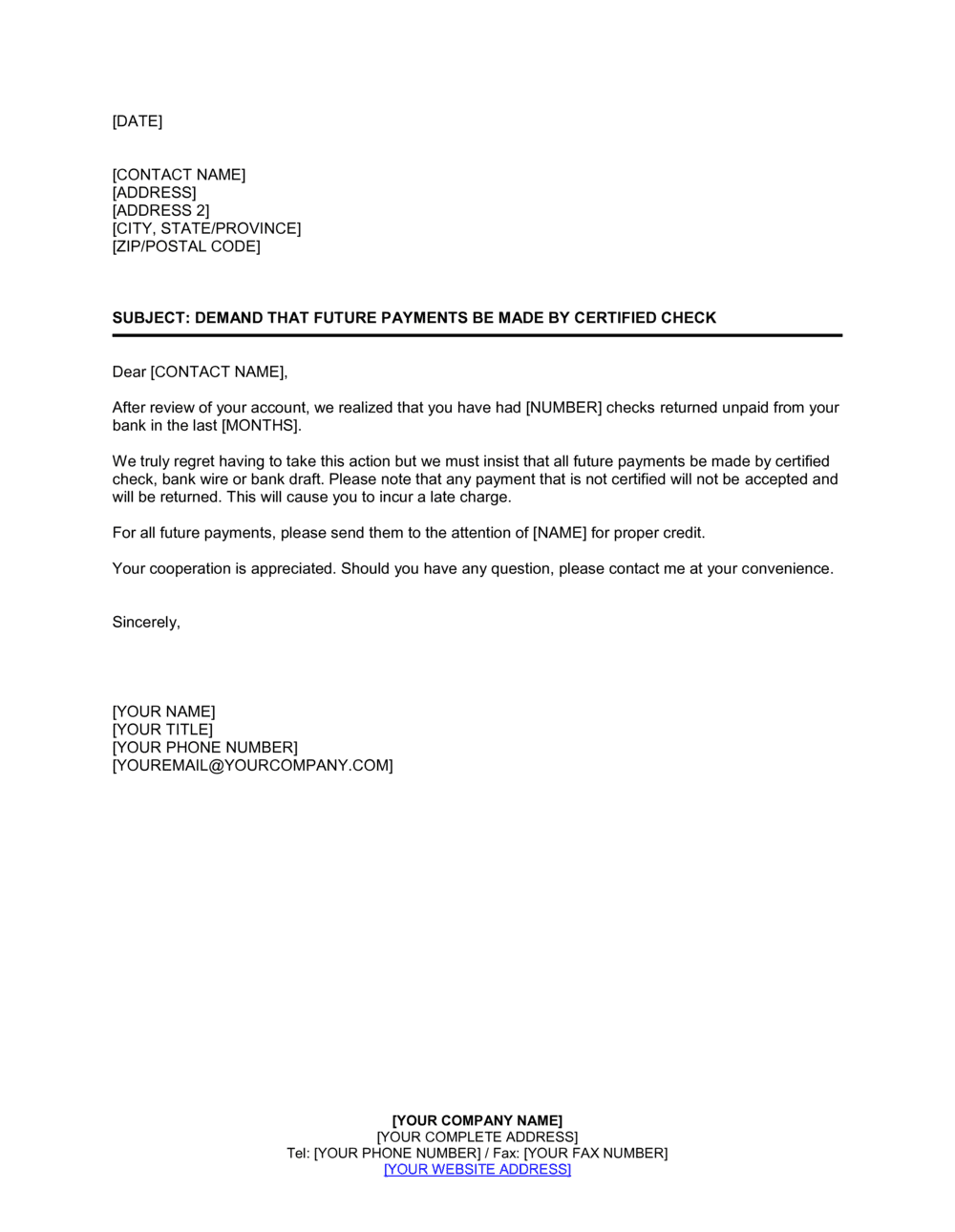
Demand Future Payments by Certified Check Template

Free Word download β€’ Edit online β€’ Save & share with Drive β€’ Export to PDF

1 pageβ€’20–30 min to fillβ€’Difficulty: Standardβ€’Signature requiredβ€’Legal review recommended
Learn more ↓
FreeDemand Future Payments by Certified Check Template

At a glance

What it is
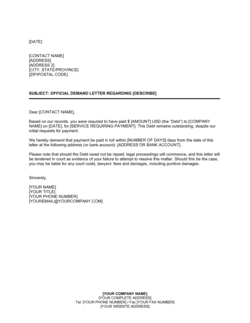
A Demand Future Payments By Certified Check is a formal written notice a creditor or payee sends to a debtor or payer requiring that all future payments under an existing obligation be remitted exclusively by certified check or other guaranteed funds β€” not personal or business checks. This free Word download gives you a legally structured template you can edit online and export as PDF to send by certified mail.
When you need it
Use it after a debtor has issued one or more returned or dishonored checks, after a payment has been reversed, or whenever you have grounds to require guaranteed funds as a condition of continued dealings. It is also appropriate when a contract or promissory note permits the creditor to demand certified funds upon default or repeated late payment.
What's inside
Identification of both parties and the underlying obligation, a clear statement of the triggering event (e.g., returned check or default), the formal demand for certified funds going forward, the consequences of non-compliance, a deadline for acknowledgment, and signature and notice blocks.

What is a Demand Future Payments By Certified Check?

A Demand Future Payments By Certified Check is a formal written notice that a creditor or payee serves on a debtor or payer to require that all future payments under an existing obligation β€” whether a promissory note, lease, invoice, or supply agreement β€” be remitted exclusively by certified check, cashier's check, money order, or wire transfer. Unlike a personal or business check, these guaranteed instruments cannot be returned for insufficient funds because the paying bank has already verified and set aside the underlying funds. The document identifies both parties, references the specific agreement being enforced, states the event that triggered the demand (typically a dishonored check or payment default), sets a deadline for remitting any currently overdue amount by certified funds, and specifies the consequences of non-compliance β€” including acceleration of the full debt and referral to legal counsel.

Why You Need This Document

Continuing to accept personal or business checks after a debtor has already issued a dishonored payment exposes you to the same loss repeatedly β€” with no documented basis for escalating to collections or litigation. Without a formal certified-check demand on file, a debtor can argue that the creditor waived its right to object to payment method by accepting non-guaranteed funds over time. A properly served demand eliminates that defense, creates an unambiguous evidentiary record of the debtor's obligation to use guaranteed funds, and satisfies the notice requirements that many state and provincial bad-check statutes require before civil damages or attorneys' fees become available. It also signals to the debtor that the creditor is managing the account actively β€” which measurably accelerates payment in the majority of commercial collection situations. This template gives you a complete, structured document ready to send by certified mail in under 30 minutes, covering every clause a court or collections attorney will look for if the matter escalates.

Which variant fits your situation?

If your situation is…Use this template
Debtor issued a personal check that was returned NSFDemand Future Payments By Certified Check
Debtor has defaulted on a promissory note installmentDemand for Payment on Promissory Note
Tenant has repeatedly paid rent late or with bounced checksNotice to Pay Rent or Quit
Customer owes an outstanding invoice balance and has not respondedDemand Letter for Payment
Party has fully defaulted and creditor is accelerating the debtNotice of Default and Acceleration
Creditor wants a written payment plan before waiving the certified check requirementPayment Agreement
Returned check has triggered a bad-check statutory notice requirementNotice of Dishonored Check

Common mistakes to avoid

❌ Overstating the amount currently due

Why it matters: Including unmatured future installments or unverified fees in the 'currently due' figure exposes the creditor to counterclaims under the Fair Debt Collection Practices Act and similar state statutes, and can result in sanctions in subsequent litigation.

Fix: Calculate the overdue amount from verified records only β€” outstanding principal, accrued interest per the contract rate, and bank-documented returned-item fees. Leave future installments out of the demand entirely.

❌ Setting an unreasonably short cure deadline

Why it matters: A demand that gives the debtor fewer than 5 business days to obtain guaranteed funds and remit payment is routinely challenged as commercially unreasonable. Courts in several jurisdictions have refused to enforce acceleration clauses triggered by non-compliance with notice periods that were effectively impossible to meet.

Fix: Set a minimum of 7 to 10 business days from the date of dispatch. For larger amounts or debtors located at a significant distance, 15 business days is more defensible.

❌ Sending the demand by email only

Why it matters: Email delivery does not satisfy formal legal notice requirements in most US states, Canadian provinces, or UK jurisdictions for debt demand letters. Without certified mail proof of delivery, the debtor can later claim they never received the notice, nullifying the demand's legal effect.

Fix: Always send the primary demand by certified mail with return receipt requested. Supplement with email only as a secondary, unofficial copy.

❌ Threatening remedies not supported by the agreement or law

Why it matters: Claiming a right to attorneys' fees when the contract has no fee-shifting clause, or threatening criminal prosecution for a civil returned-check matter in a jurisdiction where that is not available, can constitute a deceptive collection practice and expose the creditor to statutory damages.

Fix: Review the underlying agreement and the governing jurisdiction's bad-check statutes before completing the consequences clause. Include only remedies you are contractually or legally entitled to pursue.

The 10 key clauses, explained

Parties and underlying obligation

In plain language: Identifies the creditor and debtor by full legal name and references the specific contract, note, or invoice that created the payment obligation.

Sample language
This notice is issued by [CREDITOR FULL NAME] ('Creditor') to [DEBTOR FULL NAME] ('Debtor') with respect to the [AGREEMENT TYPE] dated [DATE] (the 'Agreement'), under which Debtor is obligated to make payments to Creditor.

Common mistake: Referencing a trade name instead of the debtor's legal entity name. If collection escalates to court, the complaint must name the correct legal party β€” a mismatch creates procedural delays and potential dismissal.

Statement of triggering event

In plain language: Clearly states the specific event that gives rise to the certified check demand β€” e.g., a returned check on a specific date, an NSF notice, or a missed installment.

Sample language
On [DATE], Debtor's check number [CHECK NUMBER] in the amount of $[AMOUNT] was returned by [BANK NAME] unpaid, bearing the notation '[NSF / ACCOUNT CLOSED / STOP PAYMENT].' This constitutes a dishonor under [APPLICABLE LAW / AGREEMENT SECTION].

Common mistake: Omitting the specific returned-check details (check number, date, bank, amount, and return reason). Without this specificity, the debtor can dispute the factual basis of the demand and delay compliance.

Formal demand for certified funds

In plain language: The core operative clause: instructs the debtor that all future payments under the obligation must be made by certified check, cashier's check, money order, or wire transfer only.

Sample language
Effective immediately, Creditor hereby demands that all future payments due under the Agreement be remitted exclusively by certified check, cashier's check, money order, or wire transfer. Personal checks and business checks will no longer be accepted.

Common mistake: Failing to enumerate acceptable payment alternatives. Restricting payment to 'certified check only' without listing cashier's checks or wire transfers can be challenged as commercially unreasonable in jurisdictions that require the creditor to offer practical alternatives.

Amount currently due and outstanding

In plain language: States any unpaid balance, returned-check fees, and applicable late charges that are already owed as of the date of the notice.

Sample language
As of [DATE], the total amount due and owing under the Agreement is $[AMOUNT], consisting of: unpaid principal of $[X], accrued interest of $[X], returned-item bank charge of $[X], and Creditor's returned-check fee of $[X].

Common mistake: Including estimated or anticipated future charges in the 'currently due' figure. Overstating the amount currently owed can undermine the creditor's position in subsequent litigation and may violate fair debt collection statutes.

Deadline for compliance and payment

In plain language: Sets a specific calendar date by which the debtor must remit the overdue amount by certified funds and confirm acceptance of the certified-funds requirement going forward.

Sample language
Debtor shall remit the outstanding balance of $[AMOUNT] by certified check, cashier's check, or wire transfer no later than [DATE] ('Cure Deadline'). Failure to remit by the Cure Deadline shall constitute an additional default under the Agreement.

Common mistake: Setting a cure deadline of fewer than 5 business days. Very short deadlines are routinely challenged as commercially unreasonable and may violate state-specific notice-and-cure statutes, particularly in landlord-tenant and consumer debt contexts.

Consequences of non-compliance

In plain language: States the legal and contractual consequences if the debtor fails to comply β€” including acceleration of the full balance, referral to collections, or initiation of legal proceedings.

Sample language
If Debtor fails to remit payment and comply with this certified-funds requirement by the Cure Deadline, Creditor reserves the right to (a) declare the entire outstanding balance immediately due and payable, (b) refer this matter to legal counsel for collection, and (c) seek all remedies available at law and in equity, including court costs and attorneys' fees.

Common mistake: Threatening remedies the creditor does not actually have under the governing agreement β€” for example, claiming a right to attorneys' fees when the underlying contract contains no fee-shifting clause. Overstated threats can expose the creditor to counterclaims under consumer protection statutes.

Reservation of rights

In plain language: Preserves all of the creditor's existing legal and contractual rights, clarifying that issuing this notice does not waive any prior breach or right to pursue further remedies.

Sample language
This notice is issued without waiver of, and Creditor expressly reserves, all rights and remedies available under the Agreement, applicable law, and at equity, including but not limited to the right to recover all sums due, costs, interest, and fees.

Common mistake: Omitting the reservation of rights entirely. A creditor who demands payment and accepts a partial payment without a reservation-of-rights clause may inadvertently waive the right to collect the remaining balance or pursue prior defaults.

Method and address for delivery of certified payment

In plain language: Specifies exactly how and where the certified payment must be delivered β€” mailing address, wire transfer details, or in-person delivery instructions.

Sample language
Certified payment shall be made payable to [CREDITOR LEGAL NAME] and delivered to: [ADDRESS]. Wire transfer instructions: Bank: [BANK NAME], ABA Routing: [ROUTING NUMBER], Account: [ACCOUNT NUMBER], Reference: [AGREEMENT / INVOICE NUMBER].

Common mistake: Providing incomplete wire transfer instructions. A missing routing number or account reference causes wire rejections, and any resulting delay is typically attributed to the creditor rather than the debtor.

Notice provisions and delivery method

In plain language: Specifies that the demand is being sent by certified mail with return receipt (and optionally by email) and records the date of dispatch.

Sample language
This notice is delivered by certified mail, return receipt requested, to Debtor's address at [ADDRESS] on [DATE]. A copy is also transmitted by email to [EMAIL ADDRESS] for informational purposes only.

Common mistake: Sending the demand only by email. Email delivery alone is insufficient in most jurisdictions to establish formal legal notice for a demand letter β€” certified mail creates the evidentiary record of delivery that courts require.

Signature and authorization block

In plain language: Signed by the creditor or the creditor's authorized representative, confirming the authenticity and authority behind the demand.

Sample language
Issued on [DATE] by: [CREDITOR FULL NAME] by its authorized representative, [SIGNATORY NAME], [TITLE]. Signature: ___________________________

Common mistake: Signing without confirming signatory authority. A demand letter signed by an employee who lacks authority to bind the creditor entity can be challenged as unauthorized and may complicate subsequent legal proceedings.

How to fill it out

  1. 1

    Identify both parties with their legal names

    Enter the creditor's full registered legal name and the debtor's full legal name or registered entity name β€” not nicknames, brand names, or abbreviated forms. Confirm the debtor's current mailing address for certified delivery.

    πŸ’‘ For business debtors, look up the exact registered entity name on your state or provincial corporate registry before completing this field.

  2. 2

    Reference the specific underlying obligation

    Identify the agreement, promissory note, lease, or invoice that created the payment duty. Include the document date and, if available, the contract or account number. This ties the demand to an enforceable legal obligation.

    πŸ’‘ Attach a copy of the first page of the underlying agreement to the demand letter β€” it eliminates any dispute about which obligation you are enforcing.

  3. 3

    Document the triggering event in detail

    Record the specific returned check or missed payment that triggers this demand: the check number, date issued, date returned, amount, and the bank's stated return reason (NSF, account closed, stop payment). Pull this information directly from your bank's return notice.

    πŸ’‘ Scan and retain the original bank return notice. It is your primary evidence if the matter proceeds to collections or litigation.

  4. 4

    Calculate the total amount currently due

    Add the overdue principal or rent, any accrued contractual interest, your bank's returned-item fee, and any returned-check fee your agreement permits. Do not include future installments not yet due.

    πŸ’‘ Check your agreement for the maximum returned-check fee allowed β€” many states cap this at $25–$35 for consumer transactions; your contractual amount must not exceed any statutory cap.

  5. 5

    Set a reasonable cure deadline

    Choose a cure deadline that gives the debtor enough time to obtain a certified check or arrange a wire transfer β€” a minimum of 5 to 10 business days from the date of the letter. Note the specific calendar date rather than a number of days.

    πŸ’‘ In California, New York, and Ontario, certain notice-and-cure periods are set by statute for specific debt types β€” verify the applicable minimum before choosing your deadline.

  6. 6

    Confirm your acceptable payment methods and delivery address

    List every form of guaranteed funds you will accept β€” certified check, cashier's check, money order, wire transfer β€” and provide complete delivery instructions for each, including wire transfer details with routing and account numbers.

    πŸ’‘ Test your wire transfer instructions by verifying them with your bank before including them in the letter. An error here delays payment and shifts the blame to you.

  7. 7

    Sign, dispatch by certified mail, and retain proof

    Have the letter signed by the creditor or an authorized representative. Send it by certified mail with return receipt requested and, optionally, email a copy. Retain the certified mail receipt and the signed return card.

    πŸ’‘ File the certified mail tracking number and return receipt in the same folder as the underlying agreement and bank return notice β€” you will need all three documents together if the matter goes to court.

Frequently asked questions

What is a demand for future payments by certified check?

A demand for future payments by certified check is a formal written notice a creditor sends to a debtor requiring that all future payments under an existing obligation be made exclusively by guaranteed funds β€” such as a certified check, cashier's check, money order, or wire transfer. It is typically triggered by a returned or dishonored check and serves as both a legal demand and a documented warning that personal or business checks will no longer be accepted.

When should I send a demand for certified check payment?

Send it immediately after receiving a bank notice that the debtor's check has been returned β€” whether for NSF, a closed account, or a stop-payment order. It is also appropriate after a pattern of late payments, after a default under a promissory note, or whenever the underlying agreement gives you the right to demand guaranteed funds. The sooner you send it after the triggering event, the stronger the evidentiary record.

Does a certified check guarantee I will get paid?

A certified check guarantees that the funds are on deposit and have been set aside by the debtor's bank at the time of certification β€” the check cannot bounce due to insufficient funds. However, a cashier's check or wire transfer provides an even higher level of assurance because the funds come directly from the institution rather than a customer account. For very large amounts, consider requiring a wire transfer rather than a certified check to eliminate any remaining counterparty risk.

Can I refuse personal check payments going forward after sending this notice?

Generally yes, once you have served a valid certified-funds demand in accordance with the underlying agreement and applicable law, you are entitled to reject personal or business checks and treat their tender as non-payment. However, your underlying contract must permit this escalation, and the demand must comply with any statutory notice requirements in the governing jurisdiction. Consult a lawyer before rejecting a tendered payment if the debtor disputes the demand.

Is this letter legally binding on the debtor?

The letter itself is a unilateral notice, not a bilateral contract. Its legal force depends on whether the underlying agreement or applicable law gives the creditor the right to require certified funds β€” for example, a clause stating that the creditor may demand guaranteed payment after a dishonored check. Where that contractual or statutory right exists, the demand is generally enforceable. Where no such right exists, the debtor may not be obligated to comply, though the letter still creates a useful documentary record.

What happens if the debtor ignores this demand?

If the debtor fails to remit certified funds by the stated deadline, you typically have the right β€” depending on your agreement β€” to declare the full outstanding balance immediately due, refer the matter to a collections attorney, and initiate civil litigation to recover the debt, returned-check fees, court costs, and contractual interest. In many US states, a dishonored check also triggers a separate civil bad-check statute that allows recovery of treble damages and attorneys' fees.

Should this notice be sent by certified mail?

Yes. Sending the demand by certified mail with return receipt requested creates an independent evidentiary record of delivery β€” the date, the recipient's address, and confirmation of receipt. This record is essential if the matter proceeds to court, because the debtor's awareness of the demand is a key element of any subsequent default claim. Email alone is insufficient for formal legal notice in most jurisdictions.

Can I charge a returned-check fee in this notice?

You may include a returned-check fee if the underlying agreement authorizes it or if the governing jurisdiction's bad-check statute permits it. Most US states allow creditors to charge a returned-check fee of $25 to $35 per occurrence; some permit higher amounts for commercial transactions. Do not include a fee that exceeds the contractual or statutory maximum β€” doing so can expose you to counterclaims or void the entire demand in some jurisdictions.

Do I need a lawyer to send this letter?

For straightforward commercial situations β€” a single returned check on a clear invoice or contract β€” a well-completed template is generally sufficient. Engage a lawyer when the underlying obligation is disputed, when the debtor has threatened counterclaims, when the amount is large enough to justify litigation, when consumer debt collection laws apply, or when the debtor is located in a different jurisdiction with unfamiliar notice requirements. A one-hour attorney review typically costs $150–$350 and is worthwhile for demands above $5,000.

How this compares to alternatives

vs Demand Letter for Payment

A general demand letter requests payment of an overdue balance but does not restrict the form of payment. A demand for certified check specifically prohibits personal or business checks going forward and requires guaranteed funds. Use the general demand letter for first-contact collection efforts; use the certified-check demand after a dishonored check has already occurred.

vs Notice of Default

A notice of default formally declares that the debtor has breached the agreement and triggers any contractual cure period β€” it may or may not address the form of future payment. A certified-check demand is narrower: it specifically governs how future payments must be made. In many situations, both documents are appropriate β€” the notice of default declares the breach, and the certified-check demand governs cure.

vs Payment Agreement

A payment agreement restructures the outstanding debt into a new schedule, often as a compromise between creditor and debtor. A certified-check demand does not restructure the debt β€” it simply changes the permitted form of payment. If the debtor cannot pay in full by the cure deadline, a payment agreement negotiated on certified-funds terms may be the next step.

vs Notice of Dishonored Check

A notice of dishonored check is the preliminary statutory notice required by many states before a creditor can pursue civil bad-check penalties or criminal referral. A demand for certified future payments goes further β€” it proactively restricts the debtor's payment method going forward. The dishonored-check notice addresses the past event; the certified-check demand governs all future obligations.

Industry-specific considerations

Real Estate and Property Management

Landlords use this notice to require certified rent payments from tenants with a history of bounced checks, often as a condition of not initiating eviction proceedings.

Construction and Contracting

Contractors issue certified-funds demands for progress payments after a client's draw check is returned, protecting lien rights and project cash flow.

Financial Services and Lending

Lenders and servicers send this notice to borrowers after a loan installment is dishonored, as the first step in a documented default-and-cure process under the promissory note.

Wholesale and Distribution

Wholesale suppliers require certified payment from retail accounts with repeated NSF history, protecting receivables on high-volume, thin-margin orders.

Jurisdictional notes

United States

All 50 states have bad-check statutes allowing civil recovery of the check amount plus damages ranging from 2Γ— to 3Γ— face value, plus attorneys' fees in many states, after proper notice. The Federal Fair Debt Collection Practices Act applies to third-party collectors and governs the content and delivery of demand letters to consumer debtors. Returned-check fee caps vary by state β€” commonly $25–$35 for consumers β€” and contractual fees must not exceed the applicable cap. California, Texas, and Florida each have specific pre-litigation notice requirements before civil bad-check remedies are available.

Canada

Canada's Bills of Exchange Act governs dishonored negotiable instruments nationally. Each province has separate small claims and civil enforcement procedures for collecting on returned checks. Quebec creditors must issue correspondence in French to Quebec-based debtors for provincially regulated transactions. Ontario's Consumer Protection Act imposes additional restrictions on demand letters sent to consumer debtors. Returned-check service charges are typically governed by the underlying contract rather than a statutory cap at the federal level, but provincial consumer protection rules may limit fees charged to individual consumers.

United Kingdom

Dishonored checks in the UK are governed by the Bills of Exchange Act 1882. The Cheques Act 1992 restricts crossing and transfer of certain checks. Creditors must comply with the Pre-Action Protocol for Debt Claims before issuing proceedings, which requires a formal letter of claim giving the debtor 30 days to respond. The Financial Conduct Authority's consumer credit rules apply to demand letters sent to regulated consumer debtors. Personal checks are increasingly rare in UK commerce; certified or guaranteed funds demands are more commonly addressed through banker's drafts or CHAPS wire transfers.

European Union

Check usage varies significantly across EU member states β€” France, Spain, and Belgium still use checks commercially; Germany and the Netherlands rely almost exclusively on bank transfers (SEPA). The EU Late Payment Directive (2011/7/EU) entitles creditors to interest at 8 percentage points above the ECB reference rate on overdue commercial invoices and permits recovery of reasonable debt collection costs. GDPR requirements apply to personal data included in demand letters sent to individual debtors. Member state civil procedure rules govern pre-litigation demand requirements β€” France's mise en demeure and Germany's Mahnung are the most commonly encountered formal demand frameworks.

Template vs lawyer β€” what fits your deal?

PathBest forCostTime
Use the templateCreditors with a clear returned check, an unambiguous underlying obligation, and a commercial debtor who has not disputed the debtFree15–30 minutes
Template + legal reviewDemands involving amounts over $5,000, consumer debtors covered by the FDCPA, or obligations governed by complex state-specific notice statutes$150–$350 (one-hour attorney review)1–2 business days
Custom draftedLarge commercial debts, disputed underlying obligations, multi-jurisdiction debtors, or matters where litigation is likely$500–$2,000+3–7 business days

Glossary

Certified Check
A check drawn on a personal or business account that a bank has verified and guaranteed, setting aside the funds so the check cannot be returned for insufficient funds.
Cashier's Check
A check issued and guaranteed directly by a bank, drawn on the bank's own funds rather than the payer's account β€” the highest form of guaranteed paper payment.
NSF (Non-Sufficient Funds)
A returned-check status indicating the payer's account held less money than the check amount at the time of presentment.
Dishonored Check
Any check that a bank refuses to pay, whether due to NSF, a closed account, a stop-payment order, or a signature mismatch.
Guaranteed Funds
Payment instruments β€” including certified checks, cashier's checks, money orders, and wire transfers β€” for which the paying institution has pre-verified availability of funds.
Demand Notice
A formal written communication requiring a party to perform a specific obligation β€” here, to remit payments by certified funds β€” within a stated time frame.
Underlying Obligation
The original contract, promissory note, lease, or invoice that created the payment duty being enforced by this demand.
Presentment
The act of submitting a check or negotiable instrument to a financial institution for payment.
Returned Item Fee
A charge imposed by the creditor's bank and, separately, sometimes by the creditor, when a deposited check is returned unpaid.
Cure Period
A defined window of time β€” typically 5 to 30 days β€” during which a defaulting party may remedy a breach before the non-defaulting party takes further legal action.

Part of your Business Operating System

This document is one of 3,000+ business & legal templates included in Business in a Box.

  • Fill-in-the-blanks β€” ready in minutes
  • 100% customizable Word document
  • Compatible with all office suites
  • Export to PDF and share electronically

Create your document in 3 simple steps.

From template to signed document β€” all inside one Business Operating System.
1
Download or open template

Access over 3,000+ business and legal templates for any business task, project or initiative.

2
Edit and fill in the blanks with AI

Customize your ready-made business document template and save it in the cloud.

3
Save, Share, Send, Sign

Share your files and folders with your team. Create a space of seamless collaboration.

Save time, save money, and create top-quality documents.

β˜…β˜…β˜…β˜…β˜…

"Fantastic value! I'm not sure how I'd do without it. It's worth its weight in gold and paid back for itself many times."

Managing Director Β· Mall Farm
Robert Whalley
Managing Director, Mall Farm Proprietary Limited
β˜…β˜…β˜…β˜…β˜…

"I have been using Business in a Box for years. It has been the most useful source of templates I have encountered. I recommend it to anyone."

Business Owner Β· 4+ years
Dr Michael John Freestone
Business Owner
β˜…β˜…β˜…β˜…β˜…

"It has been a life saver so many times I have lost count. Business in a Box has saved me so much time and as you know, time is money."

Owner Β· Upstate Web
David G. Moore Jr.
Owner, Upstate Web

Run your business with a system β€” not scattered tools

Stop downloading documents. Start operating with clarity. Business in a Box gives you the Business Operating System used by over 250,000 companies worldwide to structure, run, and grow their business.

Start freeΒ Β·Β No credit card required