Termination of Future Guaranty Template

Free Word download • Edit online • Save & share with Drive • Export to PDF

1 page20–30 min to fillDifficulty: StandardSignature requiredLegal review recommended
Learn more ↓
FreeTermination of Future Guaranty Template

At a glance

What it is
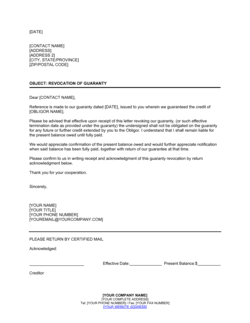
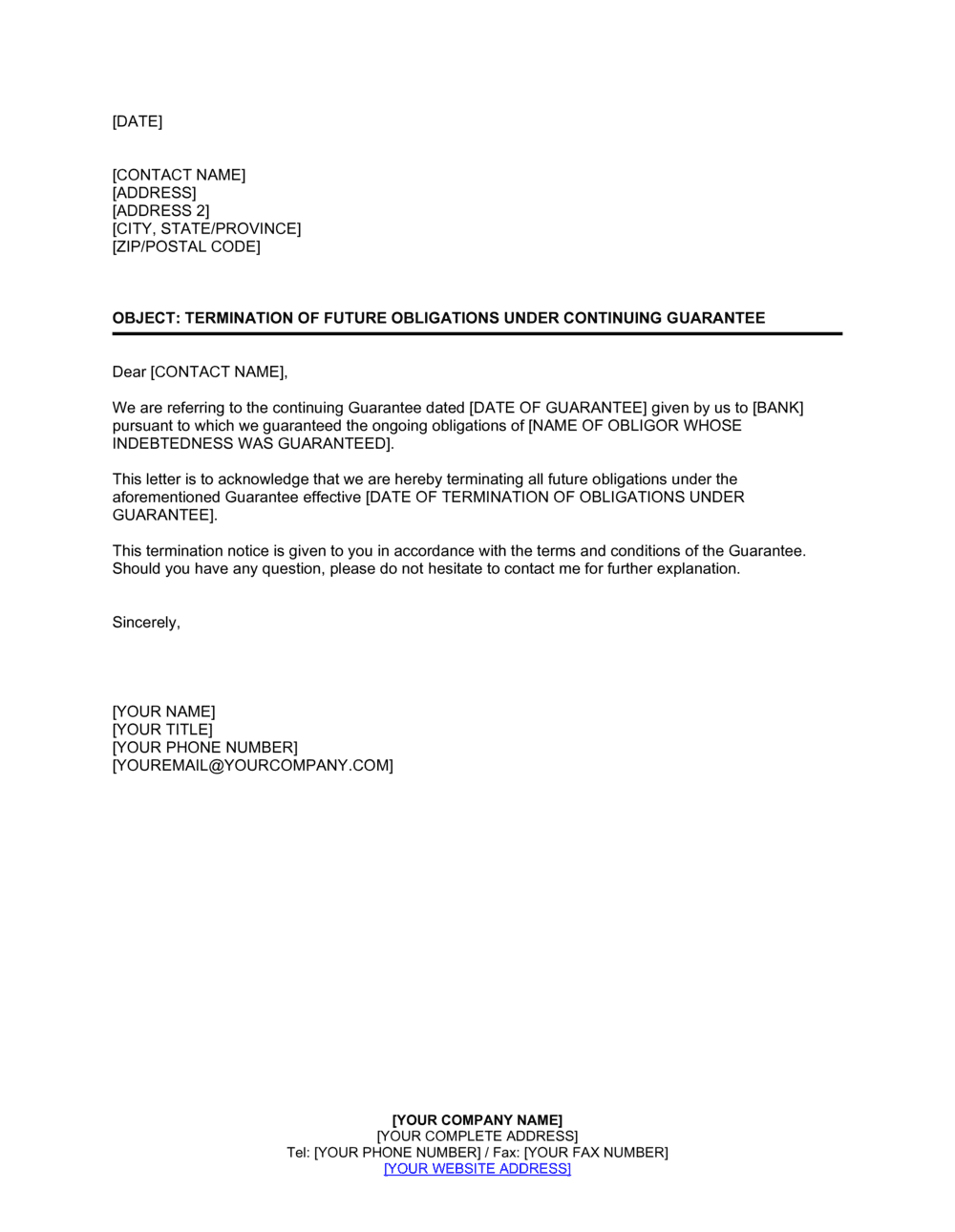
A Termination of Future Guaranty is a formal written notice that a guarantor serves on a creditor to revoke their liability for debts incurred by a principal debtor after the notice date. It does not eliminate obligations already arising under the guaranty — only those not yet created at the time the termination is delivered. This free Word download gives you a legally structured template you can edit online and export as PDF to send to a lender, supplier, or other creditor.
When you need it
Use it when a guarantor — typically a business owner, director, or departing partner — needs to cut off growing exposure under a continuing guaranty, such as when exiting a business, closing a credit line, or renegotiating a financing arrangement. Serve it before new obligations are incurred to preserve its effect.
What's inside
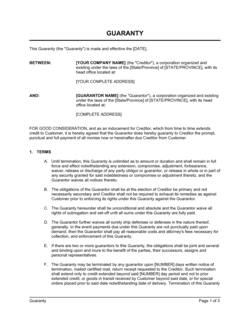
Identification of the guarantor, creditor, and principal debtor, the original guaranty reference and date, an unambiguous revocation notice limited to future obligations, a survival clause preserving existing liability, delivery and effective-date provisions, and signature and acknowledgment blocks for both parties.

What is a Termination of Future Guaranty?

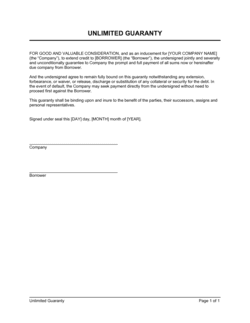
A Termination of Future Guaranty is a formal written notice that a guarantor delivers to a creditor to revoke their liability for obligations of a principal debtor that have not yet been incurred as of the effective date of the notice. Continuing guaranties — the type this document terminates — are open-ended instruments that guarantee an ongoing and potentially unlimited series of transactions rather than a single fixed debt. Over time, this exposure can compound significantly as the principal debtor continues to draw on a credit line, place orders, or extend a lease. This template gives guarantors a legally structured mechanism to draw a hard line under prospective liability while transparently preserving responsibility for obligations already created before the notice takes effect.

The document works by severing the guaranty at a defined point in time: all debts incurred by the principal debtor before that date remain the guarantor's responsibility; all new obligations created after the creditor receives the notice do not. It is not a release, a settlement, or a forgiveness of debt — it is a prospective cut-off, and its enforceability depends entirely on proper delivery, accurate identification of the original guaranty, and a clearly stated effective date.

Why You Need This Document

Without a written termination notice, a continuing guaranty has no natural expiration — it runs indefinitely, accumulating exposure with every new transaction the principal debtor enters into. A business owner who gave a personal guaranty when launching a company remains on the hook for every credit purchase, lease payment, or loan draw the business makes years later, even after they have stepped back from day-to-day operations. Directors, departing partners, and franchisees face the same problem: the guaranty they signed at the start of a relationship outlasts their involvement by default.

Serving a properly executed termination notice stops that clock. It protects the guarantor from liability for deals they were not party to, financing they did not approve, and obligations incurred after their relationship with the business ended. It also forces a clean accounting of what accrued liability remains, giving both parties a documented baseline. For creditors, a formally acknowledged termination notice provides clarity about who remains obligated going forward and prevents disputes about whether a guaranty was effectively revoked. This template provides the structure, required clauses, and delivery guidance to execute that process correctly — reducing the risk of a defective notice that a creditor can challenge in court.

Which variant fits your situation?

If your situation is…Use this template
Revoking a continuing guaranty on a revolving credit facilityTermination of Future Guaranty
Releasing a guarantor from all past and future obligations simultaneouslyGeneral Release Agreement
Substituting one guarantor for another on a credit arrangementGuaranty Agreement
Formally documenting the original personal guarantee given to a lenderPersonal Guarantee Agreement
Notifying a creditor of a change in the principal debtor's business structureNotice of Business Change Letter
Terminating a lease guaranty when a commercial tenant exitsLease Termination Agreement
Settling a disputed guaranty obligation before litigationSettlement Agreement

Common mistakes to avoid

❌ Not specifying an effective date

Why it matters: Without a clear effective date, the boundary between surviving accrued obligations and terminated future obligations is undefined — creditors can argue new charges incurred after delivery still fall under the guaranty.

Fix: Always state a specific calendar date in the revocation clause and confirm it is on or after the date of physical delivery to the creditor.

❌ Sending notice by email or untracked mail

Why it matters: If the creditor disputes receipt, the guarantor cannot prove when prospective liability ended — leaving them exposed to obligations they believed were terminated.

Fix: Deliver by certified mail with return receipt, personal delivery with a signed acknowledgment, or overnight courier with tracking confirmation. Match the method required by the original guaranty's notice clause.

❌ Omitting the survival of accrued obligations clause

Why it matters: Attempting to escape all liability, including pre-termination obligations, makes the entire termination notice vulnerable to legal challenge and signals bad faith to the creditor.

Fix: Include a clear survival clause confirming obligations incurred before the effective date remain enforceable, and obtain a current statement of account to document the scope of accrued liability.

❌ Using a different governing law than the original guaranty

Why it matters: Inconsistency between the termination notice and the original instrument forces a court to resolve which law applies before it can interpret either document — adding cost and uncertainty to any dispute.

Fix: Copy the governing-law clause verbatim from the original guaranty and insert it unchanged into the termination notice.

❌ Failing to address the effect on co-guarantors

Why it matters: Without explicit language, co-guarantors may claim the termination released them as well, or the creditor may argue the notice is ineffective because it fails to address joint liability.

Fix: Include a clause stating the termination applies solely to the signing guarantor and that all other guarantors remain fully bound.

❌ Not obtaining a signed acknowledgment from the creditor

Why it matters: A one-sided notice leaves the guarantor without documented proof of the creditor's receipt and acceptance of the effective date — the single most important fact in a future dispute.

Fix: Include an acknowledgment block requiring the creditor's countersignature and date, and follow up within 10 business days if you do not receive a signed copy.

The 10 key clauses, explained

Identification of parties

In plain language: Names the guarantor, the creditor, and the principal debtor by their full legal names and addresses, and references the original guaranty agreement by date and title.

Sample language
This Termination of Future Guaranty is given by [GUARANTOR FULL LEGAL NAME] ('Guarantor') to [CREDITOR FULL LEGAL NAME] ('Creditor') with respect to the obligations of [PRINCIPAL DEBTOR FULL LEGAL NAME] ('Debtor') under that certain Continuing Guaranty dated [DATE] ('Guaranty').

Common mistake: Using a trade name or informal abbreviation instead of the registered legal entity name — if the party identification does not match the original guaranty, the creditor may dispute the revocation's validity.

Revocation of future obligations

In plain language: The operative clause stating that the guarantor hereby revokes liability for all obligations of the principal debtor arising after the effective date of this notice.

Sample language
Guarantor hereby terminates and revokes the Guaranty with respect to any and all obligations, indebtedness, or liabilities of Debtor to Creditor arising or incurred on or after [EFFECTIVE DATE] ('Future Obligations').

Common mistake: Failing to specify an effective date explicitly — without a clear date, the scope of prospective versus accrued liability becomes disputed, potentially exposing the guarantor to obligations they believed were terminated.

Survival of accrued obligations

In plain language: Confirms that obligations of the principal debtor already created under the guaranty before the effective date remain the guarantor's responsibility and are not affected by this termination.

Sample language
Notwithstanding the foregoing, this termination shall not affect or release Guarantor from any obligation, liability, or indebtedness of Debtor to Creditor arising or incurred prior to [EFFECTIVE DATE], all of which shall survive and remain in full force and effect.

Common mistake: Omitting this clause entirely in an attempt to escape all liability — doing so makes the termination legally vulnerable to challenge and may void the entire notice if the creditor demonstrates pre-existing reliance.

Notice of termination delivery

In plain language: Describes the method and address for delivering the termination notice to the creditor and establishes when the revocation is deemed received and effective.

Sample language
This notice is delivered to Creditor at [CREDITOR ADDRESS] by [certified mail / personal delivery / overnight courier] on [DATE]. Termination shall be effective upon receipt by Creditor or [NUMBER] business days after mailing, whichever is earlier.

Common mistake: Sending by email or untracked mail without a delivery receipt — if the creditor disputes receipt, the guarantor cannot prove when their prospective liability ended, leaving them exposed to subsequent obligations.

No waiver of other rights

In plain language: States that the creditor's acceptance of the termination notice does not constitute a waiver of any rights the creditor holds under the original guaranty with respect to accrued obligations.

Sample language
Nothing in this Termination shall be construed as a waiver, release, or modification of any right or remedy Creditor may have against Guarantor with respect to obligations of Debtor arising prior to the effective date of this Termination.

Common mistake: Leaving this clause out of a bilateral version — without it, a creditor who signs an acknowledgment may later argue the acknowledgment constituted a release of pre-termination claims.

Representations and warranties of guarantor

In plain language: The guarantor confirms they have authority to terminate the guaranty, that no legal proceedings prevent them from doing so, and that the information in the notice is accurate.

Sample language
Guarantor represents and warrants that: (a) Guarantor has full legal capacity and authority to deliver this Termination; (b) no order, judgment, or proceeding prevents such delivery; and (c) all information set forth herein is accurate as of the date of execution.

Common mistake: Skipping this section in a template — without it, a creditor can claim they accepted the termination in reliance on facts the guarantor misrepresented, preserving grounds to re-impose liability.

Effect on co-guarantors

In plain language: Clarifies whether this termination affects the liability of any other guarantors under the same guaranty, typically stating that co-guarantors remain bound.

Sample language
This Termination is given solely by [GUARANTOR FULL LEGAL NAME] and shall have no effect on the obligations of any other guarantor under the Guaranty, all of whom shall remain fully bound by the terms thereof.

Common mistake: Assuming termination by one guarantor automatically releases all co-guarantors — failing to address this creates ambiguity that can result in co-guarantors unexpectedly claiming they were also released.

Governing law and jurisdiction

In plain language: Specifies which jurisdiction's law governs the termination and where disputes will be resolved, typically matching the governing-law clause of the original guaranty.

Sample language
This Termination shall be governed by and construed in accordance with the laws of the State of [STATE], without regard to its conflict-of-laws principles. Any dispute arising hereunder shall be subject to the exclusive jurisdiction of the courts of [COUNTY/STATE].

Common mistake: Choosing a different governing law than the original guaranty — inconsistency between the two documents creates interpretive conflict that courts must resolve, often at significant cost to both parties.

Entire agreement and amendment

In plain language: States that this document, together with the original guaranty, constitutes the complete understanding between the parties regarding the termination, and can only be amended in writing.

Sample language
This Termination, together with the Guaranty to the extent not terminated hereby, constitutes the entire agreement of the parties with respect to the subject matter hereof. No amendment or modification of this Termination shall be valid unless made in writing and signed by both parties.

Common mistake: Omitting this clause and relying on the original guaranty's entire-agreement provision — the termination is a separate instrument and needs its own integration clause to prevent oral modification claims.

Creditor acknowledgment and signature block

In plain language: A section for the creditor to formally acknowledge receipt of the termination notice and confirm the effective date, signed and dated by an authorized representative.

Sample language
Acknowledged and agreed by Creditor: [CREDITOR LEGAL NAME] by: _______________________ Name: [AUTHORIZED REPRESENTATIVE NAME] Title: [TITLE] Date: [DATE]

Common mistake: Sending the termination as a one-sided notice without requesting a signed acknowledgment — without creditor confirmation, the guarantor lacks documented proof of receipt and effective date.

How to fill it out

  1. 1

    Retrieve and review the original guaranty agreement

    Locate the original continuing guaranty document, note its exact title, date, and parties. The termination notice must reference the guaranty precisely to be clearly linked to the right instrument.

    💡 If the original guaranty specifies a required method for giving notices of termination, that method is controlling — your revocation notice must comply with it exactly.

  2. 2

    Insert full legal names and addresses for all three parties

    Enter the guarantor's full legal name and address, the creditor's full registered name and address, and the principal debtor's full legal name. Cross-reference each against the original guaranty to ensure exact matches.

    💡 For corporate guarantors, use the entity's registered name as it appears on the state or provincial registry — not a trade name or abbreviation.

  3. 3

    Set the effective date of termination

    Choose a specific calendar date for the revocation to take effect. This date determines the boundary between accrued obligations (which survive) and future obligations (which are terminated). Make it a date on or after the delivery date.

    💡 Align the effective date with any outstanding transaction cycles — for example, if the debtor has a monthly order with the creditor, time the effective date to fall after the current cycle closes to avoid ambiguity.

  4. 4

    Confirm the survival of pre-termination obligations

    Review the survival clause and confirm it accurately reflects the scope of pre-termination obligations you remain liable for. If you have a specific dollar figure or list of known obligations, consider attaching a schedule.

    💡 Request a statement of account from the creditor before finalizing the termination notice so you have a documented snapshot of accrued liability as of the effective date.

  5. 5

    Address co-guarantors explicitly

    If other guarantors are named in the original guaranty, include the co-guarantor clause confirming their obligations are unaffected. If you are the sole guarantor, note this in the recitals.

    💡 Notify co-guarantors directly that you are terminating your obligation — they may face increased exposure to the creditor and should have the opportunity to renegotiate their own position.

  6. 6

    Verify governing law matches the original guaranty

    Check the governing-law clause in the original guaranty and replicate the same jurisdiction in this termination. Inconsistency between the two documents creates interpretive risk.

    💡 If the original guaranty contains a jury-trial waiver or arbitration clause, consider whether the same dispute-resolution mechanism should appear in the termination notice.

  7. 7

    Execute and deliver by a documented method

    Sign the termination notice and deliver it to the creditor by certified mail with return receipt, personal delivery, or overnight courier — any method that produces a timestamped delivery record. Keep a copy of the delivery confirmation.

    💡 Send to the specific contact and address designated for notices in the original guaranty, not just to the lender's general address — misdirected delivery may delay or invalidate the effective date.

  8. 8

    Obtain and file the creditor's signed acknowledgment

    Follow up to obtain the creditor's countersignature on the acknowledgment block. File the fully executed termination with your original guaranty documents and retain for at least seven years.

    💡 If the creditor refuses to sign the acknowledgment within 10 business days, send a follow-up letter confirming the termination was delivered and the date of delivery — this creates a secondary record of notice.

Frequently asked questions

What is a termination of future guaranty?

A termination of future guaranty is a formal written notice a guarantor delivers to a creditor to revoke their liability for obligations of a principal debtor not yet incurred as of the effective date. It does not release the guarantor from pre-existing debt — only from new obligations created after the notice is received. It is used to limit growing exposure under an open-ended continuing guaranty arrangement.

Does a termination of future guaranty release all of my liability?

No. A termination of future guaranty only ends your exposure to obligations the principal debtor incurs after the effective date of the notice. Any debt or obligation that already existed under the guaranty before the notice was received by the creditor survives and remains fully enforceable against you. To be released from pre-existing obligations, you would need a separate release or settlement agreement signed by the creditor.

When should I serve a termination of future guaranty?

Serve it as early as possible — ideally before any new credit cycle or transaction begins. Common triggers include exiting a business partnership, stepping down as a corporate director, selling a franchised business, or refinancing a credit facility. The sooner the notice is delivered and received, the less accrued liability remains after the effective date.

Does the creditor have to accept the termination?

In most jurisdictions, a guarantor can unilaterally revoke a continuing guaranty for future obligations by giving notice — the creditor's consent is typically not required for the revocation to be effective. However, the original guaranty agreement may include specific requirements for valid termination, such as a notice period, a designated delivery method, or a written acknowledgment. Review the original guaranty carefully before serving notice.

What happens to the principal debtor's existing credit after I terminate?

The creditor is not obligated to continue extending credit to the principal debtor after a guaranty termination. Many lenders will reduce or freeze a credit line once a guaranty is revoked, particularly if the guaranty was a material condition of the original credit approval. The guarantor should notify the principal debtor before serving the termination to allow time to arrange alternative credit support.

Is a termination of future guaranty the same as a release of guaranty?

No. A release of guaranty eliminates all liability — past and future — and typically requires the creditor's consent and sometimes consideration. A termination of future guaranty is a unilateral act that ends prospective liability only, leaving accrued obligations intact. A full release is appropriate when the underlying debt has been repaid; a termination is appropriate when the guarantor wants to stop accumulating new exposure while the credit relationship continues.

Do I need a lawyer to terminate a continuing guaranty?

For a straightforward termination where the original guaranty is clearly documented and the accrued obligations are well understood, a high-quality template is often sufficient. Engage a lawyer when the original guaranty contains unusual termination conditions, when the accrued liability is disputed, when co-guarantors are involved in complex arrangements, or when the guaranty secures a large commercial loan where the creditor is likely to push back on the notice.

What delivery method is best for serving a termination notice?

Certified mail with return receipt requested is the most widely used method because it creates a court-admissible record of the exact date the creditor received the notice. Overnight courier with tracking confirmation is equally reliable. Personal delivery with a signed acknowledgment is the most immediate. Always check the original guaranty's notice clause — if it specifies a delivery method, that method is controlling and using a different method may delay or invalidate the effective date.

How does a termination of future guaranty affect my credit report?

Revoking a continuing guaranty does not by itself appear on a personal credit report or affect your credit score. However, if the principal debtor defaults on pre-termination obligations that you remain liable for, and you fail to pay, the unpaid debt can be reported as a collection account or judgment against you. Obtaining a current statement of accrued obligations at the time of termination helps you manage and monitor any remaining exposure.

How this compares to alternatives

vs General Release Agreement

A general release agreement eliminates all claims — past, present, and future — between the parties, and typically requires the creditor's consent and often a payment or other consideration in exchange. A termination of future guaranty is narrower and typically unilateral, ending only prospective liability while leaving accrued obligations intact. Use a release when the debt has been fully repaid; use this termination when you want to stop accumulating new exposure while existing obligations wind down.

vs Guaranty Agreement

A guaranty agreement creates the original obligation — it is the document the guarantor signs to back a debtor's performance. A termination of future guaranty ends that obligation with respect to future transactions. You need the guaranty to understand the scope of what you are terminating, and the termination should be read alongside it as a companion document.

vs Lease Termination Agreement

A lease termination agreement ends a rental or commercial lease contract between a landlord and a tenant. A termination of future guaranty specifically targets a guarantor's personal or corporate liability for a debtor's obligations and is not limited to real estate. Where a lease includes a personal guaranty, both documents may be needed — the lease termination to end the tenancy and the guaranty termination to sever the guarantor's continuing exposure.

vs Settlement Agreement

A settlement agreement resolves a disputed claim — typically after a default or threatened litigation — through a negotiated outcome that may include a partial payment, a release, or modified terms. A termination of future guaranty is not a dispute-resolution instrument; it is a prospective notice served before any default. Use a settlement agreement when a dispute over guaranty obligations has already arisen; use this termination to prevent future disputes by cleanly ending prospective exposure.

Industry-specific considerations

Financial Services and Lending

Bank officers require a properly executed termination notice with a certified delivery record before updating their guaranty register and modifying credit facility terms.

Commercial Real Estate

Partners exiting a real estate LLC routinely terminate personal guaranties on construction loans and commercial mortgages as a condition of their buyout or equity transfer.

Retail and Wholesale Trade

Departing business owners use this notice to end personal exposure on open trade credit accounts with suppliers, where new orders would otherwise continue to accumulate guaranteed debt.

Franchising

Franchise agreements commonly require a personal guaranty from the franchisee; upon transfer or sale of the franchise, the outgoing franchisee needs a formal termination to sever their ongoing liability to the franchisor and its lenders.

Jurisdictional notes

United States

In most US states, a guarantor may revoke a continuing guaranty for future obligations by delivering written notice to the creditor, even without the creditor's consent, unless the original guaranty expressly prohibits unilateral termination. The UCC does not directly govern guaranty agreements, which are typically treated as contracts subject to state common law. California, New York, and Texas have well-developed case law on guaranty termination; the specific notice requirements and effectiveness rules vary by state, making it important to confirm the governing-law clause in the original agreement.

Canada

Canadian courts generally recognize a guarantor's right to revoke a continuing guaranty for future obligations by providing notice to the creditor. Provincial limitations acts set the time period within which a creditor must enforce accrued guaranty claims — typically two years from the date the claim is discovered in most provinces. In Quebec, guaranty (cautionnement) is governed by the Civil Code of Quebec and has distinct rules regarding termination and the rights of co-sureties; a notarized notice may be advisable in some circumstances.

United Kingdom

Under English and Welsh law, a continuing guaranty can generally be revoked by written notice for future obligations, but the guarantor typically remains liable for all obligations incurred prior to notice, including any that arise from existing contracts that have not yet generated a specific debt. Scottish law treats guaranty (caution) similarly but has distinct procedural requirements. The Statute of Frauds 1677 requires guaranty agreements to be in writing and signed, and the termination should follow the same formality. Lenders regulated by the FCA may have additional notification requirements.

European Union

Guaranty law is not harmonized across the EU and is governed by the private law of each member state. In Germany, a Bürgschaft may be terminated for future obligations by written notice under §130 BGB. French cautionnement rules distinguish between a guaranty of a fixed obligation and a continuing guaranty (cautionnement omnibus), with the latter terminable for future obligations. GDPR considerations arise when the termination notice includes personal data of the debtor or guarantor — ensure the notice is transmitted securely and retained only as long as legally necessary.

Template vs lawyer — what fits your deal?

PathBest forCostTime
Use the templateGuarantors revoking a straightforward continuing guaranty on a trade credit account or small business loan with clearly documented accrued obligationsFree30–60 minutes
Template + legal reviewGuarantors with co-guarantors involved, guaranties securing credit above $100K, or original guaranty documents with non-standard termination conditions$300–$8001–3 days
Custom draftedComplex commercial loan guaranties, disputed accrued liability, multi-party guaranty arrangements, or cross-border credit facilities$1,000–$3,500+1–2 weeks

Glossary

Continuing Guaranty
A guaranty that covers an ongoing and potentially unlimited series of future transactions or obligations, rather than a single fixed debt.
Future Guaranty
The portion of a continuing guaranty that applies to obligations not yet incurred at the time a revocation notice is delivered.
Guarantor
The individual or entity that promises to satisfy a debt or obligation if the primary debtor fails to do so.
Principal Debtor
The party whose debt or obligation is guaranteed — the borrower, tenant, or buyer whose performance the guarantor is backing.
Revocation
The act of formally withdrawing a continuing guaranty with respect to obligations not yet created, effective from the date the creditor receives written notice.
Prospective Liability
Exposure arising from transactions or obligations entered into after the termination notice date — the category of liability this document eliminates.
Accrued Liability
Obligations already created under the guaranty before the revocation notice is received, which typically remain enforceable against the guarantor regardless of termination.
Creditor
The lender, supplier, landlord, or other party who extended credit or extended an obligation in reliance on the guaranty.
Consideration
Something of value exchanged to make a contract enforceable — in the context of a guaranty termination, this is often the guarantor's written notice and the creditor's acknowledgment.
Delivery
The act of formally transmitting the termination notice to the creditor in a manner that establishes a documented date of receipt, such as certified mail or personal delivery.
Survival Clause
A contractual provision confirming that certain obligations — here, pre-termination guaranty liability — remain in force even after the document takes effect.

Part of your Business Operating System

This document is one of 3,000+ business & legal templates included in Business in a Box.

  • Fill-in-the-blanks — ready in minutes
  • 100% customizable Word document
  • Compatible with all office suites
  • Export to PDF and share electronically

Create your document in 3 simple steps.

From template to signed document — all inside one Business Operating System.
1
Download or open template

Access over 3,000+ business and legal templates for any business task, project or initiative.

2
Edit and fill in the blanks with AI

Customize your ready-made business document template and save it in the cloud.

3
Save, Share, Send, Sign

Share your files and folders with your team. Create a space of seamless collaboration.

Save time, save money, and create top-quality documents.

★★★★★

"Fantastic value! I'm not sure how I'd do without it. It's worth its weight in gold and paid back for itself many times."

Managing Director · Mall Farm
Robert Whalley
Managing Director, Mall Farm Proprietary Limited
★★★★★

"I have been using Business in a Box for years. It has been the most useful source of templates I have encountered. I recommend it to anyone."

Business Owner · 4+ years
Dr Michael John Freestone
Business Owner
★★★★★

"It has been a life saver so many times I have lost count. Business in a Box has saved me so much time and as you know, time is money."

Owner · Upstate Web
David G. Moore Jr.
Owner, Upstate Web

Run your business with a system — not scattered tools

Stop downloading documents. Start operating with clarity. Business in a Box gives you the Business Operating System used by over 250,000 companies worldwide to structure, run, and grow their business.

Start free · No credit card required