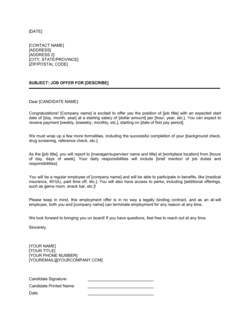
Background Check Policy Template

Free Word download β€’ Edit online β€’ Save & share with Drive β€’ Export to PDF

5 pagesβ€’20–30 min to fillβ€’Difficulty: Standard
Learn more ↓
FreeBackground Check Policy Template

At a glance

What it is
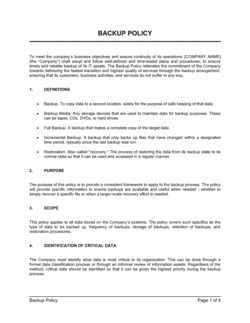
A Background Check Policy is an internal HR document that defines the circumstances under which an employer screens candidates and employees, the types of checks conducted, the consent process, and how results are used in hiring decisions. This free Word download gives you a structured, compliance-ready starting point you can edit online and export as PDF to share with hiring managers, HR staff, and legal counsel.
When you need it
Use it when formalizing your pre-employment screening process, onboarding new HR staff, updating existing screening practices to reflect current law, or responding to an audit or compliance review that requires a written policy on file.
What's inside
Policy purpose and scope, types of background checks conducted, roles subject to screening, consent and disclosure requirements, criteria for evaluating results, adverse action procedures, data retention and confidentiality rules, and employee rights and appeal process.

What is a Background Check Policy?

A Background Check Policy is an internal HR governance document that defines the conditions under which an employer screens job candidates and employees, which check types apply to which roles, how consent is collected, and how results inform hiring decisions. It translates federal requirements under the Fair Credit Reporting Act (FCRA) and EEOC guidance β€” as well as applicable state and local ban-the-box laws β€” into a consistent, repeatable procedure that every hiring manager can follow. Rather than leaving individual managers to improvise consent steps or evaluate criminal findings case-by-case, a written policy creates a documented standard that applies uniformly across every hire.

Why You Need This Document

Operating without a written background check policy exposes your organization to enforcement risk on multiple fronts simultaneously. The FCRA imposes specific disclosure, consent, and adverse action procedures β€” each step with its own timing requirements β€” and missing any one of them opens the door to statutory damages of $100–$1,000 per applicant in a class action. Beyond federal law, over 35 states and 150 cities have enacted ban-the-box or criminal history restrictions that require knowing exactly when in your hiring process you can ask screening questions. Without a written policy, hiring managers apply different standards across departments, creating the inconsistency that triggers discrimination claims. A documented background check policy closes these gaps, gives HR staff a clear procedural guide, and demonstrates to auditors, regulators, and candidates alike that your screening program is deliberate and fair. This template gives you a compliance-ready structure you can customize to your organization in under two hours.

Which variant fits your situation?

If your situation is…Use this template
Screening candidates for roles involving financial responsibility or cash handlingBackground Check Policy (Financial Roles)
Screening candidates for roles involving children, vulnerable adults, or healthcareBackground Check Policy (Sensitive Roles)
Conducting ongoing or periodic re-screening of existing employeesEmployee Re-Screening Policy
Screening contractors and vendors who access company facilities or dataVendor Background Check Policy
Documenting the individual consent form given to each candidateBackground Check Consent Form
Formalizing the full hiring process from job posting through offerRecruitment Policy
Notifying a candidate of an adverse action based on screening resultsAdverse Action Notice

Common mistakes to avoid

❌ Combining the consent disclosure with the job application

Why it matters: The FCRA requires a standalone disclosure document. Embedding it in the application form is a technical violation that has resulted in class-action settlements exceeding $1M for large employers.

Fix: Use a separate, single-purpose disclosure and authorization form for every candidate β€” ideally the form provided by your CRA vendor.

❌ Applying blanket criminal history bars without individualized assessment

Why it matters: Automatic disqualification based on any criminal record creates disparate impact exposure under Title VII and the EEOC's 2012 enforcement guidance, particularly for African-American and Hispanic applicants.

Fix: Replace automatic disqualification language with a documented individualized assessment process that evaluates offense type, recency, and job relevance before any adverse decision.

❌ Skipping the pre-adverse action notice step

Why it matters: Sending only a final adverse action notice β€” without first giving the candidate the report and a waiting period to dispute inaccuracies β€” is one of the most frequently cited FCRA violations and can result in statutory damages per applicant.

Fix: Build the two-step process into your ATS workflow: pre-adverse notice plus a minimum 5-business-day waiting period before any final decision communication is sent.

❌ Storing background check reports inside the general personnel file

Why it matters: Background check reports contain sensitive consumer data that should be accessible only to HR leadership and legal. Commingling them with general HR files exposes the data to broader internal access and complicates FCRA compliance records.

Fix: Create a separate, restricted-access file β€” physical or digital β€” for background check reports, distinct from the general employment record.

The 9 key sections, explained

Purpose and scope

Types of background checks conducted

Roles and positions subject to screening

Consent and disclosure requirements

Evaluation criteria and individualized assessment

Adverse action procedures

Confidentiality and data handling

Candidate rights and appeal process

Policy review and updates

How to fill it out

  1. 1

    Define who is covered by the policy

    Enter your company name and list every worker category subject to screening β€” full-time, part-time, temporary, contract, and volunteer. If certain categories are excluded, state that explicitly.

    πŸ’‘ Err on the side of broader scope. It is easier to document an exemption than to explain why a contractor with system access wasn't screened.

  2. 2

    Select and document the check types for each role tier

    List every check type you use (criminal, credit, employment verification, education, MVR, professional license) and assign them to role tiers. Keep the tier definitions simple β€” three tiers cover most organizations.

    πŸ’‘ Credit checks require a specific business necessity justification in several states β€” document the reason for each role category where you apply them.

  3. 3

    Specify the consent and disclosure process

    Name the standalone disclosure form and authorization document candidates must sign before any check is initiated. Reference whether you use a CRA-provided form or a company-drafted form.

    πŸ’‘ Your CRA vendor typically provides a compliant consent form β€” use theirs rather than drafting your own to reduce FCRA technical violation risk.

  4. 4

    Set your evaluation criteria

    Define which findings trigger automatic review versus individualized assessment. Document the three EEOC factors β€” nature of offense, time elapsed, and job relatedness β€” as the required evaluation framework.

    πŸ’‘ Avoid the phrase 'no felony convictions' as a blanket bar β€” it is the most litigated language in background check policies and has the highest disparate impact exposure.

  5. 5

    Document the two-step adverse action procedure

    Enter the waiting period (minimum 5 business days is the industry standard) between the pre-adverse action notice and the final notice, and name the HR role responsible for sending each communication.

    πŸ’‘ Calendar the waiting period in your ATS or HR system the moment a pre-adverse action notice is sent β€” missing the window is the most common procedural failure.

  6. 6

    Define data handling, access, and retention

    Name the roles permitted to access reports, specify the storage location (separate from the general personnel file), and enter retention periods for hired versus not-hired candidates.

    πŸ’‘ Most employment attorneys recommend a 5-year retention period to cover the full FCRA statute of limitations for civil suits.

  7. 7

    Set the policy review schedule and assign ownership

    Enter the annual review date, name the owner (typically HR Director or Chief People Officer), and add a version number and last-reviewed date to the footer of the document.

    πŸ’‘ Subscribe to your state labor department's update mailing list β€” ban-the-box and credit check laws pass at the city level with little national publicity.

  8. 8

    Distribute to all hiring managers and obtain acknowledgment

    Share the finalized policy with every manager involved in hiring and collect written acknowledgment. Add the policy to your employee handbook and new-manager onboarding materials.

    πŸ’‘ A brief 30-minute training session at policy launch prevents the most common mistakes β€” managers skipping consent steps or making informal hiring decisions before results are reviewed.

Frequently asked questions

What is a background check policy?

A background check policy is a written internal document that defines when and how a company screens job candidates and employees, which types of checks are conducted for which roles, how consent is obtained, and how results are evaluated and acted upon. It creates a consistent, documented process that reduces legal exposure and ensures hiring managers follow the same procedures across every hire.

Is a written background check policy legally required?

No federal law mandates a standalone written background check policy, but operating without one creates significant compliance risk. The FCRA requires specific disclosure, consent, and adverse action procedures that are difficult to apply consistently without a documented policy. Many state and local ban-the-box laws impose procedural requirements that also benefit from a written policy. Employment attorneys universally recommend having one in place before conducting any screening.

Which employees and roles should be subject to background checks?

At minimum, apply background checks to all candidates who receive a conditional offer of employment. Extend screening to contractors, volunteers, and vendors who access company facilities, sensitive data, or vulnerable populations. Role-specific checks β€” such as credit history for financial roles or motor vehicle records for driving roles β€” should be tied to documented business necessity and applied consistently to every person in that role category.

What types of background checks can employers run?

Common check types include criminal history (county, state, and federal), employment verification, education verification, professional license verification, credit history, motor vehicle records, sex offender registry, and reference checks. Employers typically use a combination based on role risk level. Credit and criminal checks carry the most legal restrictions and require the closest policy attention.

What is the adverse action process and why does it matter?

The adverse action process is the two-step procedure required under the FCRA before making a negative employment decision based on a background check report. Step one is a pre-adverse action notice β€” sent with a copy of the report and summary of FCRA rights β€” followed by a waiting period of at least 5 business days. Step two is the final adverse action notice if the candidate has not successfully disputed the findings. Skipping step one is the most commonly cited FCRA violation in employment class actions.

What are ban-the-box laws and how do they affect this policy?

Ban-the-box laws prohibit employers from asking about criminal history on job applications, requiring the inquiry to be delayed until later in the hiring process β€” typically after a conditional offer is made. Over 35 US states and 150 cities and counties have enacted some form of ban-the-box restriction as of 2025. Your background check policy must reflect the rules in every jurisdiction where you hire, which is why an annual policy review is essential.

Can an employer automatically disqualify a candidate based on a criminal record?

Generally no β€” not without significant legal risk. The EEOC's 2012 enforcement guidance states that blanket criminal history exclusions create disparate impact liability under Title VII. Employers are expected to conduct an individualized assessment weighing the nature of the offense, how much time has passed, and how directly the offense relates to the job duties. Automatic disqualification language in a policy is one of the most frequently scrutinized elements in EEOC investigations.

How long should background check records be retained?

The FCRA statute of limitations for civil claims is generally 2 years from the date of violation, or 5 years from the date of the violation if the plaintiff was not aware of it β€” making a 5-year retention period the widely recommended standard. Most employment attorneys suggest retaining records for hired candidates for the duration of employment plus 5 years, and records for candidates not hired for a minimum of 2–5 years depending on the applicable state law.

Does this policy template cover international background checks?

This template is structured around US federal law β€” primarily the FCRA and EEOC guidance β€” and is the appropriate starting point for domestic US hiring. International background checks are governed by local data protection and employment laws, including GDPR in the EU and the UK, which restrict the categories of information that can be collected and how consent must be obtained. Organizations hiring internationally should adapt the policy with jurisdiction-specific legal guidance for each country.

How this compares to alternatives

vs Background Check Consent Form

A background check consent form is the standalone document given to an individual candidate to obtain their signed authorization before a check is run. A background check policy is the internal governance document that tells HR and hiring managers when, how, and why to use those forms. Both are needed β€” the policy without the form cannot be executed; the form without the policy creates inconsistent application.

vs Recruitment Policy

A recruitment policy covers the full hiring lifecycle β€” job posting, interviewing, offer approval, and onboarding. A background check policy focuses specifically on the screening step that follows a conditional offer. In most organizations, the background check policy is a standalone document referenced by the broader recruitment policy rather than embedded within it.

vs Employee Handbook

An employee handbook communicates policies to employees at a high level, often including a summary of the background check policy. The standalone background check policy is the operational document with procedural detail β€” consent steps, evaluation criteria, adverse action timelines β€” that HR staff actually follow. The handbook references it; the policy governs it.

vs Drug Testing Policy

A drug testing policy governs pre-employment and ongoing substance screening β€” a distinct process from background checks with its own consent, lab, and result-handling procedures. Many employers conduct both as part of a conditional offer package, but they require separate policies because they are governed by different legal frameworks and administered by different vendors.

Industry-specific considerations

Financial Services

Credit history and financial crime checks are standard for most roles; FINRA licensing verification applies to registered representatives; fidelity bond requirements may dictate minimum screening levels.

Healthcare

OIG exclusion list checks are mandatory for any role billing federal healthcare programs; state nursing and medical board verification applies to licensed clinicians; patient-facing roles require enhanced criminal screening.

Transportation and Logistics

DOT-regulated positions require motor vehicle record checks and drug screening as a federal compliance matter; commercial driver's license verification must be documented in the policy.

Retail and Hospitality

High turnover means streamlined consent and quick-turnaround CRA relationships are operationally critical; cash-handling roles typically warrant criminal screening even in jurisdictions with broad ban-the-box laws.

Template vs pro β€” what fits your needs?

PathBest forCostTime
Use the templateSmall to mid-size businesses hiring domestically in a single state using a standard CRA vendorFree1–2 hours to customize and finalize
Template + professional reviewEmployers hiring across multiple states with ban-the-box laws, or those screening for regulated industries like healthcare or finance$300–$800 for an employment attorney review3–5 business days
Custom draftedMulti-state or international employers, companies subject to federal contractor requirements, or organizations recovering from an FCRA enforcement action$1,500–$4,000+1–3 weeks

Glossary

FCRA (Fair Credit Reporting Act)
A US federal law governing how consumer reporting agencies collect and use information, and requiring employer disclosure and consent before conducting background checks.
Consumer Reporting Agency (CRA)
A third-party vendor that compiles background check reports β€” such as criminal history, credit, and employment verification β€” for employers.
Adverse Action
Any employment decision β€” withdrawal of offer, demotion, or termination β€” taken in whole or in part based on information in a background check report.
Pre-Adverse Action Notice
A required notice sent to a candidate before a final adverse action is taken, giving them time to review and dispute inaccurate information in their report.
Ban-the-Box
Laws in many US states and municipalities that prohibit asking about criminal history on job applications, delaying the inquiry until later in the hiring process.
Individualized Assessment
An EEOC-recommended process of evaluating a criminal record finding against the specific nature of the job, the time elapsed, and evidence of rehabilitation before taking adverse action.
Scope of Screening
The defined set of checks β€” criminal, credit, employment, education, reference, motor vehicle β€” that applies to a given role or employee category.
Conditional Offer of Employment
A job offer that is contingent on the successful completion of a background check, drug screen, or other pre-employment requirement.
Data Retention Schedule
The documented policy specifying how long background check reports and related records are stored and when they must be securely destroyed.
Re-Screening
The periodic or event-triggered repetition of background checks on current employees, typically applied to roles with ongoing access to sensitive data, finances, or vulnerable populations.

Part of your Business Operating System

This document is one of 3,000+ business & legal templates included in Business in a Box.

  • Fill-in-the-blanks β€” ready in minutes
  • 100% customizable Word document
  • Compatible with all office suites
  • Export to PDF and share electronically

Create your document in 3 simple steps.

From template to signed document β€” all inside one Business Operating System.
1
Download or open template

Access over 3,000+ business and legal templates for any business task, project or initiative.

2
Edit and fill in the blanks with AI

Customize your ready-made business document template and save it in the cloud.

3
Save, Share, Send, Sign

Share your files and folders with your team. Create a space of seamless collaboration.

Save time, save money, and create top-quality documents.

β˜…β˜…β˜…β˜…β˜…

"Fantastic value! I'm not sure how I'd do without it. It's worth its weight in gold and paid back for itself many times."

Managing Director Β· Mall Farm
Robert Whalley
Managing Director, Mall Farm Proprietary Limited
β˜…β˜…β˜…β˜…β˜…

"I have been using Business in a Box for years. It has been the most useful source of templates I have encountered. I recommend it to anyone."

Business Owner Β· 4+ years
Dr Michael John Freestone
Business Owner
β˜…β˜…β˜…β˜…β˜…

"It has been a life saver so many times I have lost count. Business in a Box has saved me so much time and as you know, time is money."

Owner Β· Upstate Web
David G. Moore Jr.
Owner, Upstate Web

Run your business with a system β€” not scattered tools

Stop downloading documents. Start operating with clarity. Business in a Box gives you the Business Operating System used by over 250,000 companies worldwide to structure, run, and grow their business.

Free Forever PlanΒ Β·Β No credit card required