Reference Check Letter Template

Free Word download • Edit online • Save & share with Drive • Export to PDF

1 page15–25 min to fillDifficulty: Standard
Learn more ↓
FreeReference Check Letter Template

At a glance

What it is
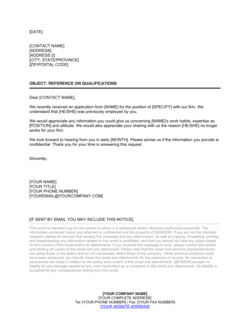
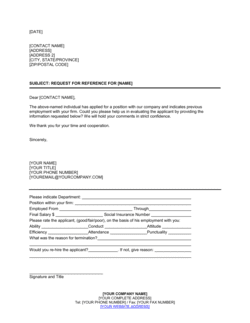
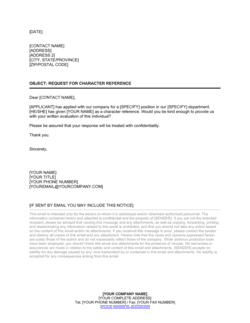
A Reference Check Letter is a formal written request sent by an employer or hiring manager to a candidate's listed referee asking for verification of employment history, job performance, and professional character. This template is a free Word download you can edit online and export as PDF, covering all standard inquiry points in a single one-page letter.
When you need it
Use it at the final stages of a hiring process, after a verbal offer or conditional acceptance, when you need documented confirmation of a candidate's background before formally onboarding them.
What's inside
A structured letter with your company header, a clear purpose statement, specific questions about the candidate's role and performance, a confidentiality assurance for the referee, and your contact details for the response.

What is a Reference Check Letter?

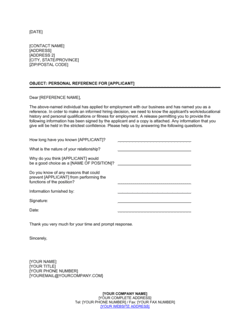
A Reference Check Letter is a formal written request sent by a prospective employer to a candidate's named referee — typically a former manager or senior colleague — asking for an independent assessment of the candidate's employment history, job performance, and professional conduct. Unlike a phone-based reference call, a written letter creates a documented record of the inquiry and gives the referee time to compose a considered, specific response. It covers confirmation of job title and dates of employment, key responsibilities, performance strengths and development areas, and — critically — whether the referee would rehire the individual.

Why You Need This Document

Skipping a formal reference check, or conducting one without a written record, leaves your hiring decision based entirely on what a candidate has told you about themselves. A reference check letter closes that gap by giving a third party — someone who managed or worked alongside the candidate — a structured opportunity to confirm or contradict the claims on the resume. Without it, title inflation, exaggerated scope of responsibilities, and gaps in employment go undetected until after onboarding, when the cost of a poor hire is already in motion. A written letter also protects your organization by creating an auditable record of the pre-hire due diligence you conducted, which matters in regulated industries and in any situation where the quality of a hire is later called into question. This template gives you a complete, professional-grade reference check letter you can customize and send in under ten minutes.

Which variant fits your situation?

If your situation is…Use this template
Requesting a written reference from a previous employerReference Check Letter
Asking a personal or character referee rather than a former employerCharacter Reference Request Letter
Following up after no response to an initial reference requestReference Check Follow-Up Letter
Providing a completed reference to another employer on behalf of a former employeeEmployment Reference Letter
Verifying academic credentials and institutional referencesAcademic Reference Check Letter
Conducting a structured phone-based reference with a written summaryReference Check Form

Common mistakes to avoid

❌ Not confirming candidate consent before sending

Why it matters: Contacting a referee without the candidate's documented consent can breach data-privacy expectations and cause the referee to alert the candidate, damaging trust before the hire is finalized.

Fix: Collect a signed reference-release form from the candidate before dispatching any reference check letters, and reference that consent in the letter body.
❌ Sending to a generic department address

Why it matters: Letters addressed to 'HR Department' or 'To Whom It May Concern' are routinely deprioritized or lost in shared inboxes, causing reference checks to expire.

Fix: Ask the candidate for their referee's direct name, title, and email address before sending the letter.

❌ Omitting the rehire eligibility question

Why it matters: Without this question, a referee can give a glowing response about a candidate they would never hire again — leaving you with an incomplete picture.

Fix: Always include a direct rehire question and leave space for the referee to explain a 'no' or 'undecided' answer.

❌ Setting no response deadline

Why it matters: Reference letters without a deadline are treated as low priority and can stall for weeks, delaying onboarding or causing a candidate to accept a competing offer.

Fix: State a specific calendar date — five to seven business days from the letter date — and set a calendar reminder to follow up the day before.

The 9 key clauses, explained

Sender and recipient header

In plain language: Identifies your organization's name and address, the date, and the referee's full name, title, and organization.

Sample language
[YOUR COMPANY NAME] | [ADDRESS] | [DATE] | Attn: [REFEREE FULL NAME], [TITLE], [REFEREE COMPANY NAME]

Common mistake: Addressing the letter to a generic department such as 'Human Resources' instead of a named individual — this often results in the letter being routed to a general inbox and never answered.

Subject line

In plain language: A clear one-line label identifying the purpose and the candidate's name so the referee can process the letter instantly.

Sample language
Re: Reference Check for [CANDIDATE FULL NAME] — Application for [JOB TITLE]

Common mistake: Omitting the subject line entirely, which forces the referee to read the full body before understanding why you contacted them.

Opening and purpose statement

In plain language: Introduces your organization, explains that you are considering the candidate for a specific role, and states that the candidate has provided the referee's name.

Sample language
We are considering [CANDIDATE FULL NAME] for the position of [JOB TITLE] at [YOUR COMPANY NAME]. [CANDIDATE FIRST NAME] has provided your name as a professional reference and has consented to this inquiry.

Common mistake: Failing to mention that the candidate authorized the contact — referees may decline or give guarded responses if they are unsure whether the candidate consented.

Employment verification questions

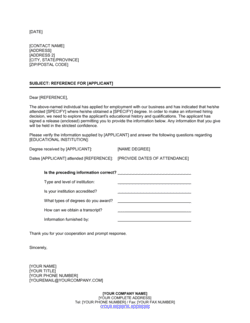
In plain language: Asks the referee to confirm the candidate's job title, employment dates, and primary responsibilities during their time at the organization.

Sample language
Could you confirm the following: (1) [CANDIDATE FIRST NAME]'s job title and department; (2) dates of employment (from [DATE] to [DATE]); (3) primary responsibilities in that role.

Common mistake: Asking only yes/no verification questions without asking about responsibilities — you lose the chance to spot title inflation or scope misrepresentation.

Performance and competency questions

In plain language: Invites the referee to comment on the candidate's work quality, key strengths, and areas for development relevant to the role being filled.

Sample language
In your view, what were [CANDIDATE FIRST NAME]'s greatest strengths in this role? Were there any areas where you observed a need for further development?

Common mistake: Asking only about strengths and omitting development areas — referees who are prompted for both tend to give more credible, balanced responses.

Rehire eligibility question

In plain language: Asks directly whether the previous employer would rehire the candidate and, if not, why — the single most diagnostic question in a reference check.

Sample language
Would you re-engage or rehire [CANDIDATE FIRST NAME] if the opportunity arose? If not, could you share the reason?

Common mistake: Skipping this question to avoid awkwardness. A 'no' or hedged response to rehire eligibility is the clearest signal a reference check can produce.

Confidentiality assurance

In plain language: Assures the referee that their response is confidential, will be used only for this hiring decision, and will not be shared with the candidate.

Sample language
Your response will be treated as strictly confidential and used solely in connection with our hiring process for this position. It will not be disclosed to [CANDIDATE FIRST NAME].

Common mistake: Omitting the confidentiality assurance — referees who are unsure whether the candidate will see their response often give bland, unhelpful answers to protect the relationship.

Response instructions and deadline

In plain language: Tells the referee how and where to respond — email, enclosed form, or phone — and sets a clear deadline.

Sample language
Please reply by [DATE] by email to [YOUR EMAIL ADDRESS] or by phone at [YOUR PHONE NUMBER]. If you prefer to complete a written form, one is enclosed for your convenience.

Common mistake: Setting no deadline, which causes reference checks to stall indefinitely while a candidate's start date approaches.

Closing and signature block

In plain language: Thanks the referee for their time, provides your name and title, and includes your direct contact details.

Sample language
Thank you for taking the time to assist us. Sincerely, [YOUR FULL NAME] | [TITLE] | [YOUR COMPANY NAME] | [EMAIL] | [PHONE]

Common mistake: Closing without a direct phone number — referees who prefer to respond verbally have no way to reach you and may not respond at all.

How to fill it out

  1. 1

    Enter your company header and the date

    Replace the placeholder header with your organization's name, address, and today's date. This establishes the letter's official provenance.

    💡 Use your company letterhead if available — a branded header increases response rates from corporate HR departments.

  2. 2

    Address the letter to a named individual

    Enter the referee's full name, job title, and organization in the recipient block. Obtain this from the candidate before sending.

    💡 Ask candidates to notify their referees that a letter is coming — a heads-up call from the candidate can cut response time by several days.

  3. 3

    Fill in the subject line with the candidate's name and role

    Complete the subject line with the candidate's full name and the exact job title they are being considered for.

    💡 Match the job title in the subject line to the one on the candidate's application — discrepancies can prompt referees to query the request.

  4. 4

    Confirm the candidate's consent in the opening paragraph

    State that the candidate provided the referee's name and has given consent for this inquiry. If you have a signed release form, reference it here.

    💡 Attaching a one-line candidate consent statement reduces the chance of a referee declining on privacy grounds.

  5. 5

    Customize the performance questions for the role

    Replace the generic competency questions with two or three specific to the position — for a sales role, ask about quota attainment; for a management role, ask about team size and retention.

    💡 Limit questions to five or fewer. Referees who receive a page of questions often respond to fewer than half of them.

  6. 6

    Set a specific response deadline

    Enter a response-by date that gives the referee five to seven business days while still fitting your hiring timeline.

    💡 Follow up by phone one day before the deadline if no response has arrived — most unanswered references result from a busy week, not an unwillingness to respond.

Frequently asked questions

What is a reference check letter?

A reference check letter is a formal written request sent by a prospective employer to a candidate's named referee asking for verification of employment history, job performance, and professional conduct. It creates a documented record of the reference inquiry and gives the referee time to compose a considered written response rather than reacting on the spot during a phone call.

When should I send a reference check letter?

Send it after making a conditional offer or identifying a finalist candidate, before issuing a formal employment contract. Sending it too early in the process wastes the referee's time and can signal disorganized hiring. Sending it too late — after the contract is signed — removes its practical value as a verification tool.

What questions should a reference check letter include?

Effective reference check letters ask for confirmation of job title and dates of employment, a description of key responsibilities, an assessment of the candidate's strengths and development areas, their suitability for the specific role being filled, and — most importantly — whether the referee would rehire them. Keep the list to five questions or fewer to maximize completion rates.

Is a written reference check letter better than a phone call?

Both have value. A written letter gives the referee time to reflect and provides a documented record for your hiring file. A phone call often yields more candid, nuanced feedback because tone and hesitation are audible. Many HR teams use the written letter as the formal record and follow up with a brief call for context on sensitive responses.

What should I do if a referee does not respond?

Follow up by phone or email one business day before your stated deadline. If there is still no response, contact the candidate to ask them to prompt their referee or offer an alternative contact. Document the attempts in your hiring file. Proceeding without a completed reference should be a conscious, recorded decision — not an oversight.

Can I use the same reference check letter for every role?

A standard template works for most hires, but customize the performance questions for the specific role. For a management hire, ask about team size and people-development style. For a technical role, ask about relevant technical competencies. Role-specific questions yield far more useful responses than generic ones.

How do I handle a negative or ambiguous reference response?

Treat a negative or evasive response as a data point, not an automatic disqualification. Note the specific concern, discuss it with the hiring manager, and consider speaking directly with the candidate to hear their account. If the response contradicts material claims on the candidate's resume, that is a more serious issue requiring a direct conversation before proceeding.

How this compares to alternatives

vs Employment Reference Letter

An employment reference letter is written by a former employer about a candidate and given to that candidate to present to prospective employers. A reference check letter is sent directly by the prospective employer to the referee to solicit an independent assessment. The two documents serve opposite directions of the same process — one is candidate-provided, the other is employer-initiated.

vs Background Check Authorization Form

A background check authorization form collects the candidate's written consent to run a formal criminal, credit, or identity check through a third-party screening agency. A reference check letter is a direct professional inquiry to named contacts about work performance and character. Background checks surface factual records; reference checks surface professional opinions.

vs Job Offer Letter

A job offer letter presents the terms of employment to a candidate and is issued after the reference check is satisfactorily completed. A reference check letter is sent before the offer is finalized to verify the candidate's suitability. The reference check informs whether the offer should proceed; the offer letter formalizes the decision to hire.

vs Interview Evaluation Form

An interview evaluation form captures the hiring team's internal assessment of the candidate based on in-person or virtual interviews. A reference check letter gathers external third-party perspectives from people who have worked directly with the candidate. Both feed the same hiring decision but from different vantage points — one internal, one external.

Industry-specific considerations

Professional Services

Client-facing roles require reference questions focused on communication style, client relationship management, and the ability to handle confidential information.

Healthcare

Reference checks for clinical and patient-facing roles typically ask about adherence to protocols, conduct under pressure, and any patient safety concerns.

Education

Schools and institutions ask referees to address classroom management, communication with students and parents, and commitment to safeguarding policies.

Technology / SaaS

Tech hiring references focus on collaboration in cross-functional teams, delivery against sprint goals, and conduct during high-pressure release cycles.

Template vs pro — what fits your needs?

PathBest forCostTime
Use the templateHR managers, hiring managers, and small business owners conducting standard pre-hire reference checksFree5–10 minutes per letter
Template + professional reviewOrganizations in regulated industries or those hiring for roles with access to sensitive data who want legal sign-off on the questions asked$100–$300 (HR consultant or employment lawyer review)1–2 business days
Custom draftedLarge enterprises with complex compliance requirements integrating reference checks into a formal background-screening program$500–$2,000 (HR consulting or legal drafting)3–7 business days

Glossary

Referee
A person listed by a job candidate who can speak to their professional performance, conduct, or character.
Employment Verification
Confirmation from a past employer of a candidate's job title, dates of employment, and eligibility for rehire.
Conditional Offer
A job offer made to a candidate that becomes binding only after specified conditions — such as a satisfactory reference check — are met.
Release of Information
Written consent from a candidate authorizing a named referee to disclose employment details to a prospective employer.
Rehire Eligibility
A past employer's indication of whether they would re-engage the candidate — widely used as a proxy for overall performance and conduct.
Due Diligence
The process of independently verifying material facts about a candidate before finalizing a hiring decision.
Confidentiality Assurance
A statement in the reference check letter promising the referee that their response will be used only for hiring purposes and will not be shared with the candidate.
Background Check
A broader verification process covering criminal history, credit, education, and identity — distinct from a reference check, which focuses on professional opinion.

Part of your Business Operating System

This document is one of 3,000+ business & legal templates included in Business in a Box.

  • Fill-in-the-blanks — ready in minutes
  • 100% customizable Word document
  • Compatible with all office suites
  • Export to PDF and share electronically

Create your document in 3 simple steps.

From template to signed document — all inside one Business Operating System.
1
Download or open template

Access over 3,000+ business and legal templates for any business task, project or initiative.

2
Edit and fill in the blanks with AI

Customize your ready-made business document template and save it in the cloud.

3
Save, Share, Send, Sign

Share your files and folders with your team. Create a space of seamless collaboration.

Save time, save money, and create top-quality documents.

★★★★★

"Fantastic value! I'm not sure how I'd do without it. It's worth its weight in gold and paid back for itself many times."

Managing Director · Mall Farm
Robert Whalley
Managing Director, Mall Farm Proprietary Limited
★★★★★

"I have been using Business in a Box for years. It has been the most useful source of templates I have encountered. I recommend it to anyone."

Business Owner · 4+ years
Dr Michael John Freestone
Business Owner
★★★★★

"It has been a life saver so many times I have lost count. Business in a Box has saved me so much time and as you know, time is money."

Owner · Upstate Web
David G. Moore Jr.
Owner, Upstate Web

Run your business with a system — not scattered tools

Stop downloading documents. Start operating with clarity. Business in a Box gives you the Business Operating System used by over 250,000 companies worldwide to structure, run, and grow their business.

Start free · No credit card required