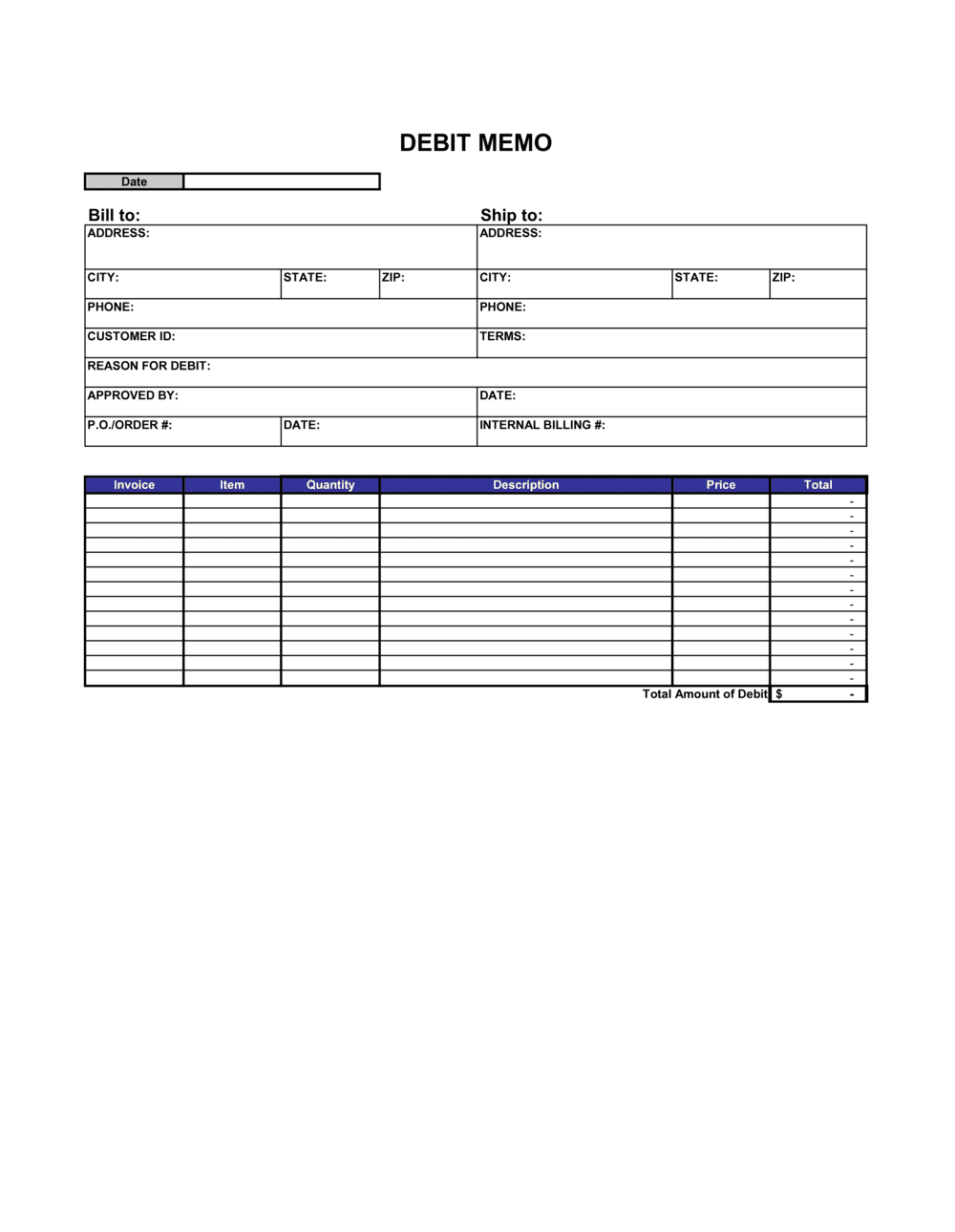
Debit Memo Template

Free Excel download β€’ Edit online β€’ Save & share with Drive β€’ Export to PDF

1 pageβ€’20–30 min to fillβ€’Difficulty: Standardβ€’Signature requiredβ€’Legal review recommended
Learn more ↓
FreeXLSDebit Memo Template

At a glance

What it is
A Debit Memo is a formal binding document issued by one party to notify another that their account has been debited or that an additional amount is owed β€” typically as an adjustment to a prior invoice, a correction for underpayment, or a charge for goods returned by a buyer to a supplier. This free Word download gives you a professionally formatted template you can edit online and export as PDF to send to customers, vendors, or banks.
When you need it
Issue a debit memo when a prior invoice understated the amount owed, when a buyer returns goods and the seller needs to offset a credit, when a bank deducts a fee from your account, or when you need to formalize an additional charge not captured on the original invoice.
What's inside
Issuer and recipient identification, original invoice reference, debit memo number and date, itemized description of the adjustment, amount owed, payment terms and due date, authorization signatures, and a supporting-reasons clause.

What is a Debit Memo?

A Debit Memo (also called a debit note or debit memorandum) is a formal commercial and legal document issued by one party to notify another that an additional amount has been charged to their account or that more money is owed than a prior invoice reflected. It may correct an undercharge on an existing invoice, formalize a restocking or freight charge, document a bank fee deducted from a client account, or record any other upward financial adjustment that the parties need to capture in their accounting records. Unlike a new invoice, a debit memo supplements an existing billing document β€” it preserves the original invoice reference and creates a clear, traceable correction chain that satisfies both accounting standards and audit requirements.

Why You Need This Document

Issuing billing adjustments informally β€” by email, phone call, or a hand-written note on a statement β€” creates three compounding problems: the recipient's AP department has no standardized document to match against an open payable, your accounting records show a discrepancy that cannot be reconciled without a formal entry, and you have no enforceable basis to demand payment by a specific date. When a counterparty disputes the additional charge, an undocumented adjustment leaves you relying on email threads rather than a signed commercial document. A properly executed debit memo with an authorized signature, an itemized adjustment reason, a specific due date, and a dispute resolution clause gives you an enforceable instrument that AP departments can process, auditors can trace, and courts can evaluate. This template provides the structure to issue that document correctly the first time β€” closing the gap between an informal billing correction and a binding obligation with legal teeth.

Which variant fits your situation?

If your situation is…Use this template
Correcting an undercharge on a previously issued invoiceDebit Memo (Invoice Adjustment)
Notifying a customer of a returned goods chargeDebit Memo (Purchase Return)
Reversing a credit note that was issued in errorDebit Memo (Credit Reversal)
Documenting a bank service fee or account deductionBank Debit Memo
Recovering vendor-side costs such as freight or duty shortfallsVendor Debit Note
Issuing a formal reduction to a supplier's credit balanceDebit Memo (Supplier Account Adjustment)
Reducing an overstated credit note previously issued to a buyerCredit Note

Common mistakes to avoid

❌ Issuing the memo with no reference to the original invoice

Why it matters: Without a link to the underlying invoice, the recipient's AP team cannot match the charge to an existing payable, causing the memo to be returned, disputed, or ignored entirely.

Fix: Always cite the original invoice number, date, and billed amount in the reference clause β€” and confirm that number matches the invoice already in the recipient's system.

❌ Vague adjustment reason with no supporting detail

Why it matters: A reason field that says only 'billing error' or 'price adjustment' gives the recipient no basis to approve payment and invites a dispute that could have been avoided.

Fix: Write a specific factual description β€” quantities delivered versus billed, the agreed rate that was misapplied, or the contractual clause that authorizes the charge β€” and attach the relevant documentation.

❌ Sending an unsigned memo

Why it matters: Corporate AP departments routinely reject or quarantine unauthenticated billing documents. An unsigned debit memo signals it may not have been reviewed or authorized, delaying payment indefinitely.

Fix: Require an authorized signatory β€” controller, CFO, or owner β€” to sign and date every debit memo before it leaves the building, or use a digital signature platform to ensure a timestamped execution record.

❌ Recalculating the due date from the original invoice date instead of the memo date

Why it matters: If the original invoice was Net 30 and was issued 45 days ago, applying that same Net 30 makes the debit memo immediately overdue β€” triggering a late-fee dispute before the recipient even had a chance to pay.

Fix: Always calculate the payment due date forward from the debit memo's own issue date, not from any prior document's date.

❌ Omitting the currency code on international memos

Why it matters: CAD and USD, or GBP and EUR, are easily confused when only a dollar or pound sign appears. A currency ambiguity can result in underpayment of 15–30% on cross-border transactions and a secondary correction cycle.

Fix: Use the three-letter ISO 4217 currency code (USD, CAD, GBP, EUR) alongside the symbol on every memo sent to a counterparty in a different country.

❌ No dispute resolution clause or timeframe

Why it matters: A recipient with no contractual deadline to raise a dispute can delay indefinitely under the guise of 'reviewing the charges,' leaving the issuer with no legal basis to demand a resolution date.

Fix: Include a dispute window of 10–15 business days from receipt, require disputes to be made in writing, and state that undisputed portions remain due by the original payment deadline regardless.

The 10 key clauses, explained

Parties and account identification

In plain language: Identifies the issuing party and the recipient, including legal entity names, billing addresses, and account or customer reference numbers.

Sample language
This Debit Memo is issued by [ISSUER LEGAL NAME], [ADDRESS] ('Issuer'), to [RECIPIENT LEGAL NAME], [ADDRESS] ('Recipient'), Customer Account No. [ACCOUNT NUMBER].

Common mistake: Using a trading name or department name instead of the full registered legal entity. A mismatch between the debit memo and the recipient's legal name delays AP processing and can make the document unenforceable.

Debit memo number and date

In plain language: Assigns a unique sequential reference number to the memo and records the date it was issued, enabling both parties to track and match the document in their accounting systems.

Sample language
Debit Memo No.: DM-[YEAR]-[SEQUENCE] | Issue Date: [DATE]

Common mistake: Reusing or omitting a unique reference number. Without a distinct identifier, neither party can match the memo to payments, and audit trails break down.

Original invoice reference

In plain language: Cites the invoice number, date, and original amount from the prior billing document that this memo corrects or supplements.

Sample language
This memo adjusts Invoice No. [ORIGINAL INVOICE NUMBER] dated [DATE], original amount [CURRENCY SYMBOL][AMOUNT].

Common mistake: Issuing a debit memo with no reference to the underlying invoice. Without this link, the recipient's AP team cannot match the charge and will typically dispute or return the document.

Reason for adjustment

In plain language: Explains in plain language exactly why the additional charge is being levied β€” underbilling, returned-goods restocking, freight shortfall, price correction, or other specific cause.

Sample language
Reason for Adjustment: [DESCRIPTION OF REASON β€” e.g., 'Correction for quantity undercharged on Invoice No. [X]: [Y] units at $[UNIT PRICE] were delivered but only [Z] units were billed.']

Common mistake: Writing a vague reason such as 'billing correction' with no supporting detail. Vague descriptions trigger disputes, slow payment, and weaken the issuer's position if the matter escalates to a formal dispute.

Itemized adjustment amount

In plain language: Lists each additional charge in a line-item format with description, quantity (if applicable), unit price, and the subtotal for that line.

Sample language
Adjustment Line 1: [DESCRIPTION] | Qty: [X] | Unit Price: $[X] | Line Total: $[X] | Applicable Tax ([RATE]%): $[X]

Common mistake: Lumping all charges into a single line with no breakdown. A single-line debit memo is routinely rejected by corporate AP departments that require itemization to code expenses.

Total debit amount and currency

In plain language: States the final additional amount owed, including applicable taxes, clearly denominated in the transaction currency.

Sample language
TOTAL DEBIT AMOUNT DUE: [CURRENCY CODE] $[TOTAL AMOUNT], inclusive of applicable [SALES TAX / VAT / GST] of $[TAX AMOUNT].

Common mistake: Omitting the currency code on cross-border memos. USD and CAD, or GBP and EUR, are easily confused β€” an ambiguous currency denomination can result in underpayment and a secondary dispute.

Payment terms and due date

In plain language: States when the additional amount must be paid, the accepted payment methods, and any late-payment consequences such as interest or penalties.

Sample language
Payment is due within [30] days of this memo's issue date (due date: [SPECIFIC DATE]). Late payments will accrue interest at [X]% per month. Accepted methods: [ACH / WIRE / CHECK / CREDIT CARD].

Common mistake: Carrying forward the original invoice's payment terms without recalculating the due date from the memo's issue date. This can result in a due date that has already passed before the recipient opens the document.

Supporting documentation reference

In plain language: Identifies any attached evidence β€” purchase orders, delivery receipts, prior correspondence, or audit reports β€” that substantiate the adjustment.

Sample language
Supporting documentation attached: (a) Delivery Receipt No. [X] dated [DATE]; (b) Email correspondence dated [DATE] re: [SUBJECT]; (c) [OTHER DOCUMENT].

Common mistake: Referencing supporting documents that are not actually attached. This forces the recipient to request them separately, delays resolution, and undermines the memo's credibility in a dispute.

Authorization and signature block

In plain language: Confirms the memo has been reviewed and approved by an authorized representative of the issuing organization, with name, title, date, and signature.

Sample language
Authorized by: [AUTHORIZED SIGNATORY NAME], [TITLE], [COMPANY NAME] | Signature: __________________ | Date: [DATE]

Common mistake: Issuing an unsigned debit memo. Without an authorized signature, many corporate AP departments will treat the document as informal, withhold payment, or return it for execution.

Dispute resolution and escalation clause

In plain language: Sets out the process and timeframe for the recipient to raise a dispute β€” typically written notice within a defined number of days β€” and the escalation path if the parties cannot resolve it directly.

Sample language
Recipient must notify Issuer in writing of any dispute within [15] business days of receipt. Undisputed amounts remain due by the payment due date regardless of any disputed portion. Disputes unresolved within [30] days shall be escalated to [MEDIATION / ARBITRATION / APPLICABLE COURT] in [JURISDICTION].

Common mistake: No dispute window or escalation path at all. Without one, a recipient can delay indefinitely by claiming to be reviewing the memo β€” and the issuer has no contractual basis to demand resolution by a specific date.

How to fill it out

  1. 1

    Enter the issuer and recipient details

    Fill in both parties' full registered legal names, addresses, and account reference numbers. Confirm the recipient's legal entity name matches their AP system records.

    πŸ’‘ Ask new counterparties for their registered entity name and AP contact at the start of the relationship β€” not after a billing dispute has already begun.

  2. 2

    Assign a sequential debit memo number and date

    Use a consistent numbering format such as DM-YYYY-NNNN and enter the date the memo is being issued. File a copy in your AR records before sending.

    πŸ’‘ Maintain a debit memo register separate from your invoice register to avoid numbering conflicts and simplify audit trails.

  3. 3

    Reference the original invoice

    Enter the invoice number, date, and original billed amount from the document being corrected. If the debit memo relates to multiple invoices, list each one separately.

    πŸ’‘ Cross-reference the invoice in your accounting system before sending β€” confirm the original amount matches what your records show to avoid a second correction.

  4. 4

    State the reason for adjustment in specific terms

    Write a clear, factual explanation of why the additional charge applies β€” quantity undercharged, omitted freight, restocking fee, price correction β€” with reference to the underlying event or agreement.

    πŸ’‘ Include the specific clause, contract section, or agreed rate that authorizes the charge. A memo grounded in a prior agreement is far harder to dispute than one citing only internal policy.

  5. 5

    Itemize the adjustment charges

    List each additional charge on its own line with a description, quantity if applicable, unit price, and line total. Apply the correct tax rate β€” sales tax, VAT, or GST β€” to the appropriate lines.

    πŸ’‘ Mirror the line-item format from the original invoice where possible. A consistent structure makes matching easier for the recipient's AP team and reduces processing delays.

  6. 6

    Calculate and state the total debit amount

    Sum all line items, add applicable taxes, and state the total in the transaction currency with the ISO currency code. Double-check arithmetic before sending.

    πŸ’‘ If the memo is in a currency other than your functional currency, include the exchange rate and effective date used to calculate the amount.

  7. 7

    Set the payment due date and attach supporting documents

    Calculate the due date from the memo's issue date using the agreed payment terms. Attach all referenced supporting documents β€” delivery receipts, correspondence, and purchase orders β€” as a single PDF package.

    πŸ’‘ Send the memo package by a tracked method β€” email with read receipt or registered post β€” so you have proof of delivery if a payment dispute arises.

  8. 8

    Obtain an authorized signature before sending

    Have an authorized signatory β€” finance director, controller, or owner β€” sign and date the memo before dispatch. Record the signed copy in your document management system.

    πŸ’‘ Use Business in a Box eSign to timestamp execution and store the executed copy alongside the original invoice in your AR file.

Frequently asked questions

What is a debit memo?

A debit memo is a formal commercial document issued by one party to notify another that an additional amount has been charged to their account or is owed beyond what a prior invoice captured. It is used to correct underbilling, recover returned-goods charges, document bank fees, or formalize any upward adjustment to an existing receivable. In accounting terms, it increases the amount the recipient owes and must be recorded in both parties' ledgers.

What is the difference between a debit memo and a credit note?

A debit memo increases the amount owed by the recipient β€” it is an upward adjustment that adds to a prior invoice. A credit note decreases the amount owed β€” it is a downward adjustment issued for returns, overbilling, or negotiated reductions. They are mirror documents: the same transaction that generates a credit note for the buyer often requires a debit memo from the seller's perspective to offset a prior credit balance.

When should I issue a debit memo instead of a new invoice?

Issue a debit memo when you need to correct or supplement an existing invoice without replacing it β€” for example, when a price error understated the amount, when additional quantities were delivered after the invoice was sent, or when a restocking or freight charge was omitted. A new invoice is appropriate for a wholly new transaction. Using a debit memo preserves the original invoice reference, making reconciliation cleaner for both parties.

Is a debit memo legally binding?

A properly executed debit memo is generally enforceable as a commercial billing document when it is signed by an authorized representative, references an underlying contract or purchase order, and clearly states the amount and basis for the charge. In most jurisdictions, it does not require notarization, but it must be consistent with the original agreement between the parties. Consider consulting a lawyer for high-value adjustments or cross-border transactions.

Does a debit memo need to be signed?

Yes β€” an authorized signature is essential for a debit memo to be treated as an official binding document. Many corporate AP departments will not process unsigned memos, treating them as informal communications rather than payment demands. The signatory should be someone with authority to issue financial obligations on behalf of the issuing entity, such as a controller, finance director, or owner.

How long does the recipient have to pay a debit memo?

Payment terms on a debit memo are set by the issuer and should be stated explicitly in the payment terms clause β€” typically Net 15 or Net 30 from the memo's issue date. If the underlying contract specifies payment terms, those govern unless otherwise agreed. Issuing a memo without stated payment terms creates ambiguity that courts in most jurisdictions resolve by implying a reasonable period, often 30 days.

What supporting documents should accompany a debit memo?

Attach the original invoice, any delivery receipts, purchase orders, or shipping documents that substantiate the charge, and any written correspondence in which the adjustment was discussed or agreed. For bank-issued debit memos, attach the fee schedule or account agreement that authorizes the deduction. Including documentation at the time of issue prevents the recipient from using missing evidence as a basis to delay payment.

How do I record a debit memo in my accounting system?

On the issuer's side, a debit memo increases accounts receivable and the corresponding revenue or cost recovery account. On the recipient's side, it increases accounts payable. Most accounting platforms β€” QuickBooks, Xero, SAP β€” have a native debit memo or debit note transaction type that links to the original invoice for automatic reconciliation. Always post the memo in the same accounting period as the underlying adjustment event for accurate period reporting.

Can a recipient dispute a debit memo?

Yes. The recipient should raise any dispute in writing within the timeframe stated in the memo's dispute resolution clause β€” typically 10–15 business days. Undisputed portions should be paid by the due date regardless of the dispute. If the parties cannot resolve the disagreement directly, the escalation clause in the memo governs whether the matter proceeds to mediation, arbitration, or litigation.

How this compares to alternatives

vs Credit Note

A credit note reduces the amount a buyer owes β€” it is issued for returns, overbilling, or negotiated discounts and decreases the seller's accounts receivable. A debit memo increases the amount owed and is used for underbilling, additional charges, or purchase returns from the seller's perspective. They are opposite adjustments to the same receivable/payable ledger.

vs Invoice

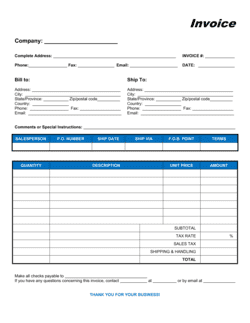
An invoice is issued for a new, standalone transaction and creates an original billing obligation. A debit memo adjusts an existing invoice β€” it supplements rather than replaces. Use an invoice when billing for a new delivery or project; use a debit memo when correcting or adding to a charge already billed.

vs Purchase Order

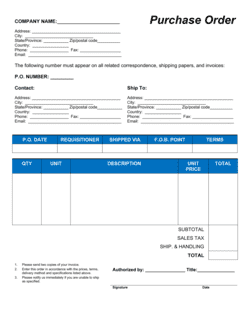
A purchase order is issued by the buyer before delivery to authorize a transaction. A debit memo is issued after delivery to adjust the financial record of that transaction. A debit memo should always reference the original purchase order number so both parties can trace the full chain: PO β†’ invoice β†’ debit memo.

vs Billing Statement

A billing statement is a periodic summary of all outstanding charges, payments, and credits on a running account β€” it shows the balance but does not itself create a new obligation. A debit memo creates a specific new charge tied to a defined event and carries its own payment terms, due date, and legal enforceability independent of any periodic statement.

Industry-specific considerations

Manufacturing and wholesale

Debit memos recover freight surcharges, quantity shortfalls on bulk orders, and raw-material price escalations that were not captured on original purchase invoices.

Banking and financial services

Banks issue debit memos to document service charges, overdraft fees, wire transfer fees, and penalty deductions against a client's account balance.

Retail and e-commerce

Retailers issue debit memos to suppliers for vendor allowance shortfalls, co-op advertising chargebacks, and compliance penalties under vendor agreements.

Professional services

Consultants and agencies use debit memos to recover hours, disbursements, or expenses omitted from a prior invoice after client approval of the additional charges.

Logistics and freight

Freight carriers issue debit memos for dimensional weight adjustments, fuel surcharge corrections, and accessorial charges assessed after the original freight invoice was issued.

Construction

Contractors issue debit memos for change-order costs, material price escalations, and delay penalties that fall outside the original contract sum.

Jurisdictional notes

United States

Debit memos are recognized commercial documents under the UCC in all 50 states, but enforceability depends on whether the underlying transaction is supported by a valid contract or purchase order. In regulated industries such as banking, the Federal Reserve and OCC require specific disclosures on debit memos issued to account holders. Sales tax implications vary by state β€” confirm whether the adjustment triggers a sales tax correction in the relevant state.

Canada

Debit memos function as adjustment notes under Canadian GAAP and must comply with the GST/HST rules under the Excise Tax Act β€” a taxable adjustment must be accompanied by a corresponding GST/HST debit note. Quebec requires French-language documentation for provincially-regulated commercial transactions. Payment terms on debit memos between businesses are typically governed by the underlying supply agreement.

United Kingdom

In the UK, debit memos are commonly referred to as debit notes and must comply with VAT invoicing requirements under HMRC rules if the adjustment affects a VAT-registered supply. A valid VAT debit note must reference the original invoice, state the reason for adjustment, and show the VAT adjustment separately. The Late Payment of Commercial Debts (Interest) Act 1998 applies to unpaid debit memos between businesses.

European Union

EU VAT Directive 2006/112/EC requires that any upward adjustment to a taxable supply be documented by a corrective invoice or debit note that references the original invoice and clearly states the adjusted VAT amount. Member states vary in their specific format requirements β€” Germany, France, and Italy each have detailed invoicing regulations. GDPR applies to any personal data included in the memo, and data minimization principles should be followed.

Template vs lawyer β€” what fits your deal?

PathBest forCostTime
Use the templateRoutine billing corrections and underpayment adjustments between established domestic trading partnersFree10–15 minutes per memo
Template + legal reviewHigh-value adjustments over $10,000, cross-border transactions, or memos tied to disputed contract terms$150–$400 for a lawyer or accountant review1–2 days
Custom draftedComplex multi-party supply chain adjustments, regulated industries, or memos that may be introduced as evidence in arbitration or litigation$500–$2,000+3–7 days

Glossary

Debit Memo
A commercial document issued to notify a counterparty that their account has been debited or that an additional sum is owed beyond what a prior invoice captured.
Credit Note
The mirror-image document to a debit memo β€” issued to reduce an amount owed, typically for returns, overbilling, or negotiated adjustments.
Original Invoice Reference
The unique invoice number from the prior billing document that the debit memo corrects or supplements, used to match records across both parties' accounting systems.
Adjustment Reason Code
A short standardized code or narrative that explains why the additional charge is being applied β€” e.g., 'underbilling', 'returned goods restocking fee', or 'freight surcharge'.
Net Amount Due
The final adjusted balance owed after applying the debit memo amount to the original invoice balance, stated in the invoice currency.
Accounts Receivable (AR)
Money owed to a business by its customers for goods or services already delivered but not yet paid β€” the ledger where outstanding invoices and debit memos are tracked.
Accounts Payable (AP)
Money a business owes to its suppliers or vendors β€” the counterpart ledger where received debit memos are recorded as additional liabilities.
Purchase Return
A transaction in which a buyer sends goods back to the seller, typically triggering a debit memo from the seller for restocking fees or a credit note for the return value.
Authorization Signature
A signature from an authorized representative of the issuing party that validates the debit memo as an official billing document binding on the organization.
Remittance Advice
A document the payer sends alongside payment that identifies which invoices and debit memos are being settled, enabling the recipient to apply funds correctly.
Accrual Accounting
An accounting method that records revenue and expenses when they are earned or incurred β€” regardless of when cash is received β€” making debit memos essential for period-accurate financial records.

Part of your Business Operating System

This document is one of 3,000+ business & legal templates included in Business in a Box.

  • Fill-in-the-blanks β€” ready in minutes
  • 100% customizable Word document
  • Compatible with all office suites
  • Export to PDF and share electronically

Create your document in 3 simple steps.

From template to signed document β€” all inside one Business Operating System.
1
Download or open template

Access over 3,000+ business and legal templates for any business task, project or initiative.

2
Edit and fill in the blanks with AI

Customize your ready-made business document template and save it in the cloud.

3
Save, Share, Send, Sign

Share your files and folders with your team. Create a space of seamless collaboration.

Save time, save money, and create top-quality documents.

β˜…β˜…β˜…β˜…β˜…

"Fantastic value! I'm not sure how I'd do without it. It's worth its weight in gold and paid back for itself many times."

Managing Director Β· Mall Farm
Robert Whalley
Managing Director, Mall Farm Proprietary Limited
β˜…β˜…β˜…β˜…β˜…

"I have been using Business in a Box for years. It has been the most useful source of templates I have encountered. I recommend it to anyone."

Business Owner Β· 4+ years
Dr Michael John Freestone
Business Owner
β˜…β˜…β˜…β˜…β˜…

"It has been a life saver so many times I have lost count. Business in a Box has saved me so much time and as you know, time is money."

Owner Β· Upstate Web
David G. Moore Jr.
Owner, Upstate Web

Run your business with a system β€” not scattered tools

Stop downloading documents. Start operating with clarity. Business in a Box gives you the Business Operating System used by over 250,000 companies worldwide to structure, run, and grow their business.

Start freeΒ Β·Β No credit card required