Memo Template

Free Word download β€’ Edit online β€’ Save & share with Drive β€’ Export to PDF

1 pageβ€’20–30 min to fillβ€’Difficulty: Standardβ€’Signature requiredβ€’Legal review recommended
Learn more ↓
FreeMemo Template

At a glance

What it is
A Memo (Memorandum) is a formal written communication used within or between organizations to record decisions, issue directives, document policy changes, or create an authoritative written record of a specific matter. This free Word download gives you a structured, professionally formatted template you can edit online and export as PDF β€” suitable for internal policy announcements, compliance notices, legal notifications, and interdepartmental directives.
When you need it
Use it whenever you need to communicate a binding directive, document a formal decision, issue a compliance notice, or create an auditable written record that may be referenced in future disputes or legal proceedings.
What's inside
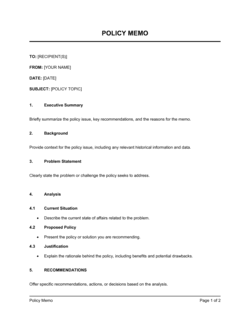
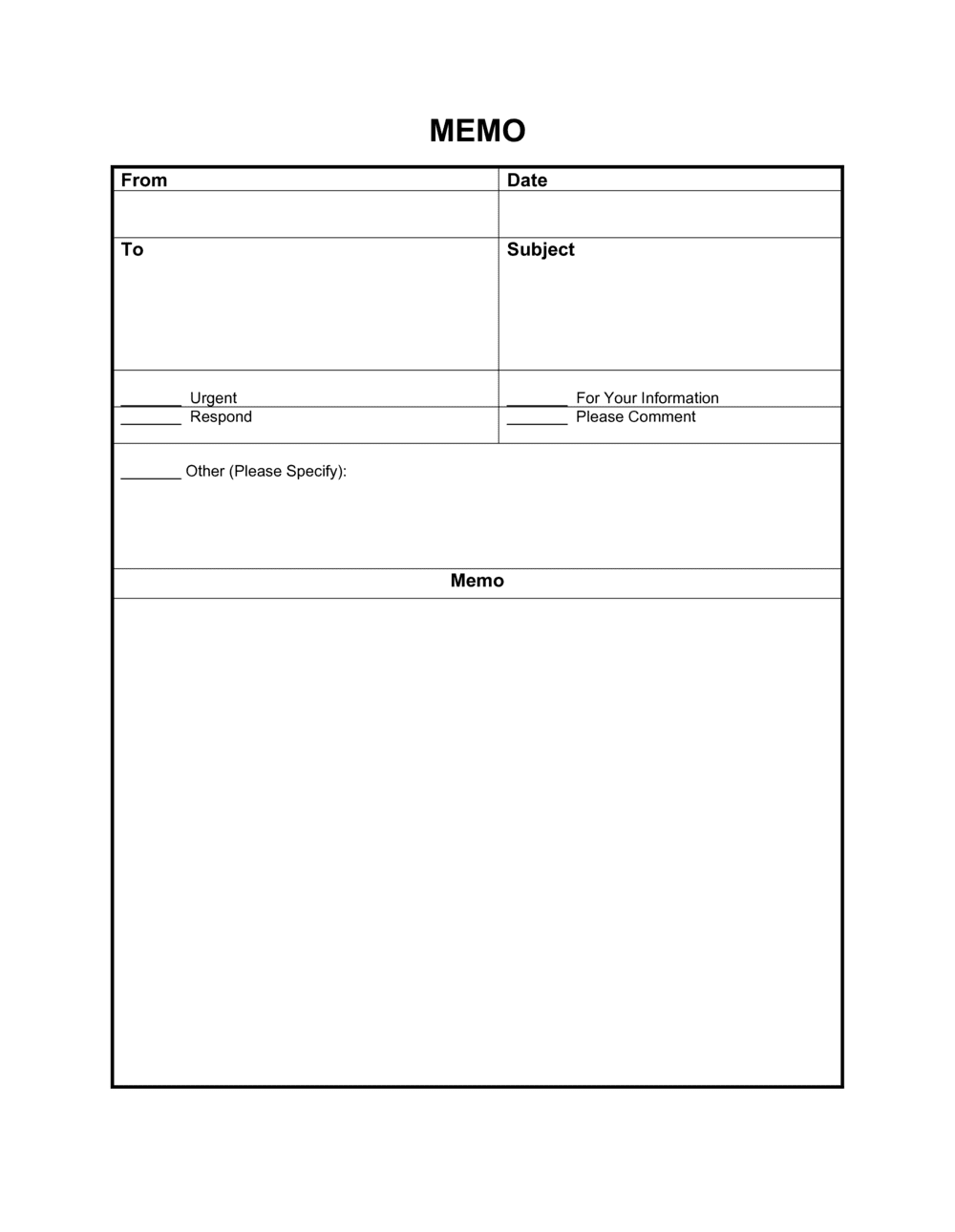
Header block with sender, recipient, date, and subject line; purpose and background sections; the core directive or decision; required actions with deadlines; acknowledgment or signature block; and distribution list.

What is a Memo?

A Memo (Memorandum) is a formal written communication used within or between organizations to record decisions, issue binding directives, announce policy changes, or create an authoritative written record of a specific matter. Unlike an informal email, a properly formatted and signed memo functions as a business record with evidentiary weight β€” it can be produced in employment disputes, compliance audits, regulatory investigations, and civil litigation to demonstrate that a party was formally put on notice of an obligation or decision. Memos follow a standardized header format (TO / FROM / DATE / RE) and typically include a purpose statement, background context, the core directive, assigned action items with deadlines, and a signed acknowledgment block.

Why You Need This Document

Operating without formal written memos exposes your organization to predictable and costly failures. When a policy change is communicated only by email or verbally, employees have no authenticated record of what was required of them or when β€” and neither do you. In employment tribunals, disciplinary actions consistently fail when the organization cannot produce a signed document proving the employee received notice of the policy they violated. In regulated industries, the absence of documented compliance directives is itself a regulatory violation, triggering fines and corrective action plans. A memo with a signed acknowledgment block closes the most common evidentiary gap in HR and compliance enforcement: it creates an authenticated, dated record that a specific individual received, read, and confirmed understanding of a binding directive. This template gives you a professionally structured, legally sound starting point β€” formatted for business use and ready to execute in under 30 minutes.

Which variant fits your situation?

If your situation is…Use this template
Communicating an internal policy change to all staffPolicy Change Memo
Issuing a formal legal or compliance notice within the organizationLegal Notice Memo
Documenting a disciplinary action for an employee fileDisciplinary Action Memo
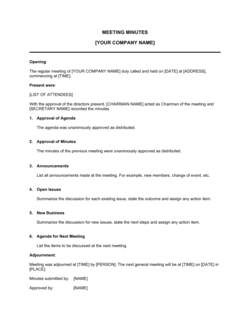
Summarizing decisions made at a meeting for the recordMeeting Minutes
Informing staff of an executive decision requiring acknowledgmentExecutive Directive Memo
Communicating a financial or budget directive to department headsBudget Memo
Notifying employees of a workplace health and safety requirementHealth and Safety Memo

Common mistakes to avoid

❌ Using hedged language in a binding directive

Why it matters: Words like 'should,' 'consider,' or 'where possible' make a mandatory directive legally ambiguous. In a disciplinary or compliance context, employees and their counsel will argue the instruction was advisory.

Fix: Replace all hedged language with 'shall,' 'must,' or 'is required to.' Review the directive clause specifically before signing β€” one weak word can undermine an otherwise sound document.

❌ Omitting the signed acknowledgment block

Why it matters: Without a signed acknowledgment, the organization cannot prove the employee received the memo. This is the single most common reason disciplinary actions are reversed in employment tribunals and HR disputes.

Fix: Include the acknowledgment block on every memo with policy, disciplinary, or legal implications, and set a deadline for return of the signed copy before the effective date.

❌ Assigning action items to a team or department rather than a named individual

Why it matters: Collective accountability consistently produces collective inaction. When no single person owns an action item, each member of the group assumes someone else will handle it.

Fix: Name one accountable individual per action item. If multiple people share responsibility, name a lead who is accountable for coordination and final confirmation.

❌ Failing to supersede conflicting prior memos

Why it matters: Employees holding contradictory written directives from the same organization will default to the version most favorable to them β€” or use the conflict as grounds to take no action at all.

Fix: Search the document archive for all prior communications on the same subject and list each by title and date in the supersession clause. Archive the superseded versions but do not delete them.

❌ Omitting a retention notice

Why it matters: Without explicit retention instructions, staff discard signed memos after the immediate issue is resolved. When a compliance audit or legal proceeding requires the document 18 months later, it no longer exists.

Fix: Add a retention notice to the distribution list section stating the minimum retention period and the filing location β€” personnel file, department records, or the legal hold folder.

❌ Distributing a confidential memo to an uncontrolled email list

Why it matters: A memo marked 'Confidential' that is forwarded broadly outside the named distribution list undermines the confidentiality designation and can waive privilege in a legal context.

Fix: Send confidential memos directly to named recipients only, using a secure platform. State in the body that forwarding outside the distribution list is prohibited and constitutes a breach of company policy.

The 10 key clauses, explained

Header block

In plain language: Identifies who sent the memo, who receives it, the date it was issued, and a concise subject line β€” creating the foundational record of the communication.

Sample language
TO: [RECIPIENT NAME / ROLE] | FROM: [SENDER NAME / ROLE] | DATE: [DATE] | RE: [SUBJECT MATTER]

Common mistake: Using a job title instead of both name and title in the 'TO' and 'FROM' fields. If the named individual leaves the organization, the document becomes impossible to attribute or authenticate in a dispute.

Confidentiality designation

In plain language: States the access level of the memo β€” internal use only, confidential, or unrestricted β€” setting the expectation for how recipients may share or reference it.

Sample language
CONFIDENTIAL β€” FOR INTERNAL USE ONLY. This memorandum contains proprietary information intended solely for the named recipient(s). Unauthorized distribution is strictly prohibited.

Common mistake: Omitting a confidentiality designation on memos containing sensitive personnel, legal, or financial information. Without it, recipients have no formal notice of restrictions and inadvertent disclosure is harder to address.

Purpose statement

In plain language: A one to three sentence opening that tells the reader exactly why the memo was written and what it is asking them to do or know.

Sample language
The purpose of this memo is to notify all [DEPARTMENT] staff of the updated [POLICY NAME], effective [DATE], and to outline the actions required to achieve compliance by [DEADLINE].

Common mistake: Burying the purpose inside the background section. Recipients who scan rather than read miss the central directive entirely, creating compliance gaps.

Background and context

In plain language: Provides the factual history, regulatory trigger, or business rationale that makes the directive or decision necessary β€” giving recipients the information they need to act correctly.

Sample language
Effective [DATE], [REGULATION / POLICY / EVENT] requires [COMPANY NAME] to [OBLIGATION]. This change is driven by [REASON] and affects all employees in [SCOPE].

Common mistake: Writing background that is longer than the directive itself. Background should give enough context to justify the decision β€” not relitigate how the organization arrived at it.

Directive or decision

In plain language: The core binding instruction or formal decision the memo communicates, stated clearly and without ambiguity.

Sample language
Effective [DATE], all employees are required to [SPECIFIC ACTION]. Non-compliance with this directive may result in [CONSEQUENCE], up to and including [DISCIPLINARY MEASURE].

Common mistake: Using hedged language such as 'should consider' or 'may wish to' in a directive that is meant to be mandatory. Ambiguous language strips the memo of its binding character and creates enforceability problems.

Action items and deadlines

In plain language: Lists specific tasks assigned to named individuals or roles, each with a clear completion deadline, so compliance can be tracked and documented.

Sample language
1. [RESPONSIBLE PARTY] shall [ACTION] by [DATE]. 2. [RESPONSIBLE PARTY] shall [ACTION] by [DATE]. Confirmation of completion must be submitted to [CONTACT] no later than [DATE].

Common mistake: Assigning actions to a department or team rather than a named individual. Collective ownership reliably produces collective inaction β€” always name a single accountable person per action item.

Escalation and objection procedure

In plain language: Tells recipients what to do if they have questions, need a clarification, or believe they cannot comply β€” directing concerns through the appropriate channel rather than leaving them unresolved.

Sample language
Questions regarding this directive should be directed to [CONTACT NAME / ROLE] at [EMAIL / PHONE] no later than [DATE]. If compliance is not possible by the stated deadline, [ESCALATION PROCESS] must be initiated.

Common mistake: Omitting an escalation path entirely. Recipients who encounter obstacles to compliance have no sanctioned route to resolve them, leading to either silent non-compliance or informal workarounds that are not documented.

Effective date and supersession clause

In plain language: States when the directive takes effect and, if applicable, which prior memos, policies, or procedures it replaces β€” preventing conflicting documents from remaining in circulation.

Sample language
This memorandum takes effect on [DATE] and supersedes [PRIOR MEMO / POLICY REFERENCE, DATED DATE] in its entirety. All prior communications on this subject are hereby rescinded.

Common mistake: Failing to reference and supersede conflicting prior memos. When employees hold contradictory written directives, they default to the one most favorable to them β€” or to inaction.

Acknowledgment and signature block

In plain language: A section where the recipient signs or initials to confirm they have received, read, and understood the memo β€” creating an evidentiary record of notice.

Sample language
I, [RECIPIENT NAME], acknowledge receipt of this memorandum dated [DATE] and confirm my understanding of its contents and requirements. Signature: _______________ Date: _______________

Common mistake: Making the signature block optional or omitting it entirely on memos with legal or disciplinary implications. Without a signed acknowledgment, the organization cannot prove the employee received notice, undermining any subsequent enforcement action.

Distribution list and retention notice

In plain language: Records every individual who received a copy of the memo and states how long it must be kept on file, ensuring the document can be located and authenticated in future proceedings.

Sample language
Copies distributed to: [NAME / ROLE], [NAME / ROLE], [NAME / ROLE]. This memorandum must be retained in the employee's personnel file / department records for a minimum of [X] years in accordance with [POLICY / REGULATION].

Common mistake: Omitting the retention notice. Without it, staff may discard signed memos after an issue is resolved, leaving the organization unable to produce the document when it is needed months or years later.

How to fill it out

  1. 1

    Complete the header block with full names and the exact date

    Enter the sender's and recipient's full legal names and job titles, the date of issuance, and a specific subject line that identifies the topic without ambiguity.

    πŸ’‘ Use 'RE:' rather than 'SUBJECT:' in formal legal or compliance memos β€” it is the recognized convention in most common-law jurisdictions and signals the document's formal character.

  2. 2

    Set the confidentiality designation before adding any content

    Decide whether the memo is confidential, for internal use only, or unrestricted, and add the designation at the top of the document before drafting the body.

    πŸ’‘ If the memo references an ongoing legal matter, add 'Prepared at the Direction of Legal Counsel β€” Privileged and Confidential' to preserve any applicable attorney-client privilege.

  3. 3

    Write the purpose statement in the first two sentences

    State exactly why the memo exists and what the recipient is expected to do or know. Do not save this for the end of the background section.

    πŸ’‘ Read your purpose statement aloud β€” if a recipient could misunderstand the required action after hearing it once, rewrite it before moving on.

  4. 4

    Draft background limited to essential context only

    Explain the regulatory trigger, business event, or prior decision that makes the directive necessary. Limit this section to facts the reader needs to act correctly β€” not the full decision-making history.

    πŸ’‘ Background should be no longer than 20% of the total memo. If it runs longer, move supporting detail to an attached appendix.

  5. 5

    State the directive in unambiguous, mandatory language

    Use 'shall,' 'must,' or 'is required to' β€” never 'should' or 'may wish to.' Identify exactly what must happen, who is responsible, and what the consequence of non-compliance is.

    πŸ’‘ Have a colleague outside the drafting process read the directive and describe back what they are required to do. If their answer differs from your intent, revise.

  6. 6

    Assign each action item to a named individual with a hard deadline

    List every required action on a separate numbered line, name the single person accountable for each, and state a specific calendar date for completion.

    πŸ’‘ Add a confirmation requirement: 'Submit written confirmation of completion to [NAME] by [DATE].' This closes the loop and creates a secondary record of compliance.

  7. 7

    Add the effective date and supersession clause

    State the date the directive takes effect and list by title and date any prior memos or policies this document replaces.

    πŸ’‘ Pull your document management system for any memos on the same subject issued in the past three years. Superseding all of them in one clause prevents employees from citing outdated authority.

  8. 8

    Circulate for signature before the effective date

    Send the memo to each named recipient in advance of the effective date with a clear deadline for returning the signed acknowledgment block.

    πŸ’‘ Use Business in a Box eSign to timestamp digital signatures and store fully-executed copies automatically β€” this eliminates the most common evidentiary gap in memo-based enforcement actions.

Frequently asked questions

What is a memo?

A memo, short for memorandum, is a formal written communication used within or between organizations to record decisions, issue directives, communicate policy changes, or create an authoritative written record of a specific matter. Unlike an informal email, a properly executed memo carries evidentiary weight in employment disputes, compliance audits, and legal proceedings β€” particularly when it includes a signed acknowledgment block.

When should I use a memo instead of an email?

Use a memo when the communication needs to function as a formal record β€” for policy changes, disciplinary notices, compliance directives, board decisions, or any matter that may be referenced in a legal or regulatory context. Emails are appropriate for routine operational communication; memos are appropriate when you need an authenticated, dated document that demonstrates the recipient was formally put on notice of a specific obligation.

Does a memo need to be signed to be legally effective?

A memo does not require a signature to communicate information, but a signed acknowledgment block is essential whenever you need to prove the recipient received and understood the document. In employment law, for example, disciplinary actions and policy directives that lack a signed acknowledgment are routinely challenged on the grounds that the employee was never formally notified. Signature requirements also vary by jurisdiction and subject matter β€” consult legal counsel for compliance-critical memos.

What is the difference between a memo and a letter?

A memo is an internal communication addressed to individuals within the same organization or a closely related entity β€” it uses a header format (TO / FROM / DATE / RE) rather than an address block and salutation. A letter is an external communication addressed to an outside party and follows formal correspondence conventions. Some organizations use memo format for external regulatory submissions, but in most contexts the distinction between internal and external audience determines the format.

How long should a business memo be?

Most effective memos fit on one to two pages. The purpose statement, directive, and action items should be findable within 30 seconds of opening the document. Background context and supporting detail belong in attached appendices rather than the memo body. Memos longer than two pages are typically read less carefully and acted on less reliably β€” complexity is better served by a formal report or policy document with the memo serving as the transmittal notice.

Does a memo need to include a confidentiality notice?

A confidentiality designation is not legally required in most jurisdictions, but it is strongly recommended for any memo covering personnel matters, legal proceedings, financial information, or proprietary business decisions. The designation puts recipients on formal notice of the restrictions and supports the organization's position in the event of an unauthorized disclosure. Memos prepared at the direction of legal counsel should also include a privilege designation to preserve attorney-client protection.

How long should I keep signed memos on file?

Retention requirements depend on the subject matter and jurisdiction. Employment-related memos β€” including disciplinary notices and policy directives β€” are typically retained for the duration of employment plus three to seven years in most North American and European jurisdictions. Memos related to financial decisions or regulatory compliance may have longer statutory retention requirements. State the minimum retention period in the memo itself and align it with your organization's document retention policy and applicable law.

What is the difference between a memo and meeting minutes?

Meeting minutes record what was discussed, decided, and assigned during a specific meeting β€” they are a chronological narrative of a group event. A memo is a unilateral written communication that issues a directive, announces a decision, or puts a party on formal notice of an obligation. A memo may reference or implement a decision captured in meeting minutes, but the two documents serve distinct purposes and are each required to create a complete organizational record.

How this compares to alternatives

vs Meeting Minutes

Meeting minutes record the chronological narrative of a group discussion β€” what was said, decided, and assigned during a specific event. A memo issues a formal directive or policy notice from an authority to recipients who may not have been present at any meeting. The two documents are complementary: minutes capture the decision-making process; a memo communicates and enforces the result.

vs Business Letter

A business letter is an external communication addressed to a party outside the organization, following formal correspondence conventions with an address block and salutation. A memo uses the TO/FROM/DATE/RE header format and is primarily an internal document. When the same directive must be communicated to both internal staff and an external party, both a memo and a letter are typically required.

vs Policy Document

A policy document is a standing, comprehensive governance instrument that defines rules applicable across the organization for an indefinite period. A memo is a point-in-time communication that typically implements, announces, or clarifies a policy β€” or issues a specific directive under an existing policy. When a policy changes, a memo is the mechanism by which affected staff are put on formal notice of the change.

vs Disciplinary Action Form

A disciplinary action form documents a specific performance or conduct issue for an individual employee's personnel file. A memo can communicate a disciplinary directive to a broader audience or announce a policy change with disciplinary consequences, but it is not a substitute for an individualized disciplinary record. Both documents are often produced in connection with the same incident and should be cross-referenced.

Industry-specific considerations

Financial Services

Compliance memos document regulatory directives, AML/KYC policy changes, and risk committee decisions β€” all of which are subject to examination by regulators and must be retained with signed acknowledgments.

Healthcare

HIPAA policy directives, infection control updates, and credentialing requirements are distributed via formal memos that must be acknowledged by all affected clinical and administrative staff.

Manufacturing

Safety procedure updates, equipment operation directives, and quality control changes require signed memos to create an auditable record of employee notification β€” critical in OSHA and ISO compliance contexts.

Professional Services

Engagement policy changes, client confidentiality directives, and conflict-of-interest disclosures are issued as formal memos that are retained in both employee and client files.

Government and Public Sector

Internal directives in government agencies carry regulatory authority and are subject to freedom-of-information requests β€” format, retention, and distribution list accuracy are all subject to statutory requirements.

Technology / SaaS

Data security policy changes, acceptable-use directives, and incident response procedures are communicated via memos that serve as evidence of employee notification in the event of a breach investigation.

Jurisdictional notes

United States

In the US, signed memos are routinely admitted as business records under the Federal Rules of Evidence and state equivalents. Employment-related memos β€” particularly those documenting policy directives and disciplinary notices β€” are critical in EEOC complaints and wrongful termination litigation. Memos prepared at the direction of legal counsel may be protected under attorney-client privilege, but that protection can be waived if the document is shared outside the privileged relationship. Retention requirements vary by state and subject matter but typically run three to seven years for employment records.

Canada

Canadian employment law places significant weight on written notice of policy changes, particularly in Ontario and British Columbia where employment standards are strictly enforced. A signed memo acknowledging a change to workplace policy can be essential to defeating a constructive dismissal claim if the change is material. In Quebec, memos that form part of an employment relationship must comply with the Charter of the French Language β€” documents issued to Quebec-based employees should be in French, or bilingual where practical. PIPEDA and provincial privacy legislation govern the retention and handling of memos containing personal employee information.

United Kingdom

In the UK, formal written communications documenting policy changes and disciplinary directives are an important part of the procedural fairness requirements under the ACAS Code of Practice. An employment tribunal will consider whether written notice was given when assessing the reasonableness of a dismissal or disciplinary action. Memos containing personal data are subject to UK GDPR and must comply with data minimization and retention principles. The Limitation Act 1980 sets a six-year limitation period for contract-based claims, which guides minimum retention periods for contractually significant memos.

European Union

EU member states impose strong procedural requirements around employee notification of policy changes β€” in France and Germany, works council consultation may be required before certain directives take effect. EU GDPR applies to any memo containing personal data about identified individuals, requiring a lawful basis for processing, data minimization, and retention limits documented in a records-of-processing register. Post-employment retention of personnel memos is typically limited to the period necessary for the purpose β€” generally three to five years β€” unless a longer period is required by national law or active legal proceedings.

Template vs lawyer β€” what fits your deal?

PathBest forCostTime
Use the templateStandard internal policy announcements, procedural updates, and informational directives for organizations with clear in-house communication standardsFree15–30 minutes
Template + legal reviewCompliance-critical directives, disciplinary notices, or memos referencing legal obligations in a regulated industry$150–$400 for a one-hour legal review1–2 business days
Custom draftedMemos prepared in connection with active litigation, regulatory investigations, or matters requiring attorney-client privilege protection$500–$2,000+ depending on complexity and counsel2–5 business days

Glossary

Memorandum
The full form of 'memo' β€” a formal written document used to communicate decisions, directives, or notices within or between organizations.
Distribution List
The list of all individuals or roles that receive a copy of the memo, establishing who is formally on notice of its contents.
Directive
A binding instruction issued by an authority within an organization, requiring specific action or compliance from the recipient.
Acknowledgment Block
A signature or initials section at the bottom of a memo confirming the recipient has read and understood the document's contents.
Action Item
A specific task assigned within the memo, including the responsible party and a required completion date.
Effective Date
The date on which the policy, directive, or decision described in the memo takes legal or operational effect.
Escalation Path
The process or chain of command a recipient must follow if they have questions, objections, or cannot comply with the memo's directive.
Subject Line
A concise statement at the top of the memo identifying the specific topic, used to categorize and retrieve the document in filing systems.
Confidentiality Designation
A label β€” such as 'Confidential' or 'For Internal Use Only' β€” restricting who may access or share the memo's contents.
Record Retention
The period for which a signed memo must be kept on file to satisfy legal, regulatory, or organizational requirements.
CC (Carbon Copy)
Recipients who receive a copy of the memo for informational purposes but are not the primary addressees or required actors.
Precedent Document
A memo or prior communication that a current memo references or supersedes, establishing continuity in the written record.

Part of your Business Operating System

This document is one of 3,000+ business & legal templates included in Business in a Box.

  • Fill-in-the-blanks β€” ready in minutes
  • 100% customizable Word document
  • Compatible with all office suites
  • Export to PDF and share electronically

Create your document in 3 simple steps.

From template to signed document β€” all inside one Business Operating System.
1
Download or open template

Access over 3,000+ business and legal templates for any business task, project or initiative.

2
Edit and fill in the blanks with AI

Customize your ready-made business document template and save it in the cloud.

3
Save, Share, Send, Sign

Share your files and folders with your team. Create a space of seamless collaboration.

Save time, save money, and create top-quality documents.

β˜…β˜…β˜…β˜…β˜…

"Fantastic value! I'm not sure how I'd do without it. It's worth its weight in gold and paid back for itself many times."

Managing Director Β· Mall Farm
Robert Whalley
Managing Director, Mall Farm Proprietary Limited
β˜…β˜…β˜…β˜…β˜…

"I have been using Business in a Box for years. It has been the most useful source of templates I have encountered. I recommend it to anyone."

Business Owner Β· 4+ years
Dr Michael John Freestone
Business Owner
β˜…β˜…β˜…β˜…β˜…

"It has been a life saver so many times I have lost count. Business in a Box has saved me so much time and as you know, time is money."

Owner Β· Upstate Web
David G. Moore Jr.
Owner, Upstate Web

Run your business with a system β€” not scattered tools

Stop downloading documents. Start operating with clarity. Business in a Box gives you the Business Operating System used by over 250,000 companies worldwide to structure, run, and grow their business.

Free Forever PlanΒ Β·Β No credit card required