1
Complete the job header with FLSA classification
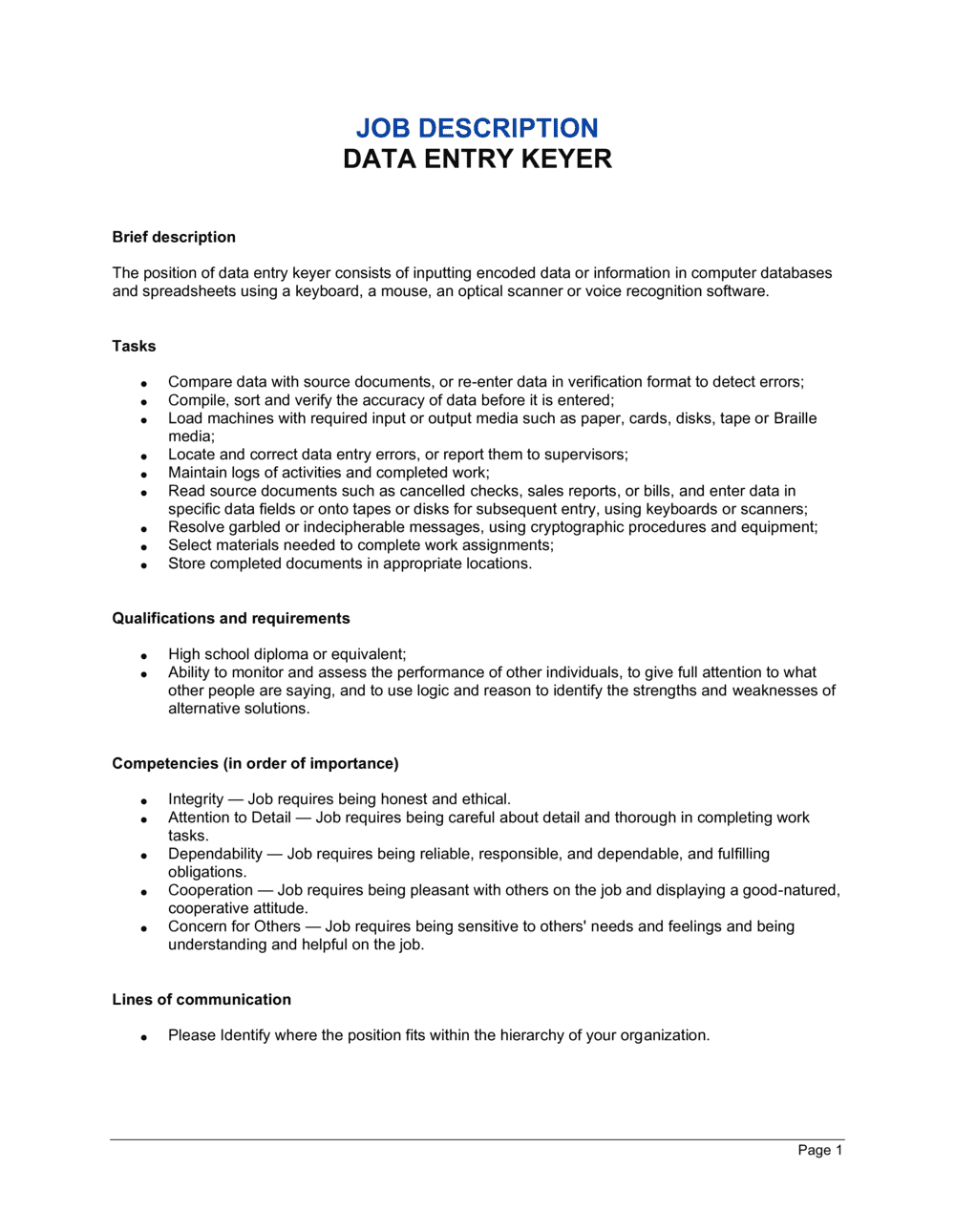
Enter the exact job title, department, reporting manager's title, employment type, and FLSA status. Data entry keyers are almost always non-exempt — confirm before publishing.
💡 Cross-check your state's minimum wage against the federal rate and use the higher figure when setting the pay range.
2
Write a specific position summary
Name the actual system the keyer will work in (e.g., Epic, SAP, QuickBooks), the data type they will enter (e.g., patient records, invoices, inventory counts), and the business function their work supports.
💡 A single sentence naming the software platform reduces unqualified applications by approximately 30% compared to generic summaries.
3
List essential duties with measurable benchmarks
Number each duty and, where possible, attach a measurable standard — KPH target, error rate ceiling, turnaround time. Separate essential functions from peripheral tasks.
💡 Limit essential functions to tasks performed at least weekly. Anything done less frequently is a marginal function and should be listed separately or omitted.
4
Set and document performance standards
Enter the minimum KPH or WPM requirement, maximum error rate, and describe how performance will be measured — automated system tracking, QA sampling, or supervisor review.
💡 Use industry benchmarks as a floor: 8,000 KPH for numeric-only entry, 50 WPM for alphanumeric. Requiring higher without justification can reduce your candidate pool unnecessarily.
5
Define minimum and preferred qualifications separately
List required qualifications in one block and preferred qualifications in a separate block. Ensure required qualifications are genuinely predictive of job performance, not proxies that could create disparate impact.
💡 If you require a college degree, document the business justification. Courts and the EEOC scrutinize degree requirements for roles that don't functionally need them.
6
Document physical requirements and working conditions
Specify hours of sitting, repetitive motion demands, screen time, and environmental conditions. Include the ADA reasonable accommodation sentence.
💡 Phrases like 'ability to lift 25 lbs occasionally' should only appear if the role actually requires it — generic physical requirements copied from other templates create ADA exposure.
7
Enter compensation range and check salary transparency compliance
Add the hourly rate range and confirm whether the posting location requires a published pay range. California, Colorado, New York, and Washington all mandate salary transparency for covered employers.
💡 Post the full range, not just the minimum — studies show postings with a full range receive 30% more applications.
8
Attach the EEO statement and at-will clause, then obtain signatures
Add your company's standard EEO statement and at-will language. Obtain a signed acknowledgment from the hiring manager and, once filled, from the new hire as part of their onboarding packet.
💡 File the signed job description with the employment contract so the two documents are always stored and produced together in any employment dispute.