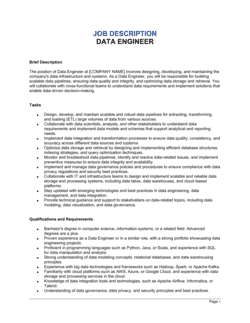
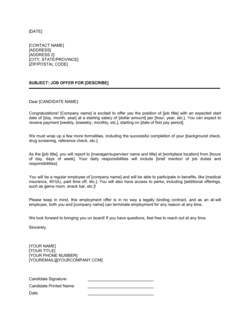
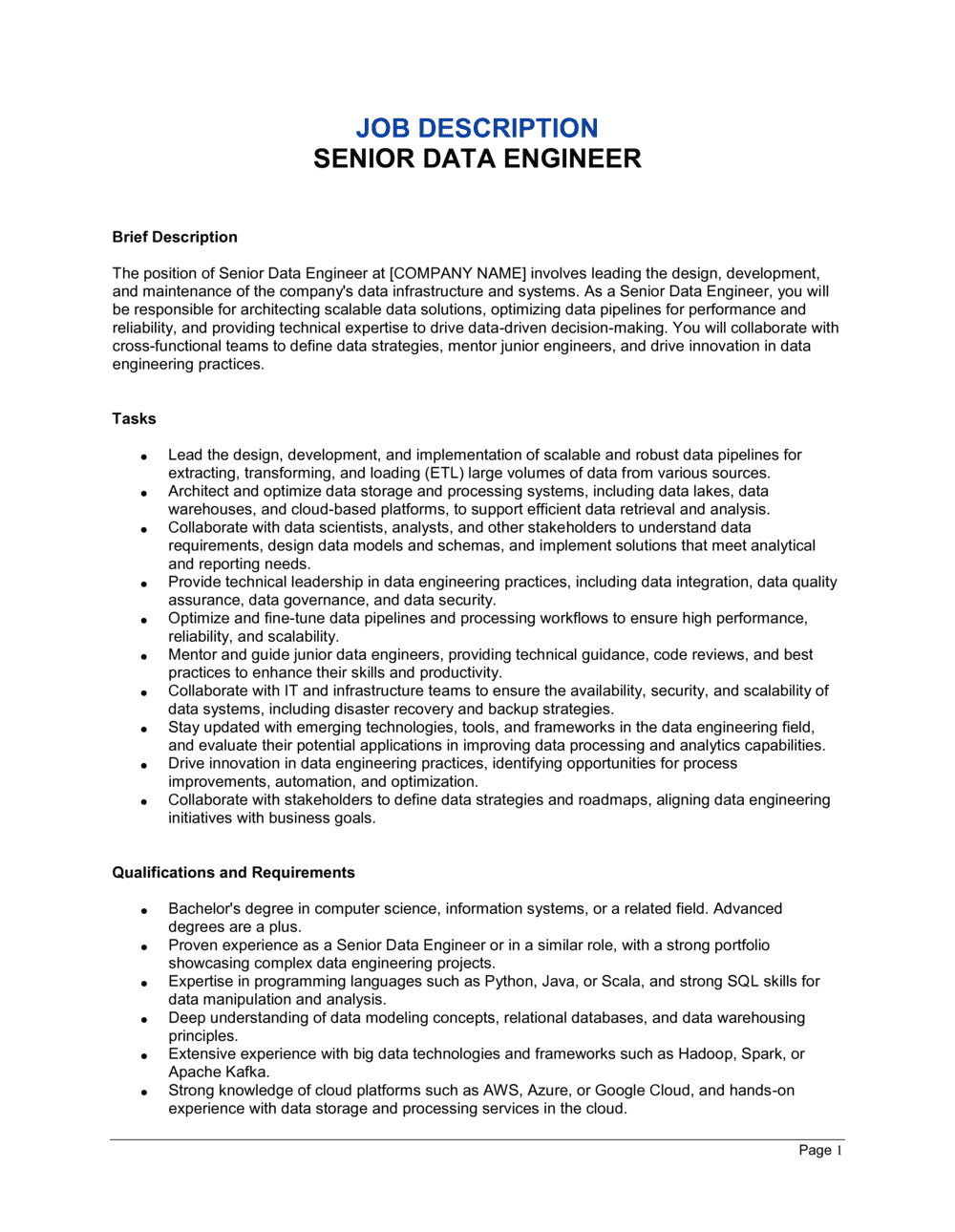
Senior Data Engineer Job Description Template

Free Word download • Edit online • Save & share with Drive • Export to PDF

2 pages25–30 min to fillDifficulty: StandardSignature requiredLegal review recommended
Learn more ↓
FreeSenior Data Engineer Job Description Template

At a glance

What it is
A Senior Data Engineer Job Description is a formal binding document that defines the scope of a senior-level data engineering role, including core duties, technical skill requirements, reporting structure, compensation range, and employment conditions. This free Word download gives you an editable, legally grounded starting point you can tailor to your organization and export as PDF for job postings, offer packages, or onboarding documentation.
When you need it
Use it when hiring a senior data engineer for a full-time, contract, or fixed-term role — whether building out a new data platform, scaling an existing pipeline team, or replacing a departing team member. It is also referenced when drafting an accompanying employment contract or when managing performance expectations post-hire.
What's inside
Role title and department, reporting structure, core responsibilities and technical duties, required and preferred qualifications, technology stack requirements, compensation range and benefits, employment type and location, and equal opportunity and compliance language.

What is a Senior Data Engineer Job Description?

A Senior Data Engineer Job Description is a formal binding document that defines the full scope of a senior-level data engineering role — including core responsibilities, required technical skills, reporting structure, compensation band, employment type, and compliance language. It functions simultaneously as a hiring document, a performance baseline, and a legal record of the employer's stated expectations at the time of hire. When incorporated by reference into an employment contract, it becomes part of the enforceable agreement governing the employment relationship.

Why You Need This Document

Without a precise, current job description, hiring for a senior data engineering role produces misaligned candidates, prolonged screening cycles, and first-year attrition when the actual role differs from what was advertised. Legally, an absent or vague job description leaves the employer with no documented basis for performance management, compensation decisions, or — critically — a termination for cause. In jurisdictions including California, Colorado, New York City, and all EU member states, publishing a job description without a salary range now carries regulatory exposure. A well-drafted senior data engineer job description closes all of these gaps in under an hour, using a template built to the exact standards that employment counsel, HR teams, and senior engineering candidates expect.

Which variant fits your situation?

If your situation is…Use this template
Hiring a data engineer at the mid-level or individual contributor levelData Engineer Job Description
Filling a leadership role overseeing a full data engineering teamData Engineering Manager Job Description
Hiring a specialist focused primarily on analytics and BI toolingData Analyst Job Description
Engaging a senior data engineer as an independent contractorIndependent Contractor Agreement
Formalizing terms beyond the job description for a full-time hireEmployment Contract
Hiring a senior engineer focused on ML model deployment and pipelinesMachine Learning Engineer Job Description
Posting the role externally and needing a condensed one-page briefJob Posting Template

Common mistakes to avoid

❌ Listing salary range as optional when jurisdiction requires it

Why it matters: Colorado, California, New York City, Washington state, and EU member states mandate salary ranges in job postings. Omitting the range creates regulatory exposure and reduces application quality.

Fix: Publish the full compensation band for every posting. Confirm local requirements before posting in each state or country, as laws are updated frequently.

❌ Over-specifying technical requirements

Why it matters: Requiring proficiency in more than ten tools simultaneously produces near-zero qualified candidate pools and signals an unrealistic hiring bar to experienced engineers.

Fix: Limit required skills to the six to eight technologies the hire will use in their first 30 days. Move everything else to preferred.

❌ Using at-will language in international job postings

Why it matters: At-will employment is a US doctrine. Including it in a posting for a role in Canada, the UK, or the EU is legally meaningless and may mislead candidates about their termination rights.

Fix: Replace at-will language with a notice-period clause that meets or exceeds the statutory minimum in the employee's work jurisdiction.

❌ Omitting the work model or using ambiguous language like 'remote-friendly'

Why it matters: Candidates interpret 'remote-friendly' as fully remote. If the role actually requires two or three days in-office weekly, the gap is a common cause of early resignation in senior technical roles.

Fix: State the work model precisely: fully remote, hybrid with specific in-office cadence, or fully on-site. For hybrid, name the office location.

❌ Skipping alignment between the job description and the employment contract

Why it matters: Contradictions between the two documents — on title, compensation, or work location — create enforceable ambiguity that courts resolve in the employee's favor in most jurisdictions.

Fix: Review both documents side by side before the offer is extended. Any discrepancy must be resolved in the contract, not papered over with a verbal understanding.

❌ Not updating the job description before reposting a backfill role

Why it matters: Reposting a two-year-old job description for a backfill hire often misrepresents the current stack, team structure, and responsibilities, attracting candidates for a role that no longer exists.

Fix: Treat every backfill as a new requisition. Spend 30 minutes reviewing and updating the tech stack, responsibilities, and compensation band before republishing.

The 10 key clauses, explained

Role title, level, and department

In plain language: States the exact job title, seniority level, and the team or business unit the role belongs to, establishing where it sits in the organizational structure.

Sample language
Role Title: Senior Data Engineer | Level: IC4 / Senior | Department: Data Platform Engineering | Reports to: [MANAGER TITLE] | Location: [CITY / REMOTE / HYBRID]

Common mistake: Using an inflated or inconsistent title that doesn't match internal leveling frameworks. Misaligned titles create comp-band disputes and complicate future promotion conversations.

Role summary and purpose

In plain language: A 2–4 sentence overview of why the role exists, what business problem it solves, and how it fits within the broader data or engineering organization.

Sample language
The Senior Data Engineer will design, build, and maintain scalable data pipelines and infrastructure for [COMPANY NAME]'s [PLATFORM NAME] data platform, enabling [TEAM / BUSINESS UNIT] to deliver reliable analytics at scale.

Common mistake: Writing a generic summary copy-pasted from a job board. Vague summaries attract misaligned candidates and undermine the document's value as a reference during performance reviews.

Core responsibilities

In plain language: An itemized list of the primary duties the employee is accountable for performing on an ongoing basis.

Sample language
Design and maintain batch and streaming data pipelines using [TECH STACK]; build and optimize data models in [WAREHOUSE]; define and enforce SLAs for data freshness and quality; mentor junior engineers; collaborate with analysts and product teams on data requirements.

Common mistake: Listing 20+ responsibilities with no prioritization. Candidates and employees cannot identify what matters most, and the list becomes unenforceable as a performance baseline.

Technical requirements and stack

In plain language: Specifies the programming languages, frameworks, platforms, and tools the candidate must be proficient in to perform the role.

Sample language
Required: Python (5+ years), SQL (advanced), Apache Spark or Flink, dbt, Airflow or Prefect, at least one cloud data warehouse (Snowflake, BigQuery, or Redshift). Preferred: Kafka, Terraform, experience with [CLOUD PROVIDER] (AWS / GCP / Azure).

Common mistake: Listing every technology the team has ever touched as required. Over-specifying narrows the candidate pool to near-zero and signals the team has not prioritized its own stack.

Required and preferred qualifications

In plain language: Distinguishes between non-negotiable minimum qualifications and preferred credentials that would make a candidate stronger but are not disqualifying if absent.

Sample language
Required: [X]+ years of data engineering experience, including [Y]+ years at senior or staff level. Bachelor's degree in Computer Science, Engineering, or equivalent experience. Preferred: experience in [INDUSTRY], prior work on a data mesh or lakehouse architecture.

Common mistake: Requiring a specific degree when the actual work requires demonstrated skill and experience. Degree requirements that do not reflect genuine job necessity may create unintended adverse-impact exposure in some jurisdictions.

Compensation, benefits, and employment type

In plain language: States the salary band, equity eligibility (if applicable), benefits summary, and whether the role is full-time, part-time, fixed-term, or contract.

Sample language
Base salary: $[MIN] – $[MAX] USD per year, commensurate with experience. Employment type: Full-Time. Eligible for annual performance bonus up to [X]% of base. Benefits: [BENEFITS SUMMARY]. Equity: [YES / NO — details in offer letter].

Common mistake: Omitting the salary range entirely. Several US states (California, Colorado, New York, Washington) and the EU now require salary ranges in job postings. Omission creates legal exposure and reduces application volume.

Reporting structure and collaboration expectations

In plain language: Identifies who the role reports to, which teams it works closely with, and any cross-functional or leadership responsibilities.

Sample language
Reports directly to [MANAGER TITLE / DATA ENGINEERING LEAD]. Works closely with the Analytics, Product, and Data Science teams. Expected to mentor [X] junior or mid-level engineers. Participates in on-call rotation: [FREQUENCY].

Common mistake: Defining a dotted-line reporting relationship without clarifying decision-making authority. Ambiguous reporting structures create conflict during performance reviews and when prioritizing competing team requests.

Work location and travel requirements

In plain language: Specifies whether the role is fully remote, hybrid, or on-site, the expected office cadence for hybrid roles, and any travel obligations.

Sample language
Work model: [Remote / Hybrid / On-site]. For hybrid roles: expected in [OFFICE LOCATION] [X] days per week. Travel: up to [X]% annually for team off-sites or client visits.

Common mistake: Stating 'remote-friendly' without defining it. Candidates interpret this phrase to mean fully remote; employers often mean hybrid. The mismatch is a leading cause of early attrition in technical hires.

Equal opportunity and compliance statement

In plain language: A legally required statement affirming the company's commitment to non-discriminatory hiring practices and compliance with applicable employment law.

Sample language
[COMPANY NAME] is an equal opportunity employer. We do not discriminate on the basis of race, color, religion, sex, national origin, age, disability, genetic information, veteran status, or any other characteristic protected by applicable law.

Common mistake: Copying a generic EEO statement without verifying it covers all protected classes in the relevant jurisdiction. Protected classes differ between the US, Canada, the UK, and the EU — a US-drafted statement may be incomplete for an international posting.

At-will or notice-period acknowledgment

In plain language: Clarifies the employment relationship type — at-will in applicable US states, or notice-based in other jurisdictions — so the job description aligns with the accompanying employment contract.

Sample language
This position is an at-will employment opportunity in [STATE]. Either party may terminate the employment relationship at any time, for any lawful reason, subject to applicable law and any separate employment agreement in effect.

Common mistake: Including at-will language in a job description posted for a role in Canada, the UK, or the EU. At-will employment has no legal standing outside the US and including it creates confusion and may expose the employer to claims of misrepresentation.

How to fill it out

  1. 1

    Define the role title and confirm the leveling framework

    Enter the exact job title as it will appear in payroll and HR systems. Confirm the seniority level (e.g., IC4 or Senior II) matches your internal leveling matrix and the corresponding compensation band.

    💡 Align the title with standard market titles on LinkedIn and Glassdoor — 'Senior Data Engineer' outperforms creative alternatives in search ranking and candidate recognition.

  2. 2

    Write a focused role summary

    Describe in two to four sentences why the role exists, what platform or product it supports, and what the new hire will build or own in their first 12 months.

    💡 Mention one specific data system the engineer will own — 'our Snowflake-based analytics warehouse' rather than 'our data platform' — to attract candidates with directly relevant experience.

  3. 3

    Prioritize core responsibilities to no more than eight

    List the eight highest-priority ongoing duties in order of time allocation. Remove anything that occurs fewer than once per quarter or that is shared equally with another role.

    💡 Starting each bullet with an action verb (design, build, maintain, mentor) makes the list scannable and easier to reference during performance reviews.

  4. 4

    Separate required from preferred technical skills

    List only the tools and languages the new hire must use in the first 30 days as required. Move everything else — advanced certifications, niche frameworks, secondary cloud platforms — to the preferred section.

    💡 Cap the required list at six to eight technologies. Requirements lists longer than ten are statistically correlated with longer time-to-fill and higher offer-decline rates.

  5. 5

    Set the compensation band and confirm local disclosure requirements

    Enter the minimum and maximum base salary for the band. Check whether the posting location requires salary disclosure — California, Colorado, New York City, Washington state, and all EU member states have active pay transparency obligations.

    💡 Publishing the salary range reduces inbound volume from misaligned candidates and cuts time-to-offer by an average of one week in high-volume engineering searches.

  6. 6

    Specify the work model precisely

    Choose remote, hybrid, or on-site. For hybrid, state the required office days per week and the specific office location. For remote, confirm whether the role is open to all US states or restricted by payroll or tax registration.

    💡 Remote roles that are restricted to certain states must say so explicitly — 'Remote (US only, excluding CA, NY)' — or you will spend screening time on ineligible candidates.

  7. 7

    Add the EEO statement and verify jurisdiction coverage

    Insert the equal opportunity employment statement and confirm it covers all protected classes required by law in every location where the role will be posted.

    💡 If posting in the EU, add a data privacy notice explaining how candidate data will be used and stored — this is required under GDPR Article 13.

  8. 8

    Review and align with the employment contract before publishing

    Cross-reference the job description against the employment contract or offer letter to ensure compensation, title, reporting structure, and employment type are consistent across both documents.

    💡 Inconsistencies between the job description and the employment contract — especially on at-will language, bonus eligibility, or work location — are a leading cause of first-year employment disputes.

Frequently asked questions

What does a senior data engineer do?

A senior data engineer designs, builds, and maintains the data pipelines, warehouses, and infrastructure that move data from source systems to analytics and product teams. At the senior level, the role typically involves owning entire pipeline domains, defining data quality SLAs, mentoring junior engineers, and collaborating closely with data scientists and analysts. Most senior data engineers work extensively with Python, SQL, a cloud data warehouse such as Snowflake or BigQuery, and an orchestration tool such as Airflow.

What is the difference between a senior data engineer and a data engineer?

A data engineer primarily executes defined pipeline and infrastructure tasks under direction. A senior data engineer is expected to scope and own projects end-to-end, make independent architectural decisions, set quality standards for the team, and mentor more junior colleagues. The compensation band for a senior data engineer in the US typically runs $150,000–$220,000 base salary, compared to $110,000–$160,000 for a mid-level data engineer, depending on location and stack.

Is a job description a legally binding document?

A job description is generally considered a binding document when it is incorporated by reference into an employment contract or offer letter. On its own, a job description creates enforceable expectations around duties and qualifications in many jurisdictions. Courts have used job descriptions to assess whether a termination was justified, whether a role was misrepresented during hiring, and whether a compensation claim is valid. Using an accurate, current job description protects both parties.

What technical skills should a senior data engineer job description require?

At minimum, a senior data engineer job description should require advanced Python and SQL, hands-on experience with at least one cloud data warehouse (Snowflake, BigQuery, or Redshift), proficiency with an orchestration tool such as Airflow or Prefect, and experience with a transformation framework like dbt. Streaming experience (Kafka, Flink, or Spark Streaming) is increasingly a required skill rather than a preferred one for roles at companies with real-time data needs.

Do I need to include a salary range in a data engineer job posting?

In an increasing number of jurisdictions, yes. Colorado's EPEWA, California's SB 1162, New York City Local Law 32, and Washington state's pay transparency law all require salary ranges in job postings. All EU member states are in the process of implementing the EU Pay Transparency Directive, which requires disclosure before or at the first interview stage. Even where not legally required, publishing the range reduces screening time and attracts better-fit candidates.

Should the job description specify remote, hybrid, or on-site?

Yes — and precisely. Vague language like 'flexible' or 'remote-friendly' is the single most common source of early attrition in senior engineering hires. State the model explicitly. For hybrid roles, name the office location and the required in-office days per week. For remote roles, specify whether the position is open to all states and countries or is restricted by payroll or tax registration.

How does a job description differ from an employment contract?

A job description defines the scope, duties, qualifications, and expectations of a role — it is used in hiring, performance management, and compensation reviews. An employment contract is the binding legal agreement that governs the employment relationship, covering termination, IP assignment, confidentiality, non-compete, and severance. The job description is typically incorporated by reference into the employment contract via a Schedule A. Both documents should be consistent with each other before the offer is signed.

What equal opportunity language is required in a senior data engineer job description?

In the US, federal contractors must include specific OFCCP-compliant EEO language; non-contractors should include a statement covering all classes protected under Title VII, the ADA, the ADEA, and applicable state law. In Canada, federal employers must address protected grounds under the Canadian Human Rights Act. In the UK, the Equality Act 2010 defines nine protected characteristics. In the EU, the Equal Treatment Directive applies. A job description posted in multiple jurisdictions should use the most comprehensive language available and be reviewed by local counsel.

How often should a senior data engineer job description be updated?

Review it before every new hire, including backfills. Data engineering stacks evolve quickly — a job description written in 2022 that still requires Hadoop on-premises or lists Hive as a required skill is likely to attract candidates whose experience does not match the current team. A full review of tech requirements, compensation band, and work model every 12 months is a reasonable minimum for active hiring organizations.

How this compares to alternatives

vs Employment Contract

A job description defines the role's scope, duties, and qualifications. An employment contract is the binding legal agreement governing the entire employment relationship — including IP, confidentiality, non-compete, termination, and severance. The job description is typically attached as Schedule A to the employment contract. Both documents must be consistent; discrepancies between them are resolved by courts in favor of the employee in most jurisdictions.

vs Job Offer Letter

A job offer letter confirms a specific candidate's acceptance of a role and summarizes compensation, start date, and key terms. A job description defines the role itself — independent of any specific candidate — and is used across all hiring rounds for that position. The offer letter references the job description but does not replace it as a standalone document.

vs Independent Contractor Agreement

An independent contractor agreement engages a self-employed data engineer for project-based work without employment entitlements. A senior data engineer job description governs a traditional employment relationship with benefits, tax withholding, and IP assignment. Misclassifying an employee as a contractor based on the nature of the work described in the job description can trigger significant back-tax and benefit liability.

vs Performance Review Template

A performance review evaluates an employee's actual output against expectations over a defined period. A job description establishes those expectations in the first place. An accurate, current job description is the foundational input to any fair performance review process — evaluating an employee against duties that have since changed without updating the job description is a common source of employment disputes.

Industry-specific considerations

SaaS / Technology

Roles typically center on event-stream pipelines, product analytics infrastructure, and multi-tenant data isolation — Kafka, dbt, and Snowflake or BigQuery are near-universal stack requirements.

Financial Services

Data governance, lineage, and SOC 2 / PCI-DSS compliance obligations are embedded in the role requirements; real-time risk and fraud data pipelines require streaming engineering experience.

Healthcare / MedTech

HIPAA data handling requirements and HL7/FHIR standards must be reflected in the technical qualifications; PHI pipeline design requires documented access controls and audit logging.

Retail / E-commerce

High-volume transaction and clickstream pipeline engineering, inventory and demand-forecasting data models, and real-time personalization infrastructure are the dominant focus areas.

Manufacturing

IoT sensor data ingestion, OT/IT integration pipelines, and predictive maintenance data infrastructure distinguish manufacturing data engineering roles from pure software-stack positions.

Media and Entertainment

Audience segmentation pipelines, content recommendation data infrastructure, and large-scale ad-tech attribution models require experience with high-throughput streaming and petabyte-scale storage.

Jurisdictional notes

United States

Pay transparency laws in Colorado, California, New York City, and Washington state require salary ranges in job postings. Federal contractors must include OFCCP-compliant EEO and affirmative action language. At-will employment clauses are enforceable in 49 states; Montana requires cause after a probationary period. Non-compete restrictions in job descriptions must comply with state-level enforceability — California bans most post-employment non-competes entirely.

Canada

At-will employment does not exist in Canada — job descriptions referencing at-will termination have no legal effect. Provincial human rights codes define protected grounds that vary slightly by province; job descriptions must avoid language that could be seen as discriminatory under these codes. In Quebec, job postings for roles where the primary work language is French must be in French under the Charter of the French Language.

United Kingdom

The Equality Act 2010 defines nine protected characteristics; job descriptions must not directly or indirectly discriminate on these grounds. IR35 rules apply when engaging data engineers through personal service companies — job descriptions should clearly distinguish employee from contractor engagements. Salary range disclosure is not yet legally mandated for all UK employers, but is emerging as a best practice under incoming pay equity regulations.

European Union

The EU Pay Transparency Directive (2023/970) requires employers to disclose salary ranges to candidates before or at the first interview stage, with full implementation expected across member states by 2026. GDPR Article 13 requires candidates to be informed how their personal data will be used during the recruitment process — a privacy notice should accompany any job description used in an EU hiring process. Protected characteristics and equal treatment obligations are set by the Equal Treatment Directive and vary in scope by member state.

Template vs lawyer — what fits your deal?

PathBest forCostTime
Use the templateStandard full-time domestic hires for individual contributor senior data engineering rolesFree30–60 minutes
Template + legal reviewCross-border postings, roles with equity or bonus components, or postings in states with active pay transparency or EEO enforcement$200–$500 for an HR or employment counsel review1–3 days
Custom draftedExecutive or staff-level roles with sensitive IP obligations, multi-jurisdiction postings, or heavily regulated industries such as healthcare or financial services$800–$2,500+1–2 weeks

Glossary

Data Pipeline
An automated sequence of processes that moves, transforms, and loads data from source systems to a destination such as a data warehouse or data lake.
ETL / ELT
Extract, Transform, Load (ETL) and Extract, Load, Transform (ELT) — two approaches to ingesting raw data and preparing it for analysis.
Data Warehouse
A centralized repository that stores structured, processed data optimized for querying and reporting, such as Snowflake, BigQuery, or Redshift.
Data Lake
A storage system that holds large volumes of raw, unstructured, or semi-structured data until it is needed for processing or analysis.
Orchestration
The scheduling and coordination of data pipeline tasks and dependencies, commonly managed using tools like Apache Airflow or Prefect.
Data Modeling
The practice of designing how data is structured, related, and stored within a database or warehouse to support efficient querying and reporting.
Streaming Data
Continuous, real-time data flows processed as they arrive rather than in scheduled batch jobs — commonly handled using Kafka, Flink, or Spark Streaming.
IC (Individual Contributor)
An employee who delivers technical work directly without managing other staff — most senior data engineers are ICs unless the role explicitly includes people management.
Data Governance
The policies, standards, and processes that ensure data quality, security, lineage, and compliance across an organization's data assets.
SLA (Service Level Agreement)
A defined standard for pipeline reliability or data freshness that the data engineering team commits to delivering — for example, daily pipeline completion by 6:00 AM.
Compensation Band
The minimum-to-maximum salary range established for a role level, used to ensure consistent pay equity across equivalent positions.

Part of your Business Operating System

This document is one of 3,000+ business & legal templates included in Business in a Box.

  • Fill-in-the-blanks — ready in minutes
  • 100% customizable Word document
  • Compatible with all office suites
  • Export to PDF and share electronically

Create your document in 3 simple steps.

From template to signed document — all inside one Business Operating System.
1
Download or open template

Access over 3,000+ business and legal templates for any business task, project or initiative.

2
Edit and fill in the blanks with AI

Customize your ready-made business document template and save it in the cloud.

3
Save, Share, Send, Sign

Share your files and folders with your team. Create a space of seamless collaboration.

Save time, save money, and create top-quality documents.

★★★★★

"Fantastic value! I'm not sure how I'd do without it. It's worth its weight in gold and paid back for itself many times."

Managing Director · Mall Farm
Robert Whalley
Managing Director, Mall Farm Proprietary Limited
★★★★★

"I have been using Business in a Box for years. It has been the most useful source of templates I have encountered. I recommend it to anyone."

Business Owner · 4+ years
Dr Michael John Freestone
Business Owner
★★★★★

"It has been a life saver so many times I have lost count. Business in a Box has saved me so much time and as you know, time is money."

Owner · Upstate Web
David G. Moore Jr.
Owner, Upstate Web

Run your business with a system — not scattered tools

Stop downloading documents. Start operating with clarity. Business in a Box gives you the Business Operating System used by over 250,000 companies worldwide to structure, run, and grow their business.

Free Forever Plan · No credit card required