Daily Cash Sheet Template

Free Excel download β€’ Edit online β€’ Save & share with Drive β€’ Export to PDF

1 pageβ€’20–25 min to fillβ€’Difficulty: Standard
Learn more ↓
FreeXLSDaily Cash Sheet Template

At a glance

What it is
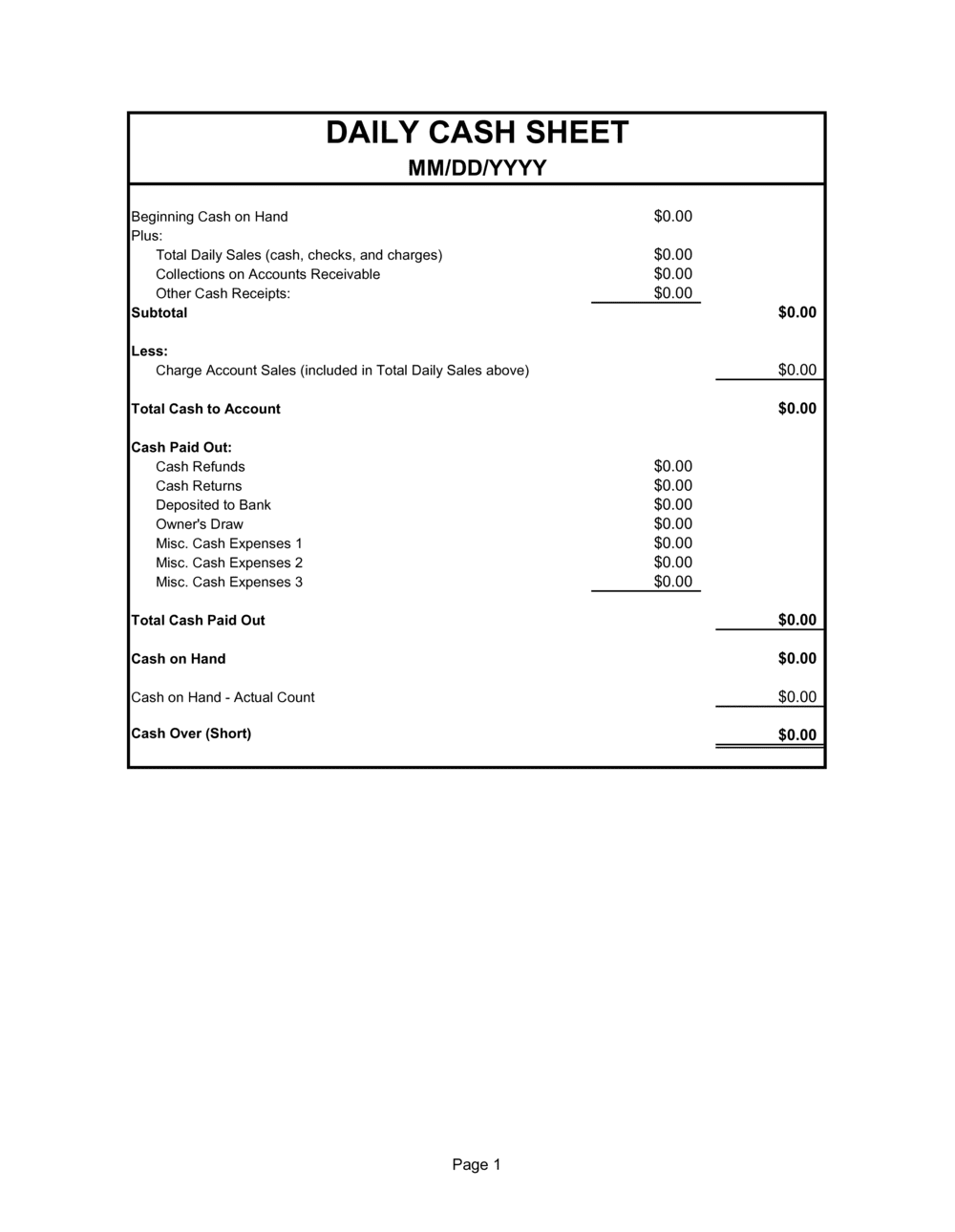
A Daily Cash Sheet is a structured reconciliation form used by retail stores, restaurants, and hospitality businesses to record every cash movement in a single shift or business day. This free Word download walks staff through opening balance, sales by tender type, refunds, payouts, and closing cash β€” producing a variance figure that confirms whether the drawer balances to the cent.
When you need it
Complete it at the end of every shift or business day whenever a cash drawer is in use. It is also required when preparing a bank deposit, reconciling point-of-sale totals against physical cash, or investigating a discrepancy flagged by a manager or auditor.
What's inside
Date and shift details, opening cash float, cash and card sales breakdown, refunds and voids, paid-out amounts, physical cash count by denomination, expected closing balance, actual closing balance, and variance with a supervisor sign-off line.

What is a Daily Cash Sheet?

A Daily Cash Sheet is a structured reconciliation form completed at the end of each shift or business day to verify that the physical cash in a register drawer matches the amount calculated from sales, refunds, and paid-outs. It records the opening float, all cash and non-cash sales by tender type, refunds, voids, paid-out amounts, a denomination-by-denomination count of the closing drawer, and the resulting over or short variance. Businesses in retail, food and beverage, and hospitality use it as the primary internal control tool for cash handling β€” and as the source document for preparing daily bank deposits and maintaining an auditable cash record.

Why You Need This Document

Without a completed daily cash sheet, a single shift's cash shortage is undetectable until it appears as an unexplained discrepancy in your monthly bank reconciliation β€” weeks after the fact and with no way to assign responsibility. Regular completion creates a documented chain of custody for every dollar that passes through the drawer, deters theft and careless handling, and gives managers a same-day signal when something is wrong. Tax authorities and external auditors expect to see daily cash records that tie to POS reports and bank deposits; missing or inconsistent records invite scrutiny and can trigger penalties. This template gives any business with a cash drawer a ready-to-use form that enforces the right process every shift β€” no accounting background required.

Which variant fits your situation?

If your situation is…Use this template
Tracking cash across multiple drawers or registers in one locationMulti-Register Cash Reconciliation Form
Recording petty cash withdrawals and reimbursements onlyPetty Cash Log
Preparing a formal record of money deposited at the bankBank Deposit Slip
Summarizing weekly cash flow across multiple daily sheetsWeekly Cash Flow Report
Tracking all business income and expenses in a single ledgerIncome and Expense Tracker
Documenting end-of-month cash position for financial reportingMonthly Cash Flow Statement

Common mistakes to avoid

❌ Skipping the opening float verification

Why it matters: An unverified float means any error introduced before the first sale appears as a shift variance β€” misdirecting investigation toward the cashier rather than the float preparation.

Fix: Require a manager to independently count and sign off on the opening float before the drawer is unlocked at the start of every shift.

❌ Entering sales from memory instead of the POS report

Why it matters: Manual estimates introduce rounding errors that produce false variances, wasting investigation time and eroding trust in the reconciliation process.

Fix: Always run and attach the POS shift or Z-report before completing any sales line on the cash sheet.

❌ Recording paid-outs without receipts

Why it matters: Unsupported paid-outs are indistinguishable from cash shortages and are one of the most exploited gaps in cash-control procedures.

Fix: Require a physical receipt and a manager's signature for every paid-out, regardless of the amount. A $4 paid-out with no receipt is as problematic as a $40 one.

❌ Accepting small variances without recording them

Why it matters: A $2–$3 nightly shortage seems trivial in isolation but can represent $500–$900 annually per register β€” and often signals a pattern of skimming that grows over time.

Fix: Record every variance, no matter the size. Review the over/short log monthly by cashier to identify patterns before they become material losses.

The 10 key fields, explained

Date, shift, and cashier details

Opening cash float

Cash sales

Non-cash sales by tender type

Refunds and voids

Paid-out amounts

Physical denomination count

Expected vs. actual closing balance and variance

Bank deposit and next-day float

Supervisor sign-off

How to fill it out

  1. 1

    Complete the header at the start of the shift

    Enter the business date, shift designation, cashier name, and register number before the drawer is opened. Have a manager count and confirm the opening float and sign the verification line.

    πŸ’‘ Set the opening float to a fixed round amount β€” $100, $150, or $200 β€” so any deviation is immediately obvious before the first transaction.

  2. 2

    Pull cash and tender totals from the POS at shift end

    Run the shift or Z-report from your POS system and transfer the cash sales total and each non-cash tender type directly to the corresponding lines on the sheet.

    πŸ’‘ Never manually total receipts β€” the POS report is the authoritative figure. Discrepancies between the POS and the drawer are the variance you are trying to find.

  3. 3

    Record all refunds and paid-outs with supporting documents

    Enter cash refunds and voids from the POS void report, and list each paid-out individually with the vendor name, purpose, amount, and whether a receipt is attached.

    πŸ’‘ Staple all paid-out receipts directly to the completed sheet before filing. Loose receipts disappear and create unexplainable variances during monthly audits.

  4. 4

    Count the drawer by denomination

    Remove the opening float from the drawer first, then count the remaining cash bill by bill and coin by coin. Enter each denomination count and calculate the total.

    πŸ’‘ Count the drawer twice independently β€” or have a second person verify β€” before recording the actual closing balance. A recount takes two minutes and eliminates the most common source of false variances.

  5. 5

    Calculate the expected balance and variance

    Add the opening float to cash sales, then subtract refunds and paid-outs to get the expected closing balance. Subtract the actual closing balance to determine the over/short amount.

    πŸ’‘ A variance over $10 in either direction should trigger an immediate recount before the drawer is closed and the cashier leaves the premises.

  6. 6

    Prepare the bank deposit and retain the next-day float

    Set aside the fixed opening float for the next shift, then count and band the remaining cash for the bank deposit. Record both amounts on the sheet before sealing the deposit bag.

    πŸ’‘ Have the supervisor β€” not the cashier who completed the shift β€” prepare or witness the deposit. Segregating these duties is the single most effective cash-control procedure.

  7. 7

    Obtain supervisor sign-off and file the completed sheet

    The supervisor independently verifies the variance, signs and dates the sheet, and notes any action taken. File the completed sheet with attached receipts in date order for at least 12 months.

    πŸ’‘ Scan or photograph the completed sheet before filing the paper copy. A digital backup makes it searchable when a discrepancy surfaces weeks later.

Frequently asked questions

What is a daily cash sheet?

A daily cash sheet is a reconciliation form completed at the end of a shift or business day to verify that the physical cash in a drawer matches the expected balance calculated from sales, refunds, and paid-outs. It is the primary internal control document for any business that accepts cash payments and is the starting point for preparing bank deposits and investigating variances.

Who should complete a daily cash sheet?

The cashier responsible for the drawer completes the form, and a shift supervisor independently verifies and signs it. Separating these two duties is critical β€” the person who handled the cash should not be the only person who counts it. In small businesses where the owner acts as both, a second count at a different time provides a basic check.

How often should a cash sheet be completed?

One sheet per drawer per shift is the standard practice in retail and hospitality. Businesses with a single shift complete one sheet per day. Multi-shift operations complete a sheet at every shift change so responsibility for any variance is clearly assigned to a specific cashier and period.

What is an acceptable cash variance?

Many businesses set a tolerance of $5 per shift for investigation β€” but no variance should go unrecorded. Variances between $5 and $20 typically warrant a recount and a note. Variances above $20 should trigger a full review of the shift's transactions. Any consistent pattern β€” even $1–$2 per night from the same cashier β€” is worth investigating regardless of the dollar amount.

How long should completed daily cash sheets be kept?

Retain completed cash sheets for a minimum of 12 months to support bank reconciliations, tax filing, and any internal or external audit. Businesses subject to sales tax audits may need records going back 3–7 years depending on jurisdiction. Scanning and storing digital copies is advisable in addition to keeping the original paper document.

What is the difference between a daily cash sheet and a petty cash log?

A daily cash sheet reconciles the entire register drawer β€” opening float, all sales by tender, refunds, paid-outs, and closing balance β€” for a full shift. A petty cash log records only small discretionary cash withdrawals from a separate petty cash fund used for minor office or operational expenses. The two documents track different cash pools and should be maintained independently.

Can a daily cash sheet be used without a POS system?

Yes. Without a POS system, cash sales are totaled from paper receipts or a manual tally, and the same reconciliation logic applies: opening float plus cash received minus cash paid out equals the expected closing balance. The process is more time-consuming and more prone to arithmetic error, but the form structure is identical.

Does a daily cash sheet replace a bank reconciliation?

No. A daily cash sheet confirms the drawer balances at shift end. A bank reconciliation compares your accounting records to the bank statement and accounts for timing differences like deposits in transit and outstanding checks. The daily cash sheet feeds into the bank reconciliation by confirming the deposit amount recorded each day, but the two documents serve different purposes.

How this compares to alternatives

vs Petty Cash Log

A petty cash log tracks small discretionary withdrawals from a dedicated petty cash fund β€” typically $50–$500 kept in an office for minor expenses. A daily cash sheet reconciles the full register drawer including all sales, refunds, and payouts for a shift. They track separate cash pools and are both needed in businesses that use a register and maintain a petty cash fund.

vs Cash Flow Statement

A cash flow statement is a formal accounting document summarizing all cash inflows and outflows across operating, investing, and financing activities for a period β€” typically monthly or quarterly. A daily cash sheet is an operational form completed at the end of each shift to verify a single drawer's balance. Daily cash sheets feed into bookkeeping entries that ultimately roll up into the cash flow statement.

vs Income and Expense Worksheet

An income and expense worksheet tracks all revenue and costs across the business over a period for financial reporting or tax purposes. A daily cash sheet focuses specifically on physical cash control at the register level β€” it does not capture non-cash income or operating expenses beyond the shift's paid-outs. Both are useful but address entirely different management needs.

vs Bank Deposit Slip

A bank deposit slip is the form submitted to the bank when making a deposit β€” it records the deposit amount and denomination breakdown for the bank's records. A daily cash sheet is an internal document that calculates what the deposit should be and reconciles the drawer before the deposit is prepared. The cash sheet determines the deposit amount; the deposit slip records it with the bank.

Industry-specific considerations

Retail

Multiple register reconciliations per day, high transaction volume requiring fast denomination counts, and gift card tender tracking alongside cash and card.

Food and Beverage

Server cash drops at shift end, tip adjustment tracking, and split-tender transactions make end-of-day reconciliation more complex than single-register retail.

Hospitality

Front-desk cash handling for incidental deposits, room-charge adjustments, and foreign currency exchanges that require separate denomination tracking.

Professional Services

Lower cash volume but still requires a formal record when co-pays, consultation fees, or event admissions are collected in person.

Template vs pro β€” what fits your needs?

PathBest forCostTime
Use the templateAny retail, restaurant, or hospitality business needing a ready-to-print cash reconciliation formFree5–10 minutes to complete per shift
Template + professional reviewBusinesses customizing the form for multiple drawers, additional tender types, or integration with a specific POS report format$50–$150 (bookkeeper or operations consultant)1–2 hours
Custom draftedMulti-location operations needing a standardized form embedded in a broader cash-control policy and staff training program$300–$800 (operations consultant or fractional CFO)1–3 days

Glossary

Opening Float
The amount of cash placed in the drawer at the start of a shift to make change β€” typically a fixed, pre-set amount such as $200.
Tender Type
The method of payment accepted β€” cash, credit card, debit card, gift card, or mobile payment β€” tracked separately for reconciliation.
Paid Out
Cash removed from the drawer during the shift for a legitimate business purpose, such as paying a delivery driver or purchasing small supplies.
Refund / Void
A transaction that returns money to a customer β€” a refund is posted after a sale is complete; a void cancels the sale before it is finalized.
Expected Closing Balance
The calculated amount that should be in the drawer: opening float plus cash sales minus refunds minus paid-outs.
Actual Closing Balance
The physical count of all bills and coins in the drawer at the end of the shift, counted denomination by denomination.
Variance
The difference between the expected closing balance and the actual closing balance β€” a positive variance means more cash than expected; negative means a shortage.
Denomination Count
A breakdown of physical cash by bill and coin type (e.g., 10 Γ— $20, 15 Γ— $10) used to verify the actual closing balance.
Bank Deposit
The portion of the closing cash sent to the bank, typically the total closing cash minus the next day's opening float.
Over/Short Report
A running record of daily variances by drawer or cashier, used to identify patterns of error or theft over time.

Part of your Business Operating System

This document is one of 3,000+ business & legal templates included in Business in a Box.

  • Fill-in-the-blanks β€” ready in minutes
  • 100% customizable Word document
  • Compatible with all office suites
  • Export to PDF and share electronically

Create your document in 3 simple steps.

From template to signed document β€” all inside one Business Operating System.
1
Download or open template

Access over 3,000+ business and legal templates for any business task, project or initiative.

2
Edit and fill in the blanks with AI

Customize your ready-made business document template and save it in the cloud.

3
Save, Share, Send, Sign

Share your files and folders with your team. Create a space of seamless collaboration.

Save time, save money, and create top-quality documents.

β˜…β˜…β˜…β˜…β˜…

"Fantastic value! I'm not sure how I'd do without it. It's worth its weight in gold and paid back for itself many times."

Managing Director Β· Mall Farm
Robert Whalley
Managing Director, Mall Farm Proprietary Limited
β˜…β˜…β˜…β˜…β˜…

"I have been using Business in a Box for years. It has been the most useful source of templates I have encountered. I recommend it to anyone."

Business Owner Β· 4+ years
Dr Michael John Freestone
Business Owner
β˜…β˜…β˜…β˜…β˜…

"It has been a life saver so many times I have lost count. Business in a Box has saved me so much time and as you know, time is money."

Owner Β· Upstate Web
David G. Moore Jr.
Owner, Upstate Web

Run your business with a system β€” not scattered tools

Stop downloading documents. Start operating with clarity. Business in a Box gives you the Business Operating System used by over 250,000 companies worldwide to structure, run, and grow their business.

Free Forever PlanΒ Β·Β No credit card required