Cash Management Policy Template

Free Word download β€’ Edit online β€’ Save & share with Drive β€’ Export to PDF

3 pagesβ€’20–30 min to fillβ€’Difficulty: Standard
Learn more ↓
FreeCash Management Policy Template

At a glance

What it is
A Cash Management Policy is an internal governance document that defines how an organization receives, holds, disburses, and reconciles cash and cash equivalents. This free Word download gives you a structured, board-ready starting point you can edit online and export as PDF to distribute to finance staff, auditors, or lenders.
When you need it
Use it when establishing financial controls for a new business, when an audit or lender review exposes gaps in existing procedures, or when scaling past the point where informal cash handling is sufficient. It is also required by many grant funders and nonprofit boards as a condition of financial oversight.
What's inside
Purpose and scope, authorized signatories and approval thresholds, bank account management rules, cash receipts and disbursements procedures, petty cash controls, investment of idle cash, bank reconciliation requirements, fraud prevention and segregation of duties, and policy review cadence.

What is a Cash Management Policy?

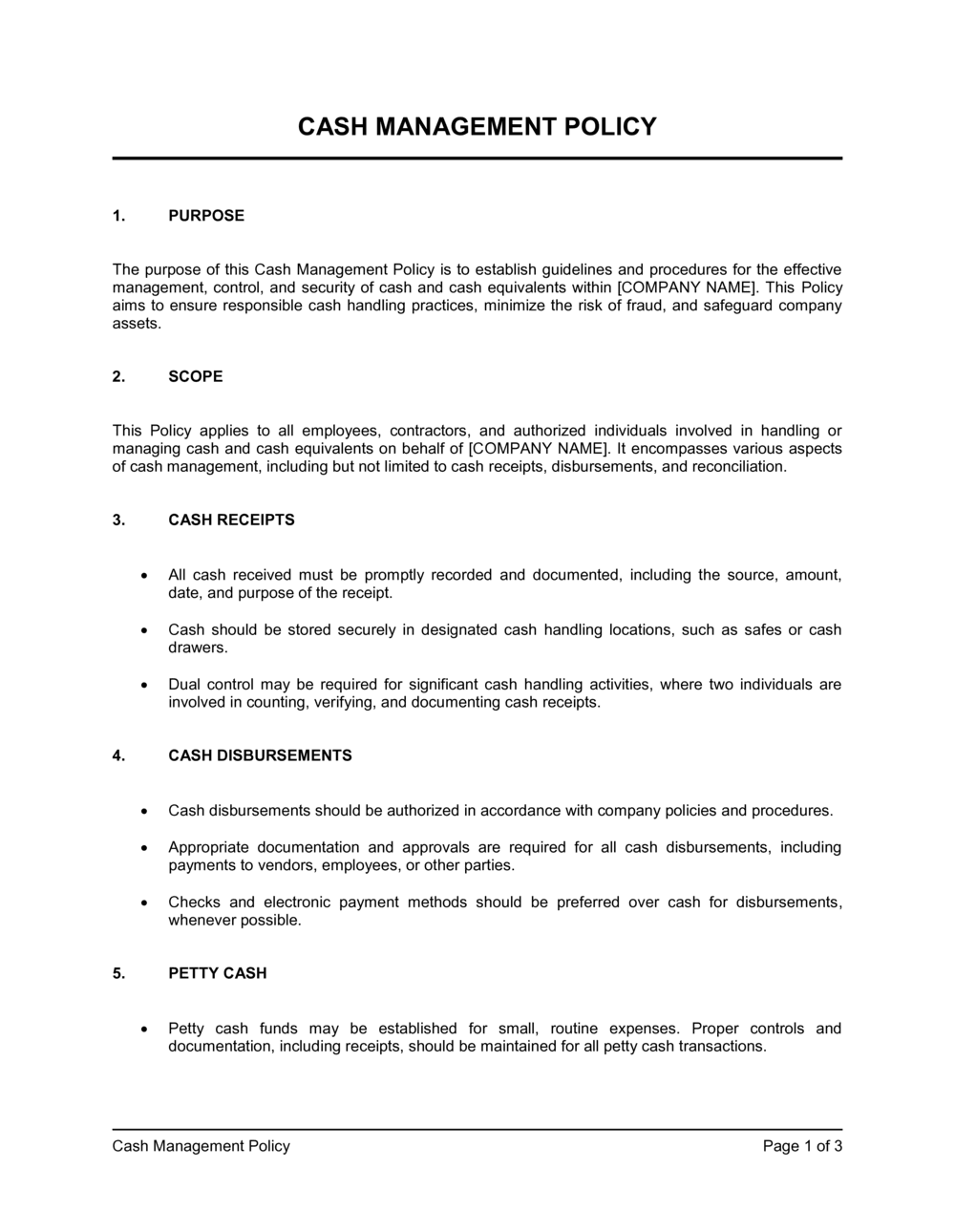
A Cash Management Policy is an internal governance document that defines how an organization receives, holds, disburses, and reconciles cash and cash equivalents. It establishes who may authorize payments and at what dollar thresholds, how bank accounts are opened and managed, what controls govern petty cash and wire transfers, and how monthly bank reconciliations are prepared and independently reviewed. Rather than leaving these decisions to informal habit or individual judgment, the policy creates a written standard that every member of the finance team β€” and every auditor, lender, or board member who reviews your financials β€” can refer to as the authoritative source of your cash controls.

Why You Need This Document

Operating without a written cash management policy means your financial controls exist only in the institutional memory of whoever currently handles the books β€” and disappear when that person leaves, gets sick, or makes an unchecked error. The practical consequences are concrete: lenders and grant funders routinely require a documented policy before approving credit facilities or disbursements; external auditors flag the absence of one as a material control weakness; and the most common vector for occupational fraud β€” a single employee controlling an entire cash cycle without oversight β€” only becomes visible after the loss has already occurred. A well-structured policy closes the four most common gaps simultaneously: it segregates duties so no one person can both initiate and record a transaction, sets specific approval thresholds that eliminate judgment calls under time pressure, mandates independent reconciliation that catches errors within days, and documents a review cadence that keeps controls current as your organization grows.

Which variant fits your situation?

If your situation is…Use this template
Setting broad corporate treasury rules including investments and debtTreasury Management Policy
Documenting day-to-day cash receipts for a retail or hospitality businessCash Handling Procedures Manual
Establishing petty cash controls as a standalone documentPetty Cash Policy
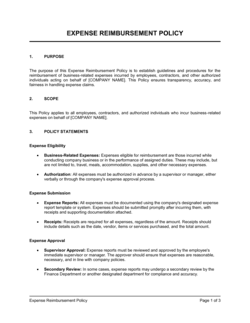
Outlining expense reimbursement rules for employeesEmployee Expense Reimbursement Policy
Documenting financial controls for a nonprofit organizationNonprofit Financial Controls Policy
Creating a broader internal financial governance frameworkFinancial Management Policy
Preparing a short-term cash flow forecast alongside the policyCash Flow Forecast

Common mistakes to avoid

❌ No segregation of duties between receipt and deposit

Why it matters: When one person opens mail, logs receipts, and makes deposits, theft can go undetected indefinitely. This is the most common mechanism for occupational fraud in small finance teams.

Fix: Assign at least two distinct roles to the cash receipts process β€” one to log and endorse, a separate person to deposit and reconcile.

❌ Approval thresholds stated in vague language

Why it matters: Terms like 'large payments' or 'significant disbursements' are interpreted differently by every employee, creating inconsistent controls that auditors will flag as ineffective.

Fix: Replace all qualitative threshold language with specific dollar amounts tied to each role and transaction type.

❌ No formal process for revoking bank access after staff departures

Why it matters: A former employee retaining online banking access is a direct fraud vector. Incidents typically surface weeks or months after the separation, when the damage is already done.

Fix: Add a mandatory step to the offboarding checklist: revoke all banking credentials within 24 hours of an employee's last day, confirmed in writing by the CFO.

❌ Policy approved once and never reviewed

Why it matters: A policy written for a 5-person team with one bank account is inadequate for a 50-person organization with 8 accounts and an ACH program β€” but it often remains the governing document by default.

Fix: Set a formal annual review with a named owner. Include a trigger-event clause requiring an off-cycle review when banking relationships, staffing, or transaction volumes change materially.

❌ Petty cash fund ceiling set too high

Why it matters: A $2,000 petty cash fund effectively bypasses the formal disbursement process for a large share of transactions, eliminating documentation and authorization controls for those payments.

Fix: Cap petty cash at an amount that genuinely covers only minor incidental expenses β€” typically $250–$500 β€” and require all larger purchases to go through the standard approval process.

❌ Bank reconciliation prepared and reviewed by the same person

Why it matters: Self-reviewed reconciliations cannot detect intentional manipulation. Errors and misappropriations stay hidden until an external audit surfaces them, often 12–18 months later.

Fix: Formally assign reconciliation preparation and review to two different roles, document the requirement in the policy, and verify compliance during the annual policy review.

The 10 key sections, explained

Purpose and scope

Roles, responsibilities, and approval thresholds

Bank account management

Cash receipts procedures

Cash disbursements and payment authorization

Petty cash controls

Investment of idle cash

Bank reconciliation and reporting

Fraud prevention and internal controls

Policy review and amendment

How to fill it out

  1. 1

    Define the scope and covered entities

    Name every legal entity, location, and fund type the policy governs. If the organization has subsidiaries or multiple bank accounts, list them in Schedule A rather than the policy body.

    πŸ’‘ A narrow, specific scope is easier to enforce than a broad one β€” add entities by amendment rather than making the initial scope aspirational.

  2. 2

    Map roles to cash functions and set approval thresholds

    List each position involved in receiving, approving, recording, or reconciling cash. Set the dollar limit each role may authorize and identify the backup approver for each primary role.

    πŸ’‘ Express thresholds as absolute dollar amounts β€” '$5,000' not 'significant amounts' β€” so there is no room for interpretation in a time-pressured payment situation.

  3. 3

    Document bank account opening and access rules

    Specify which roles may open or close accounts, which institution types are approved, and the required process for granting and revoking online banking credentials.

    πŸ’‘ Add a calendar reminder to audit bank user access quarterly β€” most organizations discover former employees still have access only after an incident.

  4. 4

    Write the cash receipts and disbursements procedures

    Describe each step in the payment cycle from receipt to deposit and from invoice approval to payment issuance. Assign a specific role to each step and confirm no single person controls more than one consecutive step.

    πŸ’‘ Walk through your last ten transactions against the drafted procedures before finalizing β€” gaps appear immediately when you test against real examples.

  5. 5

    Set petty cash parameters

    Choose a fund ceiling appropriate to typical minor expenses, define acceptable and prohibited uses, and designate a custodian who is not the same person who approves reimbursements.

    πŸ’‘ Most businesses find a $250–$500 petty cash ceiling sufficient. Higher limits push expenses outside normal controls without a meaningful efficiency benefit.

  6. 6

    Specify the bank reconciliation process

    Set the completion deadline (typically within 10 business days of month-end), name the preparer role and the independent reviewer role, and define the escalation threshold for unresolved variances.

    πŸ’‘ The reviewer must not be the same person who prepared the reconciliation β€” this single rule prevents the majority of undetected bookkeeping errors.

  7. 7

    Obtain approval and distribute to finance staff

    Submit the completed policy to the CFO, Finance Committee, or Board for formal approval. Document the approval date and version number, then distribute to all finance staff with a sign-off acknowledgment.

    πŸ’‘ Store the approved policy in your finance shared drive with version control β€” 'v1.0 β€” Approved 2026-05-02' β€” so you can track what was in force during any given period.

  8. 8

    Schedule the annual review

    Put a recurring annual review on the CFO's calendar before the policy is published. Note any trigger events β€” new bank relationships, staff changes, audit findings β€” that would require an off-cycle review.

    πŸ’‘ Tie the review to the start of your fiscal year so updated thresholds are in place before the new budget period begins.

Frequently asked questions

What is a cash management policy?

A cash management policy is an internal governance document that defines how an organization receives, holds, disburses, and reconciles cash and cash equivalents. It sets approval thresholds, assigns roles to specific cash functions, establishes segregation-of-duties requirements, and documents the bank reconciliation process. It is used by finance teams, auditors, lenders, and boards to confirm that adequate financial controls are in place.

Who needs a cash management policy?

Any organization that handles cash or makes and receives payments benefits from a written policy. It is essential for nonprofits required to demonstrate financial controls to grant funders or boards, for businesses applying for SBA loans or lines of credit, and for companies preparing for their first financial audit. Growth-stage businesses often outgrow informal cash practices well before they formalize them, which is when fraud risk peaks.

What is the difference between a cash management policy and a cash handling procedure?

A cash management policy is the governance document β€” it sets rules, approval authorities, and control requirements at a high level. A cash handling procedure is the step-by-step operational document that tells staff exactly how to execute each task described in the policy. Large organizations typically have both; smaller organizations often combine them into a single document.

What approval thresholds should I use in a cash management policy?

Thresholds vary by organization size and risk tolerance. A common structure for small businesses is: transactions up to $2,500 approved by the accounting manager; $2,500–$25,000 approved by the CFO; over $25,000 requiring dual approval from the CFO and CEO. Wire transfers and international payments typically carry a lower single-approval threshold than domestic ACH. The key principle is that thresholds must be expressed as specific dollar amounts, not vague qualitative language.

How does a cash management policy reduce fraud risk?

The policy reduces fraud risk through three primary mechanisms: segregation of duties (no single person controls an entire transaction cycle), dual approval for large disbursements (requiring collusion to circumvent), and mandatory independent bank reconciliation (detecting unauthorized transactions within days rather than months). Documented controls also deter opportunistic fraud because employees know that gaps will be caught.

Does a small business really need a formal cash management policy?

Yes, especially as the business adds finance staff. Informal cash practices work when one owner-operator reviews every transaction personally. The moment a second or third person handles cash functions without written rules, the risk of errors and fraud increases significantly. A written policy also satisfies the documentation requirements of most bank lending programs, insurance policies, and external auditors.

How often should a cash management policy be reviewed?

An annual review is the standard minimum. Off-cycle reviews are warranted when the organization opens new bank accounts, changes banking institutions, hires or loses finance staff in key roles, implements new accounting software, or receives an audit finding related to cash controls. A policy that has not been updated in more than two years should be treated as expired and rebuilt from current practices.

What is the imprest system for petty cash?

The imprest system maintains a petty cash fund at a fixed baseline amount. When expenses are paid out, receipts are collected. When the fund is replenished, the reimbursement check equals the total of collected receipts, restoring the fund to exactly the baseline amount. At any moment, cash plus receipts should equal the baseline β€” making shortfalls immediately detectable during a surprise cash count.

What should a cash management policy say about wire transfers?

Wire transfer provisions should specify the maximum amount any single role may authorize, require dual approval above a defined threshold (commonly $10,000–$25,000 for small businesses), mandate callback verification to a pre-registered phone number before executing any new wire recipient, and prohibit adding new payees based solely on email instruction β€” a direct defense against business email compromise (BEC) fraud.

How this compares to alternatives

vs Treasury Management Policy

A treasury management policy covers the full scope of corporate finance β€” short- and long-term investments, debt management, foreign exchange risk, and interest rate exposure β€” in addition to cash controls. A cash management policy focuses specifically on the day-to-day receipt, disbursement, and reconciliation of cash. Most small and mid-size businesses need only the cash management policy; treasury policies are standard for organizations with investment portfolios or multi-currency exposure.

vs Expense Reimbursement Policy

An expense reimbursement policy governs how employees submit and get paid for out-of-pocket business expenses β€” eligible categories, receipt requirements, approval chains, and payment timelines. A cash management policy governs the organizational controls around all cash flows, of which expense reimbursements are one subset. Larger organizations maintain both documents separately; smaller ones sometimes combine them.

vs Cash Flow Forecast

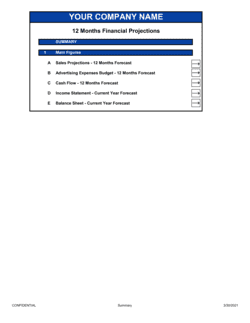
A cash flow forecast is a forward-looking financial model projecting inflows and outflows over a defined period β€” typically 13 weeks or 12 months. A cash management policy is the governance framework that controls how those cash flows are authorized and recorded. The policy tells you who can approve transactions; the forecast tells you whether you can afford them.

vs Financial Management Policy

A financial management policy is a broader governance document covering budgeting, financial reporting, asset management, debt, and internal controls across the organization's entire financial function. A cash management policy is a focused subset β€” specifically addressing cash handling, bank accounts, and reconciliation. Organizations often adopt the cash management policy first and later embed it within a comprehensive financial management policy as they mature.

Industry-specific considerations

Nonprofit organizations

Grant funders and accreditation bodies commonly require a board-approved cash management policy as a precondition for funding or membership.

Retail and hospitality

High-volume cash point-of-sale environments require detailed shift-end count procedures, till float management, and armored-carrier deposit schedules.

Professional services

Client trust accounts and advance retainer handling require strict segregation from operating funds, with dedicated reconciliation procedures and state bar or regulatory compliance considerations.

Manufacturing

Complex accounts-payable cycles with large vendor disbursements, progress payments, and raw-material prepayments make dual-control thresholds and positive-pay enrollment especially important.

Template vs pro β€” what fits your needs?

PathBest forCostTime
Use the templateSmall businesses, nonprofits, and startups establishing written cash controls for the first timeFree2–4 hours
Template + professional reviewOrganizations preparing for a first external audit, applying for bank credit, or managing multiple bank accounts and locations$200–$500 for a CPA or CFO-for-hire review1–3 days
Custom draftedMulti-entity organizations, regulated industries, or businesses with complex treasury needs including investment portfolios or foreign currency exposure$1,000–$3,000 for a fractional CFO or financial controls consultant1–2 weeks

Glossary

Cash Equivalents
Short-term, highly liquid investments β€” such as Treasury bills or money market funds β€” that can be converted to a known amount of cash within 90 days.
Segregation of Duties
A control principle that divides financial tasks β€” such as authorizing, recording, and reconciling transactions β€” among different individuals to reduce fraud risk.
Authorized Signatory
A named individual with written permission to sign checks, approve wire transfers, or execute banking transactions on behalf of the organization.
Dual Control
A requirement that two authorized persons must independently approve or execute a transaction before it is processed β€” applied to large disbursements and wire transfers.
Bank Reconciliation
The process of matching an organization's internal cash records against the bank statement to identify discrepancies, errors, or unauthorized transactions.
Petty Cash Fund
A small, fixed-amount cash reserve kept on-site to cover minor incidental expenses without requiring a formal purchase order or check.
Approval Threshold
The maximum dollar amount a specific role or individual may authorize for payment without requiring additional sign-off from a higher authority.
Float
Cash that has been recorded as disbursed by the organization but has not yet cleared the bank β€” the difference between book balance and bank balance.
Imprest System
A petty cash method where the fund is restored to a fixed baseline amount at each replenishment, so total disbursements always equal the difference from the baseline.
Treasury Management
The broader function of managing an organization's liquidity, funding, and financial risk β€” of which cash management is one component.

Part of your Business Operating System

This document is one of 3,000+ business & legal templates included in Business in a Box.

  • Fill-in-the-blanks β€” ready in minutes
  • 100% customizable Word document
  • Compatible with all office suites
  • Export to PDF and share electronically

Create your document in 3 simple steps.

From template to signed document β€” all inside one Business Operating System.
1
Download or open template

Access over 3,000+ business and legal templates for any business task, project or initiative.

2
Edit and fill in the blanks with AI

Customize your ready-made business document template and save it in the cloud.

3
Save, Share, Send, Sign

Share your files and folders with your team. Create a space of seamless collaboration.

Save time, save money, and create top-quality documents.

β˜…β˜…β˜…β˜…β˜…

"Fantastic value! I'm not sure how I'd do without it. It's worth its weight in gold and paid back for itself many times."

Managing Director Β· Mall Farm
Robert Whalley
Managing Director, Mall Farm Proprietary Limited
β˜…β˜…β˜…β˜…β˜…

"I have been using Business in a Box for years. It has been the most useful source of templates I have encountered. I recommend it to anyone."

Business Owner Β· 4+ years
Dr Michael John Freestone
Business Owner
β˜…β˜…β˜…β˜…β˜…

"It has been a life saver so many times I have lost count. Business in a Box has saved me so much time and as you know, time is money."

Owner Β· Upstate Web
David G. Moore Jr.
Owner, Upstate Web

Run your business with a system β€” not scattered tools

Stop downloading documents. Start operating with clarity. Business in a Box gives you the Business Operating System used by over 250,000 companies worldwide to structure, run, and grow their business.

Start freeΒ Β·Β No credit card required