Credit Information Cover Letter Template

Free Word download β€’ Edit online β€’ Save & share with Drive β€’ Export to PDF

1 pageβ€’20–25 min to fillβ€’Difficulty: Standard
Learn more ↓
FreeCredit Information Cover Letter Template

At a glance

What it is
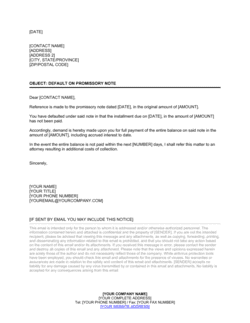
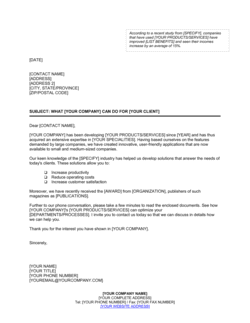
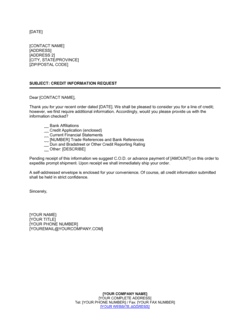
A Credit Information Cover Letter is a formal business letter that accompanies a credit application, financial statement package, or trade credit request sent to a supplier, lender, or creditor. This free Word download gives you a ready-to-edit template you can personalize with your business details and export as PDF in minutes.
When you need it
Use it whenever you submit a credit application or trade account request and need a professional cover document to introduce your business, explain the purpose of the submission, and direct the recipient to the enclosed financial information.
What's inside
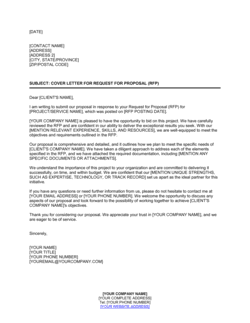
Sender and recipient identification, a clear statement of purpose, a summary of the enclosed documents, a request for the specific credit terms or credit line sought, contact details for follow-up, and a professional closing.

What is a Credit Information Cover Letter?

A Credit Information Cover Letter is a formal business letter sent alongside a credit application or financial document package to introduce your company to a supplier, lender, or creditor and explain the purpose of the submission. It identifies every enclosed document, states the specific credit terms being requested β€” including the credit limit and preferred payment terms β€” and names a contact person to handle follow-up questions. Rather than a binding agreement, it is the professional framing document that tells the creditor exactly what they are receiving and why, before they open a single attachment.

Why You Need This Document

Submitting a credit application without a cover letter forces the recipient's credit department to piece together the purpose and scope of your submission on their own β€” a friction point that routinely pushes your application to the bottom of the queue. A well-structured cover letter signals that your business is organized, creditworthy, and serious about the relationship from the first contact. It also creates a clear record of what was submitted and when, which protects you if documents go missing or the creditor later claims the package was incomplete. For businesses applying to multiple suppliers simultaneously, a consistent, professional cover letter ensures every submission reflects the same standard β€” and this template gives you that standard in under 20 minutes.

Which variant fits your situation?

If your situation is…Use this template
Applying for a trade credit account with a product supplierCredit Information Cover Letter
Formally requesting an increase to an existing credit lineCredit Increase Request Letter
Providing a credit reference for another businessCredit Reference Letter
Responding to a creditor's request for updated financial informationFinancial Information Transmittal Letter
Applying for a business bank loan or line of creditBusiness Loan Application Cover Letter
Disputing an incorrect entry on a business credit reportCredit Dispute Letter
Introducing your business to a new lender ahead of a formal applicationBusiness Introduction Letter

Common mistakes to avoid

❌ Vague or missing credit terms request

Why it matters: Without a specific credit limit and payment terms stated in the letter, the recipient must follow up to clarify the scope before processing, adding days or weeks to the decision.

Fix: State the exact dollar limit and payment terms (e.g., Net 30, $10,000 limit) in the opening paragraph of the letter.
❌ Mismatched enclosure list

Why it matters: If the letter references documents that are not in the package β€” or omits items that are β€” the credit officer must pause the application to resolve the discrepancy.

Fix: Finalize and physically assemble the document package before writing the enclosure description, then cross-check both lists before sealing the envelope or sending the email.

❌ No named follow-up contact

Why it matters: A general company phone number adds friction for the credit officer who needs to ask a quick question and may cause them to move other applications forward first.

Fix: Name a specific person with a direct number and email, and confirm that person is available and briefed on the application before it is sent.

❌ Generic 'To Whom It May Concern' salutation

Why it matters: An unaddressed letter is harder to route in a busy accounts receivable department and signals that the sender did not do basic research about the recipient company.

Fix: Call or check the recipient's website to find the name of the credit manager or accounts receivable contact before writing the letter.

The 10 key clauses, explained

Sender and Date Block

In plain language: Your company's full name, address, phone, email, and the date the letter is sent β€” placed at the top of the letter.

Sample language
[COMPANY NAME] | [STREET ADDRESS] | [CITY, STATE, ZIP] | [PHONE] | [EMAIL] | [DATE]

Common mistake: Using a personal address or contact email instead of the company's registered address and business email, which makes the letter look informal and can confuse the recipient's records.

Recipient Block

In plain language: The name, title, company name, and address of the person or department receiving the letter.

Sample language
[CONTACT NAME] | [TITLE] | [COMPANY NAME] | [STREET ADDRESS] | [CITY, STATE, ZIP]

Common mistake: Addressing the letter to a generic department (e.g., 'To Whom It May Concern') rather than a named contact, which slows routing and reduces the chance of prompt follow-up.

Subject Line

In plain language: A brief, specific line stating the purpose of the letter β€” typically referencing the credit application or account number if one has been assigned.

Sample language
Re: Credit Application β€” [COMPANY NAME] | Application Reference: [APP-XXXX]

Common mistake: Omitting the subject line entirely, which forces the recipient to read the full body before understanding the purpose and delays triage in busy credit departments.

Opening Statement of Purpose

In plain language: The first paragraph explaining who you are, why you are writing, and what type of credit or terms you are requesting.

Sample language
[COMPANY NAME] is a [DESCRIPTION OF BUSINESS] established in [YEAR]. We are writing to apply for a trade credit account with [RECIPIENT COMPANY NAME] and to request credit terms of [NET 30 / NET 60] with an initial credit limit of $[AMOUNT].

Common mistake: Writing a vague opener such as 'Please find enclosed our information' without stating the specific terms requested, leaving the credit department to guess at the scope of the request.

Business Overview

In plain language: A short paragraph providing context about your company β€” industry, years in operation, annual revenue range, and customer base β€” to establish credibility.

Sample language
[COMPANY NAME] has operated in the [INDUSTRY] industry for [X] years, serves approximately [X] customers annually, and generates approximately $[X] in annual revenue. We are [ENTITY TYPE] registered in [STATE/PROVINCE].

Common mistake: Pasting a full company history or marketing copy. The credit department needs three to five specific facts to assess stability, not a sales pitch.

Description of Enclosed Documents

In plain language: A paragraph β€” or short list β€” identifying every document included in the submission, such as financial statements, trade references, and the completed application form.

Sample language
Enclosed for your review: (1) Completed credit application form, (2) Most recent two years of financial statements, (3) Three trade references, (4) Certificate of incorporation.

Common mistake: Referencing documents in the body without listing them in an enclosure line at the bottom of the letter, causing confusion if any item is missing from the package.

Credit Terms Request

In plain language: A direct statement of the credit limit and payment terms you are seeking, and β€” where appropriate β€” the anticipated monthly purchase volume to justify the requested limit.

Sample language
We respectfully request a credit limit of $[AMOUNT] on [NET 30] terms. Based on our projected purchase volume of approximately $[MONTHLY AMOUNT] per month, this limit will support our operational requirements without exceeding our payment capacity.

Common mistake: Requesting a credit limit without providing any justification or volume context, which makes the request appear arbitrary and forces the creditor to ask follow-up questions before processing.

Contact for Follow-Up

In plain language: Names the specific person the recipient should contact to discuss the application, request additional documents, or confirm receipt.

Sample language
For questions regarding this application, please contact [CONTACT NAME], [TITLE], at [PHONE] or [EMAIL]. We are available Monday through Friday, [HOURS], and will respond to any requests within one business day.

Common mistake: Providing only a general company phone number with no named contact, which adds friction for the credit officer and signals that no one specific is managing the relationship.

Professional Closing

In plain language: A courteous closing paragraph thanking the recipient for their consideration and expressing willingness to provide any additional information.

Sample language
We appreciate your time in reviewing our application and welcome the opportunity to establish a mutually beneficial relationship with [RECIPIENT COMPANY NAME]. Please do not hesitate to contact us should you require any additional information.

Common mistake: Ending abruptly after the contact block without a closing paragraph, which leaves the letter feeling incomplete and misses the opportunity to reinforce a cooperative tone.

Signature Block and Enclosure Line

In plain language: The sender's printed name, title, and signature, followed by an 'Enclosures' line listing each document included in the package.

Sample language
Sincerely, [SIGNATORY NAME] | [TITLE] | [COMPANY NAME] | Enclosures: Completed credit application, financial statements (2 years), trade references (3), certificate of incorporation

Common mistake: Omitting the enclosure line at the bottom of the letter. Without it, neither the sender nor the recipient has a clear checklist to confirm the package is complete.

How to fill it out

  1. 1

    Complete the sender and recipient blocks

    Enter your company's full registered name, business address, phone, and email in the sender block. Look up the name and title of the credit department contact at the recipient company and use it in the recipient block.

    πŸ’‘ Call the recipient's accounts receivable department before sending to confirm the correct contact name β€” this one step can shorten approval time by several days.

  2. 2

    Add a specific subject line

    Write a subject line that names your company and the purpose β€” for example, 'Re: Trade Credit Application β€” [COMPANY NAME].' If the recipient issued a reference number with their application form, include it here.

    πŸ’‘ A clear subject line means the letter is routed correctly even if the envelope is opened by a mailroom or administrative assistant.

  3. 3

    Write the opening statement with your specific request

    State who you are, what credit terms you want (Net 30 or Net 60), and the dollar amount of the credit limit you are requesting. Put this in the first paragraph β€” do not bury the ask.

    πŸ’‘ Naming a specific credit limit in the opening paragraph signals that you understand your own financial position and have done the math.

  4. 4

    Summarize your business in three to five facts

    Include your industry, years in operation, approximate annual revenue, entity type, and state of registration. Keep this to one short paragraph.

    πŸ’‘ Years in operation and revenue range are the two numbers credit officers weigh most heavily β€” put them in the first sentence of the business overview.

  5. 5

    List and describe every enclosed document

    Write a numbered list of every document you are including β€” credit application form, financial statements, trade references, and any other supporting items. Match this list exactly to the enclosure line at the bottom of the letter.

    πŸ’‘ Assemble the full package before writing this section so you do not reference a document you forgot to include.

  6. 6

    Name a specific follow-up contact

    Provide the full name, title, direct phone number, and email address of the person who will handle questions about the application. If that person is you, include your availability hours.

    πŸ’‘ Credit decisions often hinge on one clarifying question β€” making it easy to reach you quickly can move approval forward by a week or more.

  7. 7

    Review, export as PDF, and send with the full package

    Proofread for spelling, confirm all placeholder text is replaced, and verify the enclosure list matches every document in the envelope or email attachment. Export as PDF to preserve formatting before sending.

    πŸ’‘ Send the package by a tracked method β€” certified mail or email with read receipt β€” so you have proof of delivery if timing disputes arise.

Frequently asked questions

What is a credit information cover letter?

A credit information cover letter is a formal business letter sent with a credit application or financial document package to introduce your company to a supplier, lender, or creditor. It explains the purpose of the submission, identifies the enclosed documents, states the credit terms being requested, and provides a contact for follow-up. It is not itself a credit agreement β€” it is the professional introduction that accompanies the application.

When should I send a credit information cover letter?

Send one any time you submit a trade credit application to a new supplier, request an increase to an existing credit line, respond to a creditor's request for updated financial information, or apply for a business line of credit with a bank or financial institution. It is appropriate whenever your credit submission is more than a single form β€” a cover letter ties the package together and tells the recipient exactly what they are looking at.

Does a credit information cover letter need to be signed?

A signature is professional practice and expected by most creditors, but the letter itself is not a legally binding instrument. The credit application form it accompanies typically requires a signature. Sign the cover letter with the name and title of the person authorized to enter into credit arrangements on behalf of the company β€” usually the business owner, CFO, or purchasing manager.

What documents should I include with the letter?

Typical enclosures include a completed credit application form, the most recent one to two years of financial statements (or tax returns for smaller businesses), two to three trade references with contact information, a copy of your business registration or certificate of incorporation, and a bank reference if required. The specific requirements vary by creditor β€” check the supplier's credit application instructions before assembling the package.

How long should a credit information cover letter be?

One page is the standard length. Credit departments receive many applications and do not read lengthy introductory letters. Aim for four to six short paragraphs covering your purpose, a brief business overview, the enclosed documents, your specific credit request, and contact information. Concise and specific always outperforms detailed and general in this context.

What credit limit should I request?

Base your request on your projected monthly purchase volume with that supplier. A common guideline is to request a limit equal to 60–90 days of expected purchases. For example, if you anticipate ordering $5,000 per month, a $10,000–$15,000 credit limit is reasonable. Requesting a limit dramatically higher than your projected purchases without explanation can raise questions about your cash flow management.

Can I use this letter for a bank loan application?

Yes, with minor adjustments. Replace the trade credit terms language with the specific loan amount and purpose, and ensure the enclosed document list matches the bank's requirements β€” which typically include two to three years of financial statements, a business plan, and personal financial statements for the principals. The structure and professional tone of the letter remain the same regardless of the creditor type.

What is the difference between a credit cover letter and a credit reference letter?

A credit information cover letter is written by the applicant to accompany their own credit application β€” it introduces the business and explains the submission. A credit reference letter is written by a third party (an existing supplier or lender) on the applicant's behalf to confirm a positive payment history. Both may be included in the same credit package, but they serve opposite roles.

How this compares to alternatives

vs Credit Reference Letter

A credit reference letter is written by a third party β€” an existing supplier or bank β€” to vouch for your payment history on behalf of your business. A credit information cover letter is written by you to introduce your own application. Both may appear in the same credit package, but one is an endorsement and the other is a submission document.

vs Business Introduction Letter

A business introduction letter introduces your company to a prospective partner, client, or vendor in general terms. A credit information cover letter has a specific, narrow purpose: submitting a credit application with supporting financial documents. Use the introduction letter to open the relationship and the credit cover letter when you are ready to apply for terms.

vs Letter of Intent

A letter of intent expresses a party's intention to enter into a transaction or agreement and may outline preliminary terms. A credit information cover letter makes no commitments β€” it simply presents a credit application for the creditor's review and decision. A letter of intent is used when both parties are negotiating; a cover letter is used when one party is applying.

vs Credit Application Form

A credit application form is the standardized data-collection document issued by the creditor, capturing financial details, trade references, and banking information. The cover letter accompanies and introduces that form. The form is the creditor's instrument; the cover letter is yours. Always send both together β€” a form without a cover letter lacks context, and a cover letter without a form lacks the data the creditor needs to make a decision.

Industry-specific considerations

Wholesale and Distribution

Buyers routinely open trade credit accounts with multiple product suppliers, making a standardized cover letter essential for processing applications consistently and quickly.

Construction and Trades

Contractors apply for material supplier accounts before each major project, often requiring a credit package that includes job references and proof of bonding alongside the standard financial documents.

Retail and E-commerce

Retailers applying for net-terms accounts with brand or product suppliers use the cover letter to establish credibility and distinguish their application from high-volume commodity requests.

Manufacturing

Manufacturers with ongoing raw material purchases benefit from formal trade credit arrangements, and a professional cover letter signals operational maturity to industrial suppliers evaluating new accounts.

Template vs pro β€” what fits your needs?

PathBest forCostTime
Use the templateSmall business owners and purchasing managers submitting standard trade credit applicationsFree15–20 minutes
Template + professional reviewBusinesses applying for a significant credit line where the financial package needs to be polished before submission$50–$150 (bookkeeper or accountant review)1–2 hours
Custom draftedCompanies applying for large bank credit facilities or institutional lines of credit where professional presentation is critical$200–$5001–2 days

Glossary

Trade Credit
An arrangement where a supplier allows a buyer to receive goods or services now and pay within an agreed period, such as Net 30 or Net 60.
Credit Limit
The maximum outstanding balance a creditor will extend to a borrower at any one time.
Credit Application
A formal request submitted to a supplier or lender to open a credit account, typically accompanied by financial documents and references.
Credit Reference
A third party β€” usually an existing supplier or lender β€” that can confirm a business's track record of paying on time.
Net 30 / Net 60
Payment terms stating that the full invoice amount is due 30 or 60 days after the invoice date.
Accounts Payable
Money a business owes to suppliers and creditors for goods or services received but not yet paid for.
Financial Statements
Formal records of a business's financial activity β€” typically including a balance sheet, income statement, and cash flow statement β€” used by creditors to assess creditworthiness.
Enclosure
A document included with a letter, listed at the bottom of the letter to notify the recipient of every item in the package.
Creditworthiness
A creditor's assessment of how likely a borrower is to repay obligations on time, based on financial history, current finances, and references.

Part of your Business Operating System

This document is one of 3,000+ business & legal templates included in Business in a Box.

  • Fill-in-the-blanks β€” ready in minutes
  • 100% customizable Word document
  • Compatible with all office suites
  • Export to PDF and share electronically

Create your document in 3 simple steps.

From template to signed document β€” all inside one Business Operating System.
1
Download or open template

Access over 3,000+ business and legal templates for any business task, project or initiative.

2
Edit and fill in the blanks with AI

Customize your ready-made business document template and save it in the cloud.

3
Save, Share, Send, Sign

Share your files and folders with your team. Create a space of seamless collaboration.

Save time, save money, and create top-quality documents.

β˜…β˜…β˜…β˜…β˜…

"Fantastic value! I'm not sure how I'd do without it. It's worth its weight in gold and paid back for itself many times."

Managing Director Β· Mall Farm
Robert Whalley
Managing Director, Mall Farm Proprietary Limited
β˜…β˜…β˜…β˜…β˜…

"I have been using Business in a Box for years. It has been the most useful source of templates I have encountered. I recommend it to anyone."

Business Owner Β· 4+ years
Dr Michael John Freestone
Business Owner
β˜…β˜…β˜…β˜…β˜…

"It has been a life saver so many times I have lost count. Business in a Box has saved me so much time and as you know, time is money."

Owner Β· Upstate Web
David G. Moore Jr.
Owner, Upstate Web

Run your business with a system β€” not scattered tools

Stop downloading documents. Start operating with clarity. Business in a Box gives you the Business Operating System used by over 250,000 companies worldwide to structure, run, and grow their business.

Free Forever PlanΒ Β·Β No credit card required