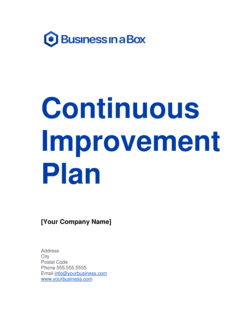
Continual Improvement Policy Template

Free Word download β€’ Edit online β€’ Save & share with Drive β€’ Export to PDF

3 pagesβ€’20–25 min to fillβ€’Difficulty: Standard
Learn more ↓
FreeContinual Improvement Policy Template

At a glance

What it is
A Continual Improvement Policy is a formal organizational document that commits a business to systematically identifying, evaluating, and acting on opportunities to improve its processes, products, and services over time. This free Word download gives you a structured, ready-to-customize template you can edit online and export as PDF for internal use, audits, or ISO 9001 certification submissions.
When you need it
Use it when pursuing ISO 9001 or other management system certification, when implementing a quality management system, or when leadership wants a documented commitment to operational improvement embedded in company policy. It is also used during internal audits, supplier onboarding, and management review cycles.
What's inside
A statement of commitment and scope, defined improvement objectives and key performance indicators, the methodology for identifying improvement opportunities, roles and responsibilities, review and reporting cycles, and the process for tracking corrective and preventive actions through to closure.

What is a Continual Improvement Policy?

A Continual Improvement Policy is a formal organizational document that establishes a business's commitment to systematically identifying, evaluating, and acting on opportunities to improve its processes, products, and services on an ongoing basis. It defines the scope of that commitment, the methodology the organization uses to drive improvement β€” most commonly the Plan-Do-Check-Act (PDCA) cycle β€” the measurable objectives being pursued, and the roles accountable for results. Unlike ad hoc improvement efforts, a documented policy embeds the improvement commitment into the governance structure of the organization, making it repeatable, auditable, and leadership-endorsed. It is a core requirement of ISO 9001:2015 and is referenced across a range of quality, environmental, and occupational health management system standards.

Why You Need This Document

Without a documented continual improvement policy, improvement efforts remain informal, inconsistent, and invisible to auditors, customers, and leadership. Organizations that have not formalized this commitment frequently experience the same process failures repeatedly β€” because corrective actions are taken without root cause analysis, closed without effectiveness verification, and never reviewed at a management level. For businesses pursuing ISO 9001 certification, the absence of a policy aligned to clause 10.3 is a straightforward audit nonconformance. Beyond certification, the act of committing to measurable improvement objectives β€” customer complaint rates, delivery times, defect percentages β€” creates accountability that informal initiatives never generate. This template gives you a ready-to-customize policy that satisfies ISO 9001 requirements, provides clear ownership and review cycles, and gives every employee a concrete understanding of how improvement is identified, actioned, and verified in your organization.

Which variant fits your situation?

If your situation is…Use this template
Seeking ISO 9001 quality management system certificationContinual Improvement Policy (ISO 9001)
Running Lean or Six Sigma improvement programsProcess Improvement Plan
Documenting corrective actions after a nonconformance eventCorrective Action Report
Defining measurable quality targets for a department or product lineQuality Management Plan
Capturing and tracking improvement ideas from staffContinuous Improvement Log
Conducting a formal review of operational performance against targetsManagement Review Report
Establishing an environmental or sustainability improvement commitmentEnvironmental Policy

Common mistakes to avoid

❌ Objectives with no numeric baseline

Why it matters: An objective like 'improve on-time delivery' cannot be audited, tracked, or meaningfully evaluated at a management review β€” it is a statement of intent, not a target.

Fix: Every objective must include a current baseline value, a specific target, and a deadline: 'Improve on-time delivery from 82% to 92% by December 31.'

❌ Using employee names instead of job titles in the roles section

Why it matters: When the named individual leaves or changes role, the policy becomes inaccurate and must be formally revised β€” creating unnecessary document control overhead.

Fix: Assign accountability to job titles or position descriptions only, ensuring the policy remains accurate through normal staff turnover.

❌ Closing corrective actions on task completion, not effectiveness verification

Why it matters: An action that was completed but did not eliminate the root cause will generate a repeat nonconformance β€” often caught in the next external audit as a major finding.

Fix: Add a mandatory effectiveness review step, completed by a different person than the one who implemented the action, at a defined interval after implementation.

❌ Scheduling improvement reviews only annually

Why it matters: A 12-month gap means process failures and missed KPI targets accumulate for nearly a year before leadership can redirect resources or adjust targets.

Fix: Set at minimum quarterly performance reviews at the operational level, with monthly KPI dashboards shared with relevant process owners between formal reviews.

❌ Storing improvement records in personal drives or email inboxes

Why it matters: Records become inaccessible during staff transitions and cannot be retrieved for external auditors β€” leading to a finding of inadequate documentation control.

Fix: Designate a single, access-controlled document management system (SharePoint, Google Drive with folder governance, or a dedicated QMS platform) and reference it by name in the policy.

❌ Treating the policy as a certification-only document, not an operational tool

Why it matters: Policies written to satisfy an auditor and then filed away generate zero improvement β€” staff do not follow processes they were never trained on or held accountable to.

Fix: Communicate the policy at induction, link it to team KPIs, and reference it in management review agendas so it functions as a live operational commitment, not a static document.

The 9 key sections, explained

Policy statement and commitment

Scope and applicability

Objectives and KPIs

Improvement methodology

Roles and responsibilities

Identification of improvement opportunities

Corrective and preventive action process

Review and reporting cycle

Documentation and records

How to fill it out

  1. 1

    Complete the policy statement and insert top management endorsement

    Replace the placeholder company name and scope description in the opening statement. Confirm whether the policy will be signed by the CEO, Managing Director, or a designated management representative.

    πŸ’‘ ISO 9001 clause 5.1 requires top management to demonstrate commitment β€” a named signatory with a job title carries more audit weight than a generic 'management' attribution.

  2. 2

    Define and bound the scope precisely

    List the specific departments, sites, product lines, or service categories the policy governs. If certain areas are excluded, state the exclusion explicitly and the reason.

    πŸ’‘ A scope that matches your ISO 9001 certification scope avoids auditor questions about why the policy covers more or less than the registered QMS.

  3. 3

    Set measurable objectives with numeric baselines

    Enter at least three specific improvement objectives with a current baseline value, target value, and deadline. Pull baseline data from your most recent performance reports.

    πŸ’‘ Use the SMART test on each objective: Specific, Measurable, Achievable, Relevant, Time-bound. Vague objectives fail ISO 9001 clause 6.2.

  4. 4

    Name the improvement methodology and describe its application

    Choose one primary methodology β€” PDCA, Lean, Six Sigma, or Kaizen β€” and write one paragraph explaining how the organization applies it in practice, not just its name.

    πŸ’‘ Reference an existing procedure or SOP if one exists β€” cross-referencing documents shows auditors the policy is embedded in operations, not just on paper.

  5. 5

    Assign roles with named positions, not individual names

    Use job titles (Quality Manager, Department Head, Process Owner) rather than personal names β€” the policy must remain accurate through staff changes.

    πŸ’‘ Include an escalation path: if the process owner cannot resolve an issue within the defined timeframe, specify who they escalate to and by when.

  6. 6

    List all improvement input sources

    Populate the identification section with every channel your organization currently uses to surface improvement opportunities β€” audits, surveys, data dashboards, suggestion boxes, supplier feedback.

    πŸ’‘ The more diverse your input sources, the more defensible the policy is to an auditor β€” single-source policies signal a reactive rather than proactive improvement culture.

  7. 7

    Set timeframes for each stage of the CAPA process

    Insert specific day-counts for logging, root cause analysis completion, action implementation, and effectiveness verification. Ranges should reflect your operational pace β€” smaller teams may need longer windows.

    πŸ’‘ Industry benchmark: nonconformance logged within 2 business days, root cause analysis within 10 days, corrective action implemented within 30 days for most operational issues.

  8. 8

    Confirm the review cycle and record retention period

    Set the management review frequency (minimum annually for ISO 9001; quarterly is best practice), the record retention period (typically 3–7 years depending on industry), and the system where records are stored.

    πŸ’‘ State a named document control system or folder path for records β€” 'stored in SharePoint under Quality > Improvement Records' is more auditable than 'stored electronically.'

Frequently asked questions

What is a continual improvement policy?

A continual improvement policy is a formal organizational document that commits a business to systematically identifying and acting on opportunities to improve its processes, products, and services over time. It defines the scope of the commitment, the methodology used, the measurable objectives being pursued, and the roles responsible for driving improvement. It is a required element of ISO 9001 and other management system standards.

Is a continual improvement policy required for ISO 9001 certification?

Yes. ISO 9001:2015 clause 10.3 explicitly requires organizations to continually improve the suitability, adequacy, and effectiveness of their quality management system. While the standard does not mandate a standalone policy document, auditors typically expect documented evidence of the commitment, objectives, and improvement activities β€” a formal policy is the most direct way to satisfy this requirement.

What is the difference between continual and continuous improvement?

Continuous improvement implies an uninterrupted, ongoing process β€” a standard that is difficult for most organizations to maintain. Continual improvement, the term used in ISO 9001, refers to improvement that occurs in cycles and steps over time, which is more realistic and operationally achievable. In practice, both terms are used interchangeably in business, but ISO documentation consistently uses "continual."

What methodology should a continual improvement policy reference?

The most widely used methodology in ISO-aligned policies is the Plan-Do-Check-Act (PDCA) cycle, which maps directly to ISO 9001's structure. Organizations with Lean or Six Sigma programs may reference those frameworks instead, or alongside PDCA. The key requirement is that the methodology is described specifically enough that staff know how to apply it β€” not just named as a label.

Who is responsible for the continual improvement policy?

Top management is ultimately accountable for the commitment and resources described in the policy, as required by ISO 9001 clause 5.1. Day-to-day coordination is typically owned by a Quality Manager or Management Representative. Department heads and process owners are responsible for identifying and implementing improvements within their areas. The policy should name each role by title, not by individual name.

How often should a continual improvement policy be reviewed?

The policy itself should be reviewed at minimum annually, typically as part of the management review process. Improvement objectives and KPIs should be reviewed more frequently β€” quarterly at the operational level is best practice. If the organization undergoes significant structural change, a merger, or a major nonconformance event, an out-of-cycle policy review is warranted.

Can a small business use a continual improvement policy without seeking ISO certification?

Yes. A continual improvement policy is useful for any organization that wants to formalize its commitment to operational excellence, regardless of whether certification is the goal. For small businesses, the discipline of setting measurable improvement objectives and reviewing them regularly produces tangible results β€” reduced rework, faster processes, and fewer customer complaints β€” independent of any certification framework.

What is the difference between a continual improvement policy and a quality policy?

A quality policy is a broader statement of the organization's overall commitment to quality β€” its purpose, principles, and alignment with strategic direction, as required by ISO 9001 clause 5.2. A continual improvement policy is more specific: it focuses on the mechanisms, objectives, and processes by which improvement will be achieved. The two are related and should be consistent, but they serve distinct purposes and are typically separate documents.

What records does a continual improvement policy require?

At minimum: an improvement register or CAPA log listing all identified opportunities and actions, root cause analysis records for nonconformances, evidence of corrective action closure and effectiveness verification, KPI performance data against objectives, and management review minutes referencing improvement outcomes. These records must be retained for a period specified in the policy β€” typically three to seven years depending on industry and certification body requirements.

How this compares to alternatives

vs Quality Policy

A quality policy states the organization's overall commitment to quality and its alignment with strategic goals, as required by ISO 9001 clause 5.2. A continual improvement policy is more operational β€” it specifies the objectives, methodology, and processes for achieving improvement. Both documents are typically required for a complete QMS; the quality policy sets the intent, the improvement policy sets the mechanism.

vs Corrective Action Report

A corrective action report documents a specific nonconformance event β€” its root cause, the action taken, and the verification of effectiveness. A continual improvement policy is the governance framework that makes corrective actions a systematic practice rather than an ad hoc response. The policy creates the obligation; the corrective action report fulfills it.

vs Process Improvement Plan

A process improvement plan is a project-level document targeting a specific process with defined actions, owners, and timelines. A continual improvement policy is an organization-wide governance document that applies to all processes. The policy creates the culture and accountability structure; the improvement plan executes specific initiatives within that structure.

vs Strategic Plan

A strategic plan sets the organization's 3–5 year direction, goals, and resource priorities. A continual improvement policy focuses specifically on the operational mechanisms for incremental and systematic enhancement of processes and systems. A strategic plan may include improvement as a goal; the improvement policy defines how that goal is institutionalized and measured.

Industry-specific considerations

Manufacturing

ISO 9001 certification is near-universal in manufacturing supply chains; the policy anchors CAPA processes for product defects, scrap rates, and machine downtime reduction.

Healthcare

Patient safety and clinical governance frameworks require documented improvement commitments; the policy supports accreditation bodies such as the Joint Commission and CQC.

Professional Services

Firms use the policy to improve project delivery timelines, client satisfaction scores, and billable utilization rates across practice areas.

SaaS / Technology

Engineering and product teams embed continual improvement cycles into sprint retrospectives, incident post-mortems, and quarterly OKR reviews to reduce defect rates and deployment lead times.

Template vs pro β€” what fits your needs?

PathBest forCostTime
Use the templateSmall to mid-size organizations implementing a QMS or seeking ISO 9001 certification for the first timeFree2–4 hours to customize and finalize
Template + professional reviewOrganizations preparing for a Stage 2 ISO 9001 audit or operating in a regulated industry requiring specific documentation standards$300–$800 for a quality consultant review1–3 days
Custom draftedLarge enterprises with complex multi-site QMS implementations, heavily regulated industries, or organizations integrating ISO 9001 with ISO 14001 or ISO 45001$1,500–$5,000 for a certified quality consultant engagement2–4 weeks

Glossary

Continual Improvement
An ongoing, systematic effort to enhance processes, products, or services by making incremental or breakthrough improvements over time.
ISO 9001
An internationally recognized standard for quality management systems that explicitly requires organizations to demonstrate continual improvement.
PDCA Cycle
Plan-Do-Check-Act β€” a four-stage iterative method for implementing and evaluating changes in a controlled, evidence-based way.
Nonconformance
A failure to meet a specified requirement, whether in a product, service, process, or management system β€” the trigger for a corrective action.
Corrective Action
A documented step taken to eliminate the root cause of an identified nonconformance and prevent it from recurring.
Preventive Action
A proactive step taken to eliminate the potential cause of a nonconformance before it occurs.
Key Performance Indicator (KPI)
A measurable value used to evaluate how effectively a process or objective is being achieved against a defined target.
Management Review
A periodic, structured evaluation by senior leadership of the quality management system's performance, suitability, and direction.
Root Cause Analysis
A structured method for identifying the underlying reason a problem or nonconformance occurred, rather than treating its symptoms.
Scope
The defined boundaries of the policy β€” which departments, sites, processes, or product lines it applies to.

Part of your Business Operating System

This document is one of 3,000+ business & legal templates included in Business in a Box.

  • Fill-in-the-blanks β€” ready in minutes
  • 100% customizable Word document
  • Compatible with all office suites
  • Export to PDF and share electronically

Create your document in 3 simple steps.

From template to signed document β€” all inside one Business Operating System.
1
Download or open template

Access over 3,000+ business and legal templates for any business task, project or initiative.

2
Edit and fill in the blanks with AI

Customize your ready-made business document template and save it in the cloud.

3
Save, Share, Send, Sign

Share your files and folders with your team. Create a space of seamless collaboration.

Save time, save money, and create top-quality documents.

β˜…β˜…β˜…β˜…β˜…

"Fantastic value! I'm not sure how I'd do without it. It's worth its weight in gold and paid back for itself many times."

Managing Director Β· Mall Farm
Robert Whalley
Managing Director, Mall Farm Proprietary Limited
β˜…β˜…β˜…β˜…β˜…

"I have been using Business in a Box for years. It has been the most useful source of templates I have encountered. I recommend it to anyone."

Business Owner Β· 4+ years
Dr Michael John Freestone
Business Owner
β˜…β˜…β˜…β˜…β˜…

"It has been a life saver so many times I have lost count. Business in a Box has saved me so much time and as you know, time is money."

Owner Β· Upstate Web
David G. Moore Jr.
Owner, Upstate Web

Run your business with a system β€” not scattered tools

Stop downloading documents. Start operating with clarity. Business in a Box gives you the Business Operating System used by over 250,000 companies worldwide to structure, run, and grow their business.

Start freeΒ Β·Β No credit card required