Environmental Policy Template

Free Word download β€’ Edit online β€’ Save & share with Drive β€’ Export to PDF

2 pagesβ€’20–25 min to fillβ€’Difficulty: Standard
Learn more ↓
FreeEnvironmental Policy Template

At a glance

What it is
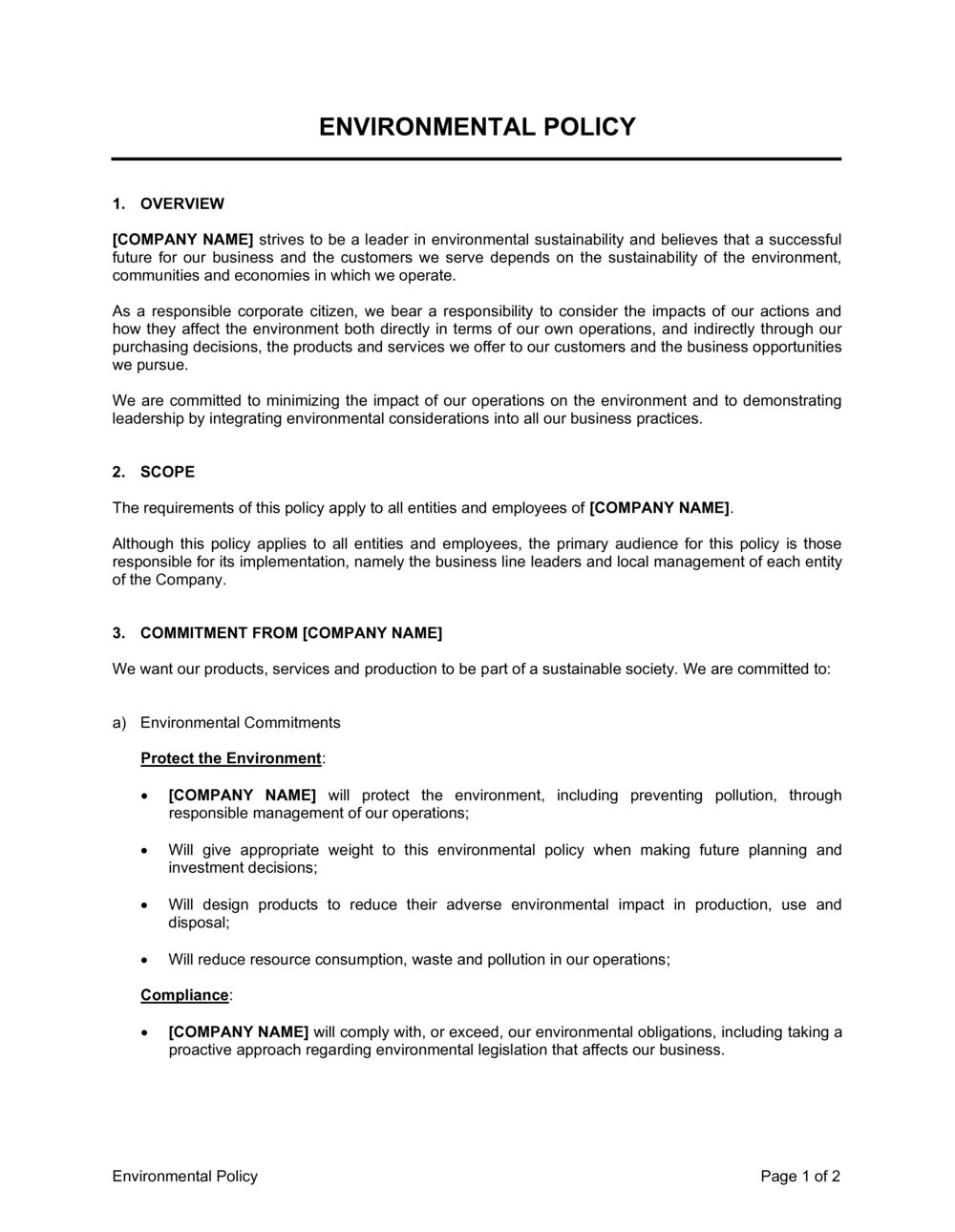
An Environmental Policy is a formal document stating a company's commitments to environmental responsibility β€” covering regulatory compliance, energy and resource consumption, waste reduction, supplier expectations, and continuous improvement targets. This free Word download gives you a structured, ISO 14001-compatible starting point you can edit online and export as PDF to share with employees, customers, auditors, and ESG reporting stakeholders.
When you need it
Use it when pursuing ISO 14001 certification, responding to customer or investor ESG questionnaires, meeting tender or procurement requirements, or formalizing existing environmental practices into a single governance document.
What's inside
A statement of environmental commitment, scope and applicability, legal compliance obligations, energy and resource use targets, waste and emissions management, supplier and contractor expectations, employee responsibilities, and a continuous improvement and review framework.

What is an Environmental Policy?

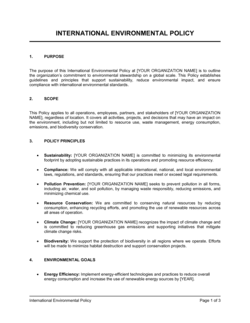
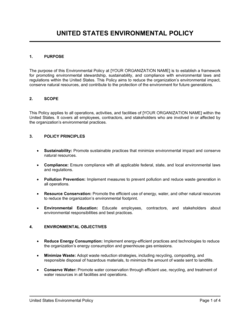
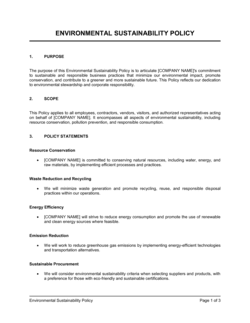
An Environmental Policy is a formal document in which an organization's senior leadership commits to managing and reducing the company's environmental impact across its operations, supply chain, and products or services. It defines the scope of the commitment, names the legal and regulatory obligations the company will meet, sets measurable targets for energy use, waste, and emissions, and assigns accountability for delivering on those targets. The policy serves as the governing document for an environmental management system and is the first document an ISO 14001 auditor, ESG reviewer, or procurement officer will request.

Why You Need This Document

Without a written environmental policy, your organization has no documented basis for the environmental claims you make to customers, investors, or regulators β€” and no governance structure to ensure those claims remain accurate over time. Procurement teams at large enterprises and public-sector bodies routinely disqualify suppliers who cannot produce one. ISO 14001 certification, the internationally recognized standard for environmental management, mandates a signed policy as a non-negotiable starting point. For ESG reporting under GRI, CDP, or TCFD frameworks, an environmental policy is the baseline evidence that your disclosures rest on a real internal commitment rather than a communications exercise. This template gives you a complete, audit-ready structure in a single Word document β€” covering every element ISO 14001 and standard ESG questionnaires require β€” so you can move from intention to governance in an afternoon rather than commissioning a document from scratch.

Which variant fits your situation?

If your situation is…Use this template
Building a full environmental management system for ISO 14001Environmental Management System Manual
Documenting health, safety, and environment togetherHealth, Safety and Environment (HSE) Policy
Covering all ESG dimensions β€” environmental, social, and governanceCorporate Social Responsibility Policy
Setting supplier-specific environmental requirementsSupplier Code of Conduct
Reporting environmental performance to stakeholdersSustainability Report
Addressing a single regulated waste stream or chemical hazardHazardous Materials Policy
Establishing office-level sustainability practices onlyGreen Office Policy

Common mistakes to avoid

❌ Targets without baselines

Why it matters: A percentage reduction target is meaningless β€” and unauditable β€” if there is no documented starting point. ISO 14001 assessors and ESG questionnaires both require baseline data.

Fix: Gather at least 12 months of utility, waste, and emissions data before publishing the policy. Record the baseline year and measurement methodology in the policy or an attached schedule.

❌ Diffuse accountability with no named owner

Why it matters: Policies that assign responsibility to 'all employees' or 'management' without naming specific roles produce no real accountability. Environmental incidents then fall through the gaps.

Fix: Name a specific job title as the policy owner and list department-level responsibilities explicitly, even if briefly.

❌ Omitting contractor and supplier scope

Why it matters: For most businesses, contractors and suppliers generate a significant share of total environmental impact. A policy that covers employees only ignores the activities with the most material risk.

Fix: Extend scope to all contractors working on company premises and to significant suppliers, and reference the policy in procurement and contract documents.

❌ No defined review cycle or owner

Why it matters: A policy with no mandatory review date becomes outdated as regulations change, operations expand, and targets expire. Auditors treat an unreviewed policy as evidence of an inactive EMS.

Fix: State a specific review interval (12 months is standard) and name the role responsible for initiating the review in the policy document itself.

The 9 key sections, explained

Policy statement and commitment

Scope and applicability

Legal and regulatory compliance

Energy and resource use

Waste management and circular economy

Emissions and climate commitments

Supplier and contractor expectations

Employee responsibilities and training

Monitoring, reporting, and continuous improvement

How to fill it out

  1. 1

    Confirm scope and name the covered sites

    Identify every site, business unit, and activity the policy will govern. Decide whether it extends to contractors working on your premises and to suppliers in your supply chain.

    πŸ’‘ If your organization has multiple sites with materially different environmental risks, consider a brief site-specific annex rather than trying to cover all variations in the main policy body.

  2. 2

    Identify your applicable legal obligations

    List the environmental laws, regulations, and permits that apply to each covered site. Check national, state or provincial, and local levels. Note any permit conditions that impose numeric limits.

    πŸ’‘ Many jurisdictions provide a free online register of environmental legislation by industry sector β€” start there before engaging a consultant.

  3. 3

    Establish baseline measurements for key environmental aspects

    Before writing targets, gather at least 12 months of data on energy consumption, water use, waste volumes, and emissions. Without a documented baseline, your targets cannot be verified by auditors or ESG reviewers.

    πŸ’‘ Utility bills, waste contractor invoices, and fuel purchase records are usually sufficient to build a credible baseline for a small or mid-sized business.

  4. 4

    Set specific, time-bound improvement targets

    Replace phrases like 'reduce our environmental impact' with measurable commitments: 'reduce electricity consumption by 15% by December 2027 against a 2024 baseline.' Assign an owner to each target.

    πŸ’‘ Align target years with your organization's broader strategic plan or fiscal year β€” targets that fall mid-year tend to get deprioritized in budget cycles.

  5. 5

    Define roles and assign accountability

    Name the role responsible for overall policy compliance (typically an operations, facilities, or sustainability manager) and describe what each department or function is expected to do day to day.

    πŸ’‘ Including a one-paragraph accountability section per department turns a policy document into a genuine operating guide rather than a declaration.

  6. 6

    Align supplier expectations with your procurement process

    Review your standard supplier onboarding and contract documents. Add a reference to this policy in supplier agreements and in your supplier questionnaire so that expectations have a contractual basis.

    πŸ’‘ For high-spend or high-risk suppliers, request a copy of their own environmental policy as part of the onboarding process.

  7. 7

    Have the policy signed by senior leadership and communicate it

    A policy signed by the CEO or Managing Director carries more internal weight and satisfies ISO 14001's requirement for top-management commitment. Distribute to all staff, post in common areas, and make it accessible on your intranet.

    πŸ’‘ Record each employee's acknowledgment of the policy at induction β€” this is required evidence during an ISO 14001 audit.

  8. 8

    Schedule the first review date before publishing

    Set a calendar reminder for the first review before the policy is even distributed. Twelve months is the maximum recommended interval; set 6 months if you are preparing for ISO 14001 certification.

    πŸ’‘ Link the policy review date to your management review meeting agenda β€” this ensures it is never deferred indefinitely.

Frequently asked questions

What is an environmental policy?

An environmental policy is a formal statement of a company's commitments to managing and reducing its environmental impact. It covers regulatory compliance, energy and resource use, waste management, emissions reduction, supplier expectations, and continuous improvement. It acts as the top-level governance document for an environmental management system and is a mandatory requirement for ISO 14001 certification.

Is an environmental policy required by law?

In most jurisdictions, no law mandates that businesses maintain a formal written environmental policy. However, ISO 14001 certification requires one, many public-sector tenders and large enterprise procurement processes require suppliers to produce one, and ESG reporting frameworks such as GRI and CDP expect documented environmental commitments. Regulated industries β€” manufacturing, extraction, waste management β€” may face permit conditions that effectively require a policy.

What should an environmental policy include?

At minimum: a commitment statement signed by senior leadership, scope and applicability, a commitment to legal compliance, energy and resource reduction targets with baselines, waste management approach, emissions commitments, supplier expectations, employee responsibilities, and a review cycle. ISO 14001 specifically requires commitments to compliance and to continual improvement to be explicit in the policy text.

How does an environmental policy support ISO 14001 certification?

ISO 14001 clause 5.2 requires top management to establish, implement, and maintain an environmental policy that includes explicit commitments to environmental protection, compliance with legal obligations, and continual improvement. The policy must be documented, communicated to all persons working under the organization's control, and available to interested parties. A well-structured policy template satisfies these requirements and forms the foundation for the wider EMS documentation an auditor will review.

How long should an environmental policy be?

One to three pages is the standard range for most small and mid-sized businesses. The policy should be concise enough for every employee to read and understand, while comprehensive enough to address each material environmental aspect of the business. Detailed procedures β€” how to segregate waste, how to report a spill β€” belong in separate operating procedures, not in the policy itself.

Who should sign an environmental policy?

ISO 14001 requires the policy to reflect top-management commitment, which means it should be signed by the CEO, Managing Director, or equivalent. For larger organizations, co-signing with the Head of Operations or Chief Sustainability Officer is common. A policy signed only by a middle manager signals insufficient leadership commitment and will be flagged in an ISO 14001 pre-assessment.

How often should an environmental policy be reviewed?

Annual review is the standard for most organizations. The policy should also be reviewed immediately following a significant change in operations β€” a new site, a new production process, a major regulatory change, or a significant environmental incident. Each review should be documented with a date and the name of the person who conducted it.

Can a small business use this environmental policy template?

Yes. The template is designed to scale β€” a sole trader or 10-person business can complete it with simpler targets and fewer roles, while a 500-person manufacturer can expand each section with site-specific annexes. The core structure satisfies ISO 14001, ESG questionnaire requirements, and procurement due diligence regardless of company size.

What is the difference between an environmental policy and an environmental management system?

The environmental policy is the single-page or short-form commitment document that states what the organization will do. The environmental management system (EMS) is the complete operational framework β€” processes, procedures, registers, training records, audit schedules, and management reviews β€” that puts those commitments into practice. ISO 14001 certifies the EMS; the policy is its foundational governing document.

How this compares to alternatives

vs Corporate Social Responsibility (CSR) Policy

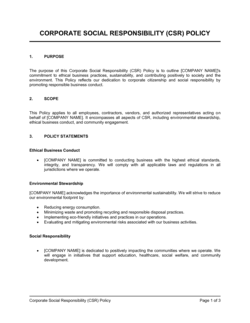
A CSR policy covers the full ESG spectrum β€” environmental, social, and governance commitments including community investment, labor practices, and diversity. An environmental policy focuses exclusively on environmental impact and is the document required for ISO 14001 and most environmental procurement questionnaires. Use the environmental policy when a dedicated, auditable environmental commitment is needed; use the CSR policy when stakeholders want to see the broader social and governance picture.

vs Health and Safety Policy

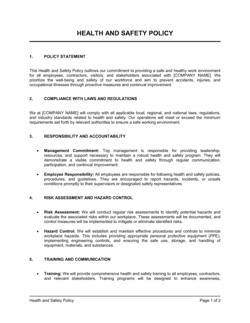
A health and safety policy governs workplace hazards and employee wellbeing β€” injury prevention, safe work procedures, and regulatory compliance under occupational health law. An environmental policy governs the company's impact on the external environment β€” emissions, waste, water, and natural resources. Many organizations maintain both as separate documents, though some combine them into an integrated HSE policy.

vs Supplier Code of Conduct

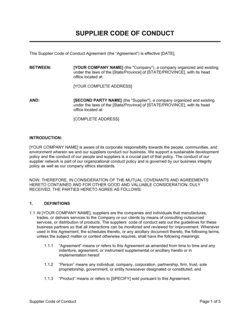
A supplier code of conduct sets behavioral and compliance standards across multiple dimensions β€” labor, ethics, anti-bribery, and environment β€” for all suppliers. An environmental policy is an internal governance document that states the company's own commitments. The policy drives the environmental section of the supplier code; both documents are needed for a complete supply chain governance framework.

vs Sustainability Report

A sustainability report is a backward-looking stakeholder disclosure document that quantifies actual environmental and social performance over a reporting period. An environmental policy is a forward-looking commitment document that states what the company intends to do. The policy provides the governance foundation; the report demonstrates whether those commitments were met.

Industry-specific considerations

Manufacturing

Addresses regulated waste streams, air and water discharge permits, chemical storage obligations, and Scope 1 emissions from on-site combustion.

Construction

Covers site-specific environmental risk assessments, dust and noise controls, hazardous materials handling, and subcontractor compliance requirements.

Retail and E-commerce

Focuses on packaging reduction, logistics emissions, supplier environmental standards, and in-store energy and waste management.

Professional Services

Typically scope-limited to office energy use, business travel emissions, paper and electronic waste, and supply chain transparency disclosures for ESG reporting.

Template vs pro β€” what fits your needs?

PathBest forCostTime
Use the templateSmall and mid-sized businesses formalizing environmental commitments for procurement, ESG questionnaires, or internal governanceFree2–4 hours
Template + professional reviewOrganizations preparing for ISO 14001 certification or operating in a regulated industry with permit conditions$300–$1,000 for a sustainability consultant or EMS specialist review1–3 days
Custom draftedLarge multisite manufacturers, businesses with complex discharge or emissions permits, or organizations undergoing a third-party EMS audit$2,000–$8,000 for a full EMS documentation package with policy2–6 weeks

Glossary

ISO 14001
An international standard specifying requirements for an effective environmental management system (EMS), used to improve environmental performance and demonstrate compliance.
Environmental Management System (EMS)
A structured framework of processes and practices that enables an organization to reduce its environmental impact and increase operating efficiency.
Scope 1 Emissions
Direct greenhouse gas emissions from sources owned or controlled by the organization β€” such as company vehicles or on-site combustion.
Scope 2 Emissions
Indirect emissions from purchased electricity, heat, or steam consumed by the organization.
Scope 3 Emissions
All other indirect emissions in a company's value chain, including supplier production, employee commuting, and product end-of-life disposal.
Continuous Improvement
A recurring cycle of measuring environmental performance, identifying gaps, implementing corrective actions, and re-measuring β€” codified in ISO 14001 as the Plan-Do-Check-Act (PDCA) cycle.
Legal Compliance Obligation
Environmental laws, regulations, permits, and other binding requirements that apply to a company's operations in each jurisdiction where it operates.
Waste Hierarchy
A ranked order of preferred waste management approaches: reduce, reuse, recycle, recover energy, then dispose β€” with reduction at the top as the most desirable outcome.
ESG (Environmental, Social, and Governance)
A framework used by investors and stakeholders to evaluate a company's non-financial performance across environmental stewardship, social responsibility, and governance practices.
Life Cycle Assessment (LCA)
A methodology for evaluating the total environmental impact of a product or service from raw material extraction through manufacturing, use, and disposal.

Part of your Business Operating System

This document is one of 3,000+ business & legal templates included in Business in a Box.

  • Fill-in-the-blanks β€” ready in minutes
  • 100% customizable Word document
  • Compatible with all office suites
  • Export to PDF and share electronically

Create your document in 3 simple steps.

From template to signed document β€” all inside one Business Operating System.
1
Download or open template

Access over 3,000+ business and legal templates for any business task, project or initiative.

2
Edit and fill in the blanks with AI

Customize your ready-made business document template and save it in the cloud.

3
Save, Share, Send, Sign

Share your files and folders with your team. Create a space of seamless collaboration.

Save time, save money, and create top-quality documents.

β˜…β˜…β˜…β˜…β˜…

"Fantastic value! I'm not sure how I'd do without it. It's worth its weight in gold and paid back for itself many times."

Managing Director Β· Mall Farm
Robert Whalley
Managing Director, Mall Farm Proprietary Limited
β˜…β˜…β˜…β˜…β˜…

"I have been using Business in a Box for years. It has been the most useful source of templates I have encountered. I recommend it to anyone."

Business Owner Β· 4+ years
Dr Michael John Freestone
Business Owner
β˜…β˜…β˜…β˜…β˜…

"It has been a life saver so many times I have lost count. Business in a Box has saved me so much time and as you know, time is money."

Owner Β· Upstate Web
David G. Moore Jr.
Owner, Upstate Web

Run your business with a system β€” not scattered tools

Stop downloading documents. Start operating with clarity. Business in a Box gives you the Business Operating System used by over 250,000 companies worldwide to structure, run, and grow their business.

Start freeΒ Β·Β No credit card required