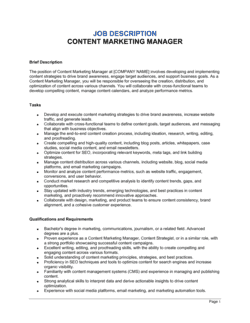
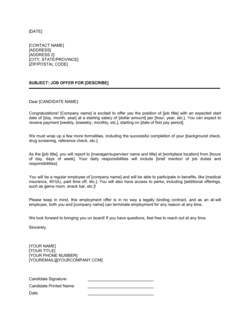
Social Media Manager Job Description Template

Free Word download β€’ Edit online β€’ Save & share with Drive β€’ Export to PDF

2 pagesβ€’20–30 min to fillβ€’Difficulty: Standardβ€’Signature requiredβ€’Legal review recommended
Learn more ↓
FreeSocial Media Manager Job Description Template

At a glance

What it is
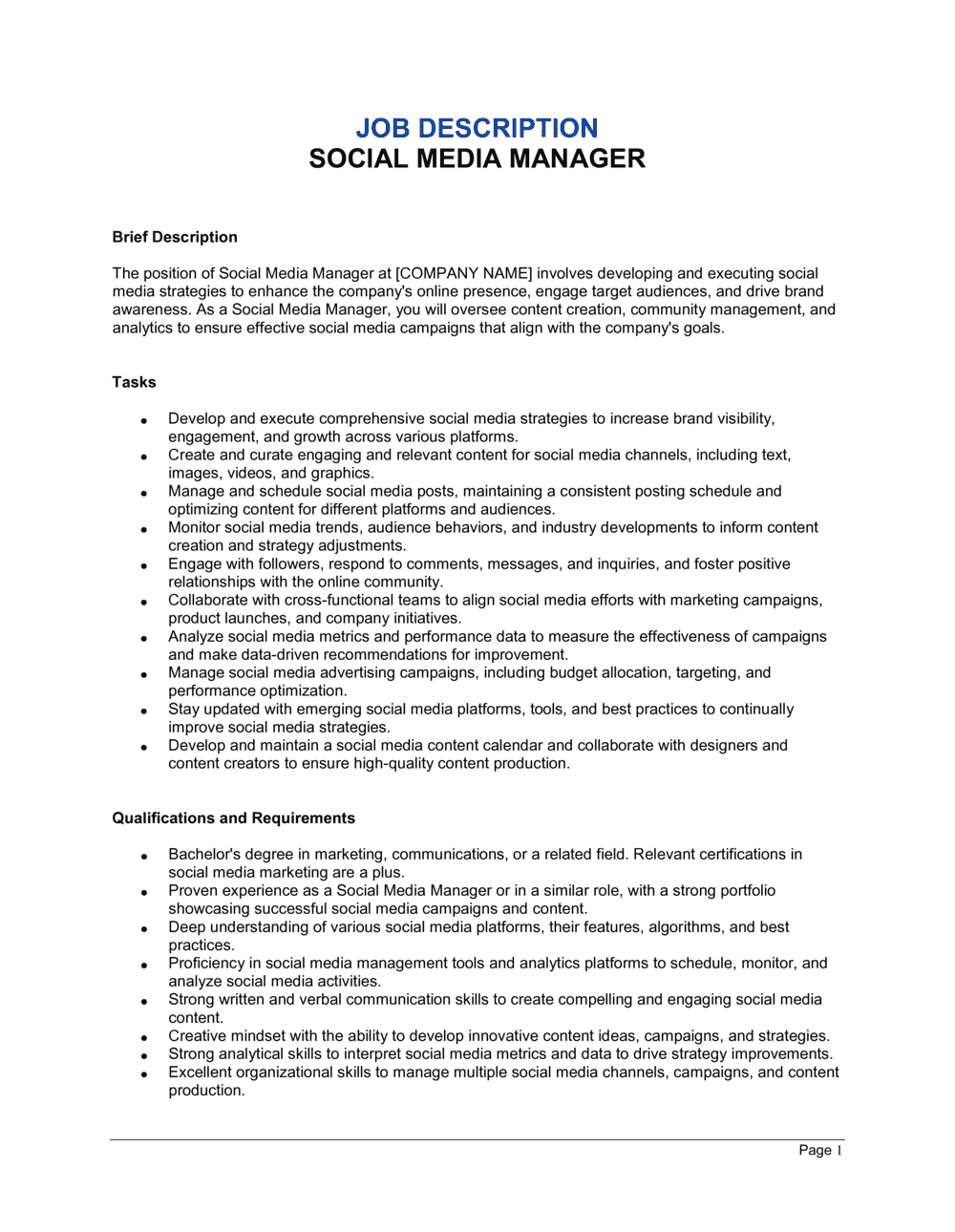
A Social Media Manager Job Description is a binding employment document that defines the scope, responsibilities, qualifications, reporting structure, and compensation expectations for a social media management role. This free Word download gives you a structured, legally grounded starting point you can edit online and export as PDF to post publicly or attach to an offer letter.
When you need it
Use it when hiring a full-time, part-time, or contract social media manager β€” whether you are filling a new role, replacing a departing employee, or formalizing duties that have been handled informally. It also serves as the authoritative reference document for performance reviews and scope disputes.
What's inside
Role title and department, reporting structure, core duties and platform responsibilities, required and preferred qualifications, key performance indicators, compensation range and benefits overview, and employment classification terms.

What is a Social Media Manager Job Description?

A Social Media Manager Job Description is a formal employment document that defines the scope, duties, qualifications, reporting structure, key performance indicators, and compensation terms for a social media management role. It functions as both a public-facing recruitment tool and an internal governance document β€” establishing a written record of what the employee was hired to do, at what level, and against which measurable standards. When signed by both the hiring manager and the incoming employee, it carries significant legal weight in performance management, scope disputes, and termination proceedings.

Why You Need This Document

Hiring a social media manager without a written, signed job description leaves your organization exposed on multiple fronts at once. Without defined duties and platforms, scope creep is inevitable β€” the employee takes on tasks beyond the original role, or refuses tasks they were always expected to perform, and neither party has a document to resolve the disagreement. Without stated KPIs, performance reviews become subjective contests rather than objective evaluations, making it difficult to justify a termination for cause or a performance improvement plan. In US states with pay-transparency laws β€” California, Colorado, New York, and Washington β€” posting a role without a salary range is a regulatory violation. A properly structured, signed job description eliminates all of these risks before the employee's first day, and this template gives you a complete, legally grounded starting point you can adapt in under an hour.

Which variant fits your situation?

If your situation is…Use this template
Hiring a senior strategist who also manages junior staffSenior Social Media Manager Job Description
Engaging a freelancer for project-based social media workIndependent Contractor Agreement
Hiring a broader digital marketing generalistDigital Marketing Manager Job Description
Filling a junior or entry-level content creation roleSocial Media Coordinator Job Description
Hiring someone to manage paid social campaigns specificallyPaid Social Media Specialist Job Description
Formalizing the role after verbal offer to attach to offer letterJob Offer Letter
Contracting an agency rather than hiring an employeeMarketing Services Agreement

Common mistakes to avoid

❌ Omitting a salary range where legally required

Why it matters: California, Colorado, New York, and Washington now mandate salary-range disclosure on job postings. Non-compliant postings expose the employer to regulatory fines and reputational damage with candidates.

Fix: Research pay-transparency requirements for every state or country where the role will be posted and include a salary band before publishing. Update the band annually against market data.

❌ Listing duties so broadly that scope is undefined

Why it matters: Vague duties like 'support marketing initiatives' invite scope creep, make performance management subjective, and give a terminated employee grounds to argue they were meeting expectations.

Fix: Write each duty with a specific action verb, a measurable output, and a defined platform or deliverable. Limit the list to the 10–12 most critical responsibilities.

❌ Misclassifying the role as FLSA exempt

Why it matters: A social media manager who spends most of their time executing content rather than exercising independent judgment may not qualify for the administrative or creative exemption β€” triggering overtime liability and back-pay exposure.

Fix: Apply the Department of Labor's exemption tests before assigning a classification. When in doubt, classify as non-exempt or consult an employment attorney.

❌ Skipping the acknowledgment signature block

Why it matters: Without a signed acknowledgment, an employee can claim they never agreed to certain duties or were unaware of KPI expectations β€” weakening the employer's position in a performance dispute or termination.

Fix: Add a signature block and collect a signed copy before or on day one. Store it in the employee file alongside the employment contract and offer letter.

❌ Setting KPIs in the job description that conflict with the employment contract

Why it matters: Two documents setting different performance targets create a contradiction the employee can use to argue they met one standard even when they missed another.

Fix: Align KPIs across the job description, offer letter, and employment contract before any document is signed. Use the job description as the source of truth and reference it explicitly in the contract.

❌ Using an outdated EEO statement that omits newer protected classes

Why it matters: Several jurisdictions have added protected categories β€” including gender identity, sexual orientation, and caregiver status β€” since standard boilerplate was written. An incomplete statement creates regulatory and reputational risk.

Fix: Review the EEO statement against federal, state, and local protected-class requirements for every location where the role will be posted, and update it at least annually.

The 10 key clauses, explained

Role title, department, and classification

In plain language: States the official job title, the department the role belongs to, the employment type (full-time, part-time, or contract), and the FLSA exempt or non-exempt classification.

Sample language
Job Title: Social Media Manager | Department: Marketing | Employment Type: Full-Time | FLSA Status: Exempt | Location: [CITY, STATE / Remote / Hybrid]

Common mistake: Misclassifying the role as exempt when duties do not meet the FLSA executive, administrative, or professional exemption tests β€” exposing the employer to overtime back-pay claims.

Reporting structure

In plain language: Identifies who the social media manager reports to and any direct reports they manage, establishing the chain of accountability.

Sample language
Reports to: [DIRECTOR OF MARKETING / VP OF COMMUNICATIONS]. Direct reports: [SOCIAL MEDIA COORDINATOR / none at this time].

Common mistake: Leaving the reporting structure blank or vague β€” without a named title, authority disputes arise when the manager needs budget approval or escalates a brand crisis.

Role summary and purpose

In plain language: A 2–4 sentence overview of why the role exists, what it is accountable for, and how it contributes to the organization's marketing objectives.

Sample language
The Social Media Manager is responsible for developing and executing [COMPANY NAME]'s social media strategy across [PLATFORMS]. This role drives brand awareness, audience growth, and engagement in alignment with [COMPANY NAME]'s marketing objectives and brand voice.

Common mistake: Writing the summary as a sales pitch for the company rather than a clear statement of what the employee is accountable for β€” making it harder to use the document in performance reviews.

Core duties and responsibilities

In plain language: A numbered or bulleted list of specific tasks the employee is expected to perform β€” platform management, content creation, campaign execution, community management, and reporting.

Sample language
1. Develop and maintain a monthly content calendar across [PLATFORMS]. 2. Create, schedule, and publish [X] posts per week per platform. 3. Monitor and respond to comments, messages, and mentions within [X] business hours. 4. Track and report monthly KPIs including reach, engagement rate, and follower growth.

Common mistake: Listing duties so broadly that scope creep becomes inevitable β€” for example, 'manage all digital marketing' leaves the employee unable to push back on tasks clearly outside a social-only role.

Platform and tool requirements

In plain language: Specifies the social platforms the manager is responsible for (Instagram, LinkedIn, TikTok, X, Facebook, YouTube) and the tools they must be proficient in (scheduling, analytics, design).

Sample language
Primary platforms: [INSTAGRAM, LINKEDIN, TIKTOK, X]. Required tools: [META BUSINESS SUITE, HOOTSUITE / SPROUT SOCIAL, CANVA / ADOBE CREATIVE SUITE, GOOGLE ANALYTICS].

Common mistake: Omitting specific platforms and tools, then expecting the employee to cover new platforms that emerge post-hire without any contract amendment or revised scope.

Key performance indicators

In plain language: Defines the measurable targets the employee is evaluated against β€” follower growth rate, engagement rate, content output volume, response time, and campaign-level metrics.

Sample language
Success in this role is measured by: monthly follower growth of [X]%, average engagement rate of [X]% per post, publishing [X] posts per week, and community response time under [X] business hours.

Common mistake: Setting KPIs in the job description that conflict with targets in the offer letter or employment contract β€” creating two competing performance standards the manager can exploit in a dispute.

Required qualifications

In plain language: States the minimum education, years of experience, platform certifications, and demonstrated skills a candidate must have to be considered for the role.

Sample language
Required: [X] years of social media management experience, demonstrated track record growing an audience on [PLATFORM], proficiency in [TOOLS], and strong written communication skills. [DEGREE REQUIREMENT OR EQUIVALENT EXPERIENCE].

Common mistake: Requiring a specific degree (e.g., bachelor's in marketing) when experience and a portfolio are more predictive of success β€” limiting the candidate pool and creating potential adverse-impact liability.

Compensation, benefits, and work arrangement

In plain language: States the salary range or hourly rate, bonus eligibility if any, benefits summary, and the work arrangement (remote, on-site, or hybrid with specific in-office days).

Sample language
Compensation: $[MIN] – $[MAX] annually, commensurate with experience. Benefits: [HEALTH / DENTAL / VISION / 401(k) / PTO]. Work arrangement: [REMOTE / HYBRID β€” [X] days in-office per week at [LOCATION]].

Common mistake: Omitting a salary range where pay-transparency laws require one β€” in states including California, Colorado, New York, and Washington, posting a range is mandatory for most employers.

Equal opportunity and non-discrimination statement

In plain language: A standard clause stating the employer does not discriminate on the basis of protected characteristics and invites applicants of all backgrounds to apply.

Sample language
[COMPANY NAME] is an equal opportunity employer. We do not discriminate on the basis of race, color, religion, sex, national origin, age, disability, or any other characteristic protected by applicable law.

Common mistake: Omitting the EEO statement entirely or using an outdated version that excludes newer protected categories β€” creating regulatory exposure in jurisdictions that have expanded protected classes.

Acknowledgment and signature block

In plain language: A section for both the employer's authorized representative and the candidate or employee to sign and date, confirming the job description has been reviewed and accepted.

Sample language
I have read, understood, and received a copy of this job description. Signature: _______________ Date: ___________ | Hiring Manager Signature: _______________ Date: ___________

Common mistake: Skipping the signature block because the document 'isn't a contract.' A signed acknowledgment establishes the employee had notice of their duties β€” critical evidence in wrongful-termination or scope-of-role disputes.

How to fill it out

  1. 1

    Enter the role title, classification, and location

    Fill in the official job title, department, FLSA classification (exempt or non-exempt), employment type, and whether the role is on-site, hybrid, or fully remote with the specific location.

    πŸ’‘ Confirm FLSA classification with HR or an employment attorney before publishing β€” misclassification is the single most expensive job-description error.

  2. 2

    Define the reporting structure

    Name the title the social media manager reports to and list any direct reports. If there are no direct reports at hire but the role is expected to grow, note it as 'with potential to manage [X] in Year 2.'

    πŸ’‘ Use titles, not names β€” managers change, and a name-specific description requires amendment every time personnel shifts.

  3. 3

    Write the role summary in outcome terms

    Draft a 2–4 sentence paragraph explaining why the role exists and what it will accomplish for the marketing team β€” not just what tasks it performs.

    πŸ’‘ Outcome-framed summaries attract stronger candidates and set clearer performance expectations than duty-list summaries.

  4. 4

    List core duties with specificity

    Write 8–12 duty statements, each starting with an action verb. Be specific about platforms, content volume, and cross-functional interactions β€” 'publish 3 posts per week on Instagram and LinkedIn' beats 'manage social content.'

    πŸ’‘ Tie each duty to a measurable output wherever possible β€” this makes the list directly usable as a performance review framework.

  5. 5

    Specify platforms and required tools

    List the exact platforms the manager will own and the tools they must be proficient in on day one. Separate required tools from nice-to-have tools to avoid over-filtering candidates.

    πŸ’‘ Limit 'required' tools to those used in the first 90 days β€” everything else belongs in 'preferred' qualifications.

  6. 6

    Set KPIs and success metrics

    Enter specific, measurable targets for the first 6–12 months β€” follower growth percentage, engagement rate benchmarks, content output volume, and response time windows.

    πŸ’‘ Cross-check these KPIs against your current baseline data before publishing β€” targets you cannot benchmark are impossible to enforce fairly.

  7. 7

    Enter compensation range and work arrangement

    Include the salary band, bonus eligibility, benefits summary, and specific work arrangement details. Check whether your posting location requires salary-range disclosure by law.

    πŸ’‘ California, Colorado, New York, and Washington all require salary ranges on job postings β€” confirm the rule for your jurisdiction before publishing.

  8. 8

    Obtain signatures before the employee's first day

    Route the signed job description to the new hire for acknowledgment before or on day one. File the signed copy in the employee's HR record alongside the offer letter and employment contract.

    πŸ’‘ A countersigned job description paired with a signed employment contract gives you two layers of written evidence of the agreed scope β€” invaluable in any performance or termination dispute.

Frequently asked questions

What is a social media manager job description?

A social media manager job description is a formal employment document that defines the duties, qualifications, reporting structure, KPIs, and compensation terms for a social media management role. It serves as the authoritative record of what the employee is hired to do, and is used for recruiting, onboarding, performance reviews, and β€” when signed β€” as evidence in scope or termination disputes.

What are the core duties of a social media manager?

Core duties typically include developing and maintaining a content calendar, creating and publishing platform-specific content, managing community engagement by responding to comments and messages, running paid social campaigns, tracking and reporting performance metrics, and collaborating with design and content teams on brand assets. The exact scope depends on company size, platform mix, and whether the role includes paid media or is organic-only.

What qualifications should a social media manager have?

Most employers require 2–5 years of hands-on social media management experience, demonstrated audience growth on at least one major platform, proficiency in scheduling and analytics tools (Hootsuite, Sprout Social, or Meta Business Suite), and strong written communication skills. A degree in marketing or communications is common but increasingly secondary to a strong portfolio. Certifications from Meta, HubSpot, or Google are valuable additions.

Is a job description a legally binding document?

A job description is not automatically a binding employment contract, but it carries significant legal weight when signed by both parties. Courts and employment tribunals use signed job descriptions as evidence of agreed duties, classification, and performance expectations. In jurisdictions that require written statements of particulars β€” including the UK β€” the job description is often incorporated by reference into the employment agreement. Always pair it with a signed employment contract.

Does a social media manager job description need to include a salary range?

In several US states β€” including California, Colorado, New York, and Washington β€” employers are legally required to include a salary range on any external job posting. Federally, there is no current mandate, but pay transparency legislation is expanding. In the EU, the Pay Transparency Directive requires employers to provide salary information before or during the hiring process. Check the requirements for every location where the posting will appear before publishing.

What KPIs should be included in a social media manager job description?

The most common KPIs are monthly follower growth rate, average engagement rate per post, content publishing volume per platform per week, community response time (in business hours), and campaign-specific metrics such as reach, impressions, or click-through rate. Set targets based on your current baseline β€” aspirational targets with no benchmarking context are unenforceable and create unfair performance standards.

What is the difference between a social media manager and a social media coordinator?

A social media manager typically owns strategy, sets the content calendar, manages any direct reports, and reports to senior marketing leadership. A coordinator executes tasks defined by the manager β€” scheduling posts, responding to routine comments, and pulling analytics β€” with less strategic autonomy. The distinction matters for FLSA classification, compensation benchmarking, and reporting structure in the job description.

Should the job description be signed by the new hire?

Yes. A signed acknowledgment establishes that the employee received, reviewed, and agreed to the defined scope of the role before starting work. This is critical evidence in performance management and termination proceedings. Collect the signature before or on day one, and file the signed copy in the employee's HR record alongside the offer letter and employment contract.

How often should a social media manager job description be updated?

Review it annually and any time the role changes materially β€” new platforms added, reporting structure changed, KPIs revised, or compensation adjusted. A job description more than two years old typically no longer reflects the role accurately, which weakens its usefulness in performance management and creates misaligned expectations for internal candidates considering a transfer or promotion.

How this compares to alternatives

vs Independent Contractor Agreement

An independent contractor agreement engages a freelance social media manager for project-based or ongoing work without creating an employment relationship β€” no benefits, no tax withholding, no overtime. A job description defines an employee role with all associated legal obligations. Misclassifying an employee as a contractor triggers back taxes, penalties, and benefit liability. Use the contractor agreement only when the worker controls their own hours, tools, and deliverable methods.

vs Job Offer Letter

A job offer letter confirms compensation, start date, and basic terms to secure the candidate's acceptance. It is not a comprehensive duty document. A signed job description defines the specific scope, KPIs, platforms, and performance standards the employee is accountable to β€” and is the document used in performance management and termination proceedings. Both should be executed before day one.

vs Employment Contract

An employment contract governs the legal relationship β€” IP assignment, confidentiality, non-compete, termination, and severance. A job description defines the operational scope of the role. They are complementary, not interchangeable. The employment contract should reference the job description by title and attach it as a schedule so both documents form a single enforceable record.

vs Digital Marketing Manager Job Description

A digital marketing manager job description covers a broader remit β€” SEO, paid search, email, content marketing, and social media. A social media manager job description scopes the role exclusively to social platforms, community management, and social-specific campaigns. Use the broader template when the hire will own all digital channels; use this template when social is a standalone function with dedicated headcount.

Industry-specific considerations

Retail / E-commerce

Emphasis on product-driven content, shoppable posts, influencer coordination, and seasonal campaign execution tied to sales targets.

SaaS / Technology

Focus on thought leadership content, LinkedIn and X engagement, developer community management, and product launch announcements.

Healthcare / MedTech

Strict content compliance requirements under HIPAA and FDA advertising rules, limited use of patient testimonials, and medical accuracy review workflows.

Professional Services

LinkedIn-heavy strategy, attorney or advisor-reviewed content approval process, reputation management, and lead generation through gated content promotion.

Food & Beverage

High-volume visual content across Instagram and TikTok, influencer and UGC management, location-tagging strategy, and seasonal promotion cadence.

Nonprofit / Education

Donor engagement and stewardship content, campaign fundraising via social channels, volunteer storytelling, and grant-reporting metrics tied to social reach.

Jurisdictional notes

United States

FLSA classification as exempt or non-exempt determines overtime eligibility β€” misclassification is the most common and costly job-description error. Pay-transparency laws in California, Colorado, New York, and Washington require salary ranges on job postings. Title VII, the ADA, and the ADEA prohibit discriminatory qualification requirements; requiring a specific degree when equivalent experience is equally predictive may create adverse-impact liability. At-will language should align with the employment contract.

Canada

Each province has its own Employment Standards Act setting minimum requirements for hours of work, overtime, and notice of termination β€” job descriptions that imply permanent employment create common-law notice obligations. Quebec employers must post in French or bilingual format for roles based in the province. Human rights codes in all provinces prohibit discriminatory qualification criteria, including overly broad education requirements.

United Kingdom

Employers must provide a written statement of employment particulars on or before day one under the Employment Rights Act 1996 β€” the job description is typically incorporated by reference into this statement. The Equality Act 2010 prohibits discriminatory qualification requirements across nine protected characteristics. Pay transparency is not yet legally mandated for all employers, but large employers (250+ employees) must report gender pay-gap data annually.

European Union

The EU Pay Transparency Directive (effective 2026 for large employers) requires salary information to be provided to candidates before or during the hiring process. The EU Transparent and Predictable Working Conditions Directive mandates written employment terms within 7 days of hire. GDPR applies to any candidate personal data collected during the recruitment process. Member states vary on protected characteristics and mandatory works-council consultation before posting new roles.

Template vs lawyer β€” what fits your deal?

PathBest forCostTime
Use the templateSmall businesses and startups hiring a social media manager in a single US state or Canadian province with straightforward scopeFree30–45 minutes
Template + legal reviewEmployers in pay-transparency jurisdictions, roles with complex FLSA classification, or job descriptions being incorporated into employment contracts$150–$400 for an HR consultant or employment attorney review1–3 days
Custom draftedRegulated industries (healthcare, financial services), multi-jurisdiction hiring, or senior roles with equity and material non-compete requirements$500–$2,000+3–7 days

Glossary

Job Description
A formal document outlining the duties, qualifications, reporting structure, and terms of a specific employment role β€” used for hiring, performance management, and legal classification.
FLSA Classification
US Fair Labor Standards Act designation of a role as exempt or non-exempt, determining whether the employee is entitled to overtime pay.
KPI (Key Performance Indicator)
A measurable metric used to evaluate whether an employee is meeting role expectations β€” for social media, this includes follower growth, engagement rate, and content output targets.
At-Will Employment
An employment arrangement in most US states where either party may end the relationship at any time for any lawful reason without notice.
Reporting Structure
The defined hierarchy showing who the employee reports to and, where applicable, who reports to them.
Scope of Work
The specific platforms, content types, campaign categories, and responsibilities assigned to the role β€” used to define and enforce reasonable performance expectations.
Content Calendar
A planning document scheduling social media posts, campaigns, and platform activity across a defined time period β€” typically owned by the social media manager.
Engagement Rate
The percentage of an audience that interacts with a post (likes, comments, shares, clicks) relative to total reach or follower count β€” a primary KPI for social media roles.
Brand Voice
The defined tone, style, and personality guidelines governing how the organization communicates across all social media platforms.
Community Management
The ongoing practice of monitoring, moderating, and responding to audience comments, messages, and mentions across social media channels.
Analytics and Reporting
The regular process of pulling platform data, interpreting trends, and presenting performance summaries to stakeholders β€” a core duty in most social media manager roles.

Part of your Business Operating System

This document is one of 3,000+ business & legal templates included in Business in a Box.

  • Fill-in-the-blanks β€” ready in minutes
  • 100% customizable Word document
  • Compatible with all office suites
  • Export to PDF and share electronically

Create your document in 3 simple steps.

From template to signed document β€” all inside one Business Operating System.
1
Download or open template

Access over 3,000+ business and legal templates for any business task, project or initiative.

2
Edit and fill in the blanks with AI

Customize your ready-made business document template and save it in the cloud.

3
Save, Share, Send, Sign

Share your files and folders with your team. Create a space of seamless collaboration.

Save time, save money, and create top-quality documents.

β˜…β˜…β˜…β˜…β˜…

"Fantastic value! I'm not sure how I'd do without it. It's worth its weight in gold and paid back for itself many times."

Managing Director Β· Mall Farm
Robert Whalley
Managing Director, Mall Farm Proprietary Limited
β˜…β˜…β˜…β˜…β˜…

"I have been using Business in a Box for years. It has been the most useful source of templates I have encountered. I recommend it to anyone."

Business Owner Β· 4+ years
Dr Michael John Freestone
Business Owner
β˜…β˜…β˜…β˜…β˜…

"It has been a life saver so many times I have lost count. Business in a Box has saved me so much time and as you know, time is money."

Owner Β· Upstate Web
David G. Moore Jr.
Owner, Upstate Web

Run your business with a system β€” not scattered tools

Stop downloading documents. Start operating with clarity. Business in a Box gives you the Business Operating System used by over 250,000 companies worldwide to structure, run, and grow their business.

Start freeΒ Β·Β No credit card required