Marketing Manager Job Description Template

Free Word download β€’ Edit online β€’ Save & share with Drive β€’ Export to PDF

2 pagesβ€’20–30 min to fillβ€’Difficulty: Standardβ€’Signature requiredβ€’Legal review recommended
Learn more ↓
FreeMarketing Manager Job Description Template

At a glance

What it is
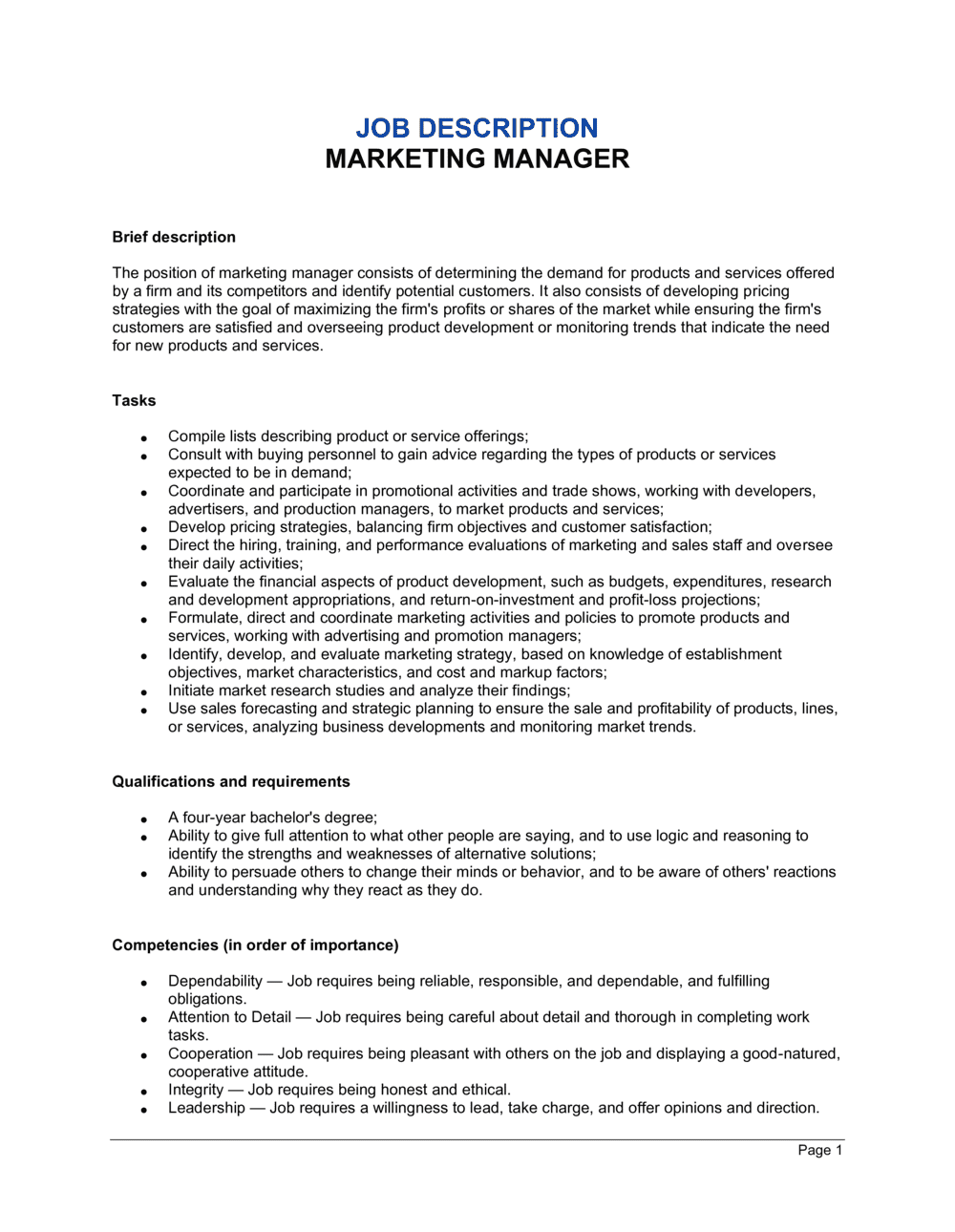
A Marketing Manager Job Description is a formal document that defines the scope of the marketing manager role within an organization β€” covering duties, required qualifications, reporting structure, compensation band, and performance expectations. This free Word download gives you a professionally structured template you can edit online, tailor to your industry and company size, and export as PDF to post on job boards or attach to an offer package.
When you need it
Use it when opening a new marketing manager position, backfilling a departure, or formalizing a role that has been operating without a written description. It also serves as the reference document for performance reviews, compensation benchmarking, and promotion decisions.
What's inside
Role summary and objectives, core duties and responsibilities, required and preferred qualifications, reporting structure and team oversight, compensation range and benefits overview, key performance indicators, and equal opportunity and compliance language.

What is a Marketing Manager Job Description?

A Marketing Manager Job Description is a formal document that defines the scope, duties, qualifications, reporting structure, compensation, and performance expectations for a marketing manager position within an organization. It functions as both a recruiting instrument β€” used to attract and screen candidates β€” and a legally significant reference document that anchors performance reviews, compensation benchmarking, ADA accommodation evaluations, and employment classification decisions. A well-drafted description distinguishes essential functions from ancillary tasks, sets measurable KPIs tied to business outcomes, and complies with pay-transparency and equal-opportunity requirements in the jurisdictions where the role is posted.

Why You Need This Document

Hiring a marketing manager without a written, signed job description leaves you exposed on multiple fronts simultaneously. Without defined essential functions, you have no defensible basis for an ADA accommodation decision or a performance improvement plan. Without a salary range, you risk non-compliance with pay-transparency laws now active in multiple US states and soon effective across the EU. Without specific KPIs tied to business outcomes, performance reviews become subjective disputes rather than objective evaluations β€” driving costly attrition or wrongful dismissal claims. A vague hybrid-work clause is now one of the top drivers of early resignation in marketing roles; precise language prevents that entirely. This template gives you a compliant, professionally structured starting point that takes 30 minutes to complete and eliminates the ambiguities that generate months of legal and HR headaches down the line.

Which variant fits your situation?

If your situation is…Use this template
Hiring a marketing manager focused on digital channels and paid mediaDigital Marketing Manager Job Description
Filling a senior role with team leadership and budget ownershipSenior Marketing Manager Job Description
Hiring for a product-centric marketing role working with engineeringProduct Marketing Manager Job Description
Recruiting a content-focused marketing leader for an inbound strategyContent Marketing Manager Job Description
Opening a brand management role for a consumer goods companyBrand Manager Job Description
Hiring a marketing coordinator to support an existing managerMarketing Coordinator Job Description
Posting the full leadership role for a standalone marketing functionChief Marketing Officer Job Description

Common mistakes to avoid

❌ Omitting the salary range

Why it matters: Pay-transparency laws in Colorado, New York, California, Washington, and growing number of jurisdictions require salary ranges in job postings β€” non-compliance carries fines up to $10,000 per violation in some states.

Fix: Research market benchmarks, set a defensible band, and include it in the posting. A range also reduces negotiation friction and signals pay-equity commitment to candidates.

❌ Listing activity-based rather than outcome-based KPIs

Why it matters: KPIs like 'send 10 emails per week' measure output, not impact β€” they set the wrong incentive and make performance reviews subjective and dispute-prone.

Fix: Replace activity metrics with outcome metrics tied to the role's business objective: qualified leads generated, marketing-attributed pipeline, or cost per acquisition.

❌ Using an outdated or generic EEO statement

Why it matters: An EEO statement that omits recently protected categories or does not reflect local law creates legal exposure and can be used as evidence of discriminatory intent in a complaint.

Fix: Have HR or legal review the EEO statement at least annually and update it to reflect current federal, state, and local protected characteristics.

❌ Specifying a degree requirement without a business justification

Why it matters: Educational requirements that are not genuinely necessary for the role's essential functions can constitute disparate impact discrimination under EEOC guidance, limiting the talent pool and exposing the employer to claims.

Fix: Replace rigid degree mandates with skills- or experience-equivalent language: 'bachelor's degree in a related field or 4 years of demonstrated marketing experience.'

❌ Defining hybrid work loosely

Why it matters: Candidates who accept a role described as 'hybrid' without specific in-office day requirements frequently dispute or resign when expectations are enforced β€” often within 90 days of hire.

Fix: State the exact number of required in-office days per week and whether specific days are fixed, and include this in the signed offer letter as well as the job description.

❌ Conflating preferred and required qualifications

Why it matters: When interviewers score all preferred items as mandatory dealbreakers, the effective requirements are more restrictive than the posted description β€” creating legal exposure and eliminating qualified candidates who self-screened out.

Fix: Train every interviewer on the distinction before the search begins, and designate a clear owner to enforce the dividing line throughout the process.

The 9 key clauses, explained

Role title and position summary

In plain language: States the official job title, the department it belongs to, the employment type (full-time, part-time, or contract), and a 3–5 sentence overview of the role's purpose within the organization.

Sample language
[COMPANY NAME] is seeking a Marketing Manager to lead planning and execution of integrated marketing programs for the [PRODUCT LINE / BUSINESS UNIT]. Reporting to the [CMO / VP OF MARKETING / CEO], this full-time role owns the [GEOGRAPHIC / CHANNEL] marketing function and is accountable for [KEY OBJECTIVE].

Common mistake: Writing a vague summary that could describe any marketing role. Without specifics, candidates self-select incorrectly and the document provides no baseline for performance management.

Core duties and responsibilities

In plain language: An itemized list of the 8–12 primary responsibilities the employee is expected to perform regularly β€” written with action verbs and measurable outcomes where possible.

Sample language
Develop and execute quarterly marketing plans aligned to revenue targets of $[X]. Manage a budget of $[X] across paid, owned, and earned channels. Oversee a team of [X] direct reports including [TITLES]. Report campaign performance weekly to [STAKEHOLDER].

Common mistake: Listing every possible task rather than the essential functions. An overloaded duties section obscures the role's actual priorities and creates ADA exposure if critical duties are buried among ancillary ones.

Required qualifications

In plain language: The minimum education, years of experience, technical skills, and certifications a candidate must have to be considered β€” these are the gatekeeping criteria used to screen applications.

Sample language
Bachelor's degree in Marketing, Business, or a related field. Minimum [X] years of experience in B2B / B2C marketing. Demonstrated proficiency in [CRM PLATFORM], [MARKETING AUTOMATION TOOL], and Google Analytics. [CERTIFICATION, if required].

Common mistake: Setting educational requirements higher than the role actually demands. Requiring a master's degree for a generalist manager role reduces the candidate pool and may constitute indirect discrimination under EEOC guidance.

Preferred qualifications

In plain language: Additional skills, experience, or credentials that would make a candidate a stronger hire but are not dealbreakers β€” used to differentiate finalists without narrowing the pipeline unnecessarily.

Sample language
Experience in [INDUSTRY VERTICAL]. Familiarity with [TOOL / PLATFORM]. Previous people-management experience of a team of [X+] marketing professionals. Proficiency in a second language ([LANGUAGE]) is an asset.

Common mistake: Treating preferred qualifications as a second required list. When interviewers score all preferred items as mandatory, the role reverts to a narrower spec and legal exposure increases.

Reporting structure and team oversight

In plain language: Identifies the position this role reports to and any direct or indirect reports managed by the marketing manager, establishing accountability and organizational hierarchy.

Sample language
This role reports directly to the [CMO / VP MARKETING / CEO]. The Marketing Manager will manage [X] direct reports: [TITLES]. Dotted-line coordination with the [SALES / PRODUCT / DESIGN] team is expected.

Common mistake: Omitting the direct reports entirely when a team-leadership element is core to the role. Candidates hired without clarity on team scope frequently contest the scope later, creating performance and compensation disputes.

Compensation, benefits, and FLSA classification

In plain language: States the salary band or OTE, any variable compensation, the FLSA exemption classification, and a reference to the company's standard benefits package.

Sample language
Base salary: $[MIN] – $[MAX] depending on experience. Annual performance bonus of up to [X]% of base. This position is classified as Exempt under the FLSA. Benefits include [HEALTH / DENTAL / VISION / 401K / PTO SUMMARY].

Common mistake: Omitting the salary range. Growing pay-transparency legislation in states including Colorado, New York, and California requires ranges in job postings β€” non-compliance carries fines and reputational risk.

Key performance indicators (KPIs)

In plain language: Defines the measurable outcomes by which the employee's performance will be evaluated in the first 6–12 months, anchoring the role to business results rather than activity.

Sample language
Performance will be evaluated against: (1) monthly qualified lead volume of [X]; (2) cost per acquisition target of $[X]; (3) marketing-attributed pipeline of $[X] per quarter; (4) campaign execution on schedule [X]% of the time.

Common mistake: Using activity KPIs (emails sent, posts published) instead of outcome KPIs (leads generated, revenue influenced). Activity metrics fail to distinguish high-impact work from busy work.

Work location and schedule requirements

In plain language: Specifies whether the role is on-site, hybrid, or fully remote, any required travel percentage, and standard working hours or schedule flexibility.

Sample language
This role is [ON-SITE / HYBRID: X days in office / FULLY REMOTE]. Office location: [CITY, STATE]. Travel requirement: up to [X]% for [EVENTS / CLIENT VISITS / AGENCY MEETINGS]. Core hours: [X AM – X PM LOCAL TIME].

Common mistake: Stating 'hybrid' without defining the minimum in-office days. Candidates accept roles expecting full flexibility, then dispute the expectation when it is enforced β€” leading to early attrition or constructive dismissal claims.

Equal opportunity and accommodation statement

In plain language: A legally required or strongly recommended statement affirming the employer's commitment to non-discriminatory hiring and willingness to provide reasonable accommodation to qualified applicants with disabilities.

Sample language
[COMPANY NAME] is an equal opportunity employer. We do not discriminate on the basis of race, color, religion, sex, national origin, age, disability, or any other characteristic protected by applicable law. Applicants requiring accommodation should contact [HR CONTACT / EMAIL].

Common mistake: Using a generic EEO statement copied from another company's template without verifying it reflects current applicable law. Some older templates omit protected categories added by recent legislation or executive order.

How to fill it out

  1. 1

    Define the role's primary objective before writing

    In one sentence, state what business problem this marketing manager will solve β€” more leads, stronger brand, international expansion, or a product launch. Every section of the description should serve that objective.

    πŸ’‘ If you cannot write that one sentence without ambiguity, the role is not yet scoped clearly enough to hire for.

  2. 2

    Complete the role title and summary block

    Enter the official job title, the department, the employment type, and a 3–5 sentence summary of why the role exists and what it will accomplish in the first year.

    πŸ’‘ Avoid inflating titles to attract candidates β€” 'Director' for a role without budget authority creates expectation mismatches that drive early attrition.

  3. 3

    Write 8–12 core responsibilities using action verbs

    List the essential functions in order of time and strategic importance. Each item should begin with an action verb (Develop, Manage, Analyze, Own) and include a scope or scale indicator where possible.

    πŸ’‘ Flag the top three responsibilities as 'essential functions' β€” this language matters if you ever need to evaluate an ADA accommodation request.

  4. 4

    Set qualifications based on the role's actual demands

    List required qualifications only if they are genuinely necessary to perform the essential functions. Move nice-to-haves to the preferred section. Review each requirement through the lens of potential disparate impact.

    πŸ’‘ Replace degree requirements with skills or experience equivalents where possible β€” 'bachelor's degree or 4 years of equivalent experience' opens the pipeline without reducing quality.

  5. 5

    Specify the compensation band and FLSA classification

    Enter a salary range based on current market benchmarks for the role level and geography. Confirm the role meets the FLSA duties test and salary threshold for exempt classification before stating it.

    πŸ’‘ Use two to three compensation benchmarking sources (BLS, Radford, Glassdoor Employer) to triangulate the band β€” a range that is 20% below market will be flagged by candidates immediately.

  6. 6

    Define at least three outcome-based KPIs

    Select KPIs that are directly influenced by the marketing manager β€” not team-wide or company-wide metrics the role cannot control. Include the target value, measurement period, and data source.

    πŸ’‘ Share the KPI section with the hiring manager and the incumbent's peer in sales or product to confirm the targets are realistic and agreed before posting.

  7. 7

    Add work location and schedule details

    State exactly how many days per week in-office are required for hybrid roles. List any required travel and the standard schedule. For remote roles, note any timezone requirements.

    πŸ’‘ Vague hybrid language is now one of the top causes of offer declines and early resignations β€” be specific to build trust with candidates.

  8. 8

    Insert the EEO and accommodation statement

    Add your company's standard EEO statement and a contact for accommodation requests. Confirm it references all legally protected categories applicable in your jurisdiction.

    πŸ’‘ Have HR or legal verify the statement annually β€” protected categories have expanded in several US states and in the EU in recent years.

Frequently asked questions

What is a marketing manager job description?

A marketing manager job description is a formal document that defines the title, duties, required qualifications, reporting structure, compensation range, and performance expectations for a marketing manager role. It is used in recruiting to attract and screen candidates, in onboarding to align expectations, and in performance management as the authoritative reference for reviews and compensation decisions.

What should a marketing manager job description include?

A complete marketing manager job description covers the role title and summary, core duties and essential functions (8–12 items), required and preferred qualifications, reporting structure and team oversight, compensation band and FLSA classification, key performance indicators, work location and schedule requirements, and an equal opportunity statement. Missing any of these creates ambiguity that surfaces as disputes during employment or claims during recruiting.

Is a job description a legally binding document?

A job description is generally not a standalone employment contract, but it carries meaningful legal weight. In most jurisdictions, courts have considered job descriptions as evidence of the agreed scope of employment, essential functions under the ADA, and the basis for discrimination or misclassification claims. The document should be drafted carefully, signed by both parties at onboarding, and updated whenever the role materially changes.

Do I need to include a salary range in a job description?

In a growing number of US jurisdictions β€” including Colorado, New York, California, and Washington β€” including a salary range in any public job posting is legally required. Penalties range from $500 to $10,000 per violation. Even where not legally required, salary transparency significantly reduces offer declines and time-to-fill. Best practice is to include a range in all postings regardless of location.

What KPIs should a marketing manager be evaluated on?

Effective KPIs for a marketing manager are outcome-based and tied to business objectives: monthly qualified lead volume, cost per acquisition, marketing-attributed pipeline, campaign-to-close conversion rate, and brand awareness metrics (share of voice, NPS). Activity-based KPIs like email sends or social posts measure effort, not impact, and create misaligned incentives. Each KPI should include a target value, a measurement period, and the data source.

What is the difference between required and preferred qualifications?

Required qualifications are the minimum threshold a candidate must meet to be considered β€” they are the gatekeeping criteria and carry legal weight as essential requirements. Preferred qualifications are differentiators used to rank qualified finalists without narrowing the pipeline. Treating preferred items as mandatory during screening effectively raises the bar beyond what was posted, creating legal exposure and reducing candidate quality.

How often should a marketing manager job description be updated?

Update the job description whenever the role's essential functions, reporting structure, team size, or compensation band materially changes β€” at minimum annually as part of the performance review cycle. An outdated description undermines performance management, creates pay-equity discrepancies, and generates legal exposure if a compliance review reveals the posted description does not match actual duties.

Does a marketing manager job description need to be signed?

Yes β€” having the employee sign the job description at onboarding, and sign updated versions whenever the role materially changes, establishes mutual agreement on scope, duties, and expectations. A signed description is the reference document for performance improvement plans, disciplinary actions, and, in some jurisdictions, the basis for evaluating reasonable accommodation requests under disability law.

What FLSA classification applies to a marketing manager?

Most marketing managers qualify as exempt under the FLSA's administrative or professional exemptions, provided they earn at least the current salary threshold ($684 per week as of 2025 β€” check for updates) and primarily perform non-manual work directly related to business operations requiring discretion and independent judgment. Confirm both the duties test and the salary level test before classifying the role as exempt to avoid back-pay liability for misclassification.

How this compares to alternatives

vs Senior Marketing Manager Job Description

A senior marketing manager description adds expanded team leadership scope, larger budget ownership, and strategic planning responsibilities beyond campaign execution. It typically requires 7–10 years of experience versus 3–5 for a standard manager role. Use the senior template when the hire will lead a sub-function or a team of more than three direct reports.

vs Marketing Director Job Description

A marketing director description covers department-level strategy, cross-functional leadership, and direct accountability to C-suite stakeholders. It encompasses a marketing manager's execution scope but adds organizational design, vendor contract authority, and board-level reporting. Use the director template when the role owns the entire marketing function rather than a channel or campaign layer.

vs Marketing Coordinator Job Description

A marketing coordinator description covers supporting tasks β€” scheduling, asset coordination, reporting, and administrative execution β€” under the supervision of a marketing manager. It requires fewer years of experience and carries no budget or team-management accountability. Use it when hiring a support role, not a decision-maker.

vs Product Marketing Manager Job Description

A product marketing manager description focuses on go-to-market strategy, positioning, competitive intelligence, and sales enablement for a specific product or product line. It requires close collaboration with product and engineering teams and a different KPI set (win rate, attach rate, feature adoption) compared to a generalist marketing manager. Use it when the role is product-centric rather than channel- or brand-centric.

Industry-specific considerations

Technology / SaaS

Emphasis on demand generation, ABM programs, product marketing alignment, and proficiency with marketing automation platforms like HubSpot or Marketo.

Retail / E-commerce

Focus on customer acquisition cost, retention marketing, seasonal campaign execution, and performance channels including paid search and social.

Professional Services

Thought leadership, content strategy, RFP support, and managing long B2B sales cycles with marketing attribution tied to proposal pipeline.

Healthcare / MedTech

FDA promotional guidelines compliance, HIPAA considerations for patient data in marketing, and clinical evidence requirements for claim substantiation.

Jurisdictional notes

United States

Pay-transparency laws now apply in Colorado, New York, California, Washington, and several other states β€” salary ranges must appear in public postings or penalties apply. The FLSA requires accurate exempt or non-exempt classification; misclassified marketing managers generate back-pay liability. The ADA requires identifying essential functions clearly so accommodation requests can be evaluated. EEOC guidance discourages educational requirements that are not demonstrably necessary.

Canada

Human rights legislation at both federal and provincial levels prohibits discrimination on protected grounds in job postings β€” educational requirements must be justified. Ontario's Pay Transparency Act requires employers with 100+ employees to include salary ranges in postings. Quebec employers must publish postings in French. Job descriptions that are signed and attached to employment agreements carry contractual weight in common-law provinces.

United Kingdom

The Equality Act 2010 prohibits indirect discrimination in job requirements β€” qualifications and experience thresholds must be proportionate to the role. Gender pay gap reporting obligations for employers with 250+ employees make consistent job grading and salary banding important. HMRC IR35 considerations apply if engaging the marketing manager through a personal service company rather than as a direct employee.

European Union

The EU Pay Transparency Directive (effective 2026 in most member states) requires employers to disclose salary information before interviews and prohibits asking candidates about pay history. GDPR applies to any personal data collected during the application process β€” the job description should not request data types that are not lawfully necessary. Works council consultation may be required before posting or materially amending a job description in Germany, the Netherlands, and France.

Template vs lawyer β€” what fits your deal?

PathBest forCostTime
Use the templateSMBs and startups hiring a marketing manager in a single jurisdiction with standard duties and compensationFree30–60 minutes
Template + legal reviewCompanies hiring in states with pay-transparency laws, multi-state postings, or roles requiring ADA essential-functions documentation$200–$500 (HR consultant or employment counsel review)1–3 days
Custom draftedEnterprise employers, heavily regulated industries (healthcare, fintech), or roles with complex cross-border or classification considerations$800–$2,500+1–2 weeks

Glossary

Job Description
A formal document that defines a role's title, responsibilities, qualifications, reporting structure, and compensation β€” used in recruiting, performance management, and legal compliance.
Essential Functions
The core duties that are fundamental to the role and cannot be removed or reassigned without fundamentally changing the job β€” a legally significant designation under the ADA and similar statutes.
FLSA Classification
A US-specific designation indicating whether a role is exempt or non-exempt from overtime requirements under the Fair Labor Standards Act, based on salary level and duties performed.
KPI (Key Performance Indicator)
A measurable metric used to evaluate whether the employee is meeting the role's defined objectives β€” such as lead volume, cost per acquisition, or campaign ROI.
Reporting Structure
The documented chain of authority identifying who the role reports to and, if applicable, which positions report to it.
OTE (On-Target Earnings)
Total compensation an employee earns when achieving 100% of performance targets, combining base salary with any variable bonus or commission.
At-Will Employment
An employment relationship in most US states where either party may end the arrangement at any time for any lawful reason β€” the job description should not inadvertently create a contract to the contrary.
Reasonable Accommodation
A modification to a job's duties, schedule, or environment that allows a qualified candidate with a disability to perform the essential functions, required under the ADA in the US and equivalent laws elsewhere.
Bona Fide Occupational Qualification (BFOQ)
A characteristic that is legally permissible to require for a specific role because it is genuinely necessary to perform the job β€” narrowly construed by courts.
Salary Band
A defined minimum and maximum pay range for a role or job grade, used to maintain pay equity and benchmark compensation against market data.

Part of your Business Operating System

This document is one of 3,000+ business & legal templates included in Business in a Box.

  • Fill-in-the-blanks β€” ready in minutes
  • 100% customizable Word document
  • Compatible with all office suites
  • Export to PDF and share electronically

Create your document in 3 simple steps.

From template to signed document β€” all inside one Business Operating System.
1
Download or open template

Access over 3,000+ business and legal templates for any business task, project or initiative.

2
Edit and fill in the blanks with AI

Customize your ready-made business document template and save it in the cloud.

3
Save, Share, Send, Sign

Share your files and folders with your team. Create a space of seamless collaboration.

Save time, save money, and create top-quality documents.

β˜…β˜…β˜…β˜…β˜…

"Fantastic value! I'm not sure how I'd do without it. It's worth its weight in gold and paid back for itself many times."

Managing Director Β· Mall Farm
Robert Whalley
Managing Director, Mall Farm Proprietary Limited
β˜…β˜…β˜…β˜…β˜…

"I have been using Business in a Box for years. It has been the most useful source of templates I have encountered. I recommend it to anyone."

Business Owner Β· 4+ years
Dr Michael John Freestone
Business Owner
β˜…β˜…β˜…β˜…β˜…

"It has been a life saver so many times I have lost count. Business in a Box has saved me so much time and as you know, time is money."

Owner Β· Upstate Web
David G. Moore Jr.
Owner, Upstate Web

Run your business with a system β€” not scattered tools

Stop downloading documents. Start operating with clarity. Business in a Box gives you the Business Operating System used by over 250,000 companies worldwide to structure, run, and grow their business.

Start freeΒ Β·Β No credit card required