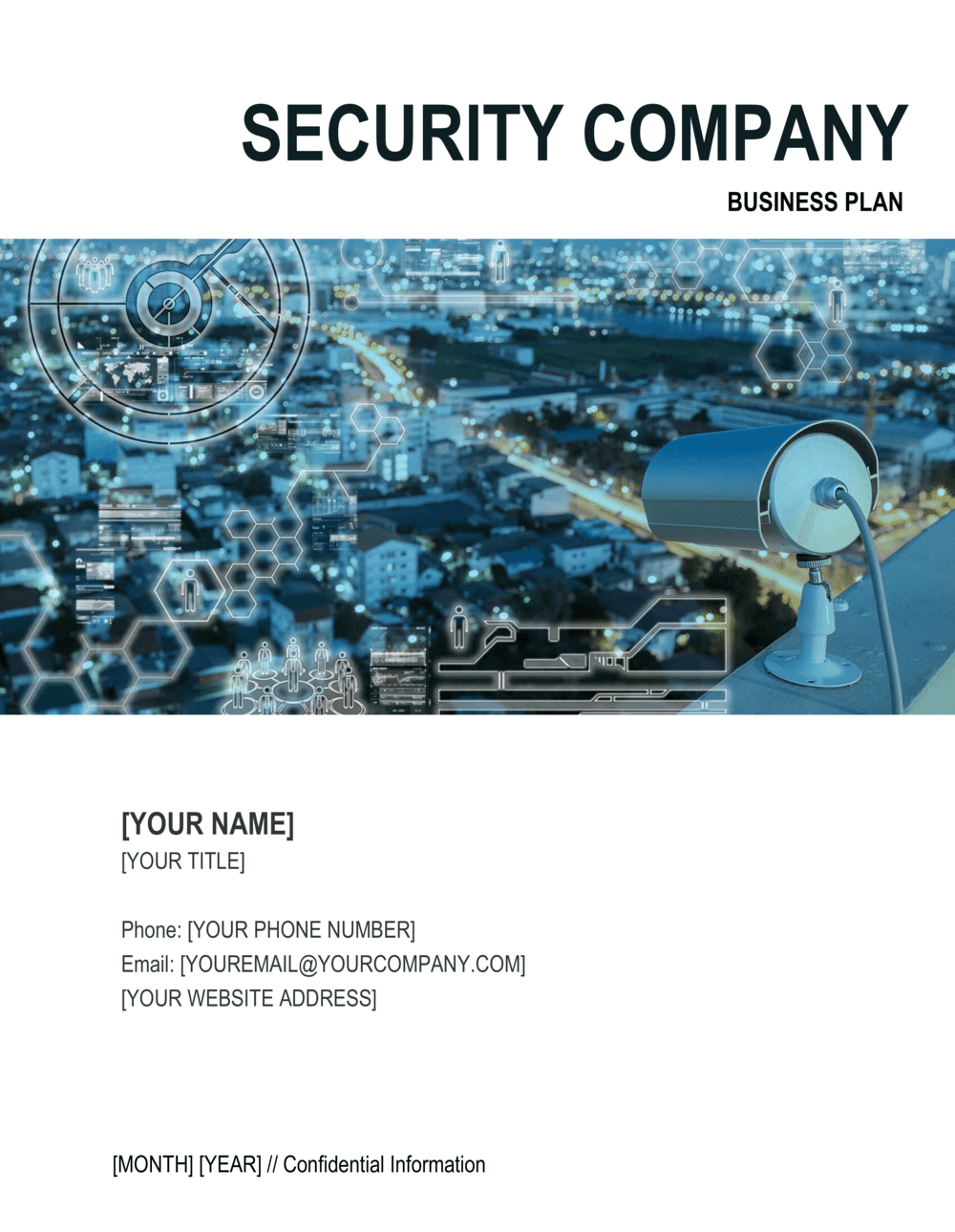
Security Company Business Plan 2 Template

Free Word download β€’ Edit online β€’ Save & share with Drive β€’ Export to PDF

33 pagesβ€’2h 45m – 3h 40m to fillβ€’Difficulty: Expert
Learn more ↓
FreeSecurity Company Business Plan 2 Template

At a glance

What it is
A Security Company Business Plan is a structured document that maps a private security firm's service offering, target market, licensing and compliance framework, operational model, staffing plan, and financial projections into a single investor- and lender-ready file. This free Word download gives you a professionally formatted starting point you can edit online and export as PDF to share with banks, investors, or licensing authorities.
When you need it
Use it when launching a new security firm, applying for a business loan or state security license, or presenting a growth strategy to investors or partners. It is also the right tool when an existing security company is expanding into new service lines, geographies, or government contracts.
What's inside
Executive summary, company overview, service descriptions, market and competitive analysis, marketing and sales strategy, operations and staffing plan, licensing and compliance framework, and three-year financial projections including P&L, cash flow, and start-up cost breakdown.

What is a Security Company Business Plan?

A Security Company Business Plan is a structured planning document that outlines a private security firm's service offering, licensing and compliance framework, officer staffing model, target market, competitive positioning, and multi-year financial projections. It functions as the primary document used to secure startup financing, satisfy regulatory licensing requirements, and align an operations team around a concrete growth strategy. Unlike a generic business plan, a security-specific plan is built around the economics of billable officer hours β€” the spread between bill rate and pay rate, the cost of compliance, and the operational challenge of deploying licensed, trained staff at scale.

Why You Need This Document

Without a written business plan, security firm founders face three immediate and concrete obstacles: banks and SBA lenders will not process a loan application, many state licensing authorities will question your organizational readiness, and prospective clients running formal procurement processes will disqualify bids that lack documented operational capacity. The cost structure of a security company β€” weekly payroll, high insurance premiums, mandatory licensing fees, and a 4–6 week gap before first client collections β€” creates a cash exposure that only a carefully modeled financial plan can expose and solve before you spend real money. This template gives you a complete, professionally structured starting point so you can focus your time on the market research, officer pipeline, and contract relationships that will determine whether the numbers actually work.

Which variant fits your situation?

If your situation is…Use this template
Starting a residential and commercial guard services companySecurity Company Business Plan 2
Launching an executive protection or VIP security firmSecurity Consulting Business Plan
Opening a private investigation agency alongside security servicesInvestigation Agency Business Plan
Bidding on a government or municipal security contractBusiness Proposal Template
Quick internal alignment before writing the full planOne-Page Business Plan
Raising seed or angel investment for a security tech startupStartup Business Plan
Planning a new cybersecurity or physical-digital hybrid service lineNew Product Launch Plan

Common mistakes to avoid

❌ Underestimating startup licensing time and cost

Why it matters: A security agency license can take 6–12 weeks to obtain in many states, and you cannot legally deploy officers or sign contracts without it. Delaying the application pushes your first revenue date and burns runway.

Fix: Research the exact licensing requirements and processing times for your state before writing the financial projections, then build the licensing timeline into the first 90 days of your operations plan.

❌ Ignoring the payroll-to-collections cash gap

Why it matters: Security firms pay officers weekly or bi-weekly but invoice clients on Net 30 terms. In Month 1, you will pay 4–6 weeks of wages before receiving any client payment, creating a predictable cash shortfall.

Fix: Include a working capital line item in your funding request β€” typically 6–8 weeks of projected payroll β€” and model the cash flow statement monthly for the first year.

❌ Presenting a generic national market size without local demand data

Why it matters: Telling a lender the US security market is worth $50B does not tell them whether there are enough contracts in your city to support your revenue projections.

Fix: Supplement national figures with local data β€” number of commercial properties, planned events, retail centers, and government facilities in your target geography, with an estimated annual contract value.

❌ Building revenue projections without a named contract pipeline

Why it matters: A bottom-up revenue model based on anonymous market share is unconvincing to lenders. One signed letter of intent from a property manager is worth more than ten pages of market analysis.

Fix: Before finalizing projections, secure at least one letter of intent or conditional contract, and reference it by name in the financial projections section.

❌ Staffing the plan at 100% officer utilization

Why it matters: Scheduling officers at 100% contracted hours with no bench leaves no capacity for callouts, training days, or new contract ramp-up β€” the most common operational failure point for new security firms.

Fix: Plan for 80–85% utilization and budget a 15–20% bench, priced into your overhead before presenting gross margin figures.

❌ Omitting insurance requirements and costs

Why it matters: Commercial general liability, workers' compensation, and umbrella coverage for a security firm are significantly more expensive than for most service businesses β€” omitting them makes the cost structure appear falsely favorable.

Fix: Get actual insurance quotes before writing the plan and include them as fixed-cost line items in both the startup costs and the annual operating budget.

The 10 key sections, explained

Executive Summary

Company Overview

Services Offered

Market Analysis

Competitive Analysis

Marketing and Sales Strategy

Operations and Staffing Plan

Licensing and Compliance Framework

Financial Projections

Funding Requirements and Use of Funds

How to fill it out

  1. 1

    Complete the company overview and licensing status

    Enter your legal entity name, state of incorporation, and current licensing status for both the company and any officers. Specify which licenses are held and which are pending, with target dates.

    πŸ’‘ Confirm your state's security agency license requirements before writing the rest of the plan β€” some states require a licensed officer to hold the agency license, which constrains your founding timeline.

  2. 2

    Define your service lines and bill rates

    List every service you will offer β€” unarmed static, armed, mobile patrol, event security β€” with the bill rate per hour, minimum shift length, and any contract minimums. Tie each rate to a cost-of-service model showing your target gross margin.

    πŸ’‘ A bill-to-pay ratio of 1.45–1.65Γ— is typical for profitable security firms. If your margin falls below 35%, revisit your pay rates or overhead assumptions.

  3. 3

    Build the local market analysis

    Research the number and type of commercial properties, retail centers, events venues, and government facilities in your target geography. Estimate the total annual contract spend and identify which segments you will prioritize in Year 1.

    πŸ’‘ County assessor databases and local chamber of commerce directories are free sources for identifying commercial property owners and property managers.

  4. 4

    Map the competitive landscape

    Identify at least four active competitors in your market β€” large national firms (Allied Universal, Securitas) and local independents. Note their pricing if publicly available, their key client segments, and any service gaps your firm will fill.

    πŸ’‘ Calling competitors as a prospective client to request a quote is a legitimate and commonly used competitive intelligence technique.

  5. 5

    Outline the staffing and training pipeline

    Define how many officers you need at launch and at the end of Year 1. Map the Guard Card licensing timeline and in-house orientation requirements for each hire so your staffing plan aligns with your revenue ramp.

    πŸ’‘ Build a 15–20% officer bench above your contracted hours to cover callouts β€” high absenteeism is the leading cause of contract cancellation in guard services.

  6. 6

    Build the financial model from officer hours up

    Start with the number of contracted guard hours per month. Multiply by bill rate to get revenue. Subtract pay rate Γ— hours, uniform and equipment amortization, dispatch overhead, and insurance to get gross profit. Add G&A to get EBITDA.

    πŸ’‘ Model a 'Month 1 cash gap' scenario where you pay officers in Week 1 but don't receive client payment until Week 6 β€” this is where most new security firms run out of cash.

  7. 7

    Write the executive summary last

    Pull the strongest data point from each section β€” total funding ask, target contracts, projected Year 1 revenue, and your single clearest differentiator β€” and compress them into one to two pages.

    πŸ’‘ Lead the executive summary with a local crime statistic or insurance mandate that quantifies why your target clients need security services now.

Frequently asked questions

What is a security company business plan?

A security company business plan is a structured document that defines a private security firm's service offering, target market, licensing status, operational model, staffing plan, and financial projections. It serves as the primary document when applying for a business loan, state security agency license, or investment β€” and as an internal roadmap for managing the first 12–36 months of operations.

What sections should a security company business plan include?

A complete plan covers ten core areas: executive summary, company overview, services offered with bill rates, local market analysis, competitive analysis, marketing and sales strategy, operations and staffing plan, licensing and compliance framework, financial projections, and funding requirements with use of funds. The licensing and compliance section is unique to security firms and is the first thing regulators and lenders will review.

Do I need a business plan to get a security agency license?

Most US states do not explicitly require a business plan as part of the security agency license application, but many lenders and insurance carriers will ask for one before issuing the financing or coverage you need to operate. Additionally, government contract bidding processes and franchise approvals routinely require a formal business plan demonstrating operational and financial capacity.

How much does it cost to start a security company?

Startup costs typically range from $15,000 to $75,000 depending on the service lines, geography, and whether you are launching with armed or unarmed services. The main cost categories are state agency licensing ($500–$3,000), workers' compensation and liability insurance ($5,000–$20,000 annually), uniforms and equipment ($500–$1,500 per officer), vehicle costs for mobile patrol, and working capital to cover 6–8 weeks of payroll before client invoices are collected.

How do security companies make money?

Security firms earn revenue by billing clients an hourly rate per deployed officer β€” typically $18–$45/hr depending on service type and geography β€” while paying officers $12–$22/hr. The spread between the bill rate and pay rate, minus equipment, insurance, supervision, and overhead, produces the gross margin. Profitable security firms target a 35–45% gross margin and 10–15% EBITDA margin at scale.

What financial projections should a security company business plan include?

Include a monthly P&L for Year 1 and annual statements for Years 2–3, a cash flow statement showing the payroll-to-collections gap in the first 90 days, a startup cost breakdown, and a breakeven analysis. Build revenue from officer hours contracted rather than from a top-down market share assumption β€” lenders will test the math.

Can I write a security company business plan myself?

Yes. A structured template handles the format and prompts you through every required section. The substantive work β€” researching local demand, modeling bill rates and officer costs, and mapping the licensing timeline β€” requires your direct knowledge of the market you plan to enter. Consider a one-session review with a SCORE mentor or SBA advisor before submitting to a lender to stress-test your financial assumptions.

What makes a security company business plan different from a standard business plan?

Three things distinguish it: a dedicated licensing and compliance section covering agency and officer credentials, an operations plan that accounts for officer bench capacity and callout management, and a financial model built from bill rate Γ— contracted hours rather than a product revenue model. Insurance costs are also a materially larger line item than in most service business plans and must be quoted before the plan is finalized.

How long should a security company business plan be?

For bank financing or investor presentations, 20–30 pages plus a financial model appendix is appropriate. For a state license application or internal use, a condensed 10–15 page version focused on operations, staffing, and licensing is sufficient. Avoid padding with generic industry statistics β€” lenders want specific local market data and a credible contract pipeline.

How this compares to alternatives

vs Generic Business Plan

A generic business plan template covers the standard sections but lacks the licensing and compliance framework, officer staffing model, and bill-rate-based financial structure specific to security firms. A security-specific plan pre-builds the sections regulators and lenders will scrutinize most, saving significant rework.

vs One-Page Business Plan

A one-page plan is useful for internal alignment and early ideation but does not meet the documentation requirements for a security agency license application, SBA loan, or investor due diligence. Use the one-page format to validate your concept, then build the full plan before any formal submission.

vs Business Proposal

A business proposal is a client-facing document used to bid on a specific security contract β€” it presents scope, staffing, and pricing for one engagement. A business plan is the company-level document that demonstrates the organizational and financial capacity behind all your proposals. You need both: the plan to get funded and licensed, the proposal to win individual contracts.

vs Strategic Plan

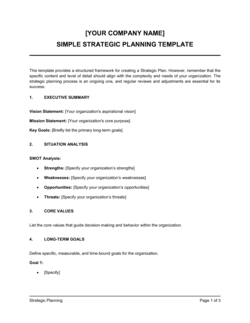
A strategic plan is an internal multi-year roadmap for an operating business β€” goals, KPIs, and resource allocation. A business plan is an external-facing capital document that adds market context, competitive positioning, and a full financial model. A security company typically uses the business plan at launch and transitions to a strategic plan once operations are established.

Industry-specific considerations

Commercial Real Estate

Long-term static guard contracts for office buildings and mixed-use developments, where low turnover and branded uniforms are key client requirements.

Retail and Loss Prevention

Loss prevention officers deployed in high-shrinkage environments with performance metrics tied to theft reduction rates and incident reports per shift.

Events and Hospitality

Variable-staffing event security contracts that require rapid scaling of licensed officers for concerts, sports events, and corporate functions.

Government and Municipal

Formal RFP and procurement processes, bonding and insurance minimums above commercial thresholds, and compliance with prevailing wage rules in many jurisdictions.

Template vs pro β€” what fits your needs?

PathBest forCostTime
Use the templateFounders launching a guard services firm, applying for an SBA loan under $350K, or preparing an initial investor presentationFree2–3 weeks (30–50 hours)
Template + professional reviewFirst-time security entrepreneurs who need a SCORE mentor, SBA advisor, or accountant to stress-test financial assumptions before a bank submission$500–$2,0003–4 weeks
Custom draftedSecurity firms pursuing government contracts above $500K, institutional investors, or multi-state expansion requiring a professionally written plan with audited financials$3,000–$8,0004–8 weeks

Glossary

Guard Licensing
State or provincial certification required before a security officer may legally perform armed or unarmed guard duties, typically including background checks, training hours, and a written exam.
Post Orders
Written instructions issued to security officers for a specific assignment, detailing duties, escalation procedures, and conduct expectations at that site.
Unarmed vs. Armed Services
Unarmed security involves patrol and access control without weapons; armed security requires additional firearms licensing, training, and liability insurance.
SIA Licence / Guard Card
Jurisdiction-specific credentials β€” called a Guard Card in most US states and an SIA licence in the UK β€” authorizing an individual to work as a security officer.
PSIRA
Private Security Industry Regulatory Authority β€” South Africa's regulator for private security firms, used here as shorthand for the category of national security industry regulators found in many countries.
Contract Security
Security services provided by a third-party firm under a service agreement, as opposed to proprietary security employed directly by the client.
Revenue per Officer (RPO)
Total billable revenue divided by the number of deployed security officers β€” a key operational efficiency metric for staffing-intensive security firms.
Bill Rate vs. Pay Rate
The bill rate is what the client pays per officer per hour; the pay rate is what the officer earns. The spread between the two, minus overhead, is the gross margin.
Loss Prevention
Security services specifically focused on reducing theft, fraud, and inventory shrinkage β€” common in retail, logistics, and warehouse environments.
Patrol Density
The number of security officers or patrol units assigned per square foot or per site, used to price contracts and demonstrate coverage capacity to clients.

Part of your Business Operating System

This document is one of 3,000+ business & legal templates included in Business in a Box.

  • Fill-in-the-blanks β€” ready in minutes
  • 100% customizable Word document
  • Compatible with all office suites
  • Export to PDF and share electronically

Create your document in 3 simple steps.

From template to signed document β€” all inside one Business Operating System.
1
Download or open template

Access over 3,000+ business and legal templates for any business task, project or initiative.

2
Edit and fill in the blanks with AI

Customize your ready-made business document template and save it in the cloud.

3
Save, Share, Send, Sign

Share your files and folders with your team. Create a space of seamless collaboration.

Save time, save money, and create top-quality documents.

β˜…β˜…β˜…β˜…β˜…

"Fantastic value! I'm not sure how I'd do without it. It's worth its weight in gold and paid back for itself many times."

Managing Director Β· Mall Farm
Robert Whalley
Managing Director, Mall Farm Proprietary Limited
β˜…β˜…β˜…β˜…β˜…

"I have been using Business in a Box for years. It has been the most useful source of templates I have encountered. I recommend it to anyone."

Business Owner Β· 4+ years
Dr Michael John Freestone
Business Owner
β˜…β˜…β˜…β˜…β˜…

"It has been a life saver so many times I have lost count. Business in a Box has saved me so much time and as you know, time is money."

Owner Β· Upstate Web
David G. Moore Jr.
Owner, Upstate Web

Run your business with a system β€” not scattered tools

Stop downloading documents. Start operating with clarity. Business in a Box gives you the Business Operating System used by over 250,000 companies worldwide to structure, run, and grow their business.

Start freeΒ Β·Β No credit card required