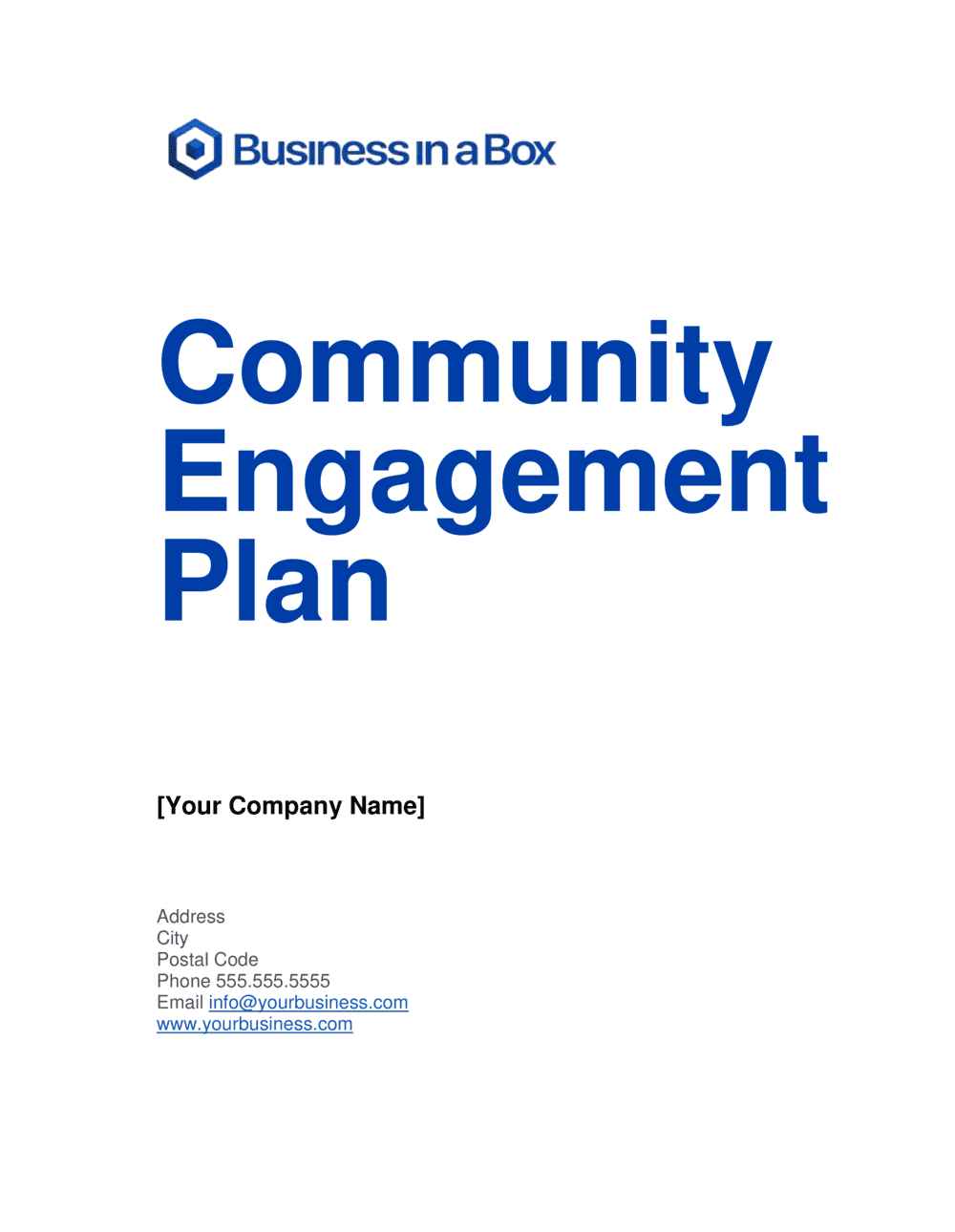
Community Engagement Plan Template

Free Word download β€’ Edit online β€’ Save & share with Drive β€’ Export to PDF

13 pagesβ€’25–35 min to fillβ€’Difficulty: Complex
Learn more ↓
FreeCommunity Engagement Plan Template

At a glance

What it is
A Community Engagement Plan is a structured operational document that defines how an organization will identify, communicate with, and involve its key stakeholder communities in decisions, projects, or programs. This free Word download gives you a ready-to-edit framework covering stakeholder mapping, engagement objectives, communication channels, activity scheduling, and outcome measurement β€” all in a single shareable document you can export as PDF.
When you need it
Use it when launching a project that affects a defined community β€” a new development, a public program, a nonprofit initiative, or a corporate social responsibility campaign β€” and when you need a documented plan to coordinate outreach, manage expectations, and track participation.
What's inside
Executive summary, stakeholder identification matrix, engagement goals and objectives, communication channels and messaging, activity timeline, roles and responsibilities, budget overview, and an evaluation and reporting framework to measure whether engagement efforts are achieving their intended outcomes.

What is a Community Engagement Plan?

A Community Engagement Plan is a structured operational document that defines how an organization will identify its key stakeholder communities, communicate with them, and involve them in decisions related to a specific project, program, or ongoing initiative. It maps who needs to be reached, what engagement looks like at each level β€” from informing to collaborating β€” and how feedback will be collected, reviewed, and reflected back to the people who provided it. Unlike a communications plan that focuses on one-way messaging, a community engagement plan is built around two-way dialogue: it commits the organization to genuine participation and provides a documented framework that holds the process accountable to measurable outcomes.

Why You Need This Document

Without a written community engagement plan, outreach efforts are inconsistent, hard-to-reach stakeholder groups are systematically missed, and feedback collected during public meetings or surveys rarely reaches the people making project decisions. The consequences are concrete: projects face last-minute objections from communities that weren't consulted, grant funders reject applications that lack documented participation processes, and government approvals stall when statutory consultation requirements haven't been met. A well-structured engagement plan prevents all of these outcomes by establishing a clear stakeholder map, a realistic activity schedule, named accountability, and a feedback loop that closes the communication cycle. This template gives you a ready-to-edit starting point that covers every core component β€” from stakeholder analysis to evaluation β€” so you can focus on building relationships rather than building structure from scratch.

Which variant fits your situation?

If your situation is…Use this template
Engaging stakeholders on a specific capital project or construction developmentStakeholder Engagement Plan
Planning outreach and communications for a nonprofit program launchNonprofit Communication Plan
Documenting public consultation for a government or municipal processPublic Consultation Plan
Coordinating internal and external communications for a corporate initiativeCommunications Plan
Managing relationships with investors, partners, and regulators at the corporate levelStakeholder Management Plan
Tracking volunteer activities and community hours for a CSR programVolunteer Program Plan
Reporting on community engagement outcomes at year endCSR Report

Common mistakes to avoid

❌ Treating engagement as a one-time event

Why it matters: A single public meeting held at the start of a project creates the illusion of consultation without giving stakeholders meaningful input into decisions made throughout the project lifecycle.

Fix: Schedule engagement activities at each major project phase β€” not just at the outset β€” and explicitly link each activity to the decisions it will inform.

❌ Excluding hard-to-reach populations

Why it matters: Engagement plans that rely solely on digital or self-selecting channels systematically under-represent elderly, low-income, non-English-speaking, and rural community members β€” groups whose concerns can surface as opposition late in the project.

Fix: Allocate specific budget and activities for reaching excluded groups β€” in-person sessions, translated materials, and community intermediaries are the most effective tools.

❌ Failing to close the feedback loop

Why it matters: When stakeholders contribute input and never hear what happened to it, they conclude that the engagement was performative β€” and they tell others, reducing future participation and damaging organizational credibility.

Fix: Publish a 'You said, we did' summary after every engagement activity and share it proactively with everyone who participated.

❌ No named engagement lead with decision-making access

Why it matters: When engagement is owned collectively or assigned to a junior coordinator with no authority, community concerns accumulate without being escalated β€” and typically reach a tipping point at the worst possible time in the project.

Fix: Name one senior person as engagement lead, give them a direct line to the project decision-maker, and confirm this accountability in writing in the plan.

The 10 key sections, explained

Executive Summary

Project and Context Overview

Stakeholder Identification and Analysis

Engagement Goals and Objectives

Communication Channels and Messaging

Engagement Activity Schedule

Roles and Responsibilities

Budget Overview

Feedback Management and Response Process

Evaluation and Reporting Framework

How to fill it out

  1. 1

    Define the project context and scope

    Write a clear description of the project or initiative driving the engagement β€” what is changing, why, and what decisions are still open to community input. Be specific about geography, timeline, and scale.

    πŸ’‘ If stakeholders can't tell from your context section what decisions they can actually influence, they will assume none β€” and participation will be low from the start.

  2. 2

    Identify and map all stakeholder groups

    List every group with a potential interest β€” residents, advocacy groups, regulators, businesses, employees, and underserved populations. Rate each group's level of influence and interest using a 2Γ—2 matrix or the IAP2 spectrum.

    πŸ’‘ Interview two or three frontline staff members before finalizing your stakeholder list β€” they often know community concerns and informal leaders that aren't visible in official records.

  3. 3

    Set engagement goals using measurable objectives

    For each major stakeholder group, define one or two goals and pair each with a measurable target β€” number reached, response rate, or decisions demonstrably shaped by input.

    πŸ’‘ At least one objective per group should be outcome-based, not output-based. 'X% of surveyed residents reported feeling informed' is an outcome; 'hold two town halls' is an output.

  4. 4

    Match communication channels to each stakeholder group

    Select the two or three channels most likely to reach each group β€” door-to-door for elderly residents, social media for younger audiences, formal letters for businesses and regulators. Write tailored key messages for each group.

    πŸ’‘ Plain-language versions of technical documents increase participation rates in community engagement by 20–40% in most government studies.

  5. 5

    Build the activity schedule with owners and dates

    List every planned engagement activity with a specific date, format, target audience, and named owner. Spread activities across the project lifecycle rather than front-loading them before key decisions are finalized.

    πŸ’‘ Build in at least one engagement touchpoint after each major project decision so stakeholders can see how input was used β€” this is the most effective driver of participation in later phases.

  6. 6

    Assign roles and name a single engagement lead

    Designate one person as the overall engagement lead with authority to coordinate feedback, escalate issues, and communicate outcomes to stakeholders. Assign supporting roles for communications, logistics, and record-keeping.

    πŸ’‘ The engagement lead should have direct access to the project decision-maker β€” if they can't get answers quickly, they can't respond to community feedback before it becomes a public issue.

  7. 7

    Define the feedback management process

    Document exactly how feedback will be collected, logged, reviewed, and responded to β€” including the timeframe for each step and the format of the response stakeholders will receive.

    πŸ’‘ A simple 'You said, we did' summary published after each engagement activity is more credible than a formal report produced six months later.

  8. 8

    Set evaluation indicators and a reporting schedule

    Define the quantitative indicators (reach, response rate, attendance) and qualitative indicators (sentiment, feedback themes) you will track. Set a reporting date and audience for the final engagement summary.

    πŸ’‘ Share the draft evaluation framework with two or three community stakeholders before the plan is finalized β€” their input on what 'good engagement' looks like will improve your indicators and build early trust.

Frequently asked questions

What is a community engagement plan?

A community engagement plan is a structured document that defines how an organization will identify, communicate with, and involve stakeholder communities in decisions related to a project, program, or initiative. It typically covers stakeholder identification, engagement goals, communication channels, activity scheduling, roles and responsibilities, and a framework for measuring outcomes. It serves as both an internal coordination tool and a documented commitment to meaningful community involvement.

Who needs a community engagement plan?

Nonprofits managing grant-funded programs, local government agencies conducting public consultations, real estate developers seeking community support for projects, healthcare organizations launching new services, and corporate CSR teams formalizing stakeholder outreach all use community engagement plans. Any organization making decisions that affect a defined community benefits from a written plan that holds the engagement process accountable to stated objectives.

What is the difference between a community engagement plan and a communications plan?

A communications plan focuses on how an organization broadcasts information to its audiences β€” messaging, channels, timing, and tone. A community engagement plan goes further by defining how stakeholders will participate in or influence decisions, not just receive information. Engagement plans include two-way feedback mechanisms, stakeholder influence mapping, and outcome measurement that a communications plan typically does not.

What is the IAP2 spectrum and how does it apply?

The IAP2 (International Association for Public Participation) spectrum classifies engagement into five levels: Inform, Consult, Involve, Collaborate, and Empower. Each level describes a different degree of stakeholder influence over decisions. A community engagement plan should explicitly assign an IAP2 level to each stakeholder group so everyone β€” inside the organization and outside it β€” understands how much influence community input will actually have.

How long should a community engagement plan be?

For most organizational projects, a community engagement plan runs 8–15 pages plus appendices such as the stakeholder matrix and activity schedule. Large public infrastructure projects or multi-year nonprofit programs may warrant 20–30 pages. One-page summaries are useful for sharing with community stakeholders but should supplement, not replace, the full plan.

How do you measure the success of a community engagement plan?

Effective measurement combines quantitative indicators β€” number of stakeholders reached, survey response rates, event attendance, and percentage of feedback themes addressed in project decisions β€” with qualitative indicators such as stakeholder sentiment surveys and documented examples of how community input changed an outcome. Measuring only activity outputs (meetings held, emails sent) without outcome indicators is the most common evaluation weakness in community engagement practice.

How often should a community engagement plan be updated?

Review and update the plan at each major project phase transition, when the stakeholder landscape changes significantly, or when actual engagement activities depart materially from what was planned. For multi-year programs, a full annual review is standard, with a mid-year checkpoint against participation and feedback data. An outdated engagement plan that no longer reflects the current project status is worse than no plan β€” it creates false expectations for both staff and community members.

What is the most common reason community engagement plans fail?

The most common failure is the absence of a genuine feedback loop β€” organizations collect community input but never communicate back what happened to it. The second most common failure is treating engagement as a front-loaded activity rather than an ongoing process, so stakeholder concerns surface publicly after key decisions have already been finalized. Both failures erode trust faster than no engagement at all, because they signal that the process was performative.

How this compares to alternatives

vs Communications Plan

A communications plan defines how an organization sends information to its audiences β€” messaging, channels, and timing. A community engagement plan defines how stakeholders are invited to participate in or influence decisions, including two-way feedback mechanisms and outcome measurement. Use a communications plan when the goal is broadcasting; use an engagement plan when the goal is genuine participation.

vs Stakeholder Management Plan

A stakeholder management plan typically focuses on managing individual relationships with influential parties β€” investors, regulators, and board members β€” often in a corporate or project management context. A community engagement plan is broader, addressing groups and communities rather than named individuals, and centers on public participation and trust-building rather than influence management.

vs Marketing Plan

A marketing plan is designed to acquire customers or grow revenue through campaigns, channels, and messaging. A community engagement plan is designed to build relationships, gather input, and earn trust from stakeholders who are not necessarily customers. The audiences, objectives, and success metrics are fundamentally different even when the channels overlap.

vs Project Communication Plan

A project communication plan coordinates information flow among internal project team members and formal project stakeholders such as sponsors, vendors, and clients. A community engagement plan reaches outward to affected communities and the public β€” people who are not part of the project team but whose support, input, or acceptance is needed for the project to succeed.

Industry-specific considerations

Nonprofit and Social Services

Grant funders increasingly require documented community engagement plans as proof of participatory program design, with stakeholder input tied to program objectives and evaluation frameworks.

Government and Public Sector

Statutory consultation requirements for planning, zoning, and infrastructure decisions mean engagement plans must meet regulatory standards for notice periods, accessibility, and documented response to public submissions.

Real Estate and Urban Development

Community engagement plans are critical to project approvals in contested neighborhoods β€” early, documented stakeholder outreach reduces permit delays and formal objections that add months to timelines.

Healthcare and Community Health

Community health organizations use engagement plans to build patient trust, coordinate with local service providers, and demonstrate community needs assessments required by accreditation bodies and public health funders.

Education

Schools and universities use engagement plans to align parents, students, staff, and community partners around curriculum changes, capital projects, or new program launches β€” particularly when the changes affect surrounding neighborhoods.

Energy and Infrastructure

Utility companies and infrastructure developers face mandatory social license requirements in many jurisdictions, making community engagement plans foundational to environmental impact assessments and project approvals.

Template vs pro β€” what fits your needs?

PathBest forCostTime
Use the templateNonprofits, small organizations, and project teams running straightforward community outreach with internal staffFree4–8 hours
Template + professional reviewGovernment agencies with statutory consultation requirements, or organizations running engagement for contentious or high-visibility projects$500–$2,000 for a community engagement specialist review1–2 weeks
Custom draftedLarge infrastructure projects, legally mandated public consultations, or multi-year programs with complex multi-stakeholder environments$3,000–$15,000 for a specialist firm3–6 weeks

Glossary

Stakeholder
Any individual, group, or organization with an interest in or ability to influence the outcome of a project or initiative.
Stakeholder Mapping
The process of identifying all relevant stakeholders and categorizing them by their level of influence and interest so engagement effort can be prioritized.
Engagement Level
A classification of how deeply stakeholders are involved β€” ranging from inform-only at the lowest level to collaborate or empower at the highest.
IAP2 Spectrum
The International Association for Public Participation's framework classifying public engagement into five levels: Inform, Consult, Involve, Collaborate, and Empower.
Key Message
A concise, audience-specific statement that communicates what an organization wants a stakeholder group to understand or feel about a project or decision.
Feedback Loop
A defined process for collecting stakeholder input, acknowledging it, and reporting back on how it influenced decisions β€” closing the communication cycle.
Community of Interest
A group of people connected by a shared concern, location, or affiliation rather than formal membership β€” often the primary audience for engagement plans.
Engagement Activity
A specific, scheduled interaction with a stakeholder group β€” such as a public meeting, survey, focus group, or workshop β€” designed to achieve a defined engagement objective.
Tone of Engagement
The manner and register in which communications are delivered to stakeholders β€” whether formal or informal, technical or plain language, depending on the audience.
Outcomes Measurement
The process of evaluating whether engagement activities achieved their intended results, using both quantitative indicators (attendance, survey responses) and qualitative feedback.

Part of your Business Operating System

This document is one of 3,000+ business & legal templates included in Business in a Box.

  • Fill-in-the-blanks β€” ready in minutes
  • 100% customizable Word document
  • Compatible with all office suites
  • Export to PDF and share electronically

Create your document in 3 simple steps.

From template to signed document β€” all inside one Business Operating System.
1
Download or open template

Access over 3,000+ business and legal templates for any business task, project or initiative.

2
Edit and fill in the blanks with AI

Customize your ready-made business document template and save it in the cloud.

3
Save, Share, Send, Sign

Share your files and folders with your team. Create a space of seamless collaboration.

Save time, save money, and create top-quality documents.

β˜…β˜…β˜…β˜…β˜…

"Fantastic value! I'm not sure how I'd do without it. It's worth its weight in gold and paid back for itself many times."

Managing Director Β· Mall Farm
Robert Whalley
Managing Director, Mall Farm Proprietary Limited
β˜…β˜…β˜…β˜…β˜…

"I have been using Business in a Box for years. It has been the most useful source of templates I have encountered. I recommend it to anyone."

Business Owner Β· 4+ years
Dr Michael John Freestone
Business Owner
β˜…β˜…β˜…β˜…β˜…

"It has been a life saver so many times I have lost count. Business in a Box has saved me so much time and as you know, time is money."

Owner Β· Upstate Web
David G. Moore Jr.
Owner, Upstate Web

Run your business with a system β€” not scattered tools

Stop downloading documents. Start operating with clarity. Business in a Box gives you the Business Operating System used by over 250,000 companies worldwide to structure, run, and grow their business.

Start freeΒ Β·Β No credit card required