Employee Engagement and Satisfaction Policy Template

Free Word download β€’ Edit online β€’ Save & share with Drive β€’ Export to PDF

3 pagesβ€’20–25 min to fillβ€’Difficulty: Standard
Learn more ↓
FreeEmployee Engagement and Satisfaction Policy Template

At a glance

What it is
An Employee Engagement and Satisfaction Policy is a formal document that defines how an organization measures, supports, and improves the engagement and job satisfaction of its workforce. This free Word download gives you a structured, editable template covering goals, measurement tools, manager responsibilities, feedback mechanisms, and accountability β€” ready to customize and share with your leadership team or HR department.
When you need it
Use it when formalizing your organization's commitment to employee well-being, launching a regular engagement survey program, or responding to retention or morale issues that require a documented, systematic approach.
What's inside
Policy purpose and scope, engagement goals and success metrics, survey and feedback mechanisms, manager and leadership responsibilities, recognition and development commitments, action-planning requirements, and a review and accountability schedule.

What is an Employee Engagement and Satisfaction Policy?

An Employee Engagement and Satisfaction Policy is a formal organizational document that defines how a company measures, supports, and continuously improves the engagement and job satisfaction of its workforce. It specifies the survey tools and cadence used to gather employee feedback, the metrics used to track progress over time, the obligations of managers and HR, and the actions the organization commits to taking in response to what it learns. Rather than treating engagement as a cultural aspiration, this policy turns it into an accountable, documented program with named owners, measurable goals, and a defined review schedule.

Why You Need This Document

Without a written engagement policy, most organizations run inconsistent programs β€” a survey goes out one year and nothing happens with the results, managers engage with their teams in wildly different ways, and employees have no visible evidence that their feedback influences anything. The cost is concrete: voluntary turnover driven by disengagement typically runs 50–200% of annual salary per departed employee, and organizations with no structured engagement program lose that talent without ever understanding why. A documented policy closes that gap by standardizing the program, assigning clear accountability to managers, and creating a public commitment to act on what employees say. This template gives you a ready-to-customize starting point that covers every core component β€” goals, measurement, recognition, development, and transparency β€” so you can launch or formalize your engagement program in hours rather than weeks.

Which variant fits your situation?

If your situation is…Use this template
Establishing a high-level organizational commitment to engagementEmployee Engagement and Satisfaction Policy
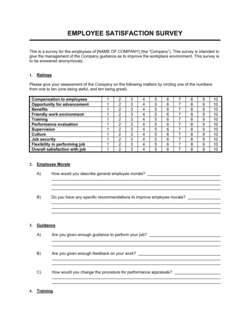
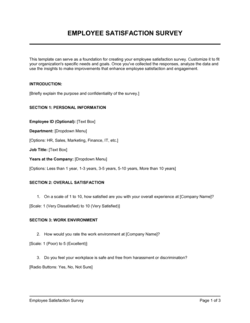
Running a structured annual or quarterly employee surveyEmployee Satisfaction Survey
Setting out the full HR operating framework for people managementEmployee Handbook
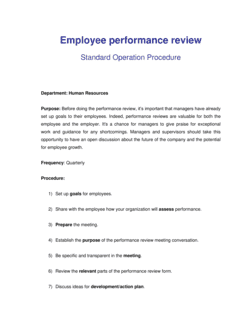
Documenting goals and development commitments for individual employeesEmployee Performance Review
Recognizing and rewarding top performers through a formal programEmployee Recognition Program Policy
Addressing identified retention risks with a structured exit processExit Interview Form
Planning learning and development initiatives to support engagementTraining and Development Plan

Common mistakes to avoid

❌ Publishing survey results with no visible follow-up

Why it matters: When employees see their feedback disappear into silence, participation rates drop sharply in subsequent cycles β€” often by 20–30 points β€” making the program worthless.

Fix: Require managers to share at least one team-level action within 30 days of results release and report progress publicly at a known cadence.

❌ Setting engagement targets without a baseline score

Why it matters: A target of '75% engagement' is meaningless if you don't know whether you are currently at 55% or 72% β€” it makes goal-setting arbitrary and progress unmeasurable.

Fix: Run a baseline survey before finalizing the goals section, or use industry benchmarks as a reference point until internal data is available.

❌ Using aspirational language for manager obligations

Why it matters: Phrases like 'managers are encouraged to review results' produce wildly inconsistent compliance β€” some managers act, most don't, and engagement outcomes diverge across teams.

Fix: State manager obligations as requirements with named deadlines and tie completion rates to the manager's own performance review.

❌ Committing to development budgets without finance approval

Why it matters: Employees who read about a $1,000 annual development budget and are then told it was not funded lose significantly more trust than if no commitment had been made.

Fix: Confirm funding with the CFO or finance business partner before inserting dollar amounts into the policy, and include a clause allowing amounts to be updated annually.

❌ Scoping the policy only to full-time employees

Why it matters: Part-time employees, contractors, and seasonal staff who are excluded from surveys still experience the culture and affect retention β€” leaving them out creates blind spots in engagement data.

Fix: Define scope inclusively or explicitly state exclusions with a rationale, and consider a separate lightweight survey track for non-full-time populations.

❌ Assigning policy ownership to a team or department rather than a named role

Why it matters: Shared ownership means no one tracks the review date, action-plan compliance goes unreported, and the policy becomes outdated without anyone noticing.

Fix: Name a specific job title as policy owner in the accountability section and add the annual review task to that person's documented responsibilities.

The 9 key sections, explained

Policy purpose and scope

Engagement goals and success metrics

Survey and feedback mechanisms

Manager and leadership responsibilities

Recognition and appreciation program

Learning and development commitments

Work environment and well-being standards

Communication and transparency standards

Policy review and accountability schedule

How to fill it out

  1. 1

    Define the policy scope and effective date

    Enter your company's legal name, specify which employee populations are covered (full-time, part-time, contractors), and set the effective date. Align the scope with your payroll and HR records.

    πŸ’‘ If your organization has separate entities or business units with different HR practices, note any scope exclusions explicitly to avoid confusion.

  2. 2

    Set measurable engagement goals with a baseline

    Enter your current engagement score or eNPS as a baseline before setting a target. If you have no prior survey data, run a pilot pulse survey before finalizing the goals section.

    πŸ’‘ A realistic improvement target is 3–5 percentage points per annual cycle β€” companies that set 20-point jumps without structural changes rarely hit them.

  3. 3

    Specify your survey tools and frequency

    Name the survey platform you will use, the question count for each survey type, and the distribution schedule. Include the minimum team size for reporting to protect anonymity.

    πŸ’‘ Match your survey frequency to your capacity to act on results β€” monthly pulse surveys you cannot act on breed cynicism faster than no surveys at all.

  4. 4

    Assign manager responsibilities with deadlines

    Fill in the specific deadlines for managers to review results, hold team discussions, and submit action plans. Name the HR owner who receives and tracks submissions.

    πŸ’‘ Building action-plan completion into manager performance reviews is the single most effective lever for driving consistent follow-through.

  5. 5

    Document recognition and development commitments

    Enter the dollar amount and hours for professional development entitlements, the recognition platform or method, and the cadence for career development conversations.

    πŸ’‘ Get sign-off from Finance on development budgets before publishing the policy β€” a commitment you cannot fund destroys more trust than not committing at all.

  6. 6

    Set communication and transparency standards

    Enter the timeline for sharing results (e.g., within 30 days of survey close), the channel (all-hands, intranet), and who is responsible for the communication.

    πŸ’‘ Schedule result-sharing meetings on the calendar before the survey launches β€” it signals seriousness and prevents delays caused by competing priorities.

  7. 7

    Assign ownership and set the annual review date

    Name a specific role (not a team) as policy owner and enter the annual review month. Add the policy to that person's performance objectives.

    πŸ’‘ Link the policy review cycle to your annual HR calendar β€” running it in the same month as your engagement survey makes it easy to incorporate fresh data.

  8. 8

    Distribute and acknowledge receipt

    Share the finalized policy with all managers and employees via your HRIS or document management system. Collect electronic acknowledgments and log the date.

    πŸ’‘ Add a brief 10-minute policy walkthrough to new-manager onboarding so incoming managers understand their obligations from day one.

Frequently asked questions

What is an employee engagement and satisfaction policy?

An employee engagement and satisfaction policy is a formal document that defines an organization's commitment to measuring and improving how connected, motivated, and satisfied its workforce is. It specifies the tools used to gather feedback, the metrics used to track progress, the responsibilities of managers and HR, and the actions the organization commits to taking in response to what it learns. It turns engagement from a vague aspiration into a documented, accountable program.

Why do organizations need a formal engagement policy?

Without a formal policy, engagement initiatives are inconsistent β€” some managers run team surveys, others don't; some share results, others bury them. A written policy standardizes the program across the organization, assigns clear accountability, and creates a record that the company is meeting its commitments to employees. It also supports employer branding and demonstrates due diligence to investors or acquirers during diligence.

What is the difference between employee engagement and employee satisfaction?

Employee satisfaction measures whether a job meets an employee's basic needs β€” pay, working conditions, and relationships. Employee engagement goes further, measuring whether employees feel emotionally committed to the organization's goals and willing to invest discretionary effort. A satisfied employee does their job; an engaged employee looks for ways to do it better. High satisfaction with low engagement is common and still leads to passive attrition.

How often should we survey employees under this policy?

The most common structure is one annual census survey of 30–50 questions paired with quarterly pulse surveys of 5–10 questions. The annual survey provides a comprehensive baseline; pulse surveys track whether specific interventions are working between cycles. The right frequency depends on your capacity to act on results β€” surveying monthly while taking three months to respond destroys credibility faster than surveying annually.

How do we protect employee anonymity in engagement surveys?

Use a third-party survey platform that aggregates responses before sharing them with the company, and set a minimum team size threshold β€” typically five respondents β€” below which team-level results are not reported. Communicate these protections explicitly before every survey cycle. Never allow managers to see individual responses, and avoid demographic cross-tabs that could identify respondents in small cohorts.

What should managers do when they receive engagement results?

Managers should review results within the deadline specified in the policy, hold a team conversation to discuss key themes without singling out individuals, identify one to three specific actions they will take in the next 30–90 days, and submit a written action plan to HR. Following up on those actions publicly β€” in team meetings or a shared document β€” is what converts survey data into actual engagement improvement.

How does this policy relate to an employee handbook?

An employee handbook sets out the full range of HR policies governing employment β€” from conduct to benefits to leave. An engagement and satisfaction policy is a focused document covering a specific program: how engagement is measured, what the company commits to, and how managers are held accountable. The engagement policy is typically referenced in the handbook but lives as a standalone document that HR can update independently without revising the entire handbook.

What metrics should the policy track?

The most common engagement metrics are an overall engagement score, an eNPS (Employee Net Promoter Score), voluntary turnover rate, manager action-plan completion rate, and survey participation rate. Best-practice organizations also track driver-level scores β€” measuring recognition, development, leadership communication, and workload separately β€” so they can target interventions precisely rather than addressing engagement as a single undifferentiated number.

Can a small business use this policy template effectively?

Yes. Small businesses with as few as 15–20 employees benefit from a documented engagement policy because it formalizes commitments that would otherwise be informal and inconsistent. Smaller organizations can simplify the survey cadence (one annual survey instead of annual plus quarterly) and the reporting structure, but the core elements β€” goals, feedback mechanism, manager responsibilities, and action planning β€” apply regardless of company size.

How this compares to alternatives

vs Employee Handbook

An employee handbook is a comprehensive reference document covering all HR policies β€” conduct, benefits, leave, and compliance. An engagement and satisfaction policy is a focused operational document governing one specific program. The handbook typically references the engagement policy but the two serve different functions: the handbook sets rules, the engagement policy drives culture outcomes.

vs Employee Performance Review

A performance review evaluates an individual employee's output and development against goals. An engagement policy is an organizational commitment to the conditions that make good performance possible. Performance reviews measure the person; the engagement policy measures and improves the environment. Both are necessary β€” neither replaces the other.

vs Training and Development Plan

A training and development plan specifies the learning activities, timelines, and resources for building specific skills. An engagement policy references development as one of several drivers of engagement and sets minimum commitments β€” hours and budget β€” but does not detail the curriculum. Organizations need both: the policy creates the commitment; the training plan delivers it.

vs HR Strategic Plan

An HR strategic plan covers the full range of people priorities β€” talent acquisition, development, compensation, and culture β€” across a multi-year horizon. An engagement policy is narrower: it governs the measurement and improvement of engagement specifically, with defined tools, metrics, and accountability. The HR strategic plan sets direction; the engagement policy operationalizes one critical component of it.

Industry-specific considerations

Technology / SaaS

Engagement policy anchors retention in high-demand talent markets where voluntary turnover is costly; developer and product team engagement scores are often tracked separately from GTM teams.

Healthcare

Engagement directly correlates with patient outcomes and safety metrics; the policy must account for shift workers and clinical staff who cannot participate in surveys during work hours.

Retail / Hospitality

High turnover and hourly workforces make engagement programs particularly valuable; mobile-friendly, short pulse surveys are necessary to reach frontline staff without email access.

Professional Services

Billable-hour pressure creates specific burnout and workload risks; the policy's well-being and workload management sections carry more weight than in other sectors.

Manufacturing

Survey accessibility for shift workers, safety culture as an engagement driver, and union considerations all shape how the policy is structured and communicated.

Financial Services

Regulatory culture and compliance pressure affect psychological safety scores; engagement policy often integrates with conduct risk frameworks and whistleblower programs.

Template vs pro β€” what fits your needs?

PathBest forCostTime
Use the templateHR managers and business owners who need a documented engagement program without a dedicated people operations teamFree2–4 hours to customize and finalize
Template + professional reviewOrganizations rolling out a formal engagement program for the first time or aligning the policy with an existing HRIS or survey platform$300–$800 for an HR consultant review session3–5 days
Custom draftedLarge enterprises with complex org structures, union considerations, or multi-country workforces requiring jurisdiction-specific adaptations$2,000–$8,000 for a specialist HR consulting engagement2–6 weeks

Glossary

Employee Engagement
The degree to which employees feel emotionally committed to their organization's goals, willing to invest discretionary effort, and motivated to contribute beyond minimum requirements.
Employee Satisfaction
An employee's overall assessment of whether their job meets their needs and expectations β€” covering pay, working conditions, relationships, and workload.
Pulse Survey
A short, frequent survey β€” typically 5–15 questions sent monthly or quarterly β€” designed to track shifts in engagement without the length and cost of an annual census survey.
Engagement Score
An aggregated numerical measure derived from survey responses, used to benchmark engagement levels over time and across teams.
eNPS (Employee Net Promoter Score)
A single-question metric that asks employees how likely they are to recommend the organization as a place to work, scored on a 0–10 scale.
Action Planning
The process by which managers and teams review engagement data and commit to specific, time-bound changes in response to identified issues.
Discretionary Effort
The extra time, energy, and initiative an engaged employee voluntarily contributes beyond the minimum required to keep their job.
Stay Interview
A structured one-on-one conversation with a current employee to identify what motivates them to stay and what might cause them to leave β€” used proactively to retain talent.
Turnover Cost
The total direct and indirect cost of replacing an employee, including recruitment, onboarding, lost productivity, and knowledge transfer β€” typically estimated at 50–200% of annual salary.
Manager Effectiveness
A subset of engagement metrics that measures how well managers communicate, recognize, support development, and respond to team feedback.

Part of your Business Operating System

This document is one of 3,000+ business & legal templates included in Business in a Box.

  • Fill-in-the-blanks β€” ready in minutes
  • 100% customizable Word document
  • Compatible with all office suites
  • Export to PDF and share electronically

Create your document in 3 simple steps.

From template to signed document β€” all inside one Business Operating System.
1
Download or open template

Access over 3,000+ business and legal templates for any business task, project or initiative.

2
Edit and fill in the blanks with AI

Customize your ready-made business document template and save it in the cloud.

3
Save, Share, Send, Sign

Share your files and folders with your team. Create a space of seamless collaboration.

Save time, save money, and create top-quality documents.

β˜…β˜…β˜…β˜…β˜…

"Fantastic value! I'm not sure how I'd do without it. It's worth its weight in gold and paid back for itself many times."

Managing Director Β· Mall Farm
Robert Whalley
Managing Director, Mall Farm Proprietary Limited
β˜…β˜…β˜…β˜…β˜…

"I have been using Business in a Box for years. It has been the most useful source of templates I have encountered. I recommend it to anyone."

Business Owner Β· 4+ years
Dr Michael John Freestone
Business Owner
β˜…β˜…β˜…β˜…β˜…

"It has been a life saver so many times I have lost count. Business in a Box has saved me so much time and as you know, time is money."

Owner Β· Upstate Web
David G. Moore Jr.
Owner, Upstate Web

Run your business with a system β€” not scattered tools

Stop downloading documents. Start operating with clarity. Business in a Box gives you the Business Operating System used by over 250,000 companies worldwide to structure, run, and grow their business.

Free Forever PlanΒ Β·Β No credit card required