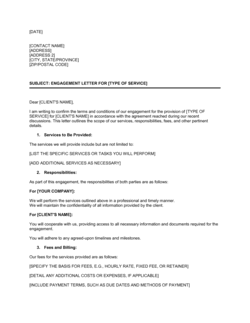
Consulting Engagement Letter Template

Free Word download β€’ Edit online β€’ Save & share with Drive β€’ Export to PDF

3 pagesβ€’20–25 min to fillβ€’Difficulty: Standard
Learn more ↓
FreeConsulting Engagement Letter Template

At a glance

What it is
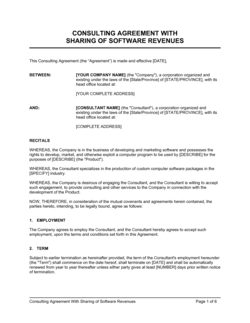
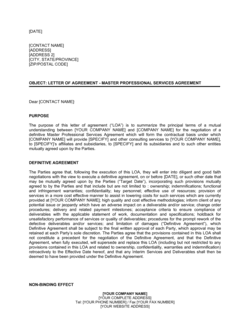
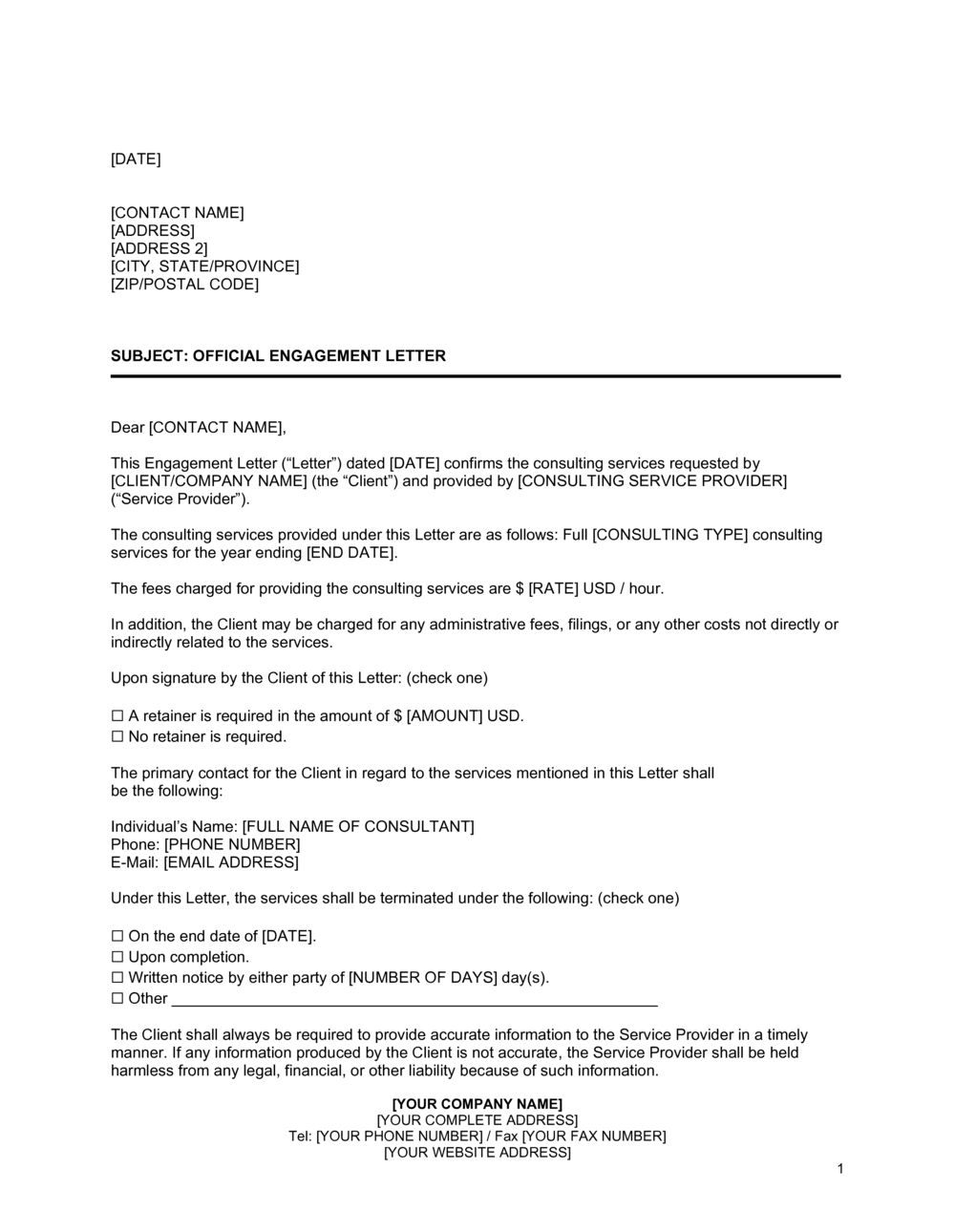
A Consulting Engagement Letter is a formal business letter sent by a consultant or consulting firm to a client before work begins, confirming the agreed scope, fees, timeline, and key terms of the engagement. This free Word download gives you a ready-to-edit template you can customize with your firm's details and export as PDF to send to clients in under 15 minutes.
When you need it
Send it after verbal or preliminary agreement has been reached but before any billable work starts. It is the document that converts an informal discussion into a written record both parties can reference throughout the engagement.
What's inside
Consultant and client identification, scope of services, project timeline and key milestones, fee structure and payment terms, expense reimbursement policy, confidentiality acknowledgment, and a clear statement of what is excluded from the engagement.

What is a Consulting Engagement Letter?

A Consulting Engagement Letter is a formal business letter sent by a consultant or consulting firm to a client immediately after an engagement has been agreed upon and before any billable work begins. It records the scope of services, fee structure, billing schedule, timeline, client responsibilities, and confidentiality expectations in a single concise document that both parties can reference throughout the project. Unlike a full consulting contract, it is designed to be read, understood, and confirmed quickly β€” typically within one or two business days of the initial agreement β€” while still creating a written record enforceable enough to address the most common consulting disputes: scope creep, late payment, and unclear client obligations.

Why You Need This Document

Starting a consulting engagement without a written engagement letter is the single most reliable way to end up working for free, or working indefinitely. Without a defined scope, every client request is implicitly included. Without a specific payment due date, every invoice is at the mercy of an accounts-payable department with no incentive to prioritize it. Without documented client responsibilities, project delays caused by late data delivery or unavailable decision-makers become your problem, not theirs. A consulting engagement letter closes all three gaps in under 30 minutes and gives you a paper trail to fall back on when a client's memory of what was agreed differs from yours. This template gives you a professionally structured starting point that covers every essential clause β€” so you spend your time on the engagement itself, not on building documents from scratch.

Which variant fits your situation?

If your situation is…Use this template
Short project with a fixed deliverable and single paymentConsulting Engagement Letter (Fixed Fee)
Ongoing advisory retainer billed monthlyConsulting Retainer Agreement
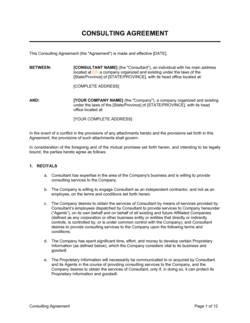
Complex multi-phase project requiring full contract termsConsulting Agreement
Technology-specific project with acceptance testing and IP termsIT Consulting Agreement
Engagement requiring an NDA alongside the letterNon-Disclosure Agreement
Proposal sent before the client has agreed to engageConsulting Proposal
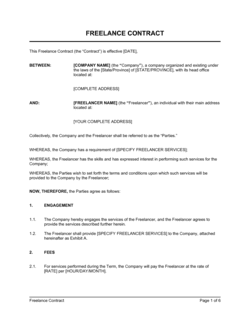
Freelance project without an ongoing consulting relationshipFreelance Contract

Common mistakes to avoid

❌ Vague scope language

Why it matters: Phrases like 'strategic advisory support' give the client unlimited grounds to request additional work at no extra charge. Disputes over what was 'included' are the most common source of consulting payment conflicts.

Fix: List each deliverable by name with a due date and follow it with an explicit out-of-scope list covering the tasks clients most frequently assume are included.

❌ No client obligations clause

Why it matters: Without documented client responsibilities, every project delay is attributed to the consultant. Late data delivery, missed review cycles, and unavailable decision-makers consume billable hours the consultant cannot recover.

Fix: Add a named section listing what the client must provide, the deadline for each item, and a statement that client-caused delays extend the timeline day-for-day.

❌ Payment terms of 'upon receipt' or 'promptly'

Why it matters: These phrases are not enforceable payment terms β€” AP departments interpret them as 45–60 days. Without a specific due date, you have no basis for a late-fee claim.

Fix: Replace with 'Net 15' or 'Net 30 from invoice date' and add a late-fee rate β€” 1.5% per month on overdue balances is standard and acts as a payment accelerant.

❌ Sending the letter after work has already started

Why it matters: An engagement letter signed mid-project does not protect the consultant for work already performed and signals to the client that terms are negotiable after the fact.

Fix: Make it a firm policy to require a signed or confirmed engagement letter before issuing any invoice or delivering any work product β€” including kick-off meeting materials.

❌ Omitting an expense pre-approval threshold

Why it matters: Clients who agreed to 'reimburse reasonable expenses' routinely reject invoices for travel or software costs they consider unnecessary. Without a threshold and approval process, every expense line is a potential dispute.

Fix: State a specific dollar threshold above which expenses require written client approval before being incurred. Include the pre-approval requirement in the expenses clause.

❌ Using a one-sided confidentiality clause

Why it matters: A clause that only binds the consultant leaves your firm's methodologies, pricing, and proprietary frameworks unprotected when a client shares them with a competitor or a subsequent vendor.

Fix: Make confidentiality mutual β€” both parties agree to protect the other's non-public information β€” and define 'Confidential Information' specifically to avoid ambiguity.

The 9 key clauses, explained

Consultant and client identification

In plain language: Identifies the consulting firm or individual and the client by full legal name, sets the date of the letter, and establishes who the primary contacts are on each side.

Sample language
[CONSULTANT NAME / FIRM NAME] is pleased to confirm our engagement with [CLIENT LEGAL NAME] ('Client'), effective [DATE]. Your primary contact at our firm will be [CONTACT NAME, TITLE], reachable at [EMAIL / PHONE].

Common mistake: Using a trading name instead of the registered legal entity name β€” if a payment dispute arises, the letter may not clearly establish which party is owed money.

Purpose and background

In plain language: One or two sentences summarizing the business context that prompted the engagement, so both parties agree on the problem being solved.

Sample language
Client has engaged [FIRM NAME] to assist with [BRIEF DESCRIPTION OF BUSINESS CHALLENGE OR INITIATIVE] in connection with [PROJECT OR PROGRAM NAME].

Common mistake: Omitting this clause entirely and jumping straight to scope. Without shared context, scope language is interpreted differently by each party when disputes arise.

Scope of services

In plain language: Lists the specific tasks and deliverables the consultant will perform, including any phasing, and explicitly states what is out of scope.

Sample language
Services include: (a) [DELIVERABLE 1] by [DATE]; (b) [DELIVERABLE 2] by [DATE]. The following are expressly excluded: [EXCLUDED ACTIVITY 1], [EXCLUDED ACTIVITY 2].

Common mistake: Describing scope in general terms like 'advisory support' without listing deliverables β€” this makes it nearly impossible to push back on scope creep when the client adds tasks.

Timeline and milestones

In plain language: States the engagement start date, key milestone dates, and the expected completion date or conditions under which the engagement concludes.

Sample language
The engagement commences [START DATE] and is expected to conclude by [END DATE]. Key milestones: Phase 1 complete by [DATE]; final report delivered by [DATE].

Common mistake: Setting an end date without a milestone schedule β€” the client treats every week as 'still on track' until the final deadline passes and nothing has been delivered.

Fees and billing schedule

In plain language: States the total fee or rate, the billing frequency, the invoice-to-payment cycle, and any deposit or upfront payment required.

Sample language
Fees for this engagement are $[AMOUNT] [per hour / per day / fixed total], invoiced [weekly / bi-weekly / monthly / at milestones]. Payment is due within [NET 30] days of each invoice date. A deposit of $[AMOUNT] is due upon acceptance of this letter.

Common mistake: Omitting the payment due date and relying on 'upon receipt' β€” this phrase has no legal meaning and routinely results in payment arriving 45–60 days after invoice.

Expense reimbursement

In plain language: Specifies which out-of-pocket costs the client will reimburse, any markup applied, the approval process for large expenses, and the documentation required.

Sample language
Pre-approved out-of-pocket expenses (travel, accommodation, third-party tools) will be billed at cost with receipts. Expenses exceeding $[THRESHOLD] require prior written approval from [CLIENT CONTACT].

Common mistake: Agreeing to 'reimburse reasonable expenses' without a dollar threshold or pre-approval requirement β€” clients and consultants disagree sharply on what 'reasonable' means.

Confidentiality

In plain language: Confirms that both parties will keep each other's non-public information confidential during and after the engagement, and identifies any carve-outs.

Sample language
Each party agrees to keep the other's Confidential Information strictly confidential and not to disclose it to third parties without prior written consent. This obligation survives termination of the engagement for [2] years.

Common mistake: A one-sided confidentiality clause that only binds the consultant β€” clients share the consultant's methods, pricing, and firm know-how with competitors just as readily as consultants share client data.

Client responsibilities

In plain language: Lists what the client must provide β€” information, access, decisions, named contacts β€” and by when, so that delays on the client side do not automatically extend the timeline at the consultant's cost.

Sample language
Client agrees to: (a) provide [DATA / SYSTEM ACCESS / KEY CONTACTS] within [X] business days of engagement start; (b) designate [CLIENT CONTACT NAME] as the primary decision-maker; (c) review and respond to deliverables within [X] business days of receipt.

Common mistake: No client obligations clause at all β€” when the project runs long, the client blames the consultant for delays that were actually caused by late document delivery or missed review cycles.

Acceptance and authorization

In plain language: Confirms how the client accepts the letter β€” signature, email reply, or commencement of work β€” and who is authorized to bind the client.

Sample language
Please confirm your acceptance of these terms by signing below and returning a copy to [EMAIL], or by replying to this email with written confirmation. Acceptance authorizes [CONSULTANT NAME / FIRM] to commence work as described above.

Common mistake: Not specifying who is authorized to accept β€” a junior employee's email reply may not bind the organization, leading the consultant to begin work without a valid engagement.

How to fill it out

  1. 1

    Enter both parties' full legal names and contact details

    Replace all placeholders with the consultant's or firm's registered legal name and the client's registered legal entity name. Include the date the letter is issued and the named contacts on each side.

    πŸ’‘ Ask the client for their legal entity name before drafting β€” trade names and registered names often differ and using the wrong one creates payment-tracing problems.

  2. 2

    Write a one-sentence purpose statement

    Describe the business problem or initiative the engagement addresses in plain language. This does not need to be detailed β€” its job is to anchor the scope clause that follows.

    πŸ’‘ Read the purpose statement back to the client in your next conversation. If they correct it, update the letter before sending β€” mismatched context is the root cause of most scope disputes.

  3. 3

    Define the scope with specific deliverables and exclusions

    List each deliverable with a due date. Then add an explicit out-of-scope list covering the two or three activities clients most commonly assume are included.

    πŸ’‘ If a deliverable is hard to name precisely, describe the acceptance criterion instead β€” 'a written report reviewed and approved by the client's CFO' is clearer than 'strategic recommendations.'

  4. 4

    Set the timeline and milestones

    Enter the start date, at least two interim milestone dates, and the expected completion date. Tie each milestone to a specific deliverable from the scope clause.

    πŸ’‘ Build in a buffer of 20% over your internal estimate β€” client review cycles almost always take longer than the client predicts.

  5. 5

    Specify fees, billing frequency, and payment terms

    Choose fixed fee or time-and-materials, enter the amount or rate, and set a specific due date (e.g., Net 15 or Net 30 from invoice date). Add deposit amount and upfront payment instructions if applicable.

    πŸ’‘ For engagements longer than four weeks, bill at milestones or monthly rather than at the end β€” a single end-of-project invoice is the leading cause of late payment disputes.

  6. 6

    List client responsibilities with deadlines

    Identify every input the client must provide β€” data, access, feedback, approvals β€” and assign a business-day deadline to each. Note that client delays beyond these deadlines will extend the project timeline proportionally.

    πŸ’‘ Getting the client to initial this section separately signals they have read it β€” the clause is useless if the client never sees it in a long letter.

  7. 7

    Confirm the acceptance method and authorized signatory

    State clearly how the client accepts β€” signed copy returned, email confirmation, or commencement of work β€” and specify that only an authorized officer or named contact can bind the organization.

    πŸ’‘ Send the letter as a PDF with a clear call to action in the email body restating the total fee and the acceptance deadline to prompt a faster response.

Frequently asked questions

What is a consulting engagement letter?

A consulting engagement letter is a formal document a consultant or consulting firm sends to a client before work begins, confirming the scope of services, fees, timeline, and key responsibilities in writing. It is less detailed than a full consulting contract but creates a clear mutual record of what has been agreed, reducing the risk of scope disputes and payment delays.

Is a consulting engagement letter legally binding?

A consulting engagement letter is generally enforceable as a contract when it includes an offer (the proposed services), consideration (the agreed fee), and acceptance (a signature, email confirmation, or commencement of work). It is not a substitute for a full consulting agreement in complex or high-value engagements, but for straightforward projects it typically provides sufficient legal grounding to pursue unpaid invoices or dispute resolution.

What is the difference between a consulting engagement letter and a consulting agreement?

An engagement letter is a shorter, lighter document β€” usually 1–3 pages β€” designed to confirm scope, fees, and start date quickly. A consulting agreement is a full contract covering IP ownership, liability caps, indemnification, governing law, dispute resolution, and other risk allocation terms in detail. Use an engagement letter for straightforward, single-phase projects and a full agreement for complex, high-value, or multi-year engagements.

Does a consulting engagement letter need to be signed?

A signature is not strictly required for enforceability in most jurisdictions β€” email confirmation or commencement of work can constitute acceptance. However, a countersigned letter is the clearest evidence of mutual agreement and is strongly recommended for any engagement where fees exceed a few thousand dollars. State the accepted acceptance method explicitly in the letter's closing clause.

What should be included in a consulting engagement letter?

At minimum: both parties' full legal names, a purpose statement, a specific scope of services with named deliverables, an explicit out-of-scope list, the engagement timeline, the fee structure and billing schedule, a payment due date, expense reimbursement terms, client responsibilities, a confidentiality acknowledgment, and the acceptance method. Missing any of these commonly leads to scope disputes or delayed payment.

How is a consulting engagement letter different from a proposal?

A consulting proposal is sent before the client has agreed to engage β€” it makes the case for why the consultant should be hired and what approach will be taken. An engagement letter is sent after agreement has been reached, to confirm the specific terms before work begins. The proposal wins the project; the engagement letter governs it.

Who sends the consulting engagement letter β€” the consultant or the client?

The consultant or consulting firm always sends the engagement letter. It reflects the firm's proposed terms, scope, and fee structure and is addressed to the client for confirmation. Some large corporate clients issue their own master service agreements instead β€” review those carefully before signing, as they often shift IP ownership and liability to the consultant.

Can I use an engagement letter for a retainer arrangement?

A basic engagement letter can cover a monthly retainer β€” including the retainer amount, included hours or services, and rollover policy. For retainers exceeding three months or $10,000 per month, consider a dedicated Consulting Retainer Agreement that addresses renewal, termination notice periods, and what happens to unused hours at the end of each billing cycle.

How detailed should the scope section of a consulting engagement letter be?

Specific enough that a third party who was not part of your initial discussions could determine whether any given task was or was not included. Each deliverable should be named, described in one sentence, and given a due date. Follow the deliverables list with an explicit out-of-scope statement covering the two or three activities clients most frequently assume are included without asking.

How this compares to alternatives

vs Consulting Agreement

A consulting agreement is a full contract covering IP ownership, liability caps, indemnification, governing law, and dispute resolution. A consulting engagement letter is a shorter, faster document that confirms scope, fees, and timeline before work begins. Use the agreement for complex, high-value, or multi-year engagements where risk allocation matters; use the letter for straightforward projects where speed and simplicity are more important.

vs Consulting Proposal

A consulting proposal is a sales document sent before the client has agreed to engage β€” it makes the case for the consultant's approach and qualifications. An engagement letter is sent after agreement is reached, to confirm the specific terms before work begins. The proposal wins the project; the letter governs it.

vs Consulting Retainer Agreement

A retainer agreement is designed for ongoing advisory relationships billed on a recurring monthly basis, covering renewal, termination notice, and rollover terms. An engagement letter suits a defined project with a clear start and end date. Use a retainer agreement when the client relationship is open-ended and the scope resets each month.

vs Statement of Work

A statement of work is a technical document that specifies deliverables, acceptance criteria, and task-level detail β€” typically attached to a master services agreement. An engagement letter is a standalone document that covers both commercial terms and scope in one place. Use a statement of work when a master agreement is already in place; use an engagement letter when you need a single document to cover everything.

Industry-specific considerations

Management consulting

Milestone-based billing tied to workshop delivery and final report sign-off, with a clear out-of-scope list covering implementation work the client may assume is included.

IT and technology consulting

Phased deliverables aligned to sprint cycles, acceptance criteria for each phase, and an explicit statement on who owns intellectual property created during the engagement.

Financial and accounting advisory

Professional standards in many jurisdictions require a written engagement letter before advisory work begins; the letter documents the consultant's independence and the agreed basis of fees.

HR and organizational development

Confidentiality clause extended to cover employee data and survey results, with data handling and destruction obligations stated explicitly.

Template vs pro β€” what fits your needs?

PathBest forCostTime
Use the templateIndependent consultants and small firms handling straightforward, single-phase projects under $50,000Free15–30 minutes per engagement
Template + professional reviewConsultants in regulated industries or engagements over $50,000 where liability exposure warrants a professional check$150–$400 for a one-hour lawyer review1–2 business days
Custom draftedMulti-phase enterprise engagements, IP-sensitive projects, or clients requiring a full master services agreement$800–$2,500 for a custom consulting agreement1–2 weeks

Glossary

Engagement Letter
A formal letter confirming the terms of a professional services relationship before work begins β€” less detailed than a full contract but sufficient to align both parties on scope, fees, and responsibilities.
Scope of Services
The specific tasks, deliverables, and activities the consultant agrees to perform β€” and, equally important, what is explicitly excluded.
Scope Creep
The gradual expansion of project work beyond what was originally agreed, often without a corresponding increase in fees or timeline.
Retainer
A recurring fixed fee paid by the client, typically monthly, to secure the consultant's availability over an ongoing period.
Fixed Fee
A set total price for the entire engagement, regardless of the actual hours worked, agreed in advance.
Time and Materials
A billing arrangement where the client pays for actual hours worked at an agreed hourly or daily rate, plus approved expenses.
Out-of-Pocket Expenses
Costs the consultant incurs on the client's behalf β€” travel, accommodation, software subscriptions β€” that are billed back with or without a markup.
Deliverable
A specific, tangible output the consultant is responsible for producing by an agreed date, such as a report, workshop, or implemented process.
Engagement Period
The defined start and end dates β€” or triggering conditions β€” that bound the consulting work covered by the letter.
Conflict of Interest
A situation in which the consultant's relationship with another client or party could compromise their objectivity or loyalty to the current client.

Part of your Business Operating System

This document is one of 3,000+ business & legal templates included in Business in a Box.

  • Fill-in-the-blanks β€” ready in minutes
  • 100% customizable Word document
  • Compatible with all office suites
  • Export to PDF and share electronically

Create your document in 3 simple steps.

From template to signed document β€” all inside one Business Operating System.
1
Download or open template

Access over 3,000+ business and legal templates for any business task, project or initiative.

2
Edit and fill in the blanks with AI

Customize your ready-made business document template and save it in the cloud.

3
Save, Share, Send, Sign

Share your files and folders with your team. Create a space of seamless collaboration.

Save time, save money, and create top-quality documents.

β˜…β˜…β˜…β˜…β˜…

"Fantastic value! I'm not sure how I'd do without it. It's worth its weight in gold and paid back for itself many times."

Managing Director Β· Mall Farm
Robert Whalley
Managing Director, Mall Farm Proprietary Limited
β˜…β˜…β˜…β˜…β˜…

"I have been using Business in a Box for years. It has been the most useful source of templates I have encountered. I recommend it to anyone."

Business Owner Β· 4+ years
Dr Michael John Freestone
Business Owner
β˜…β˜…β˜…β˜…β˜…

"It has been a life saver so many times I have lost count. Business in a Box has saved me so much time and as you know, time is money."

Owner Β· Upstate Web
David G. Moore Jr.
Owner, Upstate Web

Run your business with a system β€” not scattered tools

Stop downloading documents. Start operating with clarity. Business in a Box gives you the Business Operating System used by over 250,000 companies worldwide to structure, run, and grow their business.

Free Forever PlanΒ Β·Β No credit card required