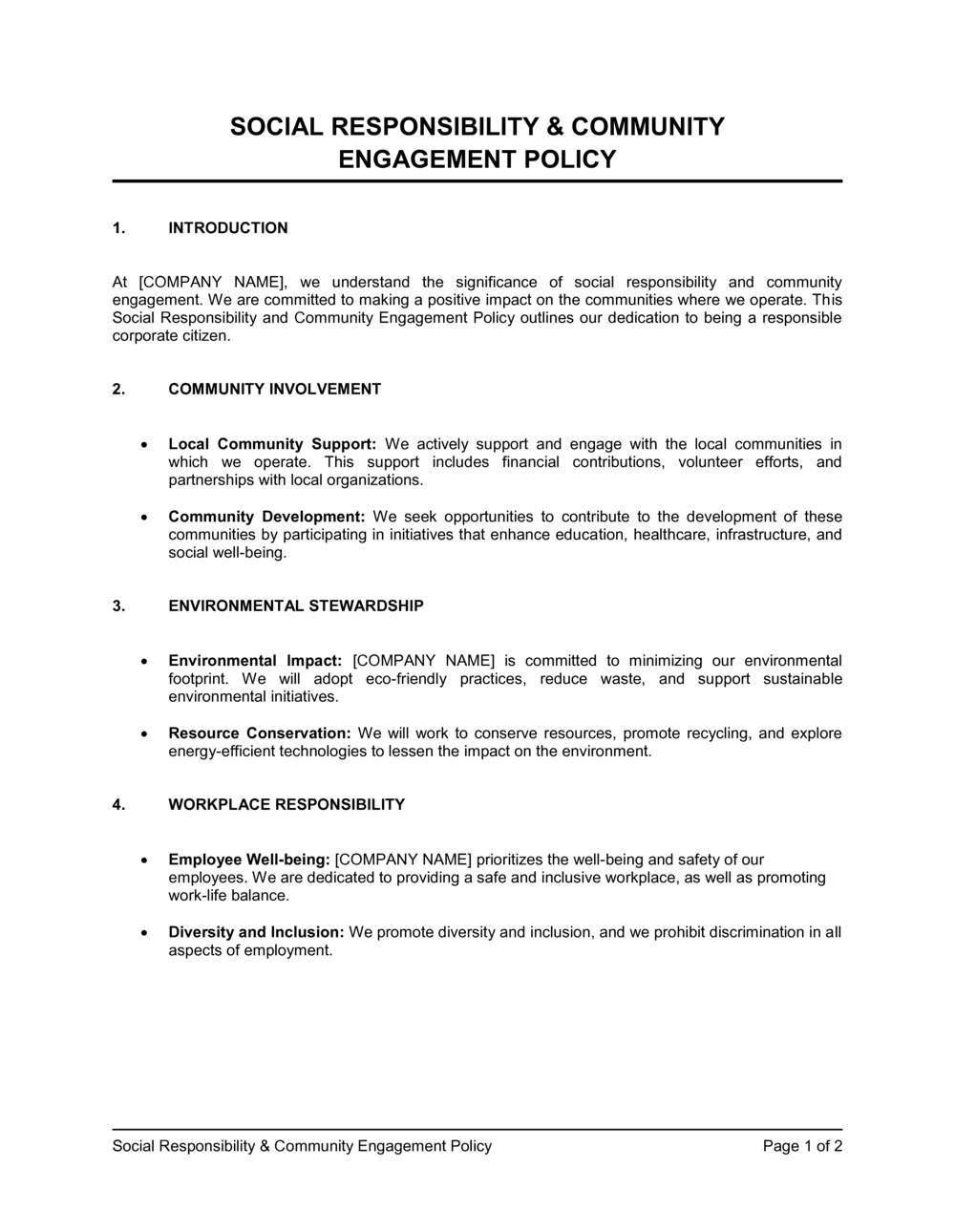
Social Responsibility and Community Engagement Policy Template

Free Word download β€’ Edit online β€’ Save & share with Drive β€’ Export to PDF

2 pagesβ€’20–25 min to fillβ€’Difficulty: Standard
Learn more ↓
FreeSocial Responsibility and Community Engagement Policy Template

At a glance

What it is
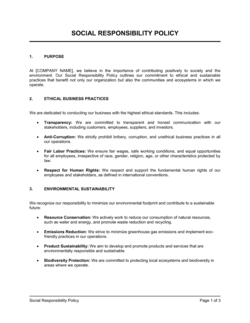
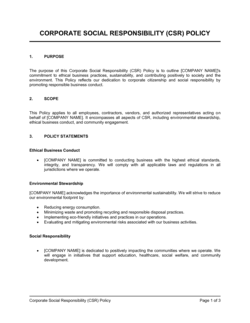
A Social Responsibility and Community Engagement Policy is a formal internal document that defines how a company commits to positive social impact β€” covering charitable giving, employee volunteerism, environmental stewardship, and community partnership programs. This free Word download gives you a structured, editable policy you can tailor to your organization's values and export as PDF to share with employees, stakeholders, or the public.
When you need it
Use it when formalizing CSR commitments for the first time, responding to stakeholder or investor requests for documented social responsibility practices, or building a structured framework around existing informal community programs. It is also used when onboarding new employees who need to understand the company's social values and engagement expectations.
What's inside
Policy purpose and scope, guiding principles and values, charitable giving guidelines, employee volunteer program structure, community partnership criteria, environmental responsibility commitments, reporting and accountability mechanisms, and governance procedures. Each section includes concrete guidance and editable placeholders so the policy reflects your organization's actual practices.

What is a Social Responsibility and Community Engagement Policy?

A Social Responsibility and Community Engagement Policy is a formal organizational document that defines how a company structures, governs, and reports on its commitments to positive social and environmental impact. It covers charitable giving guidelines, employee volunteer programs, community partnership criteria, environmental stewardship targets, and the accountability mechanisms that ensure those commitments are tracked and reported. Unlike informal CSR intentions, a written policy establishes specific budgets, approval processes, and measurable targets that hold the organization accountable across leadership transitions and growth stages.

Why You Need This Document

Without a written policy, CSR activities become inconsistent and reactive β€” donations approved on the basis of personal relationships rather than strategic fit, volunteer hours that go untracked and cannot appear in ESG disclosures, and community partnerships that dissolve when a key contact leaves. The cost of this informality is concrete: institutional investors increasingly require documented CSR policies as part of vendor and investee due diligence; B Corp certification mandates written governance for social and environmental commitments; and enterprise procurement teams routinely screen suppliers using ESG questionnaires that assume a formal policy exists. A properly structured community engagement policy closes these gaps in a single document, giving employees a clear framework for participation, giving leadership a defensible audit trail, and giving external stakeholders the transparency they expect from a responsible business.

Which variant fits your situation?

If your situation is…Use this template
Formalizing a broad CSR strategy across environmental, social, and governance pillarsCorporate Social Responsibility Report
Structuring a standalone employee volunteer program with time-off trackingVolunteer Time-Off Policy
Defining environmental commitments separately from social programsEnvironmental Policy
Establishing an ethical code of conduct covering social responsibility expectationsCode of Ethics and Business Conduct Policy
Documenting diversity, equity, and inclusion commitments as a standalone policyDiversity and Inclusion Policy
Reporting annually on CSR outcomes to shareholders and stakeholdersAnnual Report Template
Creating a formal charitable donation request and approval processCharitable Contributions Policy

Common mistakes to avoid

❌ Committing to external reporting frameworks without data infrastructure

Why it matters: Citing GRI Standards or UN SDGs in the policy signals commitments to specific metrics. If your systems cannot produce those metrics, the policy becomes misleading to investors and auditors.

Fix: Audit your current data collection capabilities before finalizing the reporting section. Start with metrics you can already track and add framework alignment incrementally.

❌ Setting aspirational targets with no baseline data

Why it matters: A target like 'reduce waste by 40% by 2030' is meaningless without a documented baseline. Stakeholders who ask for the baseline year and find it missing lose confidence in the entire policy.

Fix: Establish a baseline measurement for every quantitative commitment before the policy is published. If baseline data does not yet exist, commit to completing the baseline study within a defined timeframe.

❌ Assigning CSR ownership to a committee with no named lead

Why it matters: Shared ownership with no single accountable individual consistently produces missed reporting deadlines, inconsistent donation approvals, and a volunteer program that quietly fades after launch.

Fix: Assign one named individual as CSR owner with explicit accountability for annual reporting and policy review, even if a committee provides oversight and input.

❌ Leaving the volunteer program undocumented

Why it matters: An informal 'we encourage volunteering' statement cannot be included in ESG disclosures, is applied inconsistently by managers, and creates eligibility disputes when employees request time.

Fix: Document the entitlement in hours, the eligible activity types, the approval process, and the tracking method β€” even a simple spreadsheet log is sufficient for small companies.

The 9 key sections, explained

Policy purpose and scope

Guiding principles and values

Charitable giving guidelines

Employee volunteer program

Community partnership criteria

Environmental responsibility commitments

Reporting and impact measurement

Roles and responsibilities

Policy review and governance

How to fill it out

  1. 1

    Define your CSR priorities before editing

    Before opening the template, identify two to four social responsibility focus areas most relevant to your business β€” local community investment, environmental impact, employee wellbeing, or education. These priorities will anchor every section.

    πŸ’‘ Survey employees and review what your closest competitors publicly commit to β€” this surfaces both internal expectations and external benchmarks in under two hours.

  2. 2

    Complete the purpose and scope section

    Enter your company's legal name, the locations or business units covered, and a one-sentence mission statement for your CSR program. Be explicit about who the policy applies to β€” employees only, or also contractors and suppliers.

    πŸ’‘ If your business operates in multiple countries, note that local programs may supplement this policy without conflicting with it β€” this prevents ambiguity for international teams.

  3. 3

    Set concrete charitable giving parameters

    Enter a specific annual giving budget (as a dollar amount or percentage of pre-tax profit), the categories of organizations eligible for support, and the approval threshold above which senior sign-off is required.

    πŸ’‘ A two-tier approval process β€” manager approval under $[X], executive approval above β€” prevents both excessive giving and under-utilization of the budget.

  4. 4

    Configure the volunteer program entitlement

    Specify the number of paid volunteer hours per employee per year, the eligible activity types, the advance notice required for scheduling, and the form or system used to log hours.

    πŸ’‘ Eight hours (one full day) per employee per year is the most common starting point for small and mid-size companies β€” it is achievable without disrupting operations.

  5. 5

    Define community partnership selection criteria

    List the specific criteria a potential partner organization must meet β€” registration status, mission alignment, reporting capability, and conflict-of-interest check. These criteria protect the company from reputational risk.

    πŸ’‘ Include a simple one-page partnership application form as an appendix so prospective partners have a clear path to engagement.

  6. 6

    Set measurable environmental commitments

    Enter specific, time-bound targets for at least two environmental commitments β€” waste reduction percentage, sustainable procurement share, or carbon offset volume. Tie each target to a baseline year.

    πŸ’‘ Only commit to targets you can measure with your current data systems β€” a verifiable 10% reduction beats an aspirational 50% with no baseline.

  7. 7

    Assign roles and establish the reporting cadence

    Name the individual responsible for policy implementation and annual reporting, assign departmental reporting obligations, and set a calendar date for the annual CSR summary publication.

    πŸ’‘ Put the annual CSR review on the governance calendar immediately after adoption β€” policies with no scheduled review date are routinely ignored after the first year.

  8. 8

    Distribute and communicate the policy

    Share the final policy with all employees via your internal communications channel, add it to your employee handbook or intranet, and post a public summary on your website if external stakeholder transparency is a goal.

    πŸ’‘ A brief 15-minute all-hands walkthrough of the policy at launch drives far higher awareness and participation than an email distribution alone.

Frequently asked questions

What is a social responsibility and community engagement policy?

A social responsibility and community engagement policy is a formal internal document that defines how a company structures its commitments to social impact β€” including charitable giving, employee volunteerism, community partnerships, and environmental stewardship. It establishes clear guidelines, approval processes, and reporting obligations so that CSR activities are consistent, measurable, and aligned with the company's values rather than ad hoc or reactive.

Does a company need a formal CSR policy?

No law requires most private companies to have a formal CSR policy, but having one is increasingly expected by employees, investors, and enterprise customers. Companies that apply for B Corp certification, respond to ESG questionnaires from institutional investors, or bid on government and large corporate contracts are typically required to produce a written policy. A formal policy also prevents inconsistent giving decisions and protects the company from reputational risk.

What is the difference between a CSR policy and a CSR report?

A CSR policy defines what the company commits to doing and how decisions will be made β€” it is a governance document. A CSR report documents what the company actually did during a given period β€” outcomes, hours, dollars donated, and progress against targets. The policy comes first and provides the framework that the annual report measures against. Both documents are typically public-facing for mid-size and larger companies.

How much should a company budget for charitable giving?

Common benchmarks range from 0.5% to 2% of pre-tax annual profit for small and mid-size businesses. A straightforward approach is to set a fixed annual dollar amount with a defined approval process for individual grants, rather than committing to a percentage that fluctuates with profitability. The specific amount matters less than having a clear budget and a consistent approval process that prevents both over- and under-giving.

How many volunteer hours should a company offer employees?

Eight to sixteen paid volunteer hours per employee per year is the most common range for small and mid-size companies. Eight hours β€” one full day β€” is a practical starting point that does not significantly disrupt operations. Larger companies with robust programs often offer 16–40 hours. The key is to set a number you can actually support operationally and then track utilization before increasing the entitlement.

What reporting frameworks should a CSR policy reference?

The most widely recognized frameworks are the Global Reporting Initiative (GRI) Standards, the UN Sustainable Development Goals (SDGs), and the Sustainability Accounting Standards Board (SASB) standards. For smaller companies, referencing the UN SDGs is typically sufficient and requires less specialized data collection than full GRI alignment. Only reference frameworks you can realistically report against β€” citing a framework without producing the required metrics undermines credibility.

Should a community engagement policy be publicly available?

For companies with public stakeholder audiences β€” including publicly traded companies, B Corp applicants, and businesses that market their CSR commitments β€” publishing a policy summary on the company website is standard practice. For private companies with primarily internal audiences, distributing the policy through the employee handbook and intranet is sufficient. The level of external disclosure should match the company's actual accountability obligations.

How often should a CSR policy be reviewed and updated?

An annual review cycle is standard and sufficient for most companies. The review should assess whether commitments were met, whether targets remain appropriate, and whether new stakeholder expectations require policy updates. Schedule the review in the governance calendar at the same time each year β€” typically aligned with fiscal year-end or the annual report publication date β€” so it is not deferred indefinitely.

Can a small business use this template without a dedicated CSR team?

Yes. Most sections of the policy can be owned by a single individual β€” typically the HR manager, operations director, or founder β€” without dedicated CSR headcount. The template is designed to scale from a one-person policy owner at a 10-person company to a committee-governed program at a 500-person organization. Start with the sections most relevant to your current activities and expand the policy as your programs mature.

How this compares to alternatives

vs Code of Ethics and Business Conduct Policy

A code of ethics defines the internal behavioral standards employees must follow β€” honesty, conflicts of interest, anti-bribery. A CSR and community engagement policy defines the company's external commitments to social and environmental impact. The two documents complement each other but serve different audiences: the code governs individual conduct; the CSR policy governs organizational programs. Many companies adopt both.

vs Diversity and Inclusion Policy

A diversity and inclusion policy focuses specifically on internal workforce representation, equitable hiring, and inclusive workplace culture. A community engagement policy addresses the company's external social commitments β€” charitable giving, community partnerships, and volunteerism. Both fall under the broader CSR umbrella but address distinct stakeholder groups and program types.

vs Environmental Policy

An environmental policy covers the company's commitments to reducing its ecological footprint β€” waste, emissions, water use, and sustainable procurement β€” in dedicated depth. A community engagement policy touches environmental responsibility as one pillar alongside social programs. Companies with material environmental impact typically need both documents; the community policy is not a substitute for a standalone environmental policy.

vs Annual Report Template

An annual report documents what the company achieved during a fiscal year β€” financial results, operational milestones, and CSR outcomes. A community engagement policy is the governance document that defines commitments and processes before activities occur. The policy establishes what will be measured; the annual report records whether it was delivered. Organizations need the policy in place before CSR outcomes can be credibly reported.

Industry-specific considerations

Financial Services

Financial institutions face heightened stakeholder scrutiny on community reinvestment, financial literacy programs, and responsible lending β€” a formal policy provides documentation for CRA compliance and investor ESG questionnaires.

Retail / E-commerce

Retailers use community engagement policies to govern cause-related marketing campaigns, in-store charity drives, and local supplier commitments that are directly visible to consumers and brand partners.

Manufacturing

Manufacturers operating in local communities face environmental and employment impact expectations from neighbors and regulators β€” the policy formalizes environmental commitments and local hiring or training programs.

Professional Services

Law firms, consultancies, and accounting practices commonly offer pro bono services as their primary community contribution β€” the policy structures eligibility, approval, and hour-tracking for pro bono work alongside cash donations.

Technology / SaaS

Tech companies use CSR policies to govern skills-based volunteering programs, STEM education partnerships, and digital equity initiatives β€” all increasingly required by enterprise customers in vendor ESG assessments.

Healthcare

Healthcare organizations embed community benefit obligations into CSR policies to satisfy nonprofit hospital tax-exemption requirements and to document community health improvement programs for state regulators.

Template vs pro β€” what fits your needs?

PathBest forCostTime
Use the templateSmall and mid-size businesses formalizing CSR commitments for the first time or responding to employee and stakeholder requestsFree2–4 hours
Template + professional reviewCompanies pursuing B Corp certification, responding to institutional investor ESG questionnaires, or operating in regulated industries$300–$800 for a sustainability consultant or HR advisor review3–5 business days
Custom draftedPublicly traded companies, large enterprises with multi-jurisdictional CSR programs, or organizations publishing against GRI or SASB standards$2,000–$8,000 for a sustainability consultancy engagement3–6 weeks

Glossary

Corporate Social Responsibility (CSR)
A business framework in which a company integrates social, environmental, and ethical commitments into its operations and stakeholder relationships.
Community Engagement
Structured programs and activities through which a company builds relationships with and contributes to the communities where it operates.
ESG
Environmental, Social, and Governance β€” three criteria used by investors and stakeholders to evaluate a company's non-financial performance and sustainability.
Volunteer Time-Off (VTO)
Paid time that an employer grants employees to participate in approved volunteer activities during regular working hours.
Cause-Related Marketing
A commercial strategy that links a company's product or service sales to a charitable cause, typically through a defined donation formula.
Stakeholder Engagement
The process of identifying and involving individuals or groups who are affected by or have an interest in a company's operations and decisions.
Materiality Assessment
An evaluation process that identifies which social, environmental, and governance issues are most significant to a company and its stakeholders.
In-Kind Contribution
A non-cash donation of goods, services, or employee time provided by a company to a nonprofit or community organization.
Impact Measurement
The practice of tracking and quantifying the social or environmental outcomes produced by a company's CSR activities.
Governance
The internal systems, policies, and oversight structures that ensure a company's CSR commitments are implemented, monitored, and reported accurately.

Part of your Business Operating System

This document is one of 3,000+ business & legal templates included in Business in a Box.

  • Fill-in-the-blanks β€” ready in minutes
  • 100% customizable Word document
  • Compatible with all office suites
  • Export to PDF and share electronically

Create your document in 3 simple steps.

From template to signed document β€” all inside one Business Operating System.
1
Download or open template

Access over 3,000+ business and legal templates for any business task, project or initiative.

2
Edit and fill in the blanks with AI

Customize your ready-made business document template and save it in the cloud.

3
Save, Share, Send, Sign

Share your files and folders with your team. Create a space of seamless collaboration.

Save time, save money, and create top-quality documents.

β˜…β˜…β˜…β˜…β˜…

"Fantastic value! I'm not sure how I'd do without it. It's worth its weight in gold and paid back for itself many times."

Managing Director Β· Mall Farm
Robert Whalley
Managing Director, Mall Farm Proprietary Limited
β˜…β˜…β˜…β˜…β˜…

"I have been using Business in a Box for years. It has been the most useful source of templates I have encountered. I recommend it to anyone."

Business Owner Β· 4+ years
Dr Michael John Freestone
Business Owner
β˜…β˜…β˜…β˜…β˜…

"It has been a life saver so many times I have lost count. Business in a Box has saved me so much time and as you know, time is money."

Owner Β· Upstate Web
David G. Moore Jr.
Owner, Upstate Web

Run your business with a system β€” not scattered tools

Stop downloading documents. Start operating with clarity. Business in a Box gives you the Business Operating System used by over 250,000 companies worldwide to structure, run, and grow their business.

Start freeΒ Β·Β No credit card required