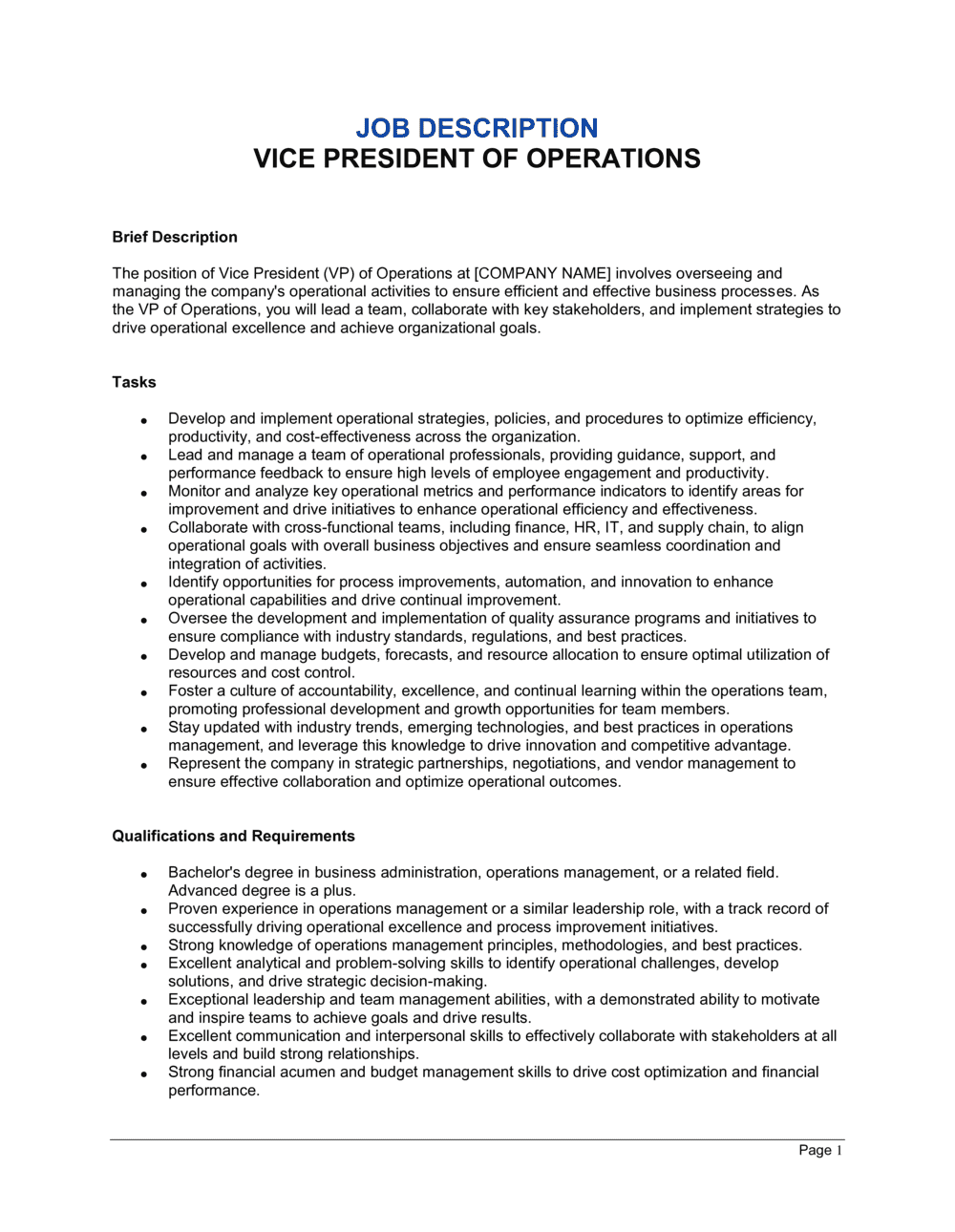
VP of Operations Job Description Template

Free Word download • Edit online • Save & share with Drive • Export to PDF

2 pages25–30 min to fillDifficulty: StandardSignature requiredLegal review recommended
Learn more ↓
FreeVP of Operations Job Description Template

At a glance

What it is
A VP of Operations Job Description is a formal document that defines the scope, responsibilities, reporting relationships, required qualifications, and compensation expectations for a Vice President of Operations role. This free Word download gives you a structured, ready-to-post template you can edit online and export as PDF to share with candidates, recruiters, or your board.
When you need it
Use it when hiring or promoting into a VP of Operations role, restructuring your executive team, or formalizing an incumbent's responsibilities after organizational changes. It is also referenced at the start of employment contract negotiations to establish agreed scope before terms are finalized.
What's inside
Role summary and organizational positioning, detailed duties and responsibilities, performance metrics and KPIs, required and preferred qualifications, reporting structure and direct reports, compensation and benefits overview, and a signature block for candidate acknowledgment.

What is a VP of Operations Job Description?

A VP of Operations Job Description is a formal document that defines the scope of authority, core responsibilities, performance expectations, reporting relationships, required qualifications, and compensation parameters for a Vice President of Operations. It functions simultaneously as a recruiting tool — attracting and screening qualified candidates — and as a foundational legal record that establishes the agreed terms of the executive's role before an employment contract is finalized. When signed by both the executive and a company representative and attached to an employment agreement as a schedule, it creates a documented baseline for performance management, role disputes, and termination decisions.

Why You Need This Document

Hiring a VP of Operations without a precise, written job description creates four compounding risks. First, without defined KPIs and responsibilities, you have no objective basis for performance reviews or for-cause termination — a critical gap when executive severance packages and potential litigation are on the table. Second, vague role definitions attract mismatched candidates who inflate the hiring cycle and impose recruiting costs that typically run 20–30% of first-year compensation for senior executives. Third, omitting a compliant EEO statement and salary range exposes the company to EEOC complaints, pay equity audits, and violations of pay transparency laws now active in more than a dozen US states and across the EU. Fourth, incumbents who lack a signed, documented job description routinely contest the scope of their authority — or the basis for their dismissal — in employment tribunals and arbitration. This template gives you a structured, legally reviewed starting point that closes all four gaps and takes under an hour to customize for your organization.

Which variant fits your situation?

If your situation is…Use this template
Hiring a VP of Operations for a manufacturing or supply chain businessVP of Operations Job Description (Manufacturing)
Defining the role for a SaaS or technology companyVP of Operations Job Description (Tech)
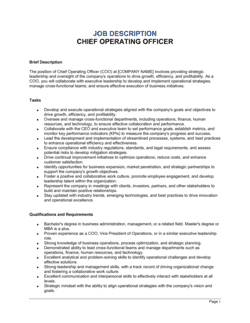
Recruiting for a Chief Operating Officer with broader authorityChief Operating Officer Job Description
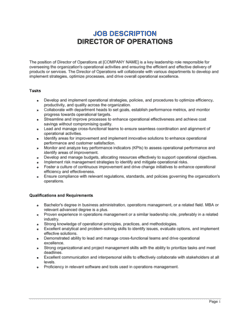
Hiring a Director of Operations one level below VPDirector of Operations Job Description
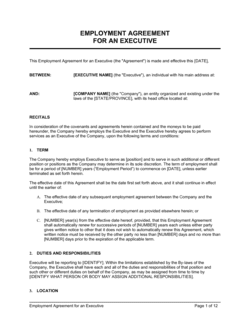
Formalizing responsibilities alongside an employment contractExecutive Employment Agreement
Posting a senior operations role at a nonprofit or public-sector organizationOperations Manager Job Description
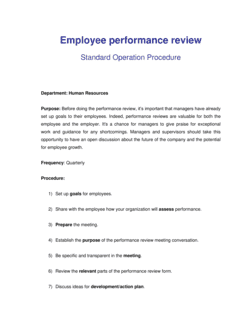
Creating a performance review framework aligned to the job descriptionEmployee Performance Review Template

Common mistakes to avoid

❌ Omitting measurable KPIs from the responsibilities section

Why it matters: Without defined metrics, performance reviews become subjective and termination-for-cause decisions are difficult to defend. Courts and tribunals look for documented performance standards when employees challenge dismissal.

Fix: Attach 4–6 specific, measurable KPIs to the job description before the hire is made, and reference them explicitly in the employment agreement and the first 90-day performance plan.

❌ Listing 20+ responsibilities without prioritization

Why it matters: Candidates cannot identify the 3–5 things that actually matter most, and incumbents spread themselves too thin — leading to executive burnout and poor performance within the first year.

Fix: Limit the responsibilities list to 8–12 items in priority order. Move secondary duties to a 'Schedule A' addendum that can be updated without amending the employment contract.

❌ Setting qualifications requirements that screen out protected classes

Why it matters: Credential requirements with no legitimate business justification — such as a four-year degree for a role where 15 years of experience is equally valid — can constitute disparate impact discrimination under Title VII in the US and equivalent laws in Canada, the UK, and the EU.

Fix: Audit each required qualification to confirm it is genuinely necessary. Replace degree mandates with experience thresholds where appropriate, and document the business rationale for any credential requirement.

❌ Omitting the signature block for executive job descriptions

Why it matters: An unsigned job description has weaker evidentiary weight in disputes over role scope, authority, or performance expectations — particularly relevant when an executive claims their actual duties differed materially from what was represented during hiring.

Fix: Always include a dated signature block and obtain signatures from both the executive and a company representative before or on day one. Treat the signed document as part of the employment record.

❌ Publishing a salary range wider than 30% of midpoint

Why it matters: An excessively wide range (e.g., $120K–$250K) signals that the company has not calibrated the role, erodes candidate trust, and can attract applicants across two or three entirely different seniority levels.

Fix: Benchmark compensation using current market data specific to your industry and geography. Set a range of no more than $30–$40K spread for a VP-level role, and disclose where required by pay transparency laws.

❌ Using the same job description for VP roles across different company sizes

Why it matters: A VP of Operations at a 50-person startup owns different responsibilities than one at a 2,000-person manufacturer — using a generic template without customization attracts candidates with mismatched experience and creates legal ambiguity about actual authority.

Fix: Customize the scope, budget authority, team size, and KPIs to reflect your company's actual scale and stage. Reference specific systems, geographies, and revenue figures wherever possible.

The 10 key clauses, explained

Role Title and Organizational Position

In plain language: States the official job title, the department or function the role belongs to, and where it sits in the organizational hierarchy.

Sample language
Title: Vice President of Operations | Department: Operations | Reports to: Chief Executive Officer | Location: [CITY, STATE] or Remote

Common mistake: Using an ambiguous title like 'VP, Operations & Strategy' that conflates two distinct roles — this attracts candidates who expect different responsibilities and creates future scope disputes.

Role Summary

In plain language: A 3–5 sentence overview of the role's purpose, its strategic significance, and the primary outcomes the hire is expected to drive.

Sample language
The Vice President of Operations will lead [COMPANY NAME]'s operational functions across [FUNCTIONS], ensuring efficient delivery of products and services to [CUSTOMERS/MARKETS]. This executive will own the P&L for [DIVISION/REGION], build scalable processes, and partner with the CEO to execute the company's [YEAR] growth strategy.

Common mistake: Writing a generic summary that could describe any operations role at any company — candidates screen for specificity, and vague summaries attract unqualified applicants.

Core Duties and Responsibilities

In plain language: An itemized list of the primary activities, decisions, and outputs the VP of Operations is accountable for on a daily, monthly, and quarterly basis.

Sample language
Responsibilities include: (a) overseeing daily operations across [FUNCTIONS]; (b) developing and implementing operational policies and procedures; (c) managing a budget of $[AMOUNT]; (d) leading a team of [X] direct reports; (e) driving continuous improvement initiatives targeting [X]% efficiency gains.

Common mistake: Listing 20 or more responsibilities without prioritization — candidates cannot identify what matters most, and the role becomes unmanageable from day one.

Performance Metrics and KPIs

In plain language: Defines the specific, measurable outcomes the VP will be held accountable to — including operational, financial, and team performance indicators.

Sample language
Success in this role will be measured by: (a) EBITDA margin improvement of [X]% by [DATE]; (b) on-time delivery rate above [X]%; (c) employee engagement score above [X]; (d) cost-per-unit reduction of [X]% within [TIMEFRAME].

Common mistake: Omitting performance metrics entirely — without measurable outcomes, the role is impossible to evaluate at review time and creates ambiguity about what 'success' looks like.

Required Qualifications

In plain language: States the minimum education, years of experience, functional expertise, and credentials necessary to be considered for the role.

Sample language
Required: Bachelor's degree in Business, Operations, Engineering, or related field; [10+] years of progressive operations experience; [5+] years in a senior leadership role managing cross-functional teams; demonstrated P&L ownership of at least $[AMOUNT].

Common mistake: Setting credential requirements (e.g., 'MBA required') that screen out qualified candidates without justification — this also creates legal exposure in jurisdictions that scrutinize credential-based exclusions.

Preferred Qualifications and Competencies

In plain language: Lists additional skills, certifications, or experience that would differentiate strong candidates from baseline-qualified ones.

Sample language
Preferred: MBA or equivalent advanced degree; Lean Six Sigma certification; experience scaling operations from [$X]M to [$X]M in revenue; proficiency with [ERP SYSTEM]; experience in [INDUSTRY VERTICAL].

Common mistake: Moving preferred qualifications into the required section — this narrows the candidate pool unnecessarily and may exclude strong candidates who match all true requirements.

Reporting Structure and Direct Reports

In plain language: Clarifies who the VP reports to, which functions fall under their direct authority, and which roles are dotted-line or matrix relationships.

Sample language
The VP of Operations reports directly to the [CEO / COO]. Direct reports include: [DIRECTOR OF SUPPLY CHAIN], [HEAD OF FACILITIES], [OPERATIONS MANAGER — REGION A], [OPERATIONS MANAGER — REGION B]. Dotted-line relationships: [FINANCE BUSINESS PARTNER], [HR BUSINESS PARTNER].

Common mistake: Omitting dotted-line relationships — candidates who discover unexpected matrix accountabilities post-hire cite it as a top reason for early departure.

Compensation and Benefits Overview

In plain language: States the base salary range, bonus or incentive structure, equity (if applicable), and benefits package to set expectations before negotiation.

Sample language
Base Salary: $[MIN] – $[MAX] annually, commensurate with experience. Annual performance bonus: up to [X]% of base salary. Equity: [X]% options vesting over [4] years with a [1]-year cliff. Benefits: [HEALTH / DENTAL / VISION / 401K / PTO SUMMARY].

Common mistake: Publishing a salary range so wide (e.g., $120K–$250K) that it provides no signal — candidates interpret this as either a bait-and-switch or lack of role clarity.

Equal Opportunity and Compliance Statement

In plain language: Affirms the employer's commitment to non-discriminatory hiring practices and compliance with applicable employment laws.

Sample language
[COMPANY NAME] is an equal opportunity employer and does not discriminate on the basis of race, color, religion, sex, national origin, age, disability, veteran status, sexual orientation, gender identity, or any other characteristic protected by applicable federal, state, or local law.

Common mistake: Omitting the EEO statement entirely — this creates legal exposure in the US (Title VII), Canada (Canadian Human Rights Act), UK (Equality Act 2010), and across the EU.

Acknowledgment and Signature Block

In plain language: A section for the candidate or incumbent employee to confirm they have read, understood, and accepted the role's responsibilities as described.

Sample language
I acknowledge that I have read and understand the responsibilities, qualifications, and expectations outlined in this job description. Employee Signature: _______________ Date: _______________ | Manager Signature: _______________ Date: _______________

Common mistake: Treating the signature block as optional for executive hires — unsigned job descriptions are routinely introduced in employment disputes as evidence that duties were never formally agreed.

How to fill it out

  1. 1

    Define the organizational context first

    Before writing a single responsibility, map where the VP of Operations sits — who they report to, which teams they lead, and which peers they coordinate with. This structural clarity prevents scope creep and candidate confusion.

    💡 Interview the CEO and any peer executives about their expectations before drafting — misalignment at this stage produces a job description that attracts the wrong person.

  2. 2

    Write the role summary around outcomes, not activities

    Draft a 3–5 sentence paragraph that answers: what will this person own, what will change because of their work, and what does success look like in 12 months? Outcome language attracts executives; activity language attracts managers.

    💡 Tie the role summary to a specific company stage — 'scale from $20M to $50M' is more compelling than 'manage operations.'

  3. 3

    List core duties in priority order

    Write 8–12 responsibilities in descending order of importance. Each should start with an action verb (Lead, Own, Drive, Build) and include a measurable scope (team size, budget, geography, or metric).

    💡 If you have more than 12 responsibilities, you are describing two jobs. Split the role or deprioritize ruthlessly.

  4. 4

    Define specific, measurable performance metrics

    Attach 4–6 KPIs directly to the responsibilities section — EBITDA margin, on-time delivery rate, cost reduction targets, or employee engagement scores. These become the basis for the employment contract and performance reviews.

    💡 KPIs should be within the VP's direct influence. Holding someone accountable for company-wide revenue when they lead operations creates unfair incentives.

  5. 5

    Separate required from preferred qualifications

    Required qualifications are the minimum threshold — the role cannot be done without them. Preferred qualifications are differentiators. Keep the required list to 5–7 items to avoid screening out strong candidates on technicalities.

    💡 Remove degree requirements that are not genuinely necessary — several US states and major employers have dropped degree mandates for roles where experience is a stronger predictor of success.

  6. 6

    Set a salary range based on market data

    Research VP of Operations compensation in your sector and geography using at least two sources (e.g., Radford, Levels.fyi, or LinkedIn Salary). Set a range no wider than 25–30% of the midpoint and disclose it in the posting where required by law.

    💡 Colorado, New York, California, and several other US states legally require salary ranges in job postings — verify current requirements before publishing.

  7. 7

    Add the EEO statement and signature block

    Include a compliant equal opportunity employer statement and a signature block for both the candidate and the hiring manager. Have both parties sign before or on the first day of employment.

    💡 Store the signed original in the employee's personnel file and your HR system — it is your primary document if a future dispute arises over role expectations.

  8. 8

    Review with legal before posting

    Have an employment attorney review the final job description for compliance with anti-discrimination laws, salary disclosure requirements, and any jurisdiction-specific restrictions before the posting goes live.

    💡 A 30-minute legal review costs $150–$300 and protects against EEOC complaints, pay equity audits, and candidate discrimination claims — especially relevant for VP-level hires with high public visibility.

Frequently asked questions

What does a VP of Operations do?

A VP of Operations is responsible for overseeing the day-to-day operational functions of a business — including supply chain, production, facilities, process improvement, and cross-functional execution. At most companies, this executive reports directly to the CEO or COO and owns a P&L or significant budget. The specific scope varies by industry and company size, but the core accountabilities are operational efficiency, cost management, team leadership, and execution of the company's strategic plan.

What is the difference between a VP of Operations and a COO?

A COO typically has broader authority, often covering functions like HR, finance, and strategy in addition to operations. A VP of Operations has a narrower mandate focused specifically on operational delivery — supply chain, logistics, production, and process management. In smaller companies, the roles may overlap significantly; in larger enterprises, the COO is the VP's direct manager with company-wide authority.

Is a VP of Operations job description a legally binding document?

On its own, a job description is generally not a binding contract — it documents role expectations rather than creating enforceable obligations. However, when incorporated by reference into an employment agreement, or when signed by both parties as a Schedule A, it becomes part of the contractual record. Courts in the US, Canada, and the UK have used job descriptions as evidence in disputes over wrongful dismissal, non-compete scope, and performance-based termination.

What qualifications should a VP of Operations have?

Most VP of Operations roles require a bachelor's degree in business, engineering, or a related field; 8–12 years of progressive operations experience; and at least 5 years managing cross-functional teams. P&L ownership, experience scaling operations, and proficiency with ERP systems are commonly required. An MBA or Lean Six Sigma certification is often preferred but not universally required, particularly in technology companies where demonstrated results outweigh credentials.

What KPIs should be included in a VP of Operations job description?

Common KPIs for a VP of Operations include EBITDA margin improvement, on-time delivery rate, cost-per-unit reduction, inventory turnover, employee engagement or retention scores, and SLA compliance across key operational processes. The most effective job descriptions tie each KPI to a specific target and timeframe — for example, 'reduce cost-per-order by 15% within 12 months' rather than 'improve operational efficiency.'

Do I need to include a salary range in a VP of Operations job posting?

Pay transparency laws in Colorado, New York, California, Washington, and several other US states require salary ranges in job postings, including for remote roles where employees may be located in those states. In the UK, pay gap reporting obligations are increasing scrutiny of compensation disclosure. Beyond legal requirements, publishing a salary range for a VP-level role reduces time wasted on mismatched candidates and signals organizational transparency.

How is a VP of Operations job description different from a Director of Operations job description?

A Director of Operations typically manages a specific function or region and reports to the VP or COO. A VP of Operations has broader authority, typically owns a larger budget, manages multiple directors or functional heads, and participates in executive decision-making at the company level. The VP role requires demonstrated strategic leadership — building processes and teams — while the Director role is more focused on executing within a defined function.

Should a VP of Operations job description include an EEO statement?

Yes — always. An equal opportunity employer statement is legally required or strongly recommended in every major jurisdiction. In the US, it demonstrates compliance with Title VII, the ADA, and the ADEA. In Canada, it signals compliance with the Canadian Human Rights Act. In the UK and EU, it reflects Equality Act and EU anti-discrimination directive obligations. Omitting it creates legal exposure and can deter diverse candidates from applying.

Can I use the same VP of Operations job description for multiple hires?

You can use the same template as a starting point, but each hire should reflect the specific scope, team size, budget authority, and KPIs relevant to the role at that point in time. A VP of Operations hired when the company has 3 direct reports and a $5M budget needs a materially different description than one hired when the function has 50 staff and a $50M budget. Using an outdated or generic description creates misaligned expectations and weaker legal standing if the role is later disputed.

How this compares to alternatives

vs Director of Operations Job Description

A Director of Operations manages a specific function or geographic region, typically reporting to the VP or COO. The VP of Operations has enterprise-wide authority, manages multiple directors, participates in executive planning, and owns a significantly larger budget. Use the Director template for mid-level operational leadership; use the VP template when the hire needs to set strategy across the entire operations function.

vs Chief Operating Officer Job Description

A COO has company-wide authority that typically extends beyond operations to HR, finance, and corporate strategy. The VP of Operations role is operationally focused — supply chain, delivery, process efficiency — and reports to the CEO or COO. Use the COO template when the hire is second-in-command with full organizational authority; use the VP template when the scope is limited to the operations function.

vs Executive Employment Agreement

An employment agreement is the binding contract that governs compensation, IP assignment, non-compete, confidentiality, and termination. A job description defines the role's scope and responsibilities. The two documents work together — the job description is typically attached as a Schedule to the employment agreement. The job description alone does not create the full set of enforceable obligations an executive hire requires.

vs Operations Manager Job Description

An Operations Manager handles day-to-day execution within a defined team, location, or process — without P&L ownership or executive-level authority. The VP of Operations role requires demonstrated strategic leadership, multi-team management, and direct participation in company-level decision-making. Use the Operations Manager template for frontline operational leadership; use the VP template for the executive who manages those managers.

Industry-specific considerations

Manufacturing and Supply Chain

Scope covers production scheduling, capacity planning, quality control, procurement, and logistics — with KPIs tied to on-time delivery, yield rates, and cost-per-unit.

Technology / SaaS

Focus shifts to engineering velocity, infrastructure uptime, customer support SLAs, and cross-functional alignment between product, engineering, and customer success teams.

Healthcare and Life Sciences

Regulatory compliance (FDA, HIPAA, ISO 13485) is a core accountability alongside operational efficiency, with credentialing requirements and patient-safety metrics added to standard KPIs.

Retail and E-commerce

Responsibilities emphasize fulfillment speed, return rate management, inventory accuracy, and third-party logistics coordination — with seasonal surge planning as a distinct competency requirement.

Professional Services

Core focus is billable utilization, resource allocation across client engagements, internal process standardization, and profitability per project — P&L ownership at the practice or regional level is standard.

Construction and Real Estate

Job scope includes project delivery oversight, subcontractor management, safety compliance (OSHA), budget tracking across multiple concurrent projects, and permitting and inspection coordination.

Jurisdictional notes

United States

Pay transparency laws in Colorado (EPEWA), New York, California, and Washington require salary ranges in job postings — including for remote roles where any employee may work in those states. The EEOC requires that job description qualification standards be job-related and consistent with business necessity to avoid disparate impact claims under Title VII. Non-compete language referenced in or attached to the job description must comply with state-specific restrictions; California, Minnesota, and Oklahoma ban most post-employment restrictions.

Canada

The Canadian Human Rights Act prohibits discriminatory qualification requirements at the federal level; provincial human rights codes extend equivalent protections for provincially regulated employers. Pay equity legislation in Ontario (Pay Equity Act) and federally regulated industries requires that compensation reflect work value rather than gender. In Quebec, any document provided to a French-speaking candidate must be available in French under the Charter of the French Language.

United Kingdom

The Equality Act 2010 prohibits direct and indirect discrimination in recruitment across nine protected characteristics. Job descriptions must not include requirements that would disproportionately disadvantage any protected group without objective justification. Gender pay gap reporting obligations apply to employers with 250 or more employees. Job descriptions used as the basis for employment contracts must be consistent with the written statement of employment particulars provided under the Employment Rights Act 1996.

European Union

The EU Pay Transparency Directive (2023/970) requires employers to provide salary ranges in job postings and prohibits asking candidates for current compensation history — member states must implement by June 2026. Anti-discrimination requirements under the Employment Equality Directive prohibit qualification criteria that produce unjustified disparate impact based on religion, disability, age, or sexual orientation. In France and Germany, works councils may have consultation rights before a senior job description is posted externally.

Template vs lawyer — what fits your deal?

PathBest forCostTime
Use the templateCompanies hiring a VP of Operations with a standard domestic scope and a straightforward employment structureFree30–60 minutes
Template + legal reviewCompanies in regulated industries, multi-state or cross-border hires, or roles with significant P&L authority and equity compensation$150–$400 for a legal review of the final job description and attached employment agreement1–2 business days
Custom draftedExecutive hires at PE-backed or publicly traded companies, international hires requiring jurisdiction-specific compliance, or roles where non-compete scope is material to the business$800–$2,500+ for a fully custom executive job description and employment agreement package1–2 weeks

Glossary

Vice President of Operations
A senior executive responsible for overseeing day-to-day business operations, supply chain, process efficiency, and cross-functional execution.
Reporting Structure
The chain of command specifying who the VP of Operations reports to and which functions or teams report to them.
KPI (Key Performance Indicator)
A quantifiable metric used to evaluate how effectively a role or department is achieving its stated objectives.
OKR (Objectives and Key Results)
A goal-setting framework that pairs a qualitative objective with two to five measurable results used to track progress.
EBITDA
Earnings Before Interest, Taxes, Depreciation, and Amortization — a core financial metric VP of Operations candidates are typically expected to influence or manage.
SLA (Service Level Agreement)
A formal commitment defining the standard of service, response time, or output quality a function is expected to deliver.
P&L Ownership
Accountability for a profit-and-loss statement — a common expectation in VP of Operations roles, particularly in multi-unit or multi-division businesses.
Cross-Functional Leadership
The ability to coordinate and align teams across departments — finance, HR, sales, and product — without direct hierarchical authority over each.
Scope of Role
The defined boundaries of a position's authority, responsibilities, and accountabilities, typically documented in a job description.
At-Will Employment
An employment arrangement in most US states where either party may end the relationship at any time for any lawful reason — relevant when the job description is appended to an employment agreement.
Job Leveling
A systematic process for defining the seniority, scope, and compensation band of a role relative to other positions in the organization.

Part of your Business Operating System

This document is one of 3,000+ business & legal templates included in Business in a Box.

  • Fill-in-the-blanks — ready in minutes
  • 100% customizable Word document
  • Compatible with all office suites
  • Export to PDF and share electronically

Create your document in 3 simple steps.

From template to signed document — all inside one Business Operating System.
1
Download or open template

Access over 3,000+ business and legal templates for any business task, project or initiative.

2
Edit and fill in the blanks with AI

Customize your ready-made business document template and save it in the cloud.

3
Save, Share, Send, Sign

Share your files and folders with your team. Create a space of seamless collaboration.

Save time, save money, and create top-quality documents.

★★★★★

"Fantastic value! I'm not sure how I'd do without it. It's worth its weight in gold and paid back for itself many times."

Managing Director · Mall Farm
Robert Whalley
Managing Director, Mall Farm Proprietary Limited
★★★★★

"I have been using Business in a Box for years. It has been the most useful source of templates I have encountered. I recommend it to anyone."

Business Owner · 4+ years
Dr Michael John Freestone
Business Owner
★★★★★

"It has been a life saver so many times I have lost count. Business in a Box has saved me so much time and as you know, time is money."

Owner · Upstate Web
David G. Moore Jr.
Owner, Upstate Web

Run your business with a system — not scattered tools

Stop downloading documents. Start operating with clarity. Business in a Box gives you the Business Operating System used by over 250,000 companies worldwide to structure, run, and grow their business.

Start free · No credit card required