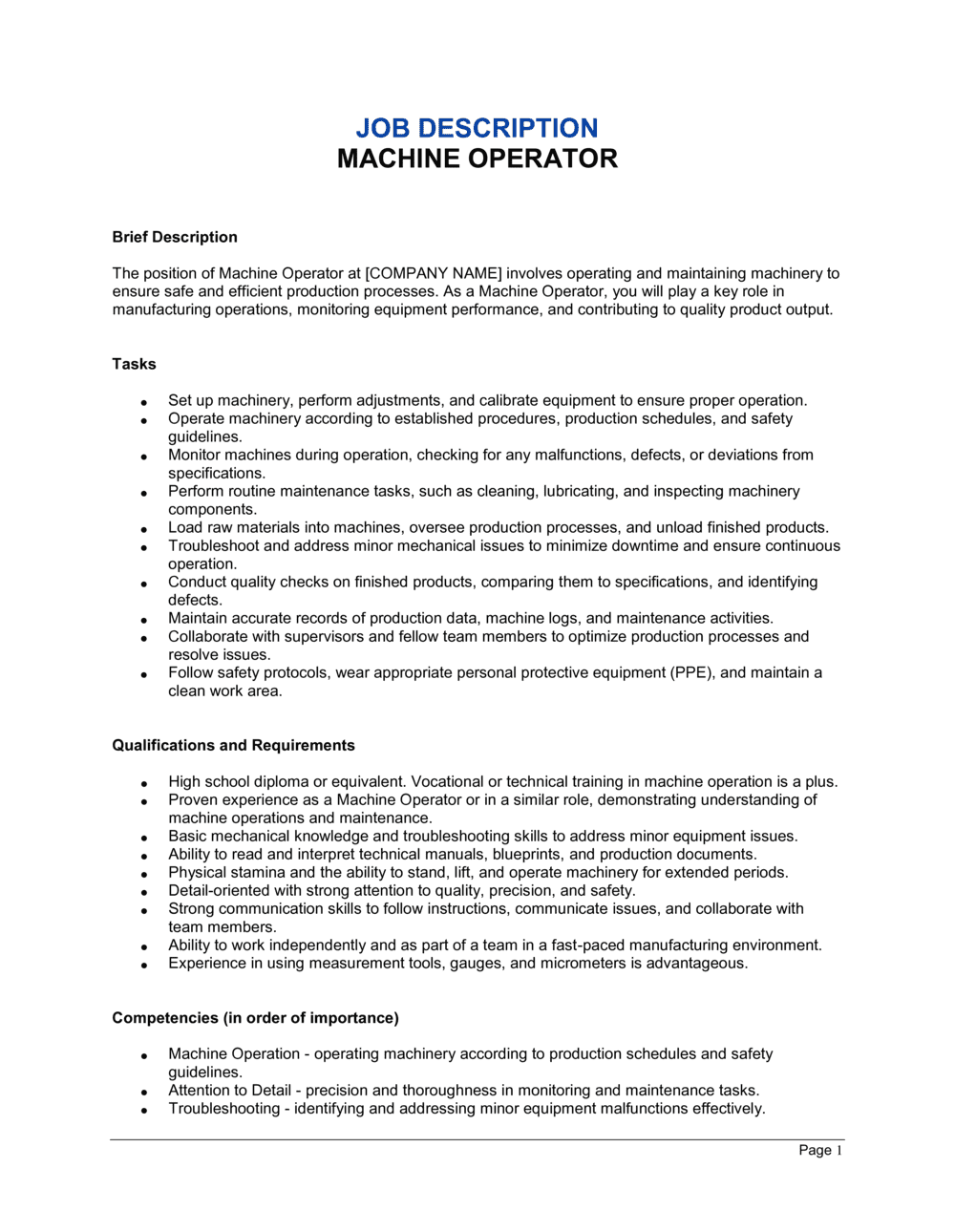
Machine Operator Job Description Template

Free Word download • Edit online • Save & share with Drive • Export to PDF

2 pages20–30 min to fillDifficulty: StandardSignature requiredLegal review recommended
Learn more ↓
FreeMachine Operator Job Description Template

At a glance

What it is
A Machine Operator Job Description is a formal employment document that defines the scope of duties, required qualifications, physical demands, safety obligations, and reporting structure for a machine operator role. This free Word download gives you a structured, legally grounded starting point you can edit online and export as PDF for posting, onboarding, or HR file documentation.
When you need it
Use it when hiring a new machine operator, updating an existing role after equipment or process changes, or documenting current roles to support performance management, compensation reviews, or compliance audits.
What's inside
Role title and department, reporting structure, core duties and responsibilities, required and preferred qualifications, physical and environmental working conditions, safety and compliance obligations, and acknowledgment signature block.

What is a Machine Operator Job Description?

A Machine Operator Job Description is a formal employment document that defines the duties, qualifications, physical demands, safety obligations, and performance standards for an operator role on a production floor or manufacturing facility. It identifies the specific equipment the operator runs, the essential and marginal functions of the position, the regulatory compliance obligations the employee must meet, and the measurable targets against which their performance will be evaluated. When signed by both employee and manager before the first day of work, it creates a documented record that role expectations were clearly communicated — a record that carries legal weight in performance management, OSHA inspections, disability accommodation decisions, and termination proceedings.

Why You Need This Document

Operating a manufacturing facility without complete, signed job descriptions for each operator role creates compounding legal and operational exposure. Without documented essential functions, an employer cannot defend an accommodation decision under the ADA or a termination for inability to perform duties. Without named safety standards and PPE requirements, OSHA citations carry higher penalties and workers' compensation disputes become harder to resolve. Without measurable production and quality targets, performance management devolves into subjective supervisor opinion that rarely survives a wrongful termination claim. A properly completed machine operator job description — updated when equipment changes and re-signed each time — closes these gaps for the cost of an hour of HR time and a legal review where the stakes warrant it.

Which variant fits your situation?

If your situation is…Use this template
Hiring an operator for a CNC or precision machining roleCNC Machine Operator Job Description
Defining a role for a forklift or heavy equipment operatorForklift Operator Job Description
Posting for a production line or assembly operatorProduction Operator Job Description
Hiring a quality-focused inspector on the production floorQuality Control Inspector Job Description
Recruiting a supervisor to oversee machine operatorsProduction Supervisor Job Description
Documenting a maintenance technician who also operates equipmentMaintenance Technician Job Description
Engaging an operator on a temporary or contract basisIndependent Contractor Agreement

Common mistakes to avoid

❌ Omitting the essential vs. marginal function distinction

Why it matters: Without this distinction, the job description cannot be used to defend a disability accommodation decision or a termination for inability to perform duties under the ADA or equivalent statutes.

Fix: Label each listed duty as Essential or Marginal. Essential functions are those that are the core reason the position exists and cannot be redistributed without fundamentally altering the role.

❌ Vague safety language with no regulatory references

Why it matters: Generic 'follow all safety rules' language creates a gap in the employer's defense during OSHA citations, workplace injury litigation, and workers' compensation disputes.

Fix: Name the specific OSHA standards, required PPE items, and LOTO procedures the operator must follow. Cross-reference your facility safety manual by section number.

❌ Physical demands set higher than actual job requirements

Why it matters: Overstated physical requirements — a 100 lb lift requirement for a 40 lb role — are scrutinized as pretextual screening and can support disparate-impact discrimination claims.

Fix: Conduct or reference a physical demands analysis based on direct observation of the role. Set requirements at the realistic maximum the job demands, not the maximum you'd prefer a candidate to have.

❌ No acknowledgment signature block

Why it matters: Without a signed acknowledgment, the employer cannot demonstrate the employee received or understood role expectations, safety requirements, or performance standards — weakening any disciplinary or termination defense.

Fix: Include a signature block requiring the employee and manager to sign and date the document before or on the first day of work. File the signed original in the employee's HR record.

❌ Using a single generic job description for all operator grades

Why it matters: Applying one description to Machine Operator I, II, and III roles creates pay-equity exposure and makes performance differentiation between grades impossible to document.

Fix: Create a separate, versioned job description for each operator classification with distinct duties, experience requirements, and production targets that justify the pay differential.

❌ Failing to update the description after equipment or process changes

Why it matters: A job description that no longer reflects actual duties becomes unreliable for performance management and may fail to capture new safety obligations introduced by equipment upgrades.

Fix: Treat the job description as a living document. Review and re-sign it whenever equipment, production processes, or reporting structures change materially — and document each revision with a date.

The 9 key clauses, explained

Job title, department, and reporting line

In plain language: Identifies the exact job title, the department the role belongs to, and who the operator reports to directly.

Sample language
Job Title: Machine Operator | Department: [DEPARTMENT NAME] | Reports To: [SUPERVISOR TITLE] | Location: [FACILITY ADDRESS]

Common mistake: Using a generic title like 'Operator' without specifying the machine type or line — this creates classification ambiguity that complicates pay-grade benchmarking and FLSA overtime determinations.

Position summary

In plain language: A 2–4 sentence overview of the role's primary purpose, the equipment involved, and the production goals the operator is expected to support.

Sample language
The Machine Operator is responsible for setting up, operating, and monitoring [MACHINE TYPE] equipment on the [PRODUCTION LINE] to produce [PRODUCT] in accordance with quality, safety, and output targets set by [COMPANY NAME].

Common mistake: Writing a position summary so vague ('operates machines as directed') that it provides no basis for performance evaluation or role differentiation from other operator grades.

Core duties and essential functions

In plain language: A numbered list of the primary tasks the operator performs daily, written in active voice and designating each as essential or marginal — a critical distinction under the ADA.

Sample language
Essential Functions: (1) Set up and adjust [MACHINE TYPE] according to production specifications. (2) Monitor equipment during operation and make real-time adjustments to maintain output quality. (3) Perform basic preventive maintenance and cleaning per [SCHEDULE]. (4) Record production data in [SYSTEM NAME].

Common mistake: Omitting the essential vs. marginal function distinction entirely — without it, the employer cannot rely on the job description to defend a disability accommodation decision or termination for inability to perform duties.

Required qualifications and certifications

In plain language: Lists the minimum education, experience, licenses, and certifications a candidate must possess to be considered for the role.

Sample language
Required: High school diploma or GED; minimum [X] years of experience operating [MACHINE TYPE]; forklift certification (or ability to obtain within [30] days of hire); demonstrated ability to read and interpret technical drawings and tolerances.

Common mistake: Listing credentials that are preferred but not genuinely required — overstated requirements can create disparate-impact discrimination exposure if they disproportionately screen out protected groups without a defensible operational justification.

Physical demands and working conditions

In plain language: Documents the physical requirements of the role — lifting limits, standing duration, environmental exposure — and the conditions under which work is performed.

Sample language
Physical Demands: Ability to lift up to [50] lbs unassisted; stand or walk for [8]-hour shifts; work in environments with noise levels exceeding 85 dB (hearing protection required); exposure to [heat / oil / dust / vibration] consistent with [MACHINE TYPE] operation.

Common mistake: Setting physical requirements higher than the job actually demands — a 100 lb lift requirement for a role that never requires lifting more than 40 lbs is a BFOR that courts and agencies scrutinize as pretextual screening.

Safety obligations and compliance requirements

In plain language: States the operator's specific safety responsibilities, required PPE, LOTO compliance obligations, and any regulatory certifications that must be maintained.

Sample language
The Operator shall: wear required PPE at all times in designated areas; follow all lockout/tagout procedures before performing any maintenance; report unsafe conditions immediately to [SUPERVISOR TITLE]; and maintain compliance with OSHA 29 CFR [APPLICABLE PART] and all facility safety policies.

Common mistake: Referencing only generic 'follow all safety rules' language without naming specific regulatory standards — vague safety clauses create gaps in the employer's defense if an OSHA citation or workers' compensation dispute arises.

Quality standards and production targets

In plain language: Defines the quality benchmarks, reject-rate tolerances, throughput targets, and documentation requirements the operator is held to.

Sample language
The Operator is expected to maintain a reject rate of no more than [X]% per shift, produce a minimum of [X UNITS] per [HOUR / SHIFT], and complete all production logs in [SYSTEM NAME] by the end of each shift.

Common mistake: Omitting measurable targets entirely, leaving performance management dependent on subjective supervisor assessments that are difficult to defend in disciplinary or termination proceedings.

Supervisory scope (if applicable)

In plain language: States whether the operator has responsibility for directing other workers, training new hires, or acting as a lead in the supervisor's absence.

Sample language
This role has no direct supervisory responsibility. / As Lead Operator, this role provides on-the-job guidance to [X] junior operators and assumes shift-lead responsibilities in the absence of [SUPERVISOR TITLE].

Common mistake: Leaving supervisory scope blank when the operator does in fact direct others — undocumented lead functions can support wage claims for supervisory pay differentials the employer never intended.

Acknowledgment and signature block

In plain language: A signed confirmation by the employee that they have received, read, and understood the job description — creating a documented record that role expectations were communicated.

Sample language
I acknowledge that I have received and reviewed this job description and understand the duties, qualifications, and requirements of the [JOB TITLE] role. Employee Signature: _______________ Date: _______________ Manager Signature: _______________ Date: _______________

Common mistake: Omitting the acknowledgment signature entirely — without it, the employer cannot demonstrate the employee was aware of specific duties or safety requirements when managing performance or responding to an OSHA inspection.

How to fill it out

  1. 1

    Enter the job title, department, and reporting structure

    Use the exact job title that will appear in the employment contract and payroll system. Name the specific supervisor title the operator reports to — not just 'management.'

    💡 Match the job title in the job description to the title in the offer letter and employment contract to avoid ambiguity in performance management or termination proceedings.

  2. 2

    Write a focused position summary

    In 2–4 sentences, state what equipment the operator runs, what output they are responsible for, and how the role contributes to production goals. Avoid generic language.

    💡 Include the specific machine type or product line — 'injection molding press operator on the automotive trim line' is more defensible and more useful for recruitment than 'machine operator.'

  3. 3

    List essential functions in numbered, active-voice statements

    Write each core duty as a discrete task beginning with an action verb. Mark each as Essential or Marginal. Include tasks the operator performs every shift, not occasional stretch assignments.

    💡 Aim for 6–10 essential functions. A list shorter than 5 is too vague; longer than 15 suggests the description hasn't been scoped properly.

  4. 4

    Set required qualifications to match genuine job needs

    List only qualifications that are operationally defensible — education level, years of experience with the specific machine class, and certifications the role actually requires. Note preferred qualifications separately.

    💡 If your facility can train a candidate on a specific machine in under 30 days, that skill is preferred — not required. Overstating requirements narrows your candidate pool unnecessarily and creates legal exposure.

  5. 5

    Document physical demands with specific measurements

    Use concrete figures: maximum lift weight in pounds, shift standing duration in hours, decibel levels, temperature ranges, and repetitive motion frequency. Reference your facility's physical demands analysis if one exists.

    💡 Coordinate with your workers' compensation carrier — they often have standardized physical demands forms that align your job description with claims documentation requirements.

  6. 6

    Name specific safety standards and PPE requirements

    Reference the applicable OSHA standard (e.g., 29 CFR 1910.147 for LOTO), list required PPE by item, and state any certifications the operator must hold or obtain within a set timeframe.

    💡 Copy the exact OSHA citation numbers from your facility's OSHA log or safety manual — specificity here protects you during inspections and workers' compensation disputes.

  7. 7

    Add measurable production and quality targets

    State throughput expectations (units per hour or shift), maximum defect or reject rates, and any documentation or reporting the operator must complete each shift.

    💡 Cross-check these targets against your current top-performer data — targets set above what your best operators currently achieve will be immediately challenged in any disciplinary proceeding.

  8. 8

    Obtain dated signatures from both employee and supervisor

    Have the employee and their direct supervisor both sign and date the completed job description before or on the employee's first day. File the original in the employee's HR file.

    💡 Store a copy in your HR system and attach a copy to the employment contract. If you use electronic signatures, ensure your platform timestamps the execution and stores the audit trail.

Frequently asked questions

What is a machine operator job description?

A machine operator job description is a formal employment document that defines the duties, qualifications, physical demands, safety obligations, and reporting structure for a machine operator role. It functions as both a recruitment tool and a binding HR record that sets documented expectations for performance, safety compliance, and conduct throughout the employment relationship.

What should a machine operator job description include?

At minimum: job title and reporting line, a position summary, a numbered list of essential and marginal functions, required and preferred qualifications, physical demands with specific measurements, safety and PPE requirements with regulatory references, quality and production targets, and a signed acknowledgment block. Missing any of these weakens the document's usefulness for performance management and legal defense.

Does a job description create a binding employment contract?

In most US jurisdictions, a job description alone does not create an employment contract or override at-will status — particularly when the description includes appropriate disclaimer language. However, courts have found in some cases that specific promises in a job description (such as guaranteed hours or termination-for-cause-only language) may create implied contractual obligations. Include a disclaimer stating the description is not an employment contract and that duties may change.

Why does a machine operator job description need to be signed?

A signed acknowledgment creates a documented record that the employee received, reviewed, and understood the role's duties, qualifications, and safety requirements. This record is critical when managing performance, issuing discipline, or terminating employment — and is frequently requested by OSHA inspectors and workers' compensation adjusters following a workplace incident.

How do OSHA requirements affect a machine operator job description?

OSHA regulations — particularly 29 CFR 1910.147 (lockout/tagout), 1910.132 (PPE), and 1910.217 (mechanical power presses) — impose specific training and compliance obligations on machine operators. A job description that names these standards and lists the specific PPE required creates a documented safety communication record. Employers who cannot demonstrate that safety obligations were communicated to operators face higher citation penalties following incidents.

What is the difference between a job description and a job posting?

A job posting is a public-facing recruitment advertisement designed to attract applicants — it summarizes the role and emphasizes benefits and company culture. A job description is an internal legal and HR document that defines the role in operational and legal detail for onboarding, performance management, and compliance purposes. The posting is derived from the description, not a replacement for it. Both should exist and reference consistent duties and qualifications.

Can I use the same job description for different operator grades?

No. Machine Operator I, II, and III roles should each have a distinct job description reflecting different duties, experience thresholds, production targets, and pay grades. Using a single description across grades creates pay-equity exposure, undermines performance differentiation, and makes it nearly impossible to justify compensation differences if challenged by an employee or a regulatory body.

How often should a machine operator job description be updated?

Review and update the job description whenever equipment changes, new safety standards are introduced, the reporting structure changes, or production targets are materially revised. At minimum, conduct an annual review aligned to performance appraisal cycles. Each revision should be re-signed by the employee and manager and filed with the updated date — an unsigned outdated description provides no legal protection.

What physical demands language is legally appropriate?

Physical demands must reflect the genuine requirements of the job and be expressed as objectively measurable criteria — lift capacity in pounds, shift standing duration in hours, environmental noise levels in decibels. Requirements must constitute a bona fide occupational requirement (BFOR in Canada) or be consistent with ADA essential-function analysis in the US. Demands set above what the job actually requires expose the employer to discrimination claims from candidates or employees with disabilities.

How this compares to alternatives

vs Employment Contract

An employment contract governs the overall legal relationship — compensation, benefits, IP, termination, and severance. A job description defines what the employee does within that relationship. Both documents should co-exist; the job description is typically incorporated by reference or attached as a schedule to the employment contract. Using a job description alone without an employment contract leaves compensation, termination, and IP obligations undocumented.

vs Offer Letter

An offer letter confirms the role, compensation, and start date to secure the candidate's acceptance. A job description provides the full operational and legal detail of what the role requires. The offer letter references the job description but does not replace it — relying solely on an offer letter leaves safety obligations, essential functions, and physical demands undocumented.

vs Independent Contractor Agreement

An independent contractor agreement engages a self-employed individual for project-based work with no employment entitlements. Machine operators who work set shifts, use company equipment, and follow company safety procedures are almost always employees — not contractors. Misclassifying a machine operator as a contractor triggers back taxes, OSHA liability, and workers' compensation exposure.

vs Performance Review Form

A performance review form evaluates how well an employee is performing the duties defined in their job description. The two documents work together: without a complete, signed job description, a performance review has no objective baseline to evaluate against — and disciplinary decisions made without that baseline are difficult to defend.

Industry-specific considerations

Automotive manufacturing

Operator descriptions must reference stamping press or welding equipment certifications, torque specifications, and automotive quality standards such as IATF 16949 and zero-defect tolerances.

Food and beverage processing

Descriptions must incorporate food safety obligations under FSMA, GMP compliance, allergen handling protocols, and sanitation requirements tied to HACCP plans.

Plastics and rubber manufacturing

Injection molding and extrusion operator roles require specific references to mold change procedures, resin handling, and cycle time targets tied to shift output standards.

Pharmaceutical and medical device manufacturing

Operator descriptions must reference FDA 21 CFR Part 820 or GMP obligations, batch record documentation requirements, and cleanroom PPE and gowning standards.

Metal fabrication and machining

CNC and manual machining roles require references to G-code programming ability, tolerance reading, tool change procedures, and coolant handling safety under OSHA 29 CFR 1910.242.

Packaging and distribution

Operator descriptions cover case packer, labeler, and shrink-wrap equipment with throughput targets in units per minute, carton counts per shift, and barcode verification requirements.

Jurisdictional notes

United States

The ADA requires employers to identify essential vs. marginal functions in job descriptions — this designation directly affects reasonable accommodation obligations and termination defenses. OSHA's General Duty Clause and machine-specific standards (29 CFR 1910.147, 1910.217) impose specific safety communication obligations that should be reflected in the description. Most machine operators are non-exempt under the FLSA and entitled to overtime; the job description should not imply exempt status. State-level OSHA plans (California Cal/OSHA, Michigan MIOSHA, etc.) may impose additional requirements.

Canada

Physical demands and qualification requirements must satisfy the bona fide occupational requirement (BFOR) test under the Canadian Human Rights Act and provincial human rights codes — requirements that cannot be shown to be genuinely necessary expose employers to discrimination complaints. Provincial occupational health and safety acts (Ontario OHSA, Alberta OHS Act, BC WorkSafeBC) require employers to communicate specific hazards and control measures to workers; the job description is one mechanism for this. Quebec employers must ensure job descriptions are available in French for provincially regulated workplaces.

United Kingdom

While a job description is not legally mandated as a standalone document, employers must provide a written statement of employment particulars covering duties within two months of hire — the job description typically satisfies this requirement. Under the Equality Act 2010, any physical or qualification requirement must be a proportionate means of achieving a legitimate aim; overstated requirements create indirect discrimination exposure. The Health and Safety at Work Act 1974 and PUWER 1998 impose specific machine safety obligations that should be referenced in the operator's documented duties.

European Union

The EU Transparent and Predictable Working Conditions Directive requires employers to provide written information about the nature of the work, including duties, within seven days of the start date. Member state implementations vary — Germany's Works Constitution Act gives works councils co-determination rights over job descriptions in establishments above 20 employees, which can affect how descriptions are drafted and revised. GDPR considerations apply when job descriptions include personal data processing activities as part of the operator's duties.

Template vs lawyer — what fits your deal?

PathBest forCostTime
Use the templateSmall manufacturers and HR teams creating standard operator job descriptions for non-hazardous production rolesFree30–60 minutes per role
Template + legal reviewRoles in regulated industries (food, pharma, automotive), roles with complex physical demands, or facilities subject to active OSHA scrutiny$200–$600 for an employment attorney or HR consultant review2–5 business days
Custom draftedMulti-jurisdiction employers, unionized workplaces, roles with significant safety risk, or facilities that have received OSHA citations$800–$2,500+1–2 weeks

Glossary

Job Description
A formal document that defines the duties, responsibilities, qualifications, and reporting structure of a specific role within an organization.
Essential Functions
The core duties a worker must be able to perform, with or without reasonable accommodation — a distinction that carries legal significance under the ADA and equivalent statutes.
OSHA
The Occupational Safety and Health Administration — the US federal agency that sets and enforces workplace safety standards, including those governing machine operation.
PPE (Personal Protective Equipment)
Protective gear — such as safety glasses, steel-toed boots, hearing protection, or gloves — required to perform a job safely.
Lockout/Tagout (LOTO)
A safety procedure that isolates energy sources on machinery before maintenance or servicing, preventing accidental startup.
At-Will Employment
An employment relationship in most US states where either party may end employment at any time for any lawful reason without a job description creating contractual guarantees.
Reasonable Accommodation
A modification to the job environment or duties that enables a qualified person with a disability to perform the essential functions of the role without causing undue hardship to the employer.
Bona Fide Occupational Requirement (BFOR)
A qualification or physical standard that is genuinely necessary to perform the job safely and effectively, used in Canadian law to justify otherwise discriminatory criteria.
Physical Demands Analysis
A documented assessment of the physical activities a role requires — lifting weight limits, standing duration, repetitive motion — used to set hiring criteria and support workers' compensation claims.
Probationary Period
A defined initial period — typically 30 to 90 days — during which a new hire's performance is evaluated against role requirements with reduced termination formalities.
FLSA Classification
The designation under the US Fair Labor Standards Act of whether a role is exempt or non-exempt from overtime pay requirements — most machine operators are non-exempt.

Part of your Business Operating System

This document is one of 3,000+ business & legal templates included in Business in a Box.

  • Fill-in-the-blanks — ready in minutes
  • 100% customizable Word document
  • Compatible with all office suites
  • Export to PDF and share electronically

Create your document in 3 simple steps.

From template to signed document — all inside one Business Operating System.
1
Download or open template

Access over 3,000+ business and legal templates for any business task, project or initiative.

2
Edit and fill in the blanks with AI

Customize your ready-made business document template and save it in the cloud.

3
Save, Share, Send, Sign

Share your files and folders with your team. Create a space of seamless collaboration.

Save time, save money, and create top-quality documents.

★★★★★

"Fantastic value! I'm not sure how I'd do without it. It's worth its weight in gold and paid back for itself many times."

Managing Director · Mall Farm
Robert Whalley
Managing Director, Mall Farm Proprietary Limited
★★★★★

"I have been using Business in a Box for years. It has been the most useful source of templates I have encountered. I recommend it to anyone."

Business Owner · 4+ years
Dr Michael John Freestone
Business Owner
★★★★★

"It has been a life saver so many times I have lost count. Business in a Box has saved me so much time and as you know, time is money."

Owner · Upstate Web
David G. Moore Jr.
Owner, Upstate Web

Run your business with a system — not scattered tools

Stop downloading documents. Start operating with clarity. Business in a Box gives you the Business Operating System used by over 250,000 companies worldwide to structure, run, and grow their business.

Start free · No credit card required