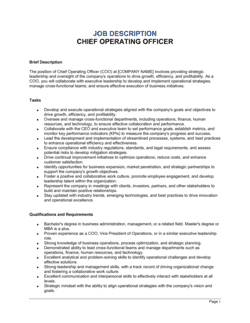
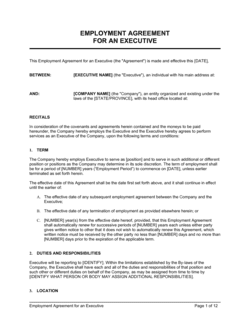
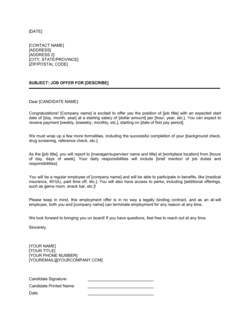
Chief Executive Job Description Template

Free Word download β€’ Edit online β€’ Save & share with Drive β€’ Export to PDF

2 pagesβ€’20–30 min to fillβ€’Difficulty: Standardβ€’Signature requiredβ€’Legal review recommended
Learn more ↓
FreeChief Executive Job Description Template

At a glance

What it is
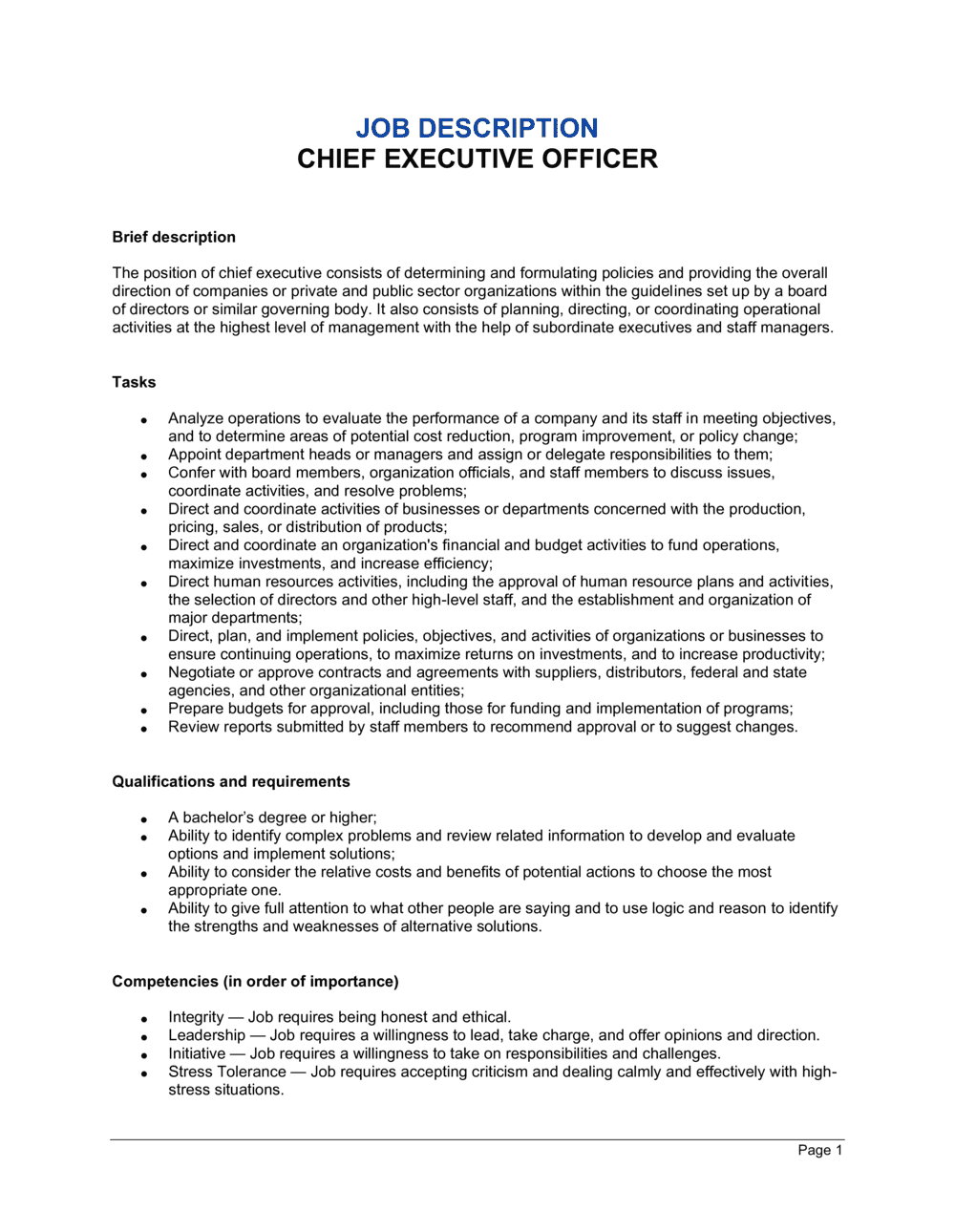
A Chief Executive Job Description is a formal binding document that defines the scope of authority, core responsibilities, reporting obligations, performance standards, and compensation framework for a CEO or equivalent top executive. This free Word download gives boards, founders, and HR teams a structured, legally grounded starting point they can edit online and export as PDF to attach to an employment agreement or board resolution.
When you need it
Use it when appointing a new CEO, formalizing an existing executive's role after a restructuring, or establishing written performance expectations before an employment contract is signed. Boards and governance committees also use it as a reference document during annual CEO performance reviews.
What's inside
Position title and reporting structure, organizational authority and decision-making limits, core duties and strategic responsibilities, required qualifications and competencies, performance metrics and review cadence, compensation and benefits framework, confidentiality obligations, and conflict-of-interest restrictions.

What is a Chief Executive Job Description?

A Chief Executive Job Description is a formal governance document β€” adopted by the board of directors and signed by the incoming CEO β€” that defines the scope of authority, core accountabilities, reporting obligations, performance expectations, and conflict-of-interest restrictions for the company's most senior executive. Unlike a standard HR job posting, it functions as a binding governance instrument: it is attached to the executive employment agreement, referenced in the board appointment resolution, and held in the corporate minute book as an authoritative record of what the board and the CEO agreed at the time of appointment. The document draws a clear line between decisions the CEO can make unilaterally and those that require board approval, establishing the governance architecture that protects both the executive and the directors.

Why You Need This Document

Without a written chief executive job description, the board has no documented basis for measuring CEO performance, no authority thresholds to enforce, and no evidentiary foundation to support a termination-for-cause decision β€” forcing expensive no-cause severance payouts even when the executive has underperformed. Auditors, regulators, and acquirers routinely request the CEO appointment documentation during due diligence; an absent or generic job description signals governance weakness and can stall a financing or M&A transaction. Investors and governance bodies in Canada, the UK, and the EU increasingly treat a formal CEO role description as a baseline corporate governance requirement, not an optional HR formality. This template gives boards a structured, legally grounded starting point that covers every critical clause β€” from authority limits and KPIs to conflict-of-interest disclosure and governing document hierarchy β€” so the appointment is documented correctly from day one.

Which variant fits your situation?

If your situation is…Use this template
Appointing a CEO at a publicly listed companyExecutive Employment Agreement (Public Company)
Defining the CEO role at a nonprofit or charityNonprofit Executive Director Job Description
Hiring a CEO for a private equity-backed portfolio companyChief Executive Job Description (PE-Backed)
Appointing an interim or acting CEO for a fixed termInterim CEO Job Description
Formalizing a co-CEO or Office of the CEO structureCo-CEO Role Description
Defining the CEO role for a subsidiary or divisionSubsidiary CEO Job Description
Attaching a role description to a full executive employment contractExecutive Employment Agreement

Common mistakes to avoid

❌ Leaving authority thresholds blank or undefined

Why it matters: An undefined scope of authority means the CEO can make any financial or operational commitment on behalf of the company. This exposes directors to personal liability for failing to exercise adequate oversight.

Fix: Set specific dollar thresholds for each decision category β€” capital expenditure, contract commitments, hiring, and debt β€” aligned to your board's materiality standards.

❌ Omitting measurable KPIs from the performance clause

Why it matters: Without documented metrics, a CEO performance dispute becomes a credibility contest between the executive and the board, making both bonus clawback and termination-for-cause claims extremely difficult to pursue.

Fix: Attach an annual KPI schedule β€” updated at the start of each fiscal year β€” specifying at least three quantitative targets with measurement methods and weightings.

❌ Duplicating compensation detail instead of cross-referencing the employment agreement

Why it matters: If the job description states a salary of $400,000 and the employment agreement states $380,000, the conflicting figures create an enforceable ambiguity that typically resolves in the executive's favor.

Fix: Reference compensation by citing the employment agreement date only. Update the reference if the employment agreement is amended β€” never update both documents independently.

❌ Using a generic job description not reviewed by the board

Why it matters: A job description that was never formally adopted by the board has questionable authority as a governance document and may be challenged as unilaterally imposed rather than mutually agreed.

Fix: Pass a board resolution formally adopting the job description at the same meeting that approves the CEO appointment. Attach the description to the resolution minutes.

❌ No governing document hierarchy clause

Why it matters: When the job description conflicts with the bylaws, employment agreement, or board charter β€” which happens more often than expected β€” there is no rule for which document controls, creating legal uncertainty at the worst possible time.

Fix: Include a hierarchy clause stating that in the event of conflict, the bylaws prevail over the job description, which prevails over any informal board direction.

❌ Prohibiting all outside activities without a pre-approved exceptions schedule

Why it matters: An absolute outside-activity prohibition applied retroactively to a CEO who holds existing board seats or investments creates an immediate breach β€” and may deter qualified candidates from accepting the role.

Fix: Schedule pre-existing outside roles at signing, with a clear process for seeking board approval for future activities. This demonstrates governance rigor while respecting the executive's existing commitments.

The 10 key clauses, explained

Position title, reporting line, and effective date

In plain language: Names the role formally, identifies who the CEO reports to (typically the board chair or full board), and states when the description takes effect.

Sample language
The position of Chief Executive Officer ('CEO') of [COMPANY LEGAL NAME] reports directly to the Board of Directors ('Board') and is effective as of [EFFECTIVE DATE].

Common mistake: Stating the CEO reports to the 'Chairman' rather than 'the Board.' This creates ambiguity when the chair changes and can undermine collective governance accountability.

Purpose and organizational role

In plain language: Summarizes the CEO's overarching function β€” providing strategic leadership, managing operations, and representing the company to external stakeholders.

Sample language
The CEO is the senior-most executive of the Company, responsible for providing strategic direction, managing day-to-day operations, and serving as the primary liaison between the Board and management.

Common mistake: Using aspirational language ('visionary leader') instead of functional language. Courts and boards interpret job descriptions as functional documents, not recruitment copy.

Core duties and strategic responsibilities

In plain language: Lists the CEO's primary accountabilities β€” strategy development, financial oversight, talent leadership, stakeholder relations, and board reporting.

Sample language
The CEO shall: (a) develop and recommend to the Board an annual strategic plan and operating budget; (b) manage overall company performance against approved plans; (c) recruit, develop, and retain the senior leadership team; (d) represent the Company to investors, regulators, and key partners.

Common mistake: Listing every conceivable task instead of focusing on the five to eight outcomes the board will actually measure the CEO against. Overloaded duty lists dilute accountability.

Scope of authority and financial limits

In plain language: Specifies the dollar thresholds and categories of decisions the CEO can authorize without board approval, and which require board sign-off.

Sample language
The CEO is authorized to approve expenditures up to $[AMOUNT] per transaction and $[AMOUNT] in aggregate per fiscal quarter without prior Board approval. Commitments exceeding these thresholds, and all debt financings, acquisitions, and divestitures, require Board approval.

Common mistake: Leaving the authority thresholds blank or setting them so high that the board effectively loses oversight. Blank thresholds are unenforceable and create personal liability exposure for directors.

Performance objectives and review process

In plain language: Defines the KPIs the CEO will be measured against, the frequency of formal review, and who conducts the evaluation.

Sample language
The CEO's performance shall be evaluated annually by the Board or its Remuneration Committee against KPIs agreed at the start of each fiscal year, including [REVENUE TARGET], [EBITDA TARGET], and [STRATEGIC MILESTONE]. A mid-year progress review shall be conducted in [MONTH].

Common mistake: Omitting specific KPIs and relying on 'performance expectations to be agreed.' Without documented metrics, performance disputes default to subjective assessments β€” making both dismissal and bonus disputes difficult to resolve.

Compensation, bonus, and benefits framework

In plain language: References the CEO's base salary, target bonus, equity entitlement, and benefits β€” with the detail held in the accompanying employment agreement.

Sample language
The CEO shall receive compensation as set out in the Executive Employment Agreement dated [DATE], including a base salary of $[AMOUNT], an annual target bonus of up to [X]% of base salary, and the equity grant specified in the Option Agreement dated [DATE].

Common mistake: Duplicating full compensation detail inside the job description rather than cross-referencing the employment agreement. Conflicting figures between two documents create enforceability disputes.

Confidentiality and information management

In plain language: Requires the CEO to protect all non-public company information β€” financial data, strategy, customer lists, and personnel matters β€” during and after tenure.

Sample language
The CEO shall maintain strict confidentiality regarding all non-public information relating to the Company's business, finances, customers, and personnel, both during tenure and for [X] years following separation, as further specified in the Confidentiality Agreement dated [DATE].

Common mistake: Relying solely on confidentiality obligations in the employment contract without mirroring them in the job description. The job description is often the document reviewed by the board β€” omitting confidentiality here creates a perception gap.

Conflict of interest and outside activities

In plain language: Prohibits the CEO from holding outside roles, investments, or directorships that could conflict with the company's interests, and requires disclosure of any potential conflicts.

Sample language
The CEO shall not hold any outside board position, material financial interest, or employment that conflicts with the interests of the Company without prior written Board approval. Any potential conflict shall be disclosed to the Board Chair within [X] business days of becoming aware of it.

Common mistake: Prohibiting all outside activities without a carve-out for pre-existing roles or passive investments. Overly broad restrictions are frequently challenged and can deter strong candidates.

Delegation to management and reporting obligations

In plain language: Authorizes the CEO to delegate operational responsibilities to direct reports while retaining personal accountability to the board, and sets reporting frequency.

Sample language
The CEO may delegate operational responsibilities to members of the senior leadership team as appropriate. The CEO shall provide the Board with a written management report no less than [MONTHLY / QUARTERLY], including financial performance, operational highlights, and material risk items.

Common mistake: No reporting cadence specified. Without a defined cadence, boards receive ad-hoc updates and lose the early-warning visibility they need for governance and fiduciary compliance.

Amendment, review, and governing document hierarchy

In plain language: States how the job description can be updated, how often it should be reviewed, and its relationship to other governing documents (bylaws, employment agreement, board charter).

Sample language
This Job Description may be amended by resolution of the Board following consultation with the CEO. It shall be reviewed annually and shall be read together with, and is subject to, the Company's Constitution / Bylaws, the CEO's Executive Employment Agreement, and the Board's Governance Charter.

Common mistake: No hierarchy clause β€” leaving open the question of which document controls when the job description conflicts with the bylaws or employment agreement.

How to fill it out

  1. 1

    Confirm the company's legal name and governance structure

    Enter the registered legal entity name exactly as it appears in corporate filings. Identify whether the CEO reports to a full board, a chair, or a sole director, and reflect this accurately in the reporting-line clause.

    πŸ’‘ Cross-reference the corporate bylaws or constitution before completing this field β€” the reporting line in the job description must be consistent with your governing documents.

  2. 2

    Define the scope of authority with specific dollar thresholds

    Work with the board or governance committee to set the transaction limits and decision categories the CEO can act on unilaterally. Enter exact dollar amounts β€” not ranges β€” for each category.

    πŸ’‘ Set thresholds that reflect the company's actual transaction volume. A threshold of $50,000 for a $50M revenue business provides no real oversight; calibrate to materiality.

  3. 3

    List five to eight specific core duties

    Identify the outcomes the board will actually measure β€” strategy execution, financial performance, talent leadership, board reporting, and stakeholder relations. Write each duty as an action the CEO is accountable for, not a task list.

    πŸ’‘ Run the duty list past the board chair before finalizing β€” if the chair can't identify how each duty will be evaluated, the duty is too vague.

  4. 4

    Document agreed KPIs and the review process

    Enter specific, measurable performance indicators for the current period β€” revenue, EBITDA, headcount milestones, or strategic deliverables. Name the reviewing body (board or remuneration committee) and set the review date.

    πŸ’‘ KPIs should be set at the start of each fiscal year, not at the time of appointment only. Build an annual KPI-setting process into the review clause.

  5. 5

    Cross-reference the employment agreement for compensation

    Reference the CEO's base salary, bonus target, and equity grant by citing the date of the executive employment agreement rather than restating dollar figures here.

    πŸ’‘ If the job description and employment agreement are signed on the same date, note both documents in a cover board resolution to establish the package as a single integrated agreement.

  6. 6

    Tailor the conflict-of-interest clause to existing roles

    List any pre-approved outside directorships, investments, or advisory roles the CEO holds at the time of signing as schedule exceptions to the conflict-of-interest prohibition.

    πŸ’‘ A pre-approved exceptions schedule prevents the CEO from needing to resign legitimate existing roles and demonstrates the board conducted proper due diligence at appointment.

  7. 7

    Set the reporting cadence and format

    Specify whether management reports are monthly or quarterly, what sections they must include (financial summary, risk register, operational update), and how they are delivered to the board.

    πŸ’‘ A standardized report template attached as a schedule eliminates recurring debates about what information the board is entitled to receive.

  8. 8

    Execute alongside the board resolution and employment agreement

    Have the CEO sign the job description on the same date as the executive employment agreement. Attach both to the board resolution authorizing the appointment.

    πŸ’‘ File the signed job description in the corporate minute book β€” it is a governance document, not just an HR record, and may be requested by auditors, regulators, or acquirers.

Frequently asked questions

What is a chief executive job description?

A chief executive job description is a formal document β€” typically adopted by the board of directors β€” that defines the CEO's scope of authority, core duties, reporting obligations, performance expectations, and compensation framework. Unlike a general hiring job posting, it functions as a governance document that is attached to the executive employment agreement and board appointment resolution, creating enforceable obligations on both the CEO and the board.

Is a chief executive job description legally binding?

When formally adopted by the board and signed by the CEO β€” typically alongside an executive employment agreement β€” a chief executive job description is generally treated as a binding governance document in most jurisdictions. It defines the scope within which the CEO acts with authority on behalf of the company, and courts have referenced job descriptions in disputes over termination for cause, bonus entitlement, and scope-of-authority claims. Consider having a lawyer review it before execution for senior roles.

What should a chief executive job description include?

At minimum: position title and reporting line, organizational purpose and role, core duties and strategic responsibilities, scope of financial and operational authority with specific thresholds, performance KPIs and review process, compensation and benefits cross-reference, confidentiality obligations, conflict-of-interest restrictions, delegation and reporting cadence, and a governing document hierarchy clause. Missing any of these creates gaps that governance reviews and auditors will flag.

Who approves the chief executive job description?

The board of directors β€” or, in smaller companies, the shareholders β€” approves the chief executive job description by formal resolution. A governance or remuneration committee typically drafts or reviews it first. The CEO should be consulted during the drafting process but should not be the sole author, as this undermines the document's purpose as an independent governance control.

How is a chief executive job description different from an executive employment agreement?

A job description defines the role β€” what the CEO is responsible for, what authority they hold, and how performance is measured. An employment agreement defines the relationship β€” salary, bonus, equity, termination notice, severance, restrictive covenants, and governing law. Both documents are necessary. The job description is typically incorporated by reference into the employment agreement and updated more frequently as strategy evolves, while the employment agreement requires formal amendment to change compensation or termination terms.

How often should a chief executive job description be reviewed?

Best practice is an annual review, typically conducted by the governance or remuneration committee as part of the CEO performance evaluation process. A review is also triggered by significant changes in the company's size, structure, strategy, or regulatory environment. Companies that have not reviewed their CEO job description in more than two years often find that the document no longer reflects how the role is actually operating β€” creating governance and accountability gaps.

What financial authority limits are typical for a CEO?

Authority limits vary widely by company size and industry. For a company with annual revenue of $10–50M, a typical CEO unilateral spending authority is $50,000–$250,000 per transaction. Above that threshold, board or committee approval is standard. All debt financings, acquisitions, divestitures, and related-party transactions typically require board approval regardless of dollar amount. PE-backed companies and listed entities tend to set tighter thresholds than private owner-managed businesses.

Can a board use a job description to support CEO dismissal?

Yes β€” a well-documented job description with specific KPIs and authority limits provides the evidentiary foundation for a termination-for-cause claim when the CEO has materially failed to perform or has exceeded their authority. Without it, boards typically must pay out notice and severance even for poor performers, because there is no written record of what was expected. Courts in Canada, the UK, and the EU have specifically referenced job descriptions in determining whether cause existed for termination.

Does the chief executive job description need to be filed publicly?

In most private company jurisdictions, the job description is an internal governance document and does not require public filing. However, publicly listed companies may need to disclose material terms of executive arrangements in proxy statements or regulatory filings β€” particularly in the US (SEC), UK (FCA), and EU (under the Shareholders Rights Directive). Nonprofit organizations in some jurisdictions must disclose executive compensation and role descriptions to regulators or funders.

How this compares to alternatives

vs Executive Employment Agreement

An executive employment agreement governs the legal relationship β€” salary, bonus, equity, termination notice, severance, restrictive covenants, and governing law. A chief executive job description governs the role β€” duties, authority, KPIs, reporting, and conflict-of-interest rules. Both are required for a complete appointment package. The job description is incorporated into the employment agreement by reference and updated more frequently as the business evolves.

vs Employment Contract (Standard)

A standard employment contract covers the legal terms of the working relationship for most employees but lacks the governance-specific elements a CEO appointment requires β€” board reporting obligations, delegation of authority schedules, fiduciary duty references, and KPI frameworks. The chief executive job description fills the governance layer that a standard employment contract does not address.

vs Board Charter

A board charter defines the board's own role, composition, and responsibilities. A chief executive job description defines the CEO's role and the boundaries between management authority and board authority. The two documents work together β€” the board charter specifies what requires board approval, and the CEO job description specifies what the CEO can decide unilaterally. Neither replaces the other.

vs Job Offer Letter

A job offer letter summarizes the role and compensation package to secure acceptance and is typically a short, informal document. A chief executive job description is a formal governance document adopted by board resolution, covering authority limits, KPIs, conflict-of-interest obligations, and document hierarchy. Relying on an offer letter alone for a CEO appointment leaves the board without an enforceable governance framework.

Industry-specific considerations

Technology / SaaS

Authority thresholds tied to MRR milestones; KPIs include ARR growth, net revenue retention, and product delivery timelines; equity grant terms cross-referenced in a separate option agreement.

Financial Services

Regulatory fit-and-proper requirements incorporated as conditions of appointment; enhanced conflict-of-interest disclosure covering personal trading accounts; FCA, SEC, or OSC accountability obligations referenced explicitly.

Healthcare and Life Sciences

Regulatory compliance obligations (FDA, Health Canada, EMA) listed as core duties; quality and patient-safety KPIs alongside financial metrics; credentialing and licensing conditions as prerequisites.

Nonprofit and Public Sector

Mission-aligned KPIs (program reach, fundraising targets, grant compliance) alongside financial metrics; board accountability to members or government funders; mandatory conflict-of-interest disclosure policies under charity law.

Jurisdictional notes

United States

No federal law mandates a written CEO job description, but Delaware corporate law and SEC proxy disclosure rules require listed companies to describe executive responsibilities and compensation in annual filings. In at-will states, the job description's KPI and authority clauses are the primary evidentiary basis for a termination-for-cause defense. California's restrictions on non-compete clauses affect the conflict-of-interest provisions β€” outside-activity prohibitions must be carefully scoped to avoid being treated as an unenforceable restraint of trade.

Canada

Canadian corporate law β€” under the CBCA and provincial equivalents β€” imposes fiduciary and duty-of-care obligations on officers, which a well-drafted job description reinforces in writing. Termination without cause entitles executives to significant common-law notice (often 12–24 months for a CEO), making documented KPI failures critical to supporting a for-cause termination. Quebec employers must provide French-language documentation alongside English versions for provincially regulated entities.

United Kingdom

The UK Corporate Governance Code requires listed companies to have a clear division of responsibilities between the chair and CEO, documented in writing β€” a CEO job description directly satisfies this requirement. FCA-regulated firms must ensure the CEO meets the Senior Managers and Certification Regime (SM&CR) fit-and-proper standards, which should be referenced in the qualifications clause. Garden leave and post-termination restrictions must be proportionate and supported by a legitimate business interest to be enforceable.

European Union

The EU Shareholders Rights Directive II requires listed companies to publish and submit executive remuneration policies β€” including role scope β€” for shareholder approval. GDPR considerations apply when the job description references personal data access or HR responsibilities. Post-employment non-compete and conflict-of-interest restrictions typically require financial compensation to the executive to be enforceable in France, Germany, and the Netherlands, with compensation rates ranging from 33–100% of salary depending on the member state.

Template vs lawyer β€” what fits your deal?

PathBest forCostTime
Use the templatePrivate companies appointing a first CEO or standardizing C-suite role documentation without complex equity or regulatory obligationsFree1–2 hours
Template + legal reviewPE-backed companies, regulated industries, or appointments with material equity, severance, or cross-border elements$400–$8002–5 days
Custom draftedPublicly listed companies, financial services, healthcare, or any appointment where the CEO has negotiated non-standard authority, compensation, or termination terms$2,000–$6,000+1–3 weeks

Glossary

Delegation of Authority
A formal schedule specifying which financial and operational decisions the CEO can make unilaterally versus those requiring board approval.
Fiduciary Duty
A legal obligation requiring the CEO to act in the best interests of the company and its shareholders, placing their interests above personal gain.
KPI (Key Performance Indicator)
A measurable value used to evaluate whether the CEO is achieving the company's strategic and operational targets.
Board Resolution
A formal decision adopted by the board of directors, often used to authorize a CEO appointment and reference the accompanying job description.
Scope of Authority
The defined boundaries within which the CEO can make binding decisions on behalf of the company without prior board approval.
Conflict of Interest
A situation where the CEO's personal or financial interests could impair β€” or appear to impair β€” impartial judgment in carrying out their duties.
Direct Reports
The senior executives or department heads who report directly to the CEO and are accountable to them for operational performance.
Remuneration Committee
A sub-committee of the board responsible for setting and reviewing CEO compensation, bonuses, and equity grants.
Strategic Plan
A multi-year document, typically approved by the board, that sets the company's goals, priorities, and resource allocation β€” the CEO is accountable for its execution.
At-Cause Termination
Removal of the CEO for documented specific reasons β€” fraud, gross negligence, or material breach β€” typically without severance entitlement.
Indemnification
A commitment by the company to cover the CEO's legal costs and liabilities arising from actions taken in good faith within the scope of their role.

Part of your Business Operating System

This document is one of 3,000+ business & legal templates included in Business in a Box.

  • Fill-in-the-blanks β€” ready in minutes
  • 100% customizable Word document
  • Compatible with all office suites
  • Export to PDF and share electronically

Create your document in 3 simple steps.

From template to signed document β€” all inside one Business Operating System.
1
Download or open template

Access over 3,000+ business and legal templates for any business task, project or initiative.

2
Edit and fill in the blanks with AI

Customize your ready-made business document template and save it in the cloud.

3
Save, Share, Send, Sign

Share your files and folders with your team. Create a space of seamless collaboration.

Save time, save money, and create top-quality documents.

β˜…β˜…β˜…β˜…β˜…

"Fantastic value! I'm not sure how I'd do without it. It's worth its weight in gold and paid back for itself many times."

Managing Director Β· Mall Farm
Robert Whalley
Managing Director, Mall Farm Proprietary Limited
β˜…β˜…β˜…β˜…β˜…

"I have been using Business in a Box for years. It has been the most useful source of templates I have encountered. I recommend it to anyone."

Business Owner Β· 4+ years
Dr Michael John Freestone
Business Owner
β˜…β˜…β˜…β˜…β˜…

"It has been a life saver so many times I have lost count. Business in a Box has saved me so much time and as you know, time is money."

Owner Β· Upstate Web
David G. Moore Jr.
Owner, Upstate Web

Run your business with a system β€” not scattered tools

Stop downloading documents. Start operating with clarity. Business in a Box gives you the Business Operating System used by over 250,000 companies worldwide to structure, run, and grow their business.

Start freeΒ Β·Β No credit card required