Checklist Sale of a Business_Critical What if

Free download β€’ Use as a template β€’ Print or share

2 pagesβ€’20–25 min to useβ€’Difficulty: Standard
Learn more ↓
FreeChecklist Sale of a Business_Critical What if Template

At a glance

What it is
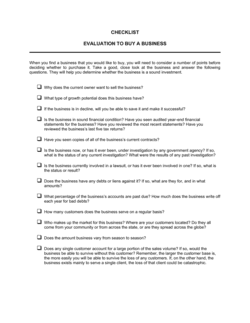
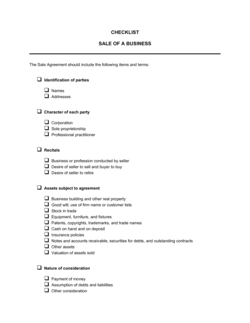
A Checklist Sale Of A Business Critical What If is a structured form that walks sellers and buyers through the high-stakes scenarios and contingency questions that most commonly derail a business sale before or after closing. This free Word download lets you work through each critical "what if" item, flag unresolved risks, and enter the closing process with no blind spots.
When you need it
Use it once a letter of intent is signed and due diligence is underway, or before accepting an offer to confirm every material risk has been examined. It is equally useful for buyers stress-testing their acquisition assumptions and for sellers identifying issues that could reduce the sale price or kill the deal.
What's inside
Risk scenario prompts organized by category (financial, legal, operational, people, and customer), a status column to flag each item as resolved, open, or not applicable, and a notes field for capturing follow-up actions and responsible parties.

What is a Checklist Sale Of A Business Critical What If?

A Checklist Sale Of A Business Critical What If is a structured scenario-based form that guides sellers and buyers through the contingency risks most likely to derail, reprice, or complicate a business sale transaction. Unlike a standard due diligence document request list, this checklist poses specific "what if" questions across financial, legal, operational, staffing, and customer risk categories β€” prompting both parties to think through the consequences of each risk before it becomes a closing-table crisis. The form includes a status tracking column, notes fields, and a deal-breaker flag so every open item has an owner and a resolution deadline.

Why You Need This Document

A business sale that reaches the closing table without a structured risk walkthrough is one undisclosed liability away from a price reduction, a delayed close, or a collapsed deal. Customer change-of-control clauses, non-transferable software licenses, and key-person dependencies are among the issues most commonly discovered late in the process β€” at maximum cost to both sides. Without a what-if checklist, these scenarios surface reactively, during legal review or in post-closing disputes, when they are far more expensive to resolve. This template gives sellers the tool to identify and remediate deal risks before entering negotiations, and gives buyers a consistent framework for stress-testing every assumption behind their offer β€” so the transaction closes on the terms both parties actually agreed to.

Which variant fits your situation?

If your situation is…Use this template
Preparing a full package of sale documents for buyersBusiness Sale Agreement
Conducting formal financial and legal due diligenceDue Diligence Checklist
Documenting the initial offer and key terms before a full agreementLetter of Intent (Business Acquisition)
Valuing the business before listing it for saleBusiness Valuation Template
Transferring ownership of specific business assets rather than the entityAsset Purchase Agreement
Protecting confidential business information shared during negotiationsNon-Disclosure Agreement (NDA)
Outlining post-sale transition responsibilities and timelinesBusiness Transition Plan

Common mistakes to avoid

❌ Running the checklist only once

Why it matters: Risks that appear resolved early in due diligence can reopen as new information surfaces. A single review misses issues that emerge after the initial data room drop.

Fix: Treat the checklist as a living document and update it at every due diligence milestone through to the week before closing.

❌ Skipping the deal structure confirmation

Why it matters: Asset sales and share sales carry different tax consequences, liability exposures, and license-transfer requirements. Using a generic checklist without confirming the structure leads to missed scenario categories.

Fix: Confirm asset versus share sale in the header before working through any other section, and remove or add scenario rows accordingly.

❌ Not flagging customer change-of-control clauses

Why it matters: A single large customer with a change-of-control clause in their contract can withdraw revenue β€” or demand renegotiation β€” immediately after closing, materially reducing deal value.

Fix: Review every material customer contract for assignment or change-of-control language before the LOI is signed, not after.

❌ Treating all open items as equally urgent

Why it matters: When every scenario is flagged the same way, true deal-breakers get buried in a list of minor negotiable items, and the critical issues are not escalated in time.

Fix: Use the deal-breaker flag column to separate must-resolve items from negotiable ones, and address flagged items before advancing to the purchase agreement.

The 9 key fields, explained

Business and deal summary

Financial risk scenarios

Legal and compliance risk scenarios

Operational continuity scenarios

Key person and staff retention scenarios

Customer and revenue retention scenarios

Financing and deal structure contingencies

Status and resolution tracking

Escalation and deal-breaker flags

How to fill it out

  1. 1

    Complete the business and deal summary header

    Enter the business name, industry, asking price, deal structure, and the names of both parties. Confirm whether this is an asset sale or a share sale before proceeding β€” this determines which risk scenarios are relevant.

    πŸ’‘ Share the completed header with your advisor before running through the scenarios β€” confirming the deal structure takes five minutes and prevents reviewing irrelevant items.

  2. 2

    Work through financial risk scenarios line by line

    Review each financial what-if prompt and mark the status as resolved, open, or not applicable. For open items, note the data source or document needed to resolve it and assign an owner.

    πŸ’‘ Pull the last three years of tax returns alongside this section β€” most financial risk items can be answered or flagged within the same session.

  3. 3

    Review legal and compliance scenarios with counsel

    Work through license transferability, pending litigation, and tax lien scenarios. Flag anything that requires a legal opinion or search before proceeding to exclusivity.

    πŸ’‘ A UCC lien search and a litigation check on the seller entity typically cost under $200 and resolve the most common legal surprises in one business day.

  4. 4

    Assess operational continuity risks

    Identify every supplier agreement, lease, and software license and confirm whether each can be assigned or assumed by the buyer. Mark non-transferable items for renegotiation before closing.

    πŸ’‘ Request a complete vendor contract list from the seller in the first week of due diligence β€” assignment restrictions are rarely volunteered.

  5. 5

    Document key person and staff dependencies

    Identify the roles whose departure would most affect revenue or operations, then confirm whether transition agreements, non-solicitation clauses, or employment offers are in place.

    πŸ’‘ Ask the seller directly: 'Which three people, if they left the day after closing, would most hurt this business?' The answer tells you where to focus retention planning.

  6. 6

    Flag all deal-breaker items and assign resolution authority

    Review the full completed checklist and mark any unresolved scenario that would cause either party to reprice or exit the deal. Assign a decision authority (buyer, seller, or both) and a hard deadline for resolution.

    πŸ’‘ Resolve deal-breaker items before signing the purchase agreement β€” raising them at the closing table adds legal fees and erodes trust on both sides.

  7. 7

    Update status at each due diligence milestone

    Revisit the checklist at every major due diligence checkpoint and update the status and notes columns. Distribute the updated version to all advisors so everyone is working from the same risk picture.

    πŸ’‘ A shared, version-controlled document prevents the scenario where the buyer's attorney and the seller's broker are tracking different open items.

Frequently asked questions

What is a critical what-if checklist for selling a business?

A critical what-if checklist for selling a business is a structured form that walks buyers and sellers through the scenario-based risks most likely to derail or reprice a transaction β€” covering financial, legal, operational, people, and customer risk categories. Unlike a standard due diligence checklist that requests documents, this checklist poses specific contingency questions that prompt both parties to think through what would happen if a given risk materialized.

When should I use this checklist in the sale process?

Use it as soon as a letter of intent is signed and due diligence begins. Sellers benefit from running through it before accepting an offer to identify and remediate issues that would reduce the sale price. Buyers benefit from using it during due diligence to stress-test their acquisition assumptions. Update it at every major due diligence milestone through to the week before closing.

What is the difference between a due diligence checklist and a what-if checklist?

A due diligence checklist is a document request list β€” it specifies what financial statements, contracts, and records the buyer needs to review. A what-if checklist is a scenario-based risk tool β€” it asks what would happen if a specific risk materialized. The two are complementary: due diligence gathers information; the what-if checklist stress-tests what that information means for the deal.

Does this checklist replace a lawyer or accountant in the sale process?

No. This checklist is a planning and communication tool, not a substitute for professional legal or financial advice. It helps sellers and buyers identify and organize risks before engaging advisors, making those advisory conversations more focused and efficient. Legal, tax, and financial professionals should review any material risks surfaced by the checklist before the purchase agreement is finalized.

What are the most common deal-breakers uncovered by a what-if checklist?

The five most common deal-killers in SMB transactions are: undisclosed tax liabilities or liens, customer contracts with change-of-control clauses that allow the customer to exit, key-person dependency where the owner is the primary driver of revenue, non-transferable licenses or leases, and a working capital level at closing that falls materially below the agreed target. This checklist prompts a direct examination of each.

Can a buyer use this checklist as well as a seller?

Yes β€” the checklist is designed to be useful from both sides of the transaction. Sellers use it to identify and resolve issues before entering negotiations. Buyers use it during due diligence to surface undisclosed risks and to confirm that the seller's representations are consistent with what the scenario analysis reveals.

How does this checklist relate to the purchase agreement?

Items flagged as unresolved on this checklist should be addressed before the purchase agreement is signed β€” either resolved outright or reflected in the representations, warranties, and indemnification provisions of the agreement. Raising unresolved what-if scenarios at the closing table typically increases legal fees, triggers price renegotiation, or collapses the deal entirely.

What file format does the template come in?

The template is available as a free Word download that you can edit directly and export as PDF. You can customize the scenario rows, add industry-specific risk prompts, and share it with advisors and counterparties without any special software.

How this compares to alternatives

vs Due Diligence Checklist

A due diligence checklist is a document request list specifying what records and contracts a buyer needs to review. A what-if checklist is a scenario-based risk tool that stress-tests what those documents reveal. Due diligence gathers the evidence; the what-if checklist asks what happens if the evidence shows a problem. Both should be used together in any business sale process.

vs Letter of Intent (Business Acquisition)

A letter of intent records the agreed headline terms β€” price, structure, and timeline β€” before the full purchase agreement is drafted. The what-if checklist is used alongside the LOI period to surface risks that may require the terms to be renegotiated. Completing the checklist before signing an exclusivity clause is the most cost-effective sequence.

vs Asset Purchase Agreement

An asset purchase agreement is the binding legal contract that transfers specified business assets from seller to buyer. The what-if checklist is a pre-contract planning tool that identifies which risks need to be addressed in the representations, warranties, and indemnification provisions of that agreement. The checklist informs the contract; it does not replace it.

vs Business Transition Plan

A business transition plan documents how operations, relationships, and responsibilities will be handed over to the buyer after closing. The what-if checklist is completed before closing to identify risks; the transition plan is completed to manage those risks through the handover period. Together they cover the two most vulnerable phases of any business sale.

Industry-specific considerations

Professional Services

Key-person risk is acute β€” the checklist flags whether client relationships are transferable or tied exclusively to the departing owner.

Retail and E-commerce

Inventory valuation accuracy, supplier contract assignability, and platform account transferability (e.g., Amazon Seller Central) are the highest-priority what-if scenarios.

Manufacturing

Equipment lease assumptions, environmental compliance history, and union contract obligations are the scenarios most likely to surface hidden post-closing costs.

SaaS / Technology

Software license transferability, customer churn post-announcement, and data privacy compliance (GDPR, CCPA) are the critical what-if categories for tech business sales.

Template vs pro β€” what fits your needs?

PathBest forCostTime
Use the templateSellers and buyers in straightforward SMB transactions who want a structured risk walkthrough without advisor costFree2–4 hours
Template + professional reviewTransactions above $500K or involving complex operational, legal, or customer-concentration risks$500–$2,000 for a business broker or M&A advisor review session1–3 days
Custom draftedTransactions above $5M, regulated industries, or multi-entity deals requiring a full advisor-led risk assessment$3,000–$15,000+ for full M&A advisory due diligence support2–6 weeks

Glossary

Letter of Intent (LOI)
A non-binding document signed by buyer and seller outlining the proposed terms of a business sale before a formal purchase agreement is drafted.
Due Diligence
The buyer's formal investigation of a business's financial, legal, operational, and commercial condition before completing a purchase.
Contingency
A condition that must be satisfied before the sale can close β€” such as financing approval, regulatory consent, or a clean audit.
Deal-Breaker
An undisclosed liability, risk, or misrepresentation significant enough to cause a buyer to withdraw from or reprice a transaction.
Working Capital Adjustment
A post-closing price adjustment based on the actual level of current assets minus current liabilities delivered at closing versus the agreed target.
Earnout
A portion of the sale price paid after closing, contingent on the business meeting specific revenue or profit targets over a defined period.
Key Person Risk
The risk that the business's performance depends heavily on one or two individuals whose departure could impair value after the sale.
Representations and Warranties
Factual statements made by the seller in the purchase agreement about the business's condition β€” breaches can trigger post-closing indemnity claims.
Indemnification
A contractual obligation by the seller to compensate the buyer for losses arising from undisclosed liabilities or misrepresentations discovered after closing.
Customer Concentration Risk
The risk that a significant portion of revenue comes from one or a few customers whose loss would materially reduce the business's value.

Part of your Business Operating System

This document is one of 3,000+ business & legal templates included in Business in a Box.

  • Fill-in-the-blanks β€” ready in minutes
  • 100% customizable Word document
  • Compatible with all office suites
  • Export to PDF and share electronically

Create your document in 3 simple steps.

From template to signed document β€” all inside one Business Operating System.
1
Download or open template

Access over 3,000+ business and legal templates for any business task, project or initiative.

2
Edit and fill in the blanks with AI

Customize your ready-made business document template and save it in the cloud.

3
Save, Share, Send, Sign

Share your files and folders with your team. Create a space of seamless collaboration.

Save time, save money, and create top-quality documents.

β˜…β˜…β˜…β˜…β˜…

"Fantastic value! I'm not sure how I'd do without it. It's worth its weight in gold and paid back for itself many times."

Managing Director Β· Mall Farm
Robert Whalley
Managing Director, Mall Farm Proprietary Limited
β˜…β˜…β˜…β˜…β˜…

"I have been using Business in a Box for years. It has been the most useful source of templates I have encountered. I recommend it to anyone."

Business Owner Β· 4+ years
Dr Michael John Freestone
Business Owner
β˜…β˜…β˜…β˜…β˜…

"It has been a life saver so many times I have lost count. Business in a Box has saved me so much time and as you know, time is money."

Owner Β· Upstate Web
David G. Moore Jr.
Owner, Upstate Web

Run your business with a system β€” not scattered tools

Stop downloading documents. Start operating with clarity. Business in a Box gives you the Business Operating System used by over 250,000 companies worldwide to structure, run, and grow their business.

Free Forever PlanΒ Β·Β No credit card required