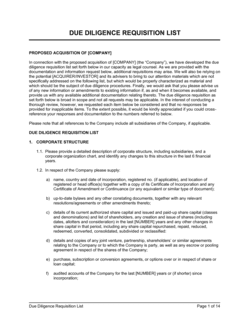
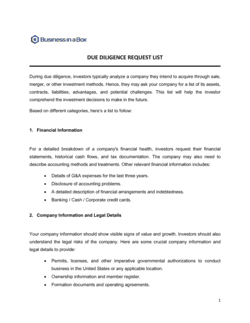
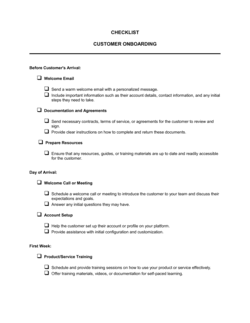
Checklist Customer Due Diligence

Free download β€’ Use as a template β€’ Print or share

4 pagesβ€’20–30 min to useβ€’Difficulty: Standard
Learn more ↓
FreeChecklist Customer Due Diligence Template

At a glance

What it is
A Customer Due Diligence (CDD) Checklist is a structured form businesses use to collect, verify, and record key information about a customer before entering into a business relationship. This free Word download gives you a ready-to-use checklist you can edit online and export as PDF to support KYC (Know Your Customer) compliance, AML screening, and internal risk assessment processes.
When you need it
Use it when onboarding a new client or customer, especially in financial services, professional services, or any regulated industry where verifying identity and assessing risk exposure is a legal or operational requirement. It is also used during periodic reviews of existing customer relationships.
What's inside
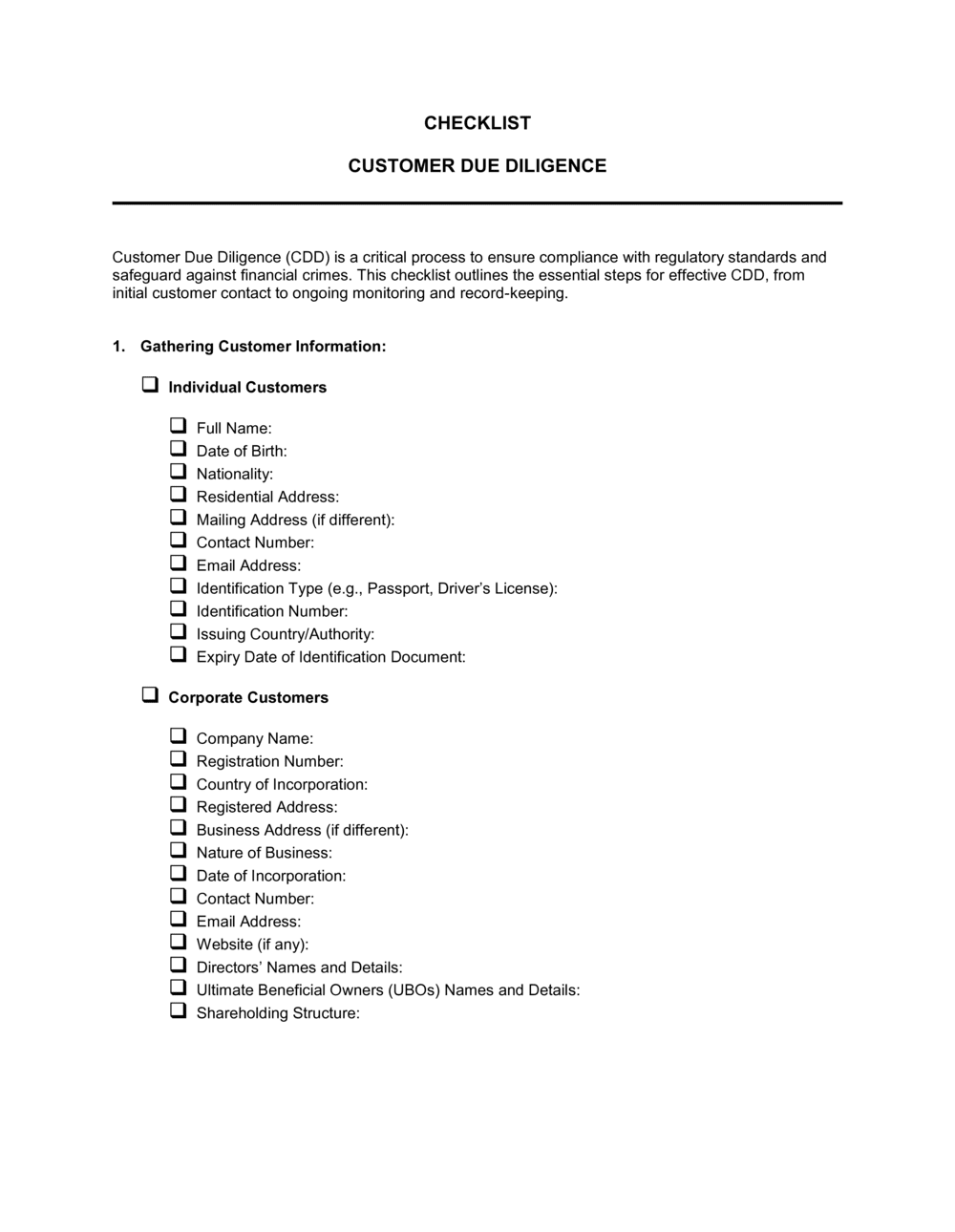
Customer identification fields, beneficial ownership details, business activity and source-of-funds verification, risk classification, document collection log, sanctions and PEP screening results, and sign-off fields for the reviewing staff member.

What is a Customer Due Diligence Checklist?

A Customer Due Diligence (CDD) Checklist is a structured form that businesses use to collect, verify, and document key information about a customer before β€” and during β€” a business relationship. It captures identity details, beneficial ownership, business activity, source of funds, and sanctions screening results in a single auditable record. Designed to support KYC (Know Your Customer) and AML (Anti-Money Laundering) compliance, this free Word download gives you a ready-to-use template you can edit online and export as PDF to standardize your customer onboarding process.

Why You Need This Document

Without a completed CDD checklist on file, your business has no auditable record that it verified who it was doing business with β€” and in regulated industries, that gap is not a procedural oversight, it is a compliance failure. Regulators can impose fines, suspend licenses, or hold compliance officers personally liable for CDD breakdowns, even when no actual financial crime occurred. Beyond regulatory risk, an undocumented customer poses a practical problem: without a baseline profile, unusual transaction activity cannot be identified as unusual. This template closes that gap by giving your team a consistent, step-by-step verification process that produces the kind of documented record that satisfies both internal auditors and external regulators.

Which variant fits your situation?

If your situation is…Use this template
Onboarding an individual retail customer with standard risk profileStandard CDD Checklist
Onboarding a high-net-worth or high-risk customer requiring deeper scrutinyEnhanced Due Diligence Checklist
Onboarding a corporate entity with complex ownership structureBusiness Customer Due Diligence Form
Screening a prospective supplier or vendor rather than a customerVendor Due Diligence Checklist
Periodic review of an existing customer relationshipCustomer Review and Re-Verification Form
Assessing a potential merger or acquisition targetM&A Due Diligence Checklist

Common mistakes to avoid

❌ Screening only the entity, not beneficial owners

Why it matters: Sanctions and PEP designations typically target individuals, not the companies they own. Screening only the entity name misses the exposure that regulators are looking for.

Fix: Screen every beneficial owner who holds 25% or more individually, and document each screening result separately in the checklist.

❌ Accepting expired identity documents

Why it matters: An expired ID does not satisfy most regulatory identity verification standards and will be flagged immediately in a compliance audit or enforcement review.

Fix: Check document expiry dates before recording them as verified, and establish a policy requiring a valid, in-date document before onboarding proceeds.

❌ Assigning low risk to every customer by default

Why it matters: A risk classification that never results in medium or high ratings signals to regulators that the process is not functioning β€” and offers no protection if a customer turns out to be involved in financial crime.

Fix: Apply documented, objective criteria for each rating level and review the distribution of risk ratings periodically to confirm it reflects a realistic spread.

❌ Completing the checklist after the relationship has already started

Why it matters: Due diligence conducted after onboarding is retroactive, not preventive, and typically does not satisfy regulatory requirements that CDD be completed before the relationship commences.

Fix: Make checklist completion a hard prerequisite to account opening, contract execution, or first transaction β€” not a task to catch up on afterward.

The 9 key fields, explained

Customer identification

Identity verification documents

Beneficial ownership

Business activity and purpose of relationship

Source of funds and source of wealth

Sanctions and PEP screening

Risk classification

Supporting documents log

Reviewer sign-off and date

How to fill it out

  1. 1

    Collect the customer's legal identity information

    Record the customer's full legal name, date of birth or registration number, nationality, and address. For corporate customers, obtain the registered entity name and jurisdiction of incorporation.

    πŸ’‘ Cross-reference the name against the identity document before entering it β€” even small spelling discrepancies can trigger false positives in screening.

  2. 2

    Request and verify identity documents

    Obtain government-issued photo ID for individuals and company registration documents for entities. Log the document type, reference number, and expiry date. Note whether you verified the original, a certified copy, or used an electronic verification service.

    πŸ’‘ Check the expiry date before accepting any document β€” expired IDs fail most regulatory standards regardless of the customer's apparent legitimacy.

  3. 3

    Identify all beneficial owners

    For corporate customers, trace ownership to the natural person(s) who ultimately hold 25% or more of shares or voting rights. Record each person's name and ownership percentage, and verify their identity separately.

    πŸ’‘ Request a corporate structure chart for any customer with more than two layers of ownership β€” it speeds up beneficial owner mapping significantly.

  4. 4

    Document business activity and purpose

    Record what the customer's business does and the specific reason they are engaging your services. Note the expected volume and nature of transactions.

    πŸ’‘ Be specific enough that a colleague unfamiliar with the customer could identify an out-of-pattern transaction six months from now.

  5. 5

    Run sanctions and PEP screening

    Screen the customer's name and any beneficial owners against OFAC, UN, EU, and any jurisdiction-specific lists. Record the date, lists checked, and outcome. Note PEP status separately.

    πŸ’‘ Screen beneficial owners individually, not just the entity name β€” sanctions often target the person, not the company they control.

  6. 6

    Assign a risk classification

    Apply your organization's risk criteria to rate the customer low, medium, or high. Document the factors that drove the rating. Flag high-risk customers for enhanced due diligence and senior sign-off.

    πŸ’‘ Geographic location, business type, and transaction volume are the three most predictive risk factors β€” weight them explicitly in your criteria.

  7. 7

    Log supporting documents and complete the sign-off

    Check off each document received in the supporting documents log. Have the reviewing staff member sign and date the completed checklist. Note any follow-up actions or escalations.

    πŸ’‘ File the completed checklist and all supporting documents together in a single record β€” fragmented files are a common finding in regulatory audits.

Frequently asked questions

What is customer due diligence?

Customer due diligence (CDD) is the process of identifying and verifying who a customer is, understanding the nature of their business, and assessing the risk they pose before entering into a business relationship. It is a core component of KYC (Know Your Customer) compliance and is required by AML regulations in most jurisdictions for financial services, professional services, and other regulated industries.

Who is required to perform customer due diligence?

Financial institutions, banks, accountants, lawyers, real estate agents, money service businesses, and other regulated professionals are typically required by law to perform CDD on their customers. Requirements vary by jurisdiction and industry, but the underlying obligation β€” verify who you are doing business with β€” applies broadly across regulated sectors.

What documents are typically collected for CDD?

For individual customers: a government-issued photo ID (passport or driver's license) and proof of address (utility bill or bank statement dated within 90 days). For corporate customers: company registration certificate, articles of incorporation, ownership structure, and identification documents for each beneficial owner. Higher-risk customers may require financial statements or source-of-funds documentation.

What is the difference between standard and enhanced due diligence?

Standard CDD applies to customers with a normal risk profile and involves identity verification, beneficial ownership identification, and basic risk assessment. Enhanced due diligence (EDD) is required for high-risk customers β€” including PEPs, customers from high-risk jurisdictions, or those with complex ownership structures β€” and involves deeper document collection, senior management approval, and more frequent ongoing monitoring.

How often should customer due diligence be repeated?

CDD should be repeated whenever there is a material change in the customer's profile β€” such as a change in ownership, business activity, or transaction patterns β€” and on a periodic schedule based on risk classification. Low-risk customers are typically reviewed every 3–5 years; high-risk customers may require annual or even more frequent review.

What is a beneficial owner and why does it matter for CDD?

A beneficial owner is the natural person who ultimately owns or controls a legal entity, typically anyone with 25% or more of shares or voting rights. Identifying beneficial owners matters because criminals frequently use corporate structures to obscure their identity. Regulators require CDD to pierce those layers and identify the real individual behind the entity.

Can I use a checklist template to meet regulatory CDD requirements?

A well-structured CDD checklist template covers the core data points required by most regulatory frameworks and provides an auditable record of the verification process. However, your organization's specific obligations depend on your industry, jurisdiction, and regulator. Consider having a compliance professional review your process to confirm it meets the applicable standards before relying on it in a regulated context.

What happens if customer due diligence is not performed?

Failing to perform adequate CDD can result in regulatory fines, suspension of operating licenses, reputational damage, and in serious cases, personal liability for compliance officers or senior management. Regulated firms have faced fines running into the tens of millions for systemic CDD failures, even where no actual money laundering was proven.

How this compares to alternatives

vs M&A Due Diligence Checklist

An M&A due diligence checklist evaluates a target company's financials, legal standing, contracts, and operations before an acquisition. A customer due diligence checklist verifies the identity and risk profile of a customer before entering a business relationship. They are both verification tools but serve entirely different purposes and audiences.

vs Vendor Due Diligence Checklist

A vendor due diligence checklist assesses the reliability, financial health, and compliance posture of a supplier your business is considering. A CDD checklist focuses on verifying customer identity and AML risk. Vendor due diligence looks outward at who you are buying from; CDD looks at who is buying from you.

vs Client Intake Form

A client intake form captures commercial and contact information needed to begin a service engagement β€” scope, billing details, and preferences. A CDD checklist goes further by verifying identity, screening for sanctions and PEP status, and producing an auditable compliance record. The intake form starts the relationship; the CDD checklist makes it legally defensible.

vs KYC Application Form

A KYC application form is completed by the customer and captures self-declared information. A CDD checklist is completed by your staff to verify and record that information, log the documents collected, and assign a risk rating. The KYC form is the input; the CDD checklist is the verification record.

Industry-specific considerations

Financial Services

CDD is a regulatory baseline for account opening, loan origination, and transaction processing β€” with enhanced screening triggered by transaction thresholds.

Legal and Accounting

Solicitors and accountants in most jurisdictions must complete CDD before accepting a new client matter, particularly for transactions involving real property or company formation.

Real Estate

High-value property transactions are a known AML risk vector; agents and brokers must verify buyer and seller identity and document source of funds for purchases above regulatory thresholds.

Fintech and Payments

Digital onboarding pipelines must replicate the same CDD controls as traditional institutions, often using electronic identity verification services and automated sanctions screening APIs.

Template vs pro β€” what fits your needs?

PathBest forCostTime
Use the templateSmall businesses and professional services firms establishing a basic, auditable CDD processFree15–30 minutes per customer
Template + professional reviewRegulated firms wanting to confirm the checklist meets their specific jurisdictional AML obligations$300–$800 for a compliance consultant review3–5 days
Custom draftedFinancial institutions, fintechs, or firms with high customer volumes needing an integrated digital CDD workflow$2,000–$10,000+ for custom compliance technology or a bespoke policy build-out2–8 weeks

Glossary

Customer Due Diligence (CDD)
The process of identifying and verifying a customer's identity and assessing the risk they pose before and during a business relationship.
Know Your Customer (KYC)
A regulatory requirement for businesses β€” particularly in financial services β€” to verify the identity of clients and understand the nature of their activity.
Anti-Money Laundering (AML)
A set of laws, regulations, and procedures designed to prevent criminals from disguising illegally obtained funds as legitimate income.
Beneficial Owner
The natural person who ultimately owns or controls a legal entity, typically defined as anyone holding 25% or more of its shares or voting rights.
Politically Exposed Person (PEP)
An individual who holds or has held a prominent public position β€” such as a government official or senior military officer β€” and who is considered higher risk for bribery and corruption.
Sanctions Screening
The process of checking a customer's name and details against government-maintained lists of sanctioned individuals, entities, and countries.
Risk Classification
A rating β€” typically low, medium, or high β€” assigned to a customer based on their identity, business activity, geographic location, and transaction profile.
Source of Funds
The origin of the money a customer uses in a specific transaction, distinct from source of wealth, which covers the broader accumulation of their assets.
Enhanced Due Diligence (EDD)
A deeper level of customer verification applied to high-risk customers, PEPs, or those from high-risk jurisdictions, requiring additional documentation and senior approval.
Ongoing Monitoring
The continuous review of a customer's transactions and profile after onboarding to detect activity that is inconsistent with the established risk assessment.

Part of your Business Operating System

This document is one of 3,000+ business & legal templates included in Business in a Box.

  • Fill-in-the-blanks β€” ready in minutes
  • 100% customizable Word document
  • Compatible with all office suites
  • Export to PDF and share electronically

Create your document in 3 simple steps.

From template to signed document β€” all inside one Business Operating System.
1
Download or open template

Access over 3,000+ business and legal templates for any business task, project or initiative.

2
Edit and fill in the blanks with AI

Customize your ready-made business document template and save it in the cloud.

3
Save, Share, Send, Sign

Share your files and folders with your team. Create a space of seamless collaboration.

Save time, save money, and create top-quality documents.

β˜…β˜…β˜…β˜…β˜…

"Fantastic value! I'm not sure how I'd do without it. It's worth its weight in gold and paid back for itself many times."

Managing Director Β· Mall Farm
Robert Whalley
Managing Director, Mall Farm Proprietary Limited
β˜…β˜…β˜…β˜…β˜…

"I have been using Business in a Box for years. It has been the most useful source of templates I have encountered. I recommend it to anyone."

Business Owner Β· 4+ years
Dr Michael John Freestone
Business Owner
β˜…β˜…β˜…β˜…β˜…

"It has been a life saver so many times I have lost count. Business in a Box has saved me so much time and as you know, time is money."

Owner Β· Upstate Web
David G. Moore Jr.
Owner, Upstate Web

Run your business with a system β€” not scattered tools

Stop downloading documents. Start operating with clarity. Business in a Box gives you the Business Operating System used by over 250,000 companies worldwide to structure, run, and grow their business.

Start freeΒ Β·Β No credit card required