1
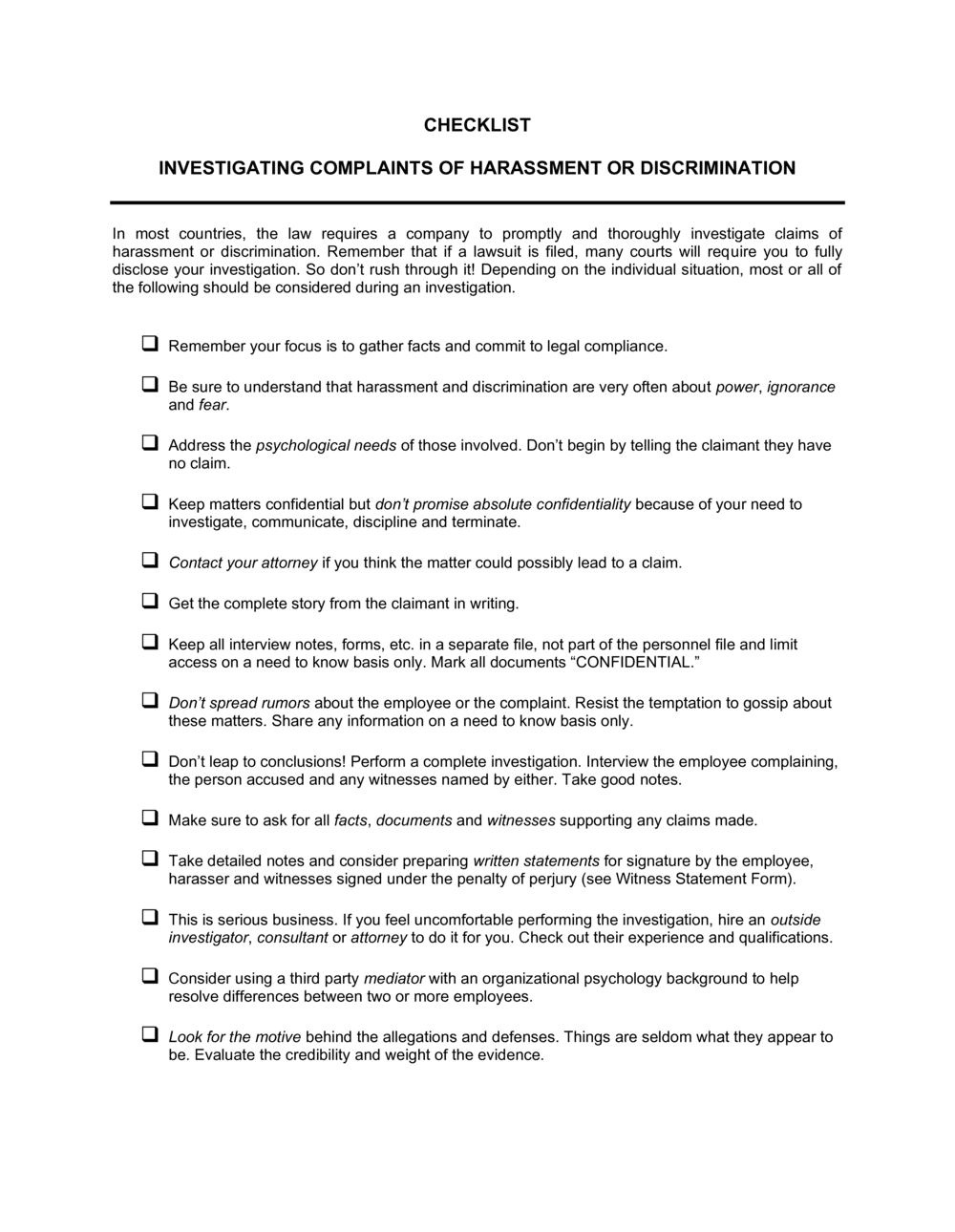
Complete the complaint intake section immediately
As soon as a complaint is received, record the date, method of submission, and who received it. Do not delay this step even if the full details are still being gathered.
💡 If the complaint was verbal, send a written summary to the complainant within 24 hours and ask them to confirm it accurately reflects what they reported.
2
Enter both parties' details and recuse conflicted managers
Record the complainant's and respondent's names, titles, departments, and supervisors. Identify any manager who has a personal or supervisory relationship with either party and remove them from the investigation.
💡 If the respondent is the complainant's direct manager, escalate to the next level of management or an external investigator before proceeding.
3
Document the alleged conduct in the complainant's own words
Record the specific behavior described, the dates and locations, and whether the complainant has noted a pattern. Use quotation marks where possible and avoid paraphrasing.
💡 Ask the complainant to write and sign their account — a signed statement is significantly stronger evidence than an investigator's summary.
4
Build the witness list independently
Note everyone who may have relevant knowledge, including colleagues who were present, those who received related communications, and anyone the respondent may identify. Do not limit the list to names the complainant provides.
💡 Interview the complainant and respondent before witnesses so you know which specific events or communications to probe.
5
Collect and log all evidence with chain-of-custody entries
Gather emails, texts, access logs, CCTV records, or any other relevant documentation. Log each item with a description, source, date obtained, and storage location.
💡 Preserve digital evidence in its original format before exporting or printing — metadata timestamps can be critical in disputed cases.
6
Conduct and document each interview
Interview each witness separately and privately. Record the date, interviewer, and a summary of key statements. Have each interviewee review and sign their summary before the interview is closed.
💡 Use open-ended questions — 'What did you observe?' rather than 'Did you see X happen?' — to avoid leading witnesses toward a predetermined conclusion.
7
Record the finding with written reasoning
Based on the weight of evidence and statements, record whether the complaint is substantiated, unsubstantiated, or inconclusive. Write at least two to three sentences explaining the basis for the conclusion.
💡 If evidence conflicts, document the conflict explicitly rather than ignoring it — unaddressed contradictions are the most common grounds for appealing investigation findings.
8
Complete the corrective action plan and sign off
Specify each action to be taken, who is responsible, and the completion deadline. Sign and date the checklist to formally close the investigation.
💡 Schedule a follow-up review 30–60 days after corrective action to confirm it was completed and that no retaliation has occurred.