Checklist Entrepreneur Skill Set

Free download β€’ Use as a template β€’ Print or share

1 pageβ€’15–20 min to useβ€’Difficulty: Standard
Learn more ↓
FreeChecklist Entrepreneur Skill Set Template

At a glance

What it is
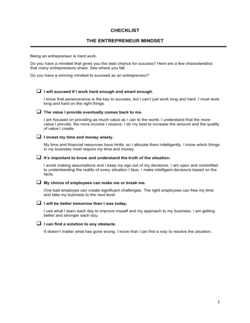
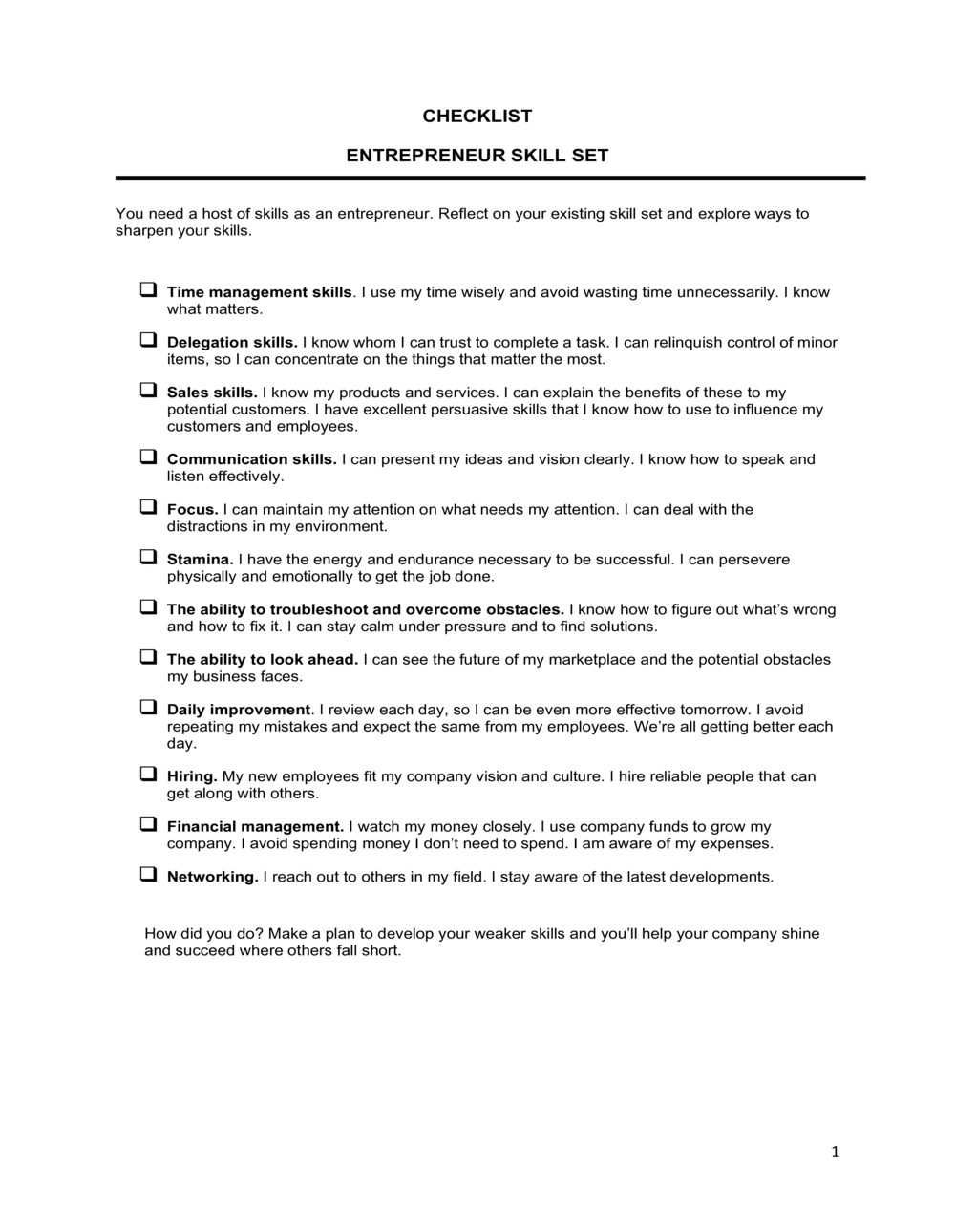
A Checklist Entrepreneur Skill Set is a structured self-assessment form that helps founders, aspiring entrepreneurs, and business owners evaluate their proficiency across the core competencies required to start and run a successful business. This free Word download lists each skill category with a rating or checkbox column so you can identify strengths and gaps at a glance.
When you need it
Use it before launching a new venture to understand where to invest in training or co-founders, during an annual business review to track skill development, or as part of a coaching or accelerator intake process.
What's inside
Skill categories spanning leadership, financial literacy, sales and marketing, operations, and resilience β€” each with a self-rating scale and a notes column for development actions. The form is designed to produce a prioritized list of gaps you can act on immediately.

What is a Checklist Entrepreneur Skill Set?

A Checklist Entrepreneur Skill Set is a structured self-assessment form that lists the core competencies required to start and operate a business β€” including financial literacy, sales, leadership, operations, and resilience β€” and prompts the user to rate their current proficiency in each area alongside the skill's importance to their specific venture. By calculating the gap between importance and proficiency for every item, the checklist produces a ranked list of development priorities the founder can act on immediately. It is designed to be completed in a single sitting and revisited every six months as the business and its skill demands evolve.

Why You Need This Document

Launching or growing a business without understanding your own skill gaps is one of the most expensive mistakes a founder can make. Decisions about which co-founders to recruit, which roles to hire first, and where to invest in training all depend on an honest picture of what you can and cannot do today. Founders who skip this step routinely spend months building a product when their critical gap is sales, or hire a marketing agency before they understand enough to brief one effectively. This checklist forces that honest inventory in 30–60 minutes, creating a written baseline you and any mentor, investor, or co-founder can review together β€” and a before-and-after record that shows real development progress over time.

Which variant fits your situation?

If your situation is…Use this template
Assessing readiness before starting a first businessChecklist Entrepreneur Skill Set
Evaluating a leadership team's combined skill coverageTeam Skills Matrix
Structured annual performance self-review for a sole proprietorEmployee Self-Evaluation Form
Mapping skill gaps to a formal training or development planEmployee Training Plan
Evaluating a business idea before committing to a full planBusiness Idea Evaluation Checklist
Onboarding a new founder partner to confirm complementary skillsCo-Founder Agreement

Common mistakes to avoid

❌ Rating skills on aspiration rather than demonstrated ability

Why it matters: Overrated scores hide real gaps from coaches, co-founders, and investors β€” and lead to poor hiring and delegation decisions when the business needs those skills most.

Fix: For each rating above 3, write at least one specific example in the evidence column. If you cannot, lower the score.

❌ Treating the checklist as a one-time exercise

Why it matters: Skills develop and business requirements shift β€” a checklist completed once and filed away provides no ongoing accountability and no way to measure progress.

Fix: Set a calendar reminder for a 6-month reassessment and compare scores against the previous version to track real development.

❌ Skipping the importance column to save time

Why it matters: Without an importance rating, every skill looks equally worth developing. You will invest time closing low-priority gaps while critical gaps stall the business.

Fix: Complete the importance column before scoring proficiency β€” it anchors your self-assessment to the actual demands of your business model.

❌ Writing vague development actions with no deadline

Why it matters: Actions like 'improve financial skills' never get done. An open-ended action with no named resource or date is not an action β€” it is a wish.

Fix: Rewrite each action as: 'Complete [SPECIFIC RESOURCE] by [DATE] and apply by doing [SPECIFIC TASK].'

The 8 key fields, explained

Skill category name

Proficiency rating scale

Importance rating

Gap score

Evidence or examples

Development action

Target proficiency level

Review date

How to fill it out

  1. 1

    Read every skill category before rating any of them

    Scan the full list first so you understand the scope and can calibrate your ratings consistently. Rating as you go leads to grade inflation early in the list.

    πŸ’‘ Print or display a definition of each skill level before you start β€” calibration matters more than speed.

  2. 2

    Rate your current proficiency honestly

    Assign a score of 1–5 to each skill based on what you can actually do today, not what you intend to learn. Use the evidence column to challenge yourself.

    πŸ’‘ Ask a mentor or co-founder to review your scores before finalizing β€” external perspective cuts self-serving bias by roughly half.

  3. 3

    Rate the importance of each skill to your specific business

    Not every entrepreneurial skill matters equally to every business model. A SaaS founder needs stronger technical and data skills than a service-based consultant.

    πŸ’‘ Rate importance based on your business model for the next 12 months, not the business you hope to have in five years.

  4. 4

    Calculate and rank your gap scores

    Subtract your proficiency rating from your importance rating for each row. Sort the results from highest to lowest β€” these are your priority development areas.

    πŸ’‘ Focus your energy on the top three gaps first. Trying to close more than three simultaneously dilutes progress.

  5. 5

    Write a specific development action for each priority gap

    For your top three gaps, identify one concrete action: a named course, a mentor conversation, a practicum, or a hire. Assign a completion date.

    πŸ’‘ The best development action for a skill gap is hands-on practice, not reading. Prioritize doing over studying wherever possible.

  6. 6

    Set a review date and store the completed checklist

    Enter a specific date β€” typically 6 months out β€” for your next assessment. Save the completed form so you can compare before-and-after scores.

    πŸ’‘ Tie your review date to a natural business milestone β€” end of a quarter, close of a funding round, or anniversary of your launch β€” so it actually happens.

Frequently asked questions

What is an entrepreneur skill set checklist?

An entrepreneur skill set checklist is a self-assessment form that lists the core competencies required to start and run a business β€” from financial literacy and sales to leadership and resilience β€” and prompts you to rate your current proficiency in each area. It produces a prioritized map of strengths and gaps so you can focus development effort where it matters most for your specific venture.

What skills should every entrepreneur assess?

The most consistently cited entrepreneurial competencies include financial management, sales and negotiation, marketing and customer acquisition, leadership and team building, operations and process design, strategic thinking, resilience and risk tolerance, communication, digital literacy, and networking. The relative importance of each depends heavily on your business model and stage.

How often should I complete an entrepreneur skills assessment?

Every 6 months is a practical cadence for most founders. Reassess at natural inflection points β€” before a funding round, when hiring your first employee, or when entering a new market β€” since the skills your business demands shift as it grows. Comparing successive assessments shows real development progress rather than just a snapshot.

Can I use this checklist to evaluate a potential co-founder?

Yes. Having each co-founder complete the checklist independently and then comparing scores is an effective way to confirm complementary skill coverage and surface honest conversations about gaps before you formalize the partnership. Pay particular attention to areas where both founders score low β€” those are the roles you need to hire or outsource early.

What should I do after identifying a skill gap?

Prioritize gaps by their gap score (importance minus proficiency) and address the top three first. For each, choose one concrete action: a specific online course, a mentor with demonstrated expertise in that area, a part-time hire or contractor to cover the gap while you develop, or a practicum where you apply the skill on a real low-stakes project.

Is this checklist suitable for an accelerator application or intake?

Many accelerators and incubators use a structured skill assessment as part of their intake process to customize curriculum and mentorship matching. This template gives program managers a consistent baseline across applicants. Founders can also submit a completed checklist as supporting material to demonstrate self-awareness β€” a trait most accelerator reviewers weight heavily.

How is this different from a personality test like Myers-Briggs or DISC?

Personality assessments measure relatively stable traits and communication styles. This checklist assesses specific, learnable business skills against the concrete demands of running a company. The two are complementary β€” personality tools explain how you work, this checklist identifies what you need to be able to do. For development planning, skills-based assessments produce more actionable outputs.

How this compares to alternatives

vs Employee Self-Evaluation Form

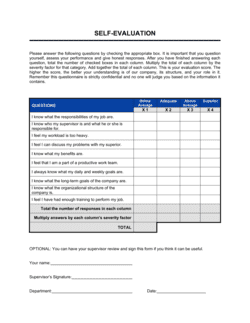
An employee self-evaluation assesses job performance against a specific role's responsibilities and targets. The entrepreneur skill set checklist assesses the broad cross-functional competencies required to run an entire business. Use the employee form for staff reviews and this checklist for founder development.

vs SWOT Analysis

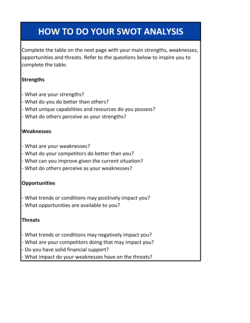
A SWOT analysis maps organizational strengths, weaknesses, opportunities, and threats at the business level. This checklist focuses specifically on the founder's personal skill competencies. The two are complementary β€” complete the skill checklist first, then incorporate personal gaps into the Weaknesses quadrant of your SWOT.

vs Business Plan

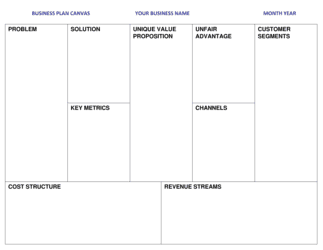
A business plan defines market opportunity, strategy, and financial projections for an external audience. This checklist is an internal founder-development tool. Completing the checklist before drafting a business plan helps you identify which sections you can write confidently and where you need expert input or co-author support.

vs Employee Training Plan

A training plan documents a structured curriculum, timeline, and assessment criteria for developing a specific skill. This checklist identifies which skills need development. Use the checklist to determine what to prioritize, then use a training plan to structure how you will close the most critical gaps.

Industry-specific considerations

Technology / SaaS

Technical founders use this to identify gaps in sales, marketing, and financial modeling β€” the skills most commonly missing in engineering-led startups.

Retail / E-commerce

Retail entrepreneurs prioritize inventory management, customer acquisition cost awareness, and supplier negotiation as the highest-importance skill categories.

Professional Services

Consultants and agency founders often rate technical skills highly but underestimate gaps in business development, pricing strategy, and cash flow management.

Food & Beverage

Food entrepreneurs frequently over-index on product skill and under-assess operations, food-cost management, and health-regulation compliance readiness.

Template vs pro β€” what fits your needs?

PathBest forCostTime
Use the templateFounders, business owners, and students completing a self-directed skills assessmentFree30–60 minutes
Template + professional reviewEntrepreneurs working with a coach or mentor who will interpret results and build a development plan$100–$500 for a coaching session1–2 hours
Custom draftedAccelerators or business schools needing a scored, weighted assessment tool integrated into a formal curriculum$500–$2,000 for custom design and facilitation1–2 weeks

Glossary

Entrepreneurial Competency
A specific, learnable skill or behavior β€” such as financial literacy or customer discovery β€” that contributes to building and sustaining a business.
Self-Assessment
A structured process in which an individual rates their own proficiency against a defined set of criteria, producing a baseline for development planning.
Skill Gap
The difference between the proficiency level a role or task requires and the level an individual currently demonstrates.
Growth Mindset
The belief that abilities can be developed through effort and learning, as opposed to being fixed at birth β€” a trait consistently linked to entrepreneurial resilience.
Financial Literacy
The ability to read and interpret financial statements, manage cash flow, and make decisions based on unit economics and margins.
Customer Discovery
The practice of interviewing prospective customers to validate a problem and test whether a proposed solution genuinely meets their needs.
Risk Tolerance
An individual's capacity to accept uncertainty and potential loss in pursuit of a business goal, distinct from recklessness.
Delegation
Assigning specific tasks or responsibilities to others with defined expectations and accountability, freeing the founder to focus on high-leverage activities.
Pivot
A deliberate, structured change in strategy β€” product, market, or business model β€” in response to validated evidence that the current direction is not working.
Networking
Building and maintaining relationships with customers, partners, investors, and advisors that generate opportunities, referrals, or support.

Part of your Business Operating System

This document is one of 3,000+ business & legal templates included in Business in a Box.

  • Fill-in-the-blanks β€” ready in minutes
  • 100% customizable Word document
  • Compatible with all office suites
  • Export to PDF and share electronically

Create your document in 3 simple steps.

From template to signed document β€” all inside one Business Operating System.
1
Download or open template

Access over 3,000+ business and legal templates for any business task, project or initiative.

2
Edit and fill in the blanks with AI

Customize your ready-made business document template and save it in the cloud.

3
Save, Share, Send, Sign

Share your files and folders with your team. Create a space of seamless collaboration.

Save time, save money, and create top-quality documents.

β˜…β˜…β˜…β˜…β˜…

"Fantastic value! I'm not sure how I'd do without it. It's worth its weight in gold and paid back for itself many times."

Managing Director Β· Mall Farm
Robert Whalley
Managing Director, Mall Farm Proprietary Limited
β˜…β˜…β˜…β˜…β˜…

"I have been using Business in a Box for years. It has been the most useful source of templates I have encountered. I recommend it to anyone."

Business Owner Β· 4+ years
Dr Michael John Freestone
Business Owner
β˜…β˜…β˜…β˜…β˜…

"It has been a life saver so many times I have lost count. Business in a Box has saved me so much time and as you know, time is money."

Owner Β· Upstate Web
David G. Moore Jr.
Owner, Upstate Web

Run your business with a system β€” not scattered tools

Stop downloading documents. Start operating with clarity. Business in a Box gives you the Business Operating System used by over 250,000 companies worldwide to structure, run, and grow their business.

Free Forever PlanΒ Β·Β No credit card required