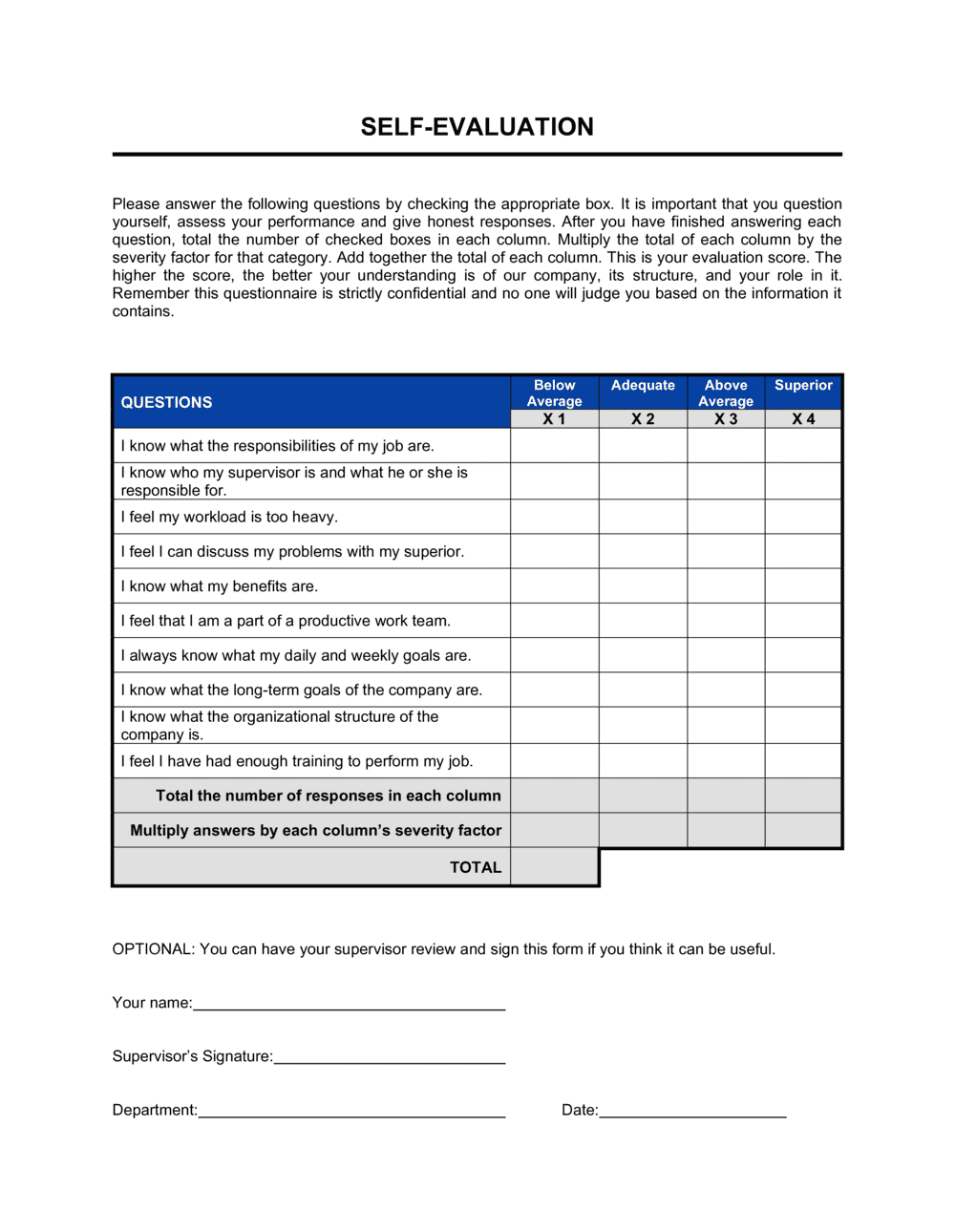
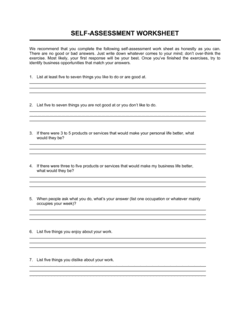
Self-Evaluation Template

Free Word download β€’ Edit online β€’ Save & share with Drive β€’ Export to PDF

1 pageβ€’20–30 min to fillβ€’Difficulty: Standardβ€’Signature requiredβ€’Legal review recommended
Learn more ↓
FreeSelf-Evaluation Template

At a glance

What it is
A Self Evaluation is a formal written document in which an employee assesses their own performance, accomplishments, strengths, development areas, and goals over a defined review period. This free Word download gives you a structured, HR-ready form you can edit online and export as PDF β€” covering every major dimension of performance documentation in a single signable record.
When you need it
Use it during annual or mid-year performance review cycles, before a promotion or compensation discussion, or whenever an employee's role or responsibilities are formally reassessed. It creates the employee's documented perspective that managers and HR teams need before finalizing a performance rating.
What's inside
Employee and review period identification, achievement summary against set goals, competency and skills self-assessment, areas for development, professional goals for the next review period, manager feedback request, and employee and manager signature blocks confirming the evaluation was completed and reviewed.

What is a Self Evaluation?

A Self Evaluation is a formal written document in which an employee assesses their own performance, contributions, strengths, development areas, and professional goals over a defined review period β€” typically six or twelve months. It is completed by the employee before or during the performance review cycle and submitted to their manager as the employee's documented perspective on their own work. Unlike informal check-ins, a properly completed and signed self evaluation becomes a permanent part of the employee's HR record, carrying evidentiary weight in compensation discussions, promotion decisions, and β€” when performance issues arise β€” termination proceedings and employment disputes.

Why You Need This Document

Without a documented self-evaluation process, performance reviews become one-sided narratives that courts and employment tribunals routinely scrutinize for procedural fairness. Employees who feel their perspective was not considered are more likely to challenge termination or performance-based decisions, and employers who cannot produce a consistent documented process face significantly higher exposure in wrongful dismissal claims. Beyond legal protection, self evaluations capture accomplishments that occurred early in the review period before recency bias erases them, give managers the data they need to calibrate ratings fairly across a team, and create the structured record that makes promotion and compensation decisions defensible to the entire organization. This template gives HR teams and managers a consistent, signable form that satisfies documentation requirements in every major employment jurisdiction while taking each employee less than thirty minutes to complete.

Which variant fits your situation?

If your situation is…Use this template
Annual formal performance review across all staffSelf Evaluation (Annual)
Mid-year check-in or 6-month progress reviewEmployee Performance Review (Mid-Year)
90-day probationary period evaluationProbationary Period Review
Manager assessing a direct report's performanceEmployee Performance Review
360-degree feedback gathering from peers and reports360-Degree Feedback Form
Goal-setting at the start of a new review periodEmployee Performance Improvement Plan
Documenting a promotion recommendationEmployee Promotion Recommendation Letter

Common mistakes to avoid

❌ Describing activities instead of outcomes

Why it matters: Activity-based responses β€” 'I attended client meetings' or 'I managed the project' β€” give managers and HR teams nothing to differentiate performance levels at calibration.

Fix: Replace every activity statement with an outcome statement that includes a metric: 'I managed the project' becomes 'I delivered the migration project two weeks ahead of schedule, reducing downtime costs by $18,000.'

❌ Rating every competency at the highest level

Why it matters: Uniformly inflated self-ratings with no supporting evidence are immediately discounted in calibration sessions and can result in the manager assigning a lower rating than they otherwise would have.

Fix: Use the full range of the rating scale honestly. One 'Exceeds Expectations' backed by evidence is worth more than five unsupported top ratings.

❌ Reframing all weaknesses as disguised strengths

Why it matters: Managers recognize 'I care too much about quality' as a non-answer. It signals poor self-awareness, which itself becomes a documented development area in the manager's assessment.

Fix: Name one specific skill gap or behavioral shortfall and follow it immediately with the concrete step you have already taken or plan to take to address it.

❌ Submitting without a signature

Why it matters: An unsigned self evaluation is not a formal HR document. If performance becomes the basis for a termination decision, an unsigned form carries no evidentiary weight and may actually weaken the employer's documentation record.

Fix: Always sign and date the acknowledgement block before submitting. If using a digital copy, use a dated electronic signature or print, sign, and scan.

❌ Setting vague goals with no measurable target

Why it matters: Goals like 'improve my communication skills' provide no baseline for the next evaluation cycle, making it impossible to assess progress and easy to claim the goal was unachievable.

Fix: Apply the SMART framework: 'Complete a business writing course on LinkedIn Learning by [DATE] and reduce revision rounds on my weekly reports from three to one by [QUARTER].'

❌ Leaving the support-requested section blank

Why it matters: Employees who don't document resource needs in writing lose the ability to later demonstrate that unmet needs contributed to a performance gap.

Fix: Name at least one specific resource β€” a course, a tool, a process change, or a clarification of role scope β€” that would enable you to achieve your stated goals.

The 10 key clauses, explained

Employee and Review Period Identification

In plain language: Records the employee's full name, job title, department, direct manager, and the exact start and end dates of the review period being assessed.

Sample language
Employee Name: [FULL NAME] | Job Title: [TITLE] | Department: [DEPARTMENT] | Manager: [MANAGER NAME] | Review Period: [START DATE] to [END DATE]

Common mistake: Leaving the review period dates blank or writing 'annual review' without dates. Undated evaluations become impossible to sequence during employment disputes or termination proceedings.

Achievement Summary Against Set Goals

In plain language: Asks the employee to describe what they accomplished during the review period, referencing the goals or KPIs set at the start of the period and providing measurable evidence.

Sample language
Goal: [GOAL AS SET AT PERIOD START]. Achievement: [DESCRIPTION OF OUTCOME]. Supporting metric: [QUANTITATIVE RESULT, e.g., 'Increased customer satisfaction score from 78 to 87 (target: 85)'].

Common mistake: Describing activities rather than outcomes β€” writing 'I managed the client account' instead of 'I retained the client, renewing a $120,000 contract in Q3.' Activity-based responses make performance differentiation impossible at calibration.

Core Competency Self-Assessment

In plain language: Prompts the employee to rate and explain their performance on defined competencies β€” such as communication, collaboration, initiative, and technical skills β€” using the company's standard rating scale.

Sample language
Competency: [COMPETENCY NAME] | Self-Rating: [RATING β€” e.g., Exceeds / Meets / Below Expectations] | Evidence: [SPECIFIC EXAMPLE OR BEHAVIOR DEMONSTRATING THIS RATING]

Common mistake: Rating every competency at the highest level without supporting evidence. Uniformly inflated self-ratings with no examples erode the credibility of the evaluation and trigger calibration adjustments that disadvantage the employee.

Strengths and Key Contributions

In plain language: Invites the employee to identify two to four areas where they performed distinctly well and explain the impact on the team, project, or business.

Sample language
Strength: [SPECIFIC STRENGTH]. Impact: [QUANTIFIED OR DESCRIBED OUTCOME β€” e.g., 'Led the migration project that reduced system downtime by 40%, saving approximately $15,000 in quarterly support costs'].'

Common mistake: Listing generic traits like 'hard-working' or 'team player' with no specific examples. These phrases carry no evidentiary weight and are discarded in calibration reviews.

Development Areas and Gaps

In plain language: Asks the employee to honestly identify one to three areas where their performance or skills fell short of expectations and explain what contributed to the gap.

Sample language
Development Area: [SKILL OR BEHAVIOR]. Gap Description: [HONEST EXPLANATION β€” e.g., 'I underestimated the complexity of the Q2 reporting requirement and delivered the draft four days late, which compressed the review cycle for the finance team'].'

Common mistake: Reframing weaknesses as hidden strengths β€” 'I work too hard' or 'I care too much about quality.' Managers and HR teams recognize this pattern immediately, and it signals low self-awareness, which itself becomes a development note.

Professional Goals for the Next Review Period

In plain language: Documents two to five SMART goals the employee commits to achieving in the upcoming period, including any development activities (training, certifications, or stretch assignments) required to meet them.

Sample language
Goal: [SMART GOAL β€” e.g., 'Complete PMP certification by [DATE] and lead at least one cross-functional project using the methodology before next review']. Success Metric: [HOW PROGRESS WILL BE MEASURED].

Common mistake: Setting goals so vague they cannot be measured β€” 'improve communication skills' with no target behavior, course, or deadline. Unmeasurable goals provide no baseline for the next evaluation cycle.

Manager and Organizational Support Requested

In plain language: Gives the employee the opportunity to formally request resources, training, mentoring, role clarity, or organizational changes they believe are necessary for them to meet their stated goals.

Sample language
Support Requested: [SPECIFIC REQUEST β€” e.g., 'Budget approval for a $1,200 data visualization course (LinkedIn Learning Professional) by [DATE] to support the new analytics reporting responsibilities added in [MONTH]'].

Common mistake: Leaving this section blank entirely. Employees who don't document resource needs in writing cannot later claim those needs went unaddressed β€” and managers lose the opportunity to proactively remove barriers before performance suffers.

Additional Comments

In plain language: An open-text field for any context not captured in structured sections β€” including unusual circumstances that affected performance, feedback on team dynamics, or concerns about role scope.

Sample language
Additional Comments: [EMPLOYEE FREE-TEXT RESPONSE β€” e.g., 'The restructuring in Q1 resulted in two months of role ambiguity. I documented how I prioritized during that period in Attachment A.']

Common mistake: Using this section to raise compensation grievances or management complaints. These belong in a separate HR process; embedding them here creates a documentation conflict that can complicate the formal record.

Employee Acknowledgement and Signature

In plain language: A formal statement the employee signs to confirm the self evaluation is complete, accurate to the best of their knowledge, and ready for manager review β€” not a statement agreeing with any subsequent manager rating.

Sample language
I confirm that the information provided in this Self Evaluation is accurate and complete to the best of my knowledge. Employee Signature: [SIGNATURE] | Date: [DATE]

Common mistake: Skipping the employee signature entirely and treating the form as an informal email attachment. An unsigned self evaluation carries no evidentiary weight if a performance dispute leads to termination proceedings.

Manager Review Acknowledgement

In plain language: A signature block for the reviewing manager confirming they have read the self evaluation, discussed it with the employee, and incorporated it into the formal performance assessment.

Sample language
I confirm that I have reviewed this Self Evaluation with the employee and incorporated it into the formal performance assessment. Manager Signature: [SIGNATURE] | Date: [DATE]

Common mistake: Having the manager sign before the review discussion takes place. Pre-signing creates a paper trail showing the manager's assessment was finalized before the employee's perspective was considered, which is a procedural deficiency in a wrongful dismissal claim.

How to fill it out

  1. 1

    Complete the identification section before writing anything else

    Enter your full legal name, job title, department, manager's name, and the exact start and end dates of the review period. These fields anchor every other section and must be correct before the evaluation is submitted.

    πŸ’‘ Check your offer letter or the most recent job description to confirm your official title β€” informal titles used day-to-day often differ from the HR record.

  2. 2

    Pull your goals from the previous review cycle

    Retrieve the goals or KPIs documented at the start of the period. For each goal, write what you achieved and include at least one specific metric or deliverable as evidence.

    πŸ’‘ If formal goals were never set in writing, document what you understood your priorities to be and note that no written targets existed β€” this protects you and flags the gap for HR.

  3. 3

    Rate each competency and back every rating with an example

    Work through each competency on the rating scale. For every rating above or below 'Meets Expectations,' write at least one specific behavioral example that justifies the rating.

    πŸ’‘ Use the STAR format for examples: Situation, Task, Action, Result. A single well-constructed STAR example outweighs three vague claims.

  4. 4

    Write the strengths section with quantified impact

    Identify two to four areas where you genuinely outperformed expectations. For each, describe the outcome in terms the business cares about β€” revenue, time saved, error rates reduced, customer satisfaction, or team capacity.

    πŸ’‘ Numbers you can verify from company systems (Salesforce, Jira, CSAT dashboards) are far more convincing than estimates. Pull the data before you write.

  5. 5

    Name at least one genuine development area

    Select one to three areas where your performance or skills genuinely fell short and explain the contributing factors honestly. Avoid reframing weaknesses as strengths.

    πŸ’‘ Pairing a development area with a concrete remediation plan β€” a course, a mentoring relationship, a stretch project β€” signals self-awareness and initiative simultaneously.

  6. 6

    Set SMART goals for the next period

    Write two to five goals for the upcoming review cycle. Each goal must have a specific outcome, a measurable success metric, and a target completion date.

    πŸ’‘ Align at least two of your goals to a stated business or team priority from your manager or company OKRs β€” this makes your contribution to team outcomes visible.

  7. 7

    Document any support or resources you need

    List specific training, budget, tools, role clarity, or organizational support you need to achieve your stated goals. Be precise: name the course, the cost, and the timeline.

    πŸ’‘ Framing requests in terms of business impact β€” 'this certification will enable me to take over X responsibility' β€” makes approval significantly more likely.

  8. 8

    Sign and submit before the deadline, then schedule the review meeting

    Sign and date the acknowledgement block and submit the completed form to your manager before the HR deadline. Follow up immediately to schedule the review discussion.

    πŸ’‘ Submit at least two business days before the deadline β€” last-minute submissions give managers no time to prepare, which leads to superficial review conversations.

Frequently asked questions

What is a self evaluation?

A self evaluation is a formal written document in which an employee assesses their own performance, contributions, strengths, development areas, and professional goals over a defined review period. It is completed before or during the annual or mid-year performance review cycle and submitted to the manager as part of the formal appraisal process. The completed document becomes a permanent HR record tied to the employee's performance history.

Why do companies require employees to complete a self evaluation?

Self evaluations give managers the employee's documented perspective before finalizing a rating, reducing recency bias and ensuring accomplishments that occurred early in the review period are captured. They also create a formal record that supports defensible performance decisions, including promotions, compensation adjustments, and β€” when necessary β€” terminations or performance improvement plans. Jurisdictions with strong employment protections place significant weight on documented process in wrongful dismissal proceedings.

Is a self evaluation legally binding?

A self evaluation is not a contract, but it is a legally significant HR document. Once signed, it becomes part of the employee's permanent personnel file and can be introduced as evidence in employment disputes, wrongful dismissal claims, or discrimination proceedings. The employee signature confirms the statements were made voluntarily and accurately; the manager signature confirms the evaluation was reviewed and considered. Incomplete or unsigned evaluations carry significantly less weight.

What should I write in a self evaluation?

Cover four core areas: accomplishments against your stated goals for the period (with measurable evidence), an honest self-rating on each defined competency with supporting examples, one to three genuine development areas paired with remediation steps, and two to five SMART goals for the next review period. Close by documenting any specific support or resources you need from the organization to achieve those goals.

How long should a self evaluation be?

Most organizations expect one to three pages of substantive content. Shorter than one page signals minimal effort and gives the manager little to work with; longer than three pages risks burying key points in narrative. Focus on quality and specificity β€” one quantified achievement is more useful than three paragraphs of general description.

What is the difference between a self evaluation and a performance review?

A self evaluation is completed by the employee and documents their own perspective. A performance review is completed by the manager and documents the organization's formal assessment. In a complete performance cycle, the self evaluation is submitted first, the manager drafts their assessment incorporating it, and both documents are discussed in the review meeting. The manager's final rating is the official performance record, but the self evaluation is preserved alongside it.

How should I handle a review period where performance was impacted by circumstances outside my control?

Document the circumstances clearly and factually in the achievement summary and additional comments sections β€” for example, a restructuring, a key resource departure, or a scope change that wasn't reflected in the original goals. Attach supporting documentation where relevant. Avoid framing the entire evaluation around external factors; focus on what you accomplished despite those circumstances and what you would do differently if they recur.

Can a self evaluation be used in a termination proceeding?

Yes. Signed self evaluations are part of the personnel file and are routinely introduced in wrongful dismissal, discrimination, and constructive dismissal claims to establish what the employee understood about their performance at the time. A self evaluation in which the employee rated themselves highly in the period immediately before a performance-based termination can complicate the employer's case if the manager's concurrent assessments are inconsistent with those ratings.

Should a self evaluation be completed for a probationary employee?

Yes β€” and especially so. A self evaluation at the end of a probationary period creates a documented record of the employee's self-awareness and commitment before a hire confirmation or extension decision is made. In jurisdictions where probationary terminations carry reduced notice obligations, having a consistent documented process β€” including a self evaluation β€” strengthens the employer's procedural record.

How this compares to alternatives

vs Employee Performance Review

A performance review is completed by the manager and represents the organization's official assessment of the employee. A self evaluation is completed by the employee and documents their own perspective. Both documents are part of the same review cycle β€” the self evaluation informs the manager's assessment, but the manager's rating is the official record. Using only one without the other produces an incomplete HR file.

vs Performance Improvement Plan

A performance improvement plan (PIP) is issued by the employer when performance has fallen below acceptable standards and documents specific targets the employee must meet to avoid further action. A self evaluation is a routine periodic document completed by all employees regardless of performance standing. A self evaluation completed just before a PIP is issued can significantly affect the credibility of the PIP if the employee's self-ratings are sharply inconsistent with the manager's assessment.

vs Job Description

A job description defines the role's responsibilities and required competencies at a point in time. A self evaluation uses that description as a baseline to assess how well the employee fulfilled those responsibilities during a specific period. The job description sets the standard; the self evaluation documents performance against it. Outdated job descriptions that no longer match actual duties create misalignment in self-evaluation ratings.

vs Employee Satisfaction Survey

An employee satisfaction survey captures how the employee feels about their work environment, management, and company β€” it is an organizational listening tool. A self evaluation captures how the employee assesses their own performance and goals β€” it is a personal accountability document. Both contribute to the HR picture but serve entirely different purposes; combining them into a single form creates a document that does neither well.

Industry-specific considerations

Technology / SaaS

Self evaluations tied to OKR cycles, engineering competency frameworks, and product delivery metrics such as sprint velocity and release quality.

Financial Services

Regulatory role requirements, compliance training completion, and quantified client or portfolio performance metrics must be documented to satisfy audit and licensing records.

Healthcare

Clinical competency ratings, continuing education credits, patient satisfaction scores, and credentialing maintenance are standard self-evaluation components in regulated healthcare roles.

Professional Services

Billable utilization rates, client feedback scores, business development contributions, and professional certification progress anchor self-assessments for consultants and advisors.

Retail / Hospitality

Sales conversion rates, customer satisfaction survey scores, schedule adherence, and upsell metrics are the primary measurable evidence for frontline self-evaluations.

Manufacturing

Safety incident records, production targets versus actuals, quality defect rates, and cross-training certifications form the quantitative backbone of shop-floor self-evaluations.

Jurisdictional notes

United States

No federal law mandates self evaluations, but they are standard practice as part of a defensible performance management process. In at-will states, consistent documented review cycles β€” including signed self evaluations β€” significantly strengthen the employer's position in wrongful termination claims. California's Fair Employment and Housing Act and Title VII require that performance documentation be free of protected-class bias; self evaluations must use objective, role-based criteria.

Canada

Canadian common law places considerable weight on documented progressive discipline and performance management when assessing wrongful dismissal claims. Ontario courts in particular scrutinize whether the employer followed a consistent process before termination. A signed self evaluation is strong evidence of a fair and transparent process. Quebec employers must ensure all HR documents are available in French for provincially regulated workplaces.

United Kingdom

ACAS Code of Practice on Disciplinary and Grievance Procedures recommends fair and transparent performance processes. While self evaluations are not legally mandated, Employment Tribunals assess whether employers followed a reasonable process before dismissal. A documented review cycle that includes employee self-assessment supports the employer's case that performance issues were communicated and the employee had opportunity to respond. Data protection obligations under UK GDPR apply to personal data in personnel files.

European Union

GDPR applies to personal data stored in self evaluations β€” employees have the right to access, correct, and in some cases request deletion of their personnel records. Retention periods for performance documents must be defined and disclosed. Member states with strong labor protections (France, Germany, Netherlands) require documented performance processes before dismissal for cause; a consistent self-evaluation cycle is material evidence of procedural fairness. Works councils in Germany and the Netherlands may have co-determination rights over the design of performance appraisal systems.

Template vs lawyer β€” what fits your deal?

PathBest forCostTime
Use the templateCompanies with straightforward annual review cycles, single-jurisdiction workforces, and no recent history of employment disputesFree15–30 minutes per employee
Template + legal reviewOrganizations in jurisdictions with strong employment protections (Ontario, California, UK, France), or any company with a recent termination, PIP, or discrimination complaint on file$200–$500 for an HR consultant or employment lawyer review of the template and process1–3 days
Custom draftedEnterprises with unionized workforces, regulated industries (healthcare, financial services), or multi-jurisdiction operations requiring jurisdiction-specific language and process design$1,000–$4,000+1–3 weeks

Glossary

Review Period
The defined span of time β€” typically 6 or 12 months β€” that the self evaluation covers.
Performance Rating
A numeric or descriptive score (e.g., Exceeds Expectations, Meets Expectations, Needs Improvement) assigned to each competency or overall performance.
Key Performance Indicator (KPI)
A measurable value that tracks progress toward a specific business or role objective, used to anchor self-assessment claims to concrete data.
Competency
A defined skill, behavior, or attribute β€” such as communication, problem-solving, or leadership β€” against which performance is assessed.
SMART Goals
Goals that are Specific, Measurable, Achievable, Relevant, and Time-bound β€” the standard framework for setting and evaluating professional objectives.
Professional Development Plan
A documented roadmap of training, certifications, mentoring, or stretch assignments the employee will pursue in the next review period.
360-Degree Feedback
Performance input gathered from multiple sources β€” manager, peers, direct reports, and sometimes clients β€” to complement the employee's self-assessment.
Calibration Session
A meeting where managers compare and align performance ratings across their teams to ensure consistent application of evaluation criteria.
Performance Improvement Plan (PIP)
A formal document outlining specific deficiencies, measurable targets, and a timeline for an employee to meet expectations before further action is taken.
Acknowledgement Signature
A signature by the employee confirming they have completed and reviewed the document β€” distinct from a signature agreeing with the manager's assessment.

Part of your Business Operating System

This document is one of 3,000+ business & legal templates included in Business in a Box.

  • Fill-in-the-blanks β€” ready in minutes
  • 100% customizable Word document
  • Compatible with all office suites
  • Export to PDF and share electronically

Create your document in 3 simple steps.

From template to signed document β€” all inside one Business Operating System.
1
Download or open template

Access over 3,000+ business and legal templates for any business task, project or initiative.

2
Edit and fill in the blanks with AI

Customize your ready-made business document template and save it in the cloud.

3
Save, Share, Send, Sign

Share your files and folders with your team. Create a space of seamless collaboration.

Save time, save money, and create top-quality documents.

β˜…β˜…β˜…β˜…β˜…

"Fantastic value! I'm not sure how I'd do without it. It's worth its weight in gold and paid back for itself many times."

Managing Director Β· Mall Farm
Robert Whalley
Managing Director, Mall Farm Proprietary Limited
β˜…β˜…β˜…β˜…β˜…

"I have been using Business in a Box for years. It has been the most useful source of templates I have encountered. I recommend it to anyone."

Business Owner Β· 4+ years
Dr Michael John Freestone
Business Owner
β˜…β˜…β˜…β˜…β˜…

"It has been a life saver so many times I have lost count. Business in a Box has saved me so much time and as you know, time is money."

Owner Β· Upstate Web
David G. Moore Jr.
Owner, Upstate Web

Run your business with a system β€” not scattered tools

Stop downloading documents. Start operating with clarity. Business in a Box gives you the Business Operating System used by over 250,000 companies worldwide to structure, run, and grow their business.

Start freeΒ Β·Β No credit card required