Checklist Entrepreneur Mindset

Free download β€’ Use as a template β€’ Print or share

1 pageβ€’15–25 min to useβ€’Difficulty: Standard
Learn more ↓
FreeChecklist Entrepreneur Mindset Template

At a glance

What it is
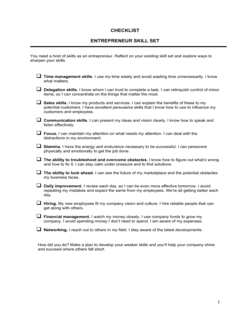
The Entrepreneur Mindset Checklist is a structured self-assessment form that helps founders, business owners, and aspiring entrepreneurs evaluate their attitudes, habits, and mental frameworks against the core traits consistently linked to business success. This free Word download lets you complete the checklist individually or with a coach, export it as PDF, and revisit it at regular intervals to track personal development progress.
When you need it
Use it before launching a new venture to identify gaps in your readiness, at key inflection points β€” pivots, funding rounds, or rapid growth phases β€” to recalibrate your approach, or as a recurring quarterly self-review tool.
What's inside
Grouped assessment items covering resilience, risk tolerance, learning orientation, goal-setting discipline, financial awareness, leadership habits, customer focus, adaptability, and accountability β€” each with a yes/no or frequency rating and a notes field for personal reflection.

What is an Entrepreneur Mindset Checklist?

An Entrepreneur Mindset Checklist is a structured self-assessment form that helps founders and business owners evaluate their current habits, attitudes, and behavioral patterns against the traits most consistently linked to entrepreneurial success β€” resilience, adaptability, customer focus, financial discipline, accountability, and learning orientation. Unlike a personality test, which measures fixed traits, this checklist measures specific behaviors you are either practicing right now or are not, making every gap an actionable development opportunity rather than a fixed characteristic. The template is a free Word download you can complete individually or with a coach, annotate with personal notes, and revisit at regular intervals to track meaningful change over time.

Why You Need This Document

Launching or scaling a business without an honest assessment of your own readiness is the single most common reason capable people build weak foundations under otherwise sound ventures. Blind spots in financial discipline, accountability, or adaptability do not disappear once a business is operating β€” they compound. A founder who avoids direct customer conversations, delegates financial tracking without understanding the numbers, or attributes setbacks to external forces rather than their own decisions will make the same mistakes at $1M in revenue that they made at $100K. This checklist forces the specific, behavior-based self-reflection that prevents those patterns from calcifying. Completing it before a launch, a fundraise, or a major pivot takes less than an hour and produces a prioritized development backlog that a coach, mentor, or peer can hold you accountable to β€” making it one of the highest-leverage documents in any founder's toolkit.

Which variant fits your situation?

If your situation is…Use this template
Evaluating readiness to launch a new business from scratchEntrepreneur Mindset Checklist
Assessing a team's collective strengths before a product launchTeam Skills Assessment
Reviewing personal goals and progress on a quarterly basisPersonal Development Plan
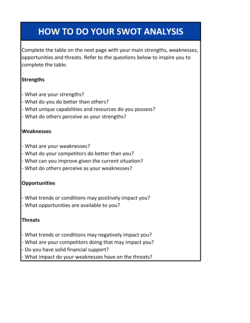
Identifying strategic gaps in a growing businessSWOT Analysis
Tracking daily habits and routines critical to business successDaily Habits Tracker
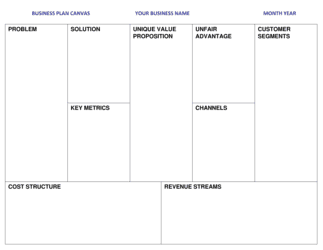
Structuring a new business idea before committing to a full planOne-Page Business Plan

Common mistakes to avoid

❌ Answering based on aspiration, not behavior

Why it matters: Inflated scores produce a false picture of readiness and leave real development gaps unaddressed until they cause visible problems β€” a failed hire, a cash crisis, or a stalled pivot.

Fix: Require a specific example from the past 90 days to support any 'Yes' rating. If you cannot name one, downgrade to 'Sometimes'.
❌ Completing the checklist only once

Why it matters: Mindset and behavior evolve β€” a single snapshot taken at the start of a venture cannot reflect the changes, regressions, or growth that occur over 12–24 months of operation.

Fix: Set a recurring calendar reminder for quarterly reviews and store previous versions to compare scores over time.

❌ Skipping the notes field on low-scoring items

Why it matters: A low score without a written explanation is an observation without a diagnosis β€” you know there is a problem but have no basis for designing a response.

Fix: For every 'No' or 'Sometimes' rating, write at least one sentence describing the specific situation where that gap showed up.

❌ Treating the checklist as a pass/fail test

Why it matters: No founder scores 'Yes' on every item, especially early in a venture. Treating low scores as failures causes people to inflate their answers to avoid a negative feeling rather than use the tool honestly.

Fix: Frame low scores as a prioritized development backlog, not a verdict. The goal is an accurate baseline, not a perfect score.

The 9 key fields, explained

Resilience and failure response

Risk awareness and tolerance

Learning orientation and curiosity

Goal-setting and planning discipline

Customer and market focus

Financial awareness and discipline

Accountability and ownership

Adaptability and pivot readiness

Leadership and team-building habits

How to fill it out

  1. 1

    Set aside uninterrupted time for honest reflection

    Block 30–45 minutes without distractions. The value of this checklist depends entirely on honest, behavior-based answers β€” not aspirational ones.

    πŸ’‘ Complete it at the end of a quarter, when recent performance is fresh and specific examples are easy to recall.

  2. 2

    Answer each item based on observed behavior, not intent

    For every item, ask yourself: can I cite a specific example from the past 90 days? If not, answer 'Sometimes' or 'No' regardless of how you see yourself.

    πŸ’‘ Write a one-sentence example in the notes field for any item you rate 'Yes' β€” this turns the checklist into a concrete evidence log.

  3. 3

    Score each section and identify your bottom two categories

    Tally your 'Yes', 'Sometimes', and 'No' responses by section. The two sections with the most 'No' or 'Sometimes' answers are your highest-priority development areas.

    πŸ’‘ Resist the urge to focus on your strongest sections β€” entrepreneurs typically over-invest in areas they already excel in.

  4. 4

    Write one specific action for each priority area

    For your two lowest-scoring sections, write a single concrete action β€” a habit, a resource, or a behavioral change β€” you will implement in the next 30 days.

    πŸ’‘ Actions tied to a specific time and context (e.g., 'Every Monday at 9am I will review cash flow') are executed at roughly twice the rate of vague intentions.

  5. 5

    Share the completed checklist with a coach, mentor, or trusted peer

    A second perspective surfaces blind spots that self-assessment alone cannot catch. Ask your reviewer to flag any items where your self-rating seems inconsistent with what they observe.

    πŸ’‘ If you do not have a coach or mentor, a fellow founder who knows your work is a credible second reviewer.

  6. 6

    Schedule your next review date before closing the document

    Write a specific review date β€” 90 days out is the minimum useful interval β€” directly on the checklist before saving it. This converts a one-time exercise into a recurring development tool.

    πŸ’‘ Compare your scores across review periods to track trajectory, not just current state. A 'Sometimes' becoming a 'Yes' is meaningful progress.

Frequently asked questions

What is an entrepreneur mindset checklist?

An entrepreneur mindset checklist is a structured self-assessment form that helps founders and business owners evaluate their current habits, attitudes, and behavioral patterns against the traits most associated with entrepreneurial success β€” resilience, adaptability, financial awareness, customer focus, and accountability. It provides an honest baseline for personal and professional development, not a test to pass.

Who should use this checklist?

First-time founders evaluating their readiness before launch, experienced owners navigating a growth plateau or pivot, business coaches structuring a discovery session with a client, and accelerator participants meeting program self-assessment requirements all benefit from this checklist. It is equally useful for corporate intrapreneurs leading internal innovation initiatives.

How often should I complete this checklist?

Quarterly is the minimum useful interval for most active entrepreneurs. At that cadence, recent behavior is specific enough to answer honestly and enough time has passed for habits to have meaningfully shifted. Completing it at key transitions β€” pre-launch, post-fundraise, or after a major setback β€” adds additional value outside the regular cycle.

What makes this checklist different from a personality test?

Personality tests measure stable traits; this checklist measures current behaviors that can be changed. Every item asks whether you are doing something specific right now β€” not whether you are the kind of person who tends to do it. That distinction makes the output actionable rather than descriptive.

Can I use this checklist with my team or co-founder?

Yes, and doing so is often more revealing than completing it alone. Having a co-founder or trusted advisor rate you independently on the same items β€” then comparing scores β€” surfaces blind spots and misalignments in self-perception that solo assessment cannot catch. Business coaches routinely use it as the basis for a structured feedback conversation.

What should I do after completing the checklist?

Identify your two lowest-scoring sections and write one specific, time-bound action for each. Share the results with a coach, mentor, or peer who can provide an outside perspective on your ratings. Store the completed document and schedule a follow-up review 90 days out so you can compare scores and track genuine behavioral change over time.

Is this checklist suitable for an experienced entrepreneur or just beginners?

It is useful at any stage. Early-stage founders use it to identify readiness gaps before committing fully to a venture. Experienced operators use it to surface habits that have eroded under pressure β€” financial discipline, customer contact frequency, and learning investment are the first to slip during rapid growth. The behavioral specificity of each item makes it equally diagnostic at any experience level.

Does completing this checklist guarantee business success?

No checklist guarantees business outcomes. The entrepreneur mindset checklist identifies behavioral and attitudinal factors that research consistently links to founder resilience and decision quality. Acting on the results reduces the likelihood of avoidable mistakes and increases the consistency of habits that compound over time β€” but market conditions, timing, and execution all remain independent variables.

How this compares to alternatives

vs SWOT Analysis

A SWOT analysis evaluates a business or opportunity from the outside in β€” market strengths, weaknesses, opportunities, and threats. The entrepreneur mindset checklist evaluates the founder from the inside out β€” habits, attitudes, and behavioral patterns. Both are useful at venture launch; the mindset checklist should typically come first, because founder gaps shape which business risks become existential.

vs One-Page Business Plan

A one-page business plan documents the venture concept β€” customer segment, value proposition, revenue model, and key metrics. The entrepreneur mindset checklist documents the founder's readiness to execute that concept. They address complementary questions and are most powerful when completed together during the pre-launch phase.

vs Personal Development Plan

A personal development plan is a broader goal-setting document covering career, skills, and life objectives across any domain. The entrepreneur mindset checklist is narrower and more diagnostic β€” it focuses specifically on the behavioral traits that predict entrepreneurial performance and produces a prioritized development backlog rather than a general goal list.

vs Business Plan Template

A business plan describes the market opportunity, strategy, and financial model for a venture. The entrepreneur mindset checklist assesses whether the person behind the plan has the habits and resilience to execute it under pressure. A strong plan does not compensate for the mindset gaps this checklist is designed to surface before they become visible in performance.

Industry-specific considerations

Technology / SaaS

Founders use this checklist to assess execution bias and learning orientation before committing to a product roadmap, where building the wrong thing for 6 months is the most common and costly mistake.

Retail / E-commerce

Operators apply the financial awareness and adaptability sections to prepare for seasonal volatility and inventory decisions where slow pivots directly erode margin.

Professional Services

Solo practitioners and agency founders use the accountability and customer-focus sections to counteract the service-delivery trap, where client work crowds out the business-building habits that drive growth.

Food & Beverage / Restaurant

Restaurant operators reference the resilience and financial discipline sections most heavily, given the industry's above-average failure rate in the first three years and its thin margin for mindset errors.

Template vs pro β€” what fits your needs?

PathBest forCostTime
Use the templateIndividual founders and business owners completing a self-directed quarterly reviewFree30–45 minutes
Template + professional reviewFounders wanting an external perspective from a coach, mentor, or peer reviewer$0–$300 (one coaching session)1–2 hours including debrief
Custom draftedAccelerators and incubators building a standardized assessment into a cohort onboarding program$500–$2,000 (facilitation design and customization)1–2 weeks

Glossary

Growth Mindset
The belief that abilities and intelligence can be developed through effort and learning, rather than being fixed traits.
Risk Tolerance
An individual's willingness to accept uncertainty and potential loss in pursuit of a business opportunity.
Resilience
The capacity to recover from setbacks, adapt to adversity, and continue pursuing goals despite failure or difficulty.
Accountability
Taking ownership of outcomes β€” both successes and failures β€” without deflecting responsibility onto external factors.
Adaptability
The ability to adjust plans, strategies, or behaviors in response to new information, market shifts, or unexpected obstacles.
Self-Efficacy
A person's confidence in their own ability to execute tasks and achieve specific outcomes in a given domain.
Delayed Gratification
The discipline to forgo immediate rewards in favor of larger long-term gains β€” a trait strongly associated with entrepreneurial persistence.
Customer Obsession
A consistent habit of centering decisions on solving real customer problems rather than on product features or internal preferences.
Execution Bias
A preference for taking action and testing ideas quickly over extended analysis, accepting imperfect information as normal.
Financial Literacy
The practical understanding of key financial concepts β€” cash flow, margin, burn rate, and unit economics β€” necessary to run a sustainable business.

Part of your Business Operating System

This document is one of 3,000+ business & legal templates included in Business in a Box.

  • Fill-in-the-blanks β€” ready in minutes
  • 100% customizable Word document
  • Compatible with all office suites
  • Export to PDF and share electronically

Create your document in 3 simple steps.

From template to signed document β€” all inside one Business Operating System.
1
Download or open template

Access over 3,000+ business and legal templates for any business task, project or initiative.

2
Edit and fill in the blanks with AI

Customize your ready-made business document template and save it in the cloud.

3
Save, Share, Send, Sign

Share your files and folders with your team. Create a space of seamless collaboration.

Save time, save money, and create top-quality documents.

β˜…β˜…β˜…β˜…β˜…

"Fantastic value! I'm not sure how I'd do without it. It's worth its weight in gold and paid back for itself many times."

Managing Director Β· Mall Farm
Robert Whalley
Managing Director, Mall Farm Proprietary Limited
β˜…β˜…β˜…β˜…β˜…

"I have been using Business in a Box for years. It has been the most useful source of templates I have encountered. I recommend it to anyone."

Business Owner Β· 4+ years
Dr Michael John Freestone
Business Owner
β˜…β˜…β˜…β˜…β˜…

"It has been a life saver so many times I have lost count. Business in a Box has saved me so much time and as you know, time is money."

Owner Β· Upstate Web
David G. Moore Jr.
Owner, Upstate Web

Run your business with a system β€” not scattered tools

Stop downloading documents. Start operating with clarity. Business in a Box gives you the Business Operating System used by over 250,000 companies worldwide to structure, run, and grow their business.

Free Forever PlanΒ Β·Β No credit card required