Co-Ownership Agreement Template

Free Word download β€’ Edit online β€’ Save & share with Drive β€’ Export to PDF

7 pagesβ€’25–35 min to fillβ€’Difficulty: Complexβ€’Signature requiredβ€’Legal review recommended
Learn more ↓
FreeCo-Ownership Agreement Template

At a glance

What it is
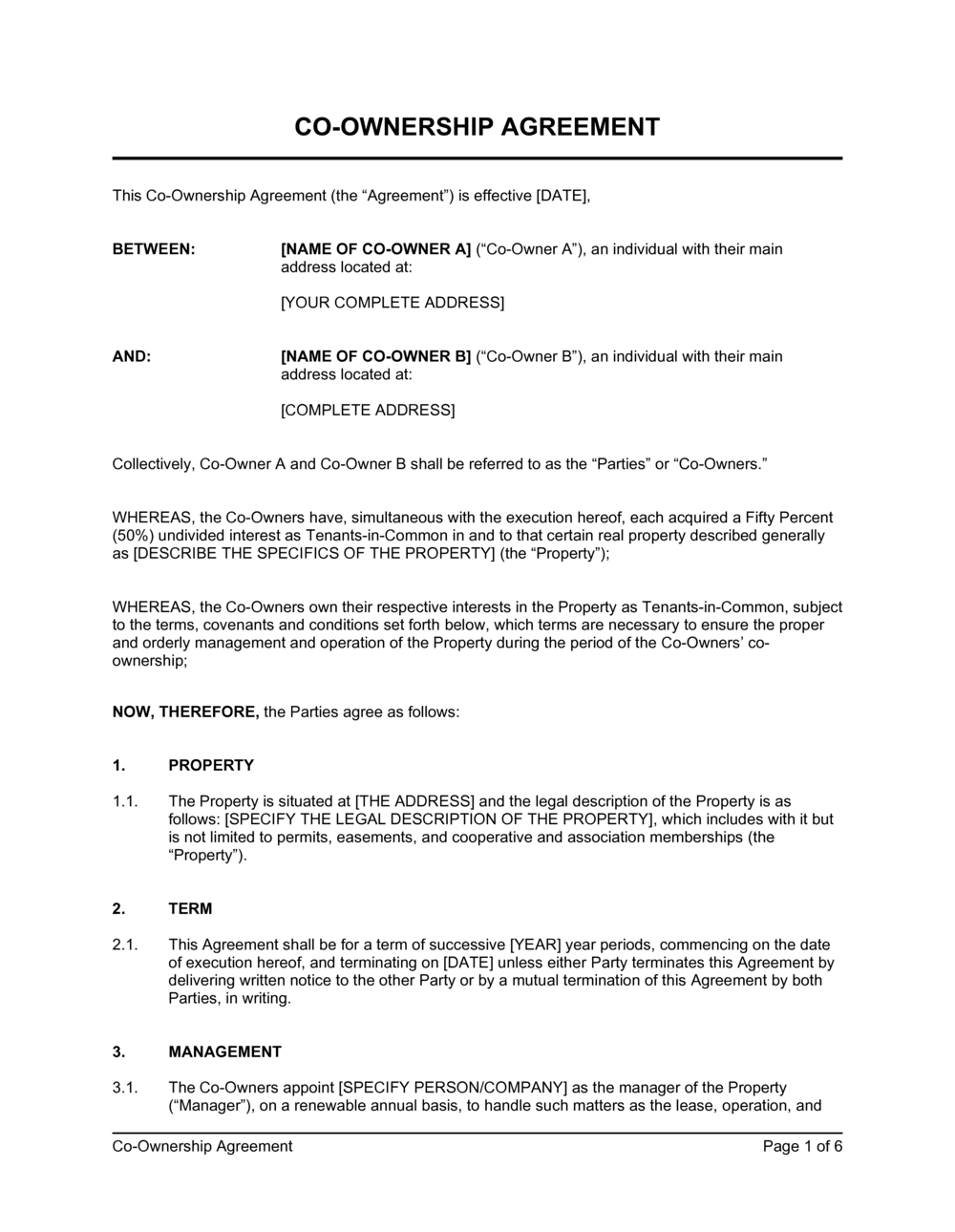
A Co-Ownership Agreement is a legally binding contract between two or more parties who jointly own an asset β€” most commonly real property, a vacation home, a vehicle, or a business interest β€” that defines each owner's share, rights, and responsibilities. This free Word download gives you a structured, editable template you can tailor to your asset type and ownership structure, then export as PDF for signing.
When you need it
Use it any time two or more people take title to an asset together β€” whether siblings inheriting a vacation property, partners buying a vehicle, or investors acquiring a rental unit β€” before disputes about use, costs, or exit arise.
What's inside
Ownership percentages, permitted use and scheduling, expense sharing and decision-making rules, buy-sell and right of first refusal provisions, deadlock resolution, transfer restrictions, and governing law β€” covering the full lifecycle of a jointly owned asset from acquisition through exit.

What is a Co-Ownership Agreement?

A Co-Ownership Agreement is a legally binding contract between two or more parties who jointly hold title to an asset β€” most commonly real property, a vacation home, a vehicle, or a business interest β€” that replaces informal understandings with enforceable written rules. It defines each owner's percentage interest, how use of the asset is scheduled and shared, how carrying costs are divided and collected, what voting threshold is required for major decisions, and how any co-owner can exit the arrangement without triggering a court-ordered partition. Without one, co-owners' rights default entirely to the property statutes of the applicable jurisdiction, which rarely reflect what the parties actually intended.

Why You Need This Document

The absence of a co-ownership agreement does not mean no rules apply β€” it means the rules are written by the legislature rather than by you. In most jurisdictions, any co-owner can demand a court-ordered partition at any time, forcing either a physical division of the asset or a public sale at whatever price the market delivers on the day the court orders it. Beyond the forced-sale risk, undocumented co-ownership produces predictable disputes: who gets the vacation home at peak season, who pays when the roof needs replacing, what happens when one owner dies and their share passes to a stranger-heir or is seized by a creditor. A co-ownership agreement addresses all of these scenarios upfront, when the parties are aligned and negotiating in good faith, rather than in the middle of a breakdown when legal costs are mounting and the relationship is already fractured. This template gives co-owners a structured, professionally drafted starting point they can adapt to their specific asset and circumstances β€” saving the cost of drafting from scratch while preserving enough flexibility to reflect the actual terms they negotiate.

Which variant fits your situation?

If your situation is…Use this template
Two or more people jointly buying residential real propertyCo-Ownership Agreement (Real Property)
Family members sharing a vacation home or cottageVacation Home Co-Ownership Agreement
Partners buying a vehicle together for personal or business useVehicle Co-Ownership Agreement
Investors co-owning a rental income propertyJoint Venture Agreement (Real Estate)
Business partners sharing ownership of a company or interestPartnership Agreement
Two parties co-owning intellectual property or a creative workJoint IP Ownership Agreement
Spouses or domestic partners holding property together with survivorship rightsTenancy in Common vs Joint Tenancy Addendum

Common mistakes to avoid

❌ No scheduling mechanism for use

Why it matters: Without a written schedule or booking process, peak-period use becomes a first-come-first-served race that breeds resentment and escalates into legal disputes over time.

Fix: Include a specific scheduling process in Schedule A β€” even a simple rotating priority system β€” and a deadlock process for years when parties cannot agree.

❌ Omitting a forced exit or buy-sell clause

Why it matters: Without a buyout or forced-sale mechanism, a co-owner who wants to exit has no practical remedy short of a court-ordered partition β€” which can force a sale of the entire asset at an unfavorable price.

Fix: Include at minimum a right of first refusal and a shotgun or appraisal-based buyout clause so any co-owner can exit cleanly without court involvement.

❌ Splitting expenses equally when ownership is unequal

Why it matters: A co-owner with a 30% interest paying 50% of carrying costs is effectively subsidizing the other party; this imbalance creates financial stress and may be argued to modify the ownership percentages over time.

Fix: Tie expense sharing to ownership percentages by default and require a separate written agreement for any deviation from that formula.

❌ Failing to address death, divorce, or bankruptcy

Why it matters: A co-owner's spouse, estate, or creditor can acquire an ownership interest through these events and invoke statutory partition rights, forcing an unwanted sale of the entire asset.

Fix: Add explicit clauses giving remaining co-owners a right of first refusal triggered by death, bankruptcy, or involuntary transfer, with a defined valuation and exercise timeline.

❌ Choosing a governing law that conflicts with the asset's location

Why it matters: For real property, courts apply the law of the jurisdiction where the property is located β€” a governing-law clause pointing elsewhere may be disregarded for property-specific issues like partition rights.

Fix: Use the jurisdiction where the asset is located as the governing law, or add a carve-out specifying that property law issues are governed by the asset's location.

❌ Signing after taking title or possession

Why it matters: In common-law jurisdictions, a party who has already taken title may have given no fresh consideration for restrictive provisions signed afterward, potentially voiding transfer restrictions and buy-sell clauses.

Fix: Execute the agreement on or before the date of title transfer or first possession; have all parties sign and date it at or before closing.

The 9 key clauses, explained

Parties, asset description, and ownership percentages

In plain language: Identifies each co-owner by legal name, describes the asset with enough specificity to be unambiguous (address, VIN, or registration number), and states each party's percentage interest.

Sample language
This Co-Ownership Agreement is entered into as of [DATE] between [CO-OWNER 1 FULL NAME] ('[NICKNAME 1]') and [CO-OWNER 2 FULL NAME] ('[NICKNAME 2]') (together, the 'Co-Owners'). The Co-Owners jointly own the following asset: [ASSET DESCRIPTION] (the 'Property'). [NICKNAME 1] holds a [X]% interest and [NICKNAME 2] holds a [Y]% interest.

Common mistake: Describing the asset by common name only ('the cottage') without a legal description or registration number. Ambiguity about which asset is covered can render the agreement unenforceable against third parties.

Capital contributions and acquisition costs

In plain language: Records how much each co-owner contributed toward the purchase price and any upfront costs, and whether unequal contributions affect ownership percentages or are treated as loans.

Sample language
[NICKNAME 1] contributed $[AMOUNT] and [NICKNAME 2] contributed $[AMOUNT] toward the total acquisition cost of $[TOTAL]. Contributions are reflected in the ownership percentages above. Any additional capital contributions must be agreed in writing and may adjust ownership percentages proportionally.

Common mistake: Not documenting unequal contributions at the outset. When one party later contributes more toward a renovation or repair, disagreements about whether it was a loan or an equity adjustment become nearly impossible to resolve without a written record.

Use, scheduling, and access rights

In plain language: Defines how co-owners allocate use of the asset β€” whether by calendar schedule, first-come-first-served, or rotating priority β€” and what notice is required to reserve access.

Sample language
Each Co-Owner shall be entitled to use the Property for a minimum of [X] weeks per calendar year. Scheduling shall be agreed annually by [DATE] using the schedule attached as Schedule A. Changes require [X] days' prior written notice to all Co-Owners.

Common mistake: Leaving use rights as 'equal access by agreement.' Without a specific scheduling mechanism, peak-period conflicts (summer holidays, long weekends) are almost guaranteed and often damage the co-ownership relationship.

Carrying costs, expenses, and contributions

In plain language: Establishes how recurring costs β€” mortgage, taxes, insurance, utilities, and routine maintenance β€” are divided and collected, including what happens when one co-owner fails to pay their share.

Sample language
Each Co-Owner shall contribute [PERCENTAGE]% of all carrying costs, payable on or before the [X]th of each month to the joint account at [BANK NAME], account number [ACCOUNT NO.]. A Co-Owner who fails to pay within [X] days of the due date shall be charged interest at [X]% per annum on the outstanding amount.

Common mistake: Splitting costs equally regardless of ownership percentages. When ownership is unequal (e.g., 70/30), equal cost sharing can create resentment and legal disputes over the implied change in effective ownership.

Decision-making and major expenditures

In plain language: Sets the voting threshold required for routine maintenance decisions versus major capital expenditures or improvements, and specifies what happens when owners cannot agree.

Sample language
Routine maintenance decisions may be made by any Co-Owner and charged to the joint account. Expenditures exceeding $[AMOUNT] require the written consent of Co-Owners holding at least [X]% of the total interest. In the event of a deadlock, Co-Owners shall submit the dispute to mediation within [X] days before seeking other remedies.

Common mistake: Requiring unanimous consent for all decisions. With two equal co-owners, unanimous consent for routine matters guarantees deadlock and can prevent urgent repairs from being authorized in time to prevent greater damage.

Transfer restrictions and right of first refusal

In plain language: Prevents a co-owner from selling or transferring their interest to a third party without first offering it to the remaining co-owners at the same price and on the same terms.

Sample language
No Co-Owner shall transfer, sell, pledge, or otherwise dispose of their interest in the Property without first providing written notice to all other Co-Owners (the 'Transfer Notice'). The remaining Co-Owners shall have [X] days from receipt of the Transfer Notice to elect to purchase the departing Co-Owner's interest at the price and on the terms stated in the Transfer Notice.

Common mistake: Setting the right of first refusal period too short β€” 5 or 10 days is common but rarely enough time for remaining co-owners to arrange financing. A 30–60 day window is more workable and more likely to be enforceable.

Buy-sell and forced exit provisions

In plain language: Establishes the mechanism β€” buyout valuation method, shotgun clause, or forced sale β€” that applies when one co-owner wants to exit and the parties cannot agree on price.

Sample language
If a Co-Owner wishes to exit and the Co-Owners cannot agree on a purchase price within [X] days, either Co-Owner may invoke the Shotgun Clause by delivering written notice stating a price per [UNIT / PERCENTAGE POINT]. The receiving Co-Owner shall, within [X] days, elect to purchase the notifying Co-Owner's interest at that price or sell their own interest to the notifying Co-Owner at that same price.

Common mistake: No forced exit mechanism at all. Without one, a co-owner who wants to sell cannot do so without a willing buyer or court-ordered partition β€” a costly, slow, and relationship-destroying process.

Death, incapacity, and involuntary transfer

In plain language: Addresses what happens to a co-owner's interest upon death, incapacity, bankruptcy, or divorce β€” whether it passes to heirs, triggers a buyout right, or requires the estate to offer the interest to remaining co-owners first.

Sample language
Upon the death or incapacity of a Co-Owner, their personal representative or trustee shall notify the remaining Co-Owners within [X] days. The remaining Co-Owners shall have [X] days to purchase the deceased or incapacitated Co-Owner's interest at Fair Market Value determined by an independent appraiser. If the option is not exercised, the interest may pass to the estate or successor.

Common mistake: Forgetting to address bankruptcy or divorce. A creditor or divorcing spouse acquiring a co-ownership interest can trigger partition proceedings, forcing an unwanted sale of the entire asset.

Dispute resolution and governing law

In plain language: Specifies the sequence of dispute resolution β€” negotiation, then mediation, then arbitration or litigation β€” and the jurisdiction whose law governs the agreement.

Sample language
Any dispute arising under this Agreement shall first be submitted to good-faith negotiation for [X] days. If unresolved, the parties shall engage a mutually agreed mediator. If mediation fails, the dispute shall be resolved by binding arbitration administered by [BODY] in [CITY], [STATE/PROVINCE]. This Agreement is governed by the laws of [JURISDICTION].

Common mistake: Choosing a governing jurisdiction that differs from where the asset is located. For real property, the law of the property's location typically governs regardless of the governing-law clause.

How to fill it out

  1. 1

    Identify all co-owners and the asset precisely

    Enter each co-owner's full legal name as it appears on government-issued ID. Describe the asset with its legal description, address, VIN, or registration number β€” not a nickname. Confirm title or registration documents match the names being used.

    πŸ’‘ If the asset is real property, pull the registered title description from the land registry or county recorder β€” use that exact language in the agreement.

  2. 2

    Record ownership percentages and capital contributions

    State each party's percentage interest and the dollar amount they contributed at acquisition. If contributions are unequal, decide explicitly whether the imbalance is reflected in percentages or treated as a loan from one co-owner to another.

    πŸ’‘ Document any verbal agreement about unequal contributions in writing now β€” memories about money diverge quickly.

  3. 3

    Set the use and scheduling rules

    Choose a scheduling mechanism β€” annual calendar, rotating priority, or first-come-first-served with a booking window. Attach a Schedule A with the current year's allocation and the process for agreeing subsequent years.

    πŸ’‘ Address peak periods (summer, school holidays, long weekends) explicitly; these are the dates most disputes center on.

  4. 4

    Define the expense-sharing formula and payment mechanics

    Decide whether costs are split by ownership percentage or equally, and set up a joint bank account or payment platform for shared expenses. Specify the payment due date and the interest rate for late contributions.

    πŸ’‘ A dedicated joint account β€” even a basic one β€” eliminates the friction and record-keeping burden of reimbursing each other informally.

  5. 5

    Set decision-making thresholds

    Establish two tiers: a lower threshold (e.g., simple majority by interest) for routine maintenance decisions and a higher threshold (e.g., 75% or unanimous) for major capital expenditures, financing, or sale of the asset.

    πŸ’‘ Include a dollar figure that separates routine from major β€” for example, expenses above $2,500 require written consent from all parties.

  6. 6

    Draft the right of first refusal and buy-sell provisions

    Set the notice period for the ROFR (30–60 days is standard), the valuation method for a forced buyout (independent appraisal, agreed formula, or shotgun), and the timeline for exercising any option.

    πŸ’‘ The shotgun clause works best between two equal co-owners. For three or more, or unequal ownership, an independent appraisal process is usually fairer and less likely to be challenged.

  7. 7

    Address death, incapacity, and involuntary transfer

    Add a clause giving remaining co-owners a right to purchase the interest of a deceased, incapacitated, or bankrupt co-owner before it passes to heirs or creditors. Specify the valuation method and the exercise period.

    πŸ’‘ Coordinate this clause with each co-owner's estate plan β€” a will or trust that contradicts the agreement creates an expensive conflict for the surviving owners.

  8. 8

    Sign before taking title or possession

    Both or all parties must sign the agreement before or on the same day as taking title to the asset. Post-acquisition signatures can raise enforceability questions in jurisdictions requiring fresh consideration.

    πŸ’‘ For real property, have the agreement signed at or before closing, and reference it in the deed or title documentation.

Frequently asked questions

What is a co-ownership agreement?

A co-ownership agreement is a legally binding contract between two or more parties who jointly hold an asset β€” such as real property, a vacation home, a vehicle, or a business interest β€” that governs each owner's rights and responsibilities. It defines ownership percentages, use rights, expense sharing, decision-making rules, transfer restrictions, and the process for exiting the arrangement, replacing informal understandings with enforceable written terms.

Is a co-ownership agreement legally required?

No law requires co-owners to have a written agreement, but without one each owner's rights are governed entirely by default property law β€” which in most jurisdictions gives any co-owner the right to demand a court-ordered partition at any time. A written agreement replaces those defaults with terms the parties actually agreed to, including how disputes are resolved and how a co-owner exits without triggering a forced sale.

What is the difference between tenancy in common and joint tenancy?

In a tenancy in common, each owner holds a distinct share that can be sold or inherited independently. In a joint tenancy, all owners hold equal shares with a right of survivorship β€” a deceased owner's share passes automatically to the surviving co-owners rather than to the estate. A co-ownership agreement can add contractual rules on top of either form of title, but the title structure itself is typically determined at the time of acquisition and recorded on the deed.

What happens if a co-owner wants to sell and the others don't?

Without a written agreement, a co-owner who wants to exit can typically apply to a court for a partition order β€” forcing either a physical division of the property or a sale of the entire asset with proceeds divided by interest. A co-ownership agreement replaces this remedy with a right of first refusal, a buyout mechanism, or a shotgun clause, giving the remaining co-owners the opportunity to purchase the departing owner's share at a fair price without court involvement.

Does a co-ownership agreement need to be notarized?

Notarization is generally not required for a co-ownership agreement to be enforceable as a contract between the parties, but recording requirements vary. For real property, some jurisdictions require notarized signatures before a document can be registered against the title. Even where not required, notarization adds an evidentiary layer confirming identity and voluntary execution, which can be valuable in disputes.

Can co-owners have unequal ownership percentages?

Yes. Co-owners can hold any combination of percentages β€” 50/50, 70/30, 33/33/34, or any other split β€” provided the percentages are clearly stated in both the agreement and the title documentation. Unequal percentages should be reflected in cost sharing, decision-making weight (if applicable), and the distribution of proceeds on sale. Mismatches between the agreement and the title register can create significant legal complications.

What should a co-ownership agreement say about improvements and renovations?

The agreement should require co-owner consent above a specified dollar threshold before any renovation or improvement is made, and state how the cost of approved improvements is shared and whether it adjusts ownership percentages. Without this, one co-owner can make significant improvements and later claim a larger share of the sale proceeds, or conversely, a co-owner can block necessary work indefinitely.

How does a co-ownership agreement interact with a will or estate plan?

A co-ownership agreement typically contains transfer restrictions and buyout rights that apply on death β€” these provisions operate alongside (and may override) a will's instructions regarding the co-owned asset. Co-owners should coordinate the agreement with their estate planning documents to avoid a conflict between the will and the agreement's right-of-first-refusal clause, which could leave heirs and surviving co-owners in an expensive dispute.

Do I need a lawyer to draft a co-ownership agreement?

For a straightforward two-party co-ownership of a vacation property or vehicle with simple equal ownership, a high-quality template is usually sufficient. Consider engaging a lawyer when the asset is high-value real property, ownership is unequal or involves three or more parties, there are financing or mortgage implications, a party is in a different jurisdiction, or the asset forms part of a business or investment structure. A 1–2 hour legal review typically costs $300–$700 and is worthwhile for any co-owned property above $250,000 in value.

How this compares to alternatives

vs Partnership Agreement

A partnership agreement governs the operation of a for-profit business carried on by two or more people, covering profit sharing, management roles, and dissolution. A co-ownership agreement governs shared ownership of a specific asset β€” typically property or equipment β€” without creating a business entity. Use a partnership agreement when co-owners are running a business together; use a co-ownership agreement when they are simply holding an asset jointly.

vs Joint Venture Agreement

A joint venture agreement establishes a temporary collaboration between parties to achieve a specific commercial project β€” such as developing a property β€” after which the venture ends. A co-ownership agreement governs ongoing shared ownership of an asset with no defined end date. Joint ventures are project-scoped; co-ownership arrangements are asset-scoped and typically indefinite.

vs Property Management Agreement

A property management agreement engages a third-party manager to operate a property on behalf of its owner or owners. A co-ownership agreement governs the relationship between the owners themselves β€” who decides, who pays, and who can exit. The two documents complement each other when co-owners hire an external manager, but serve entirely different functions.

vs Cohabitation Agreement

A cohabitation agreement governs the financial and personal arrangements between two people living together in a romantic relationship, including property owned individually or jointly. A co-ownership agreement focuses exclusively on the mechanics of jointly owning a specific asset, without addressing the personal dimension of the relationship. Couples who co-own property may benefit from having both documents.

Industry-specific considerations

Real Estate

Mortgage allocation, title structure (tenancy in common vs joint tenancy), partition rights, and rental income distribution between co-owners of investment or vacation properties.

Professional Services

Joint ownership of office space or practice assets between professionals, with buy-sell provisions tied to retirement, departure from the practice, or professional license revocation.

Family Offices and Estates

Multi-generational property ownership among siblings or heirs, coordinated with wills and trusts to prevent partition proceedings upon the death of any one owner.

Hospitality and Short-Term Rentals

Revenue sharing and expense allocation for co-owned properties listed on rental platforms, with use calendars that balance personal enjoyment against rental income maximization.

Jurisdictional notes

United States

Co-ownership of real property is typically structured as tenancy in common or joint tenancy, with the chosen form recorded on the deed. Any co-owner in a tenancy in common can petition a court for partition at any time unless the co-ownership agreement restricts this right β€” and even then, enforceability varies by state. California, New York, and Texas each have specific partition reform statutes that affect how courts treat co-ownership disputes; review local law before execution.

Canada

Co-ownership of real property in Canada is governed by provincial law, with significant variation between provinces on partition rights, title registration requirements, and survivorship rules. In Ontario, the Partition Act gives any co-owner the right to apply for partition or sale; a well-drafted co-ownership agreement can influence (but not entirely eliminate) that right. Quebec's civil law framework treats co-ownership differently from common-law provinces, with specific rules on undivided co-ownership (indivision) that should be addressed with a Quebec notary.

United Kingdom

In England and Wales, co-owners of real property hold as either joint tenants or tenants in common, with legal title held on trust. A Declaration of Trust (Form TR1 or a separate deed) is the standard document recording beneficial ownership percentages and should be filed at HM Land Registry. Scotland operates under a distinct property law system; co-ownership arrangements there should be reviewed by a Scottish solicitor. Stamp Duty Land Tax (SDLT) implications apply on any transfer of a co-owner's share.

European Union

Co-ownership rules vary significantly across EU member states β€” French indivision, German Bruchteilsgemeinschaft, and Spanish copropiedad each impose different default rules on decision-making and partition rights. Cross-border co-ownership within the EU may engage EU Succession Regulation 650/2012 (Brussels IV), which affects how a co-owner's share passes on death. Non-resident co-owners may also face local income and capital gains tax obligations on rental income or eventual sale proceeds.

Template vs lawyer β€” what fits your deal?

PathBest forCostTime
Use the templateTwo equal co-owners of a vacation property, vehicle, or low-complexity shared asset in a single jurisdictionFree30–60 minutes
Template + legal reviewUnequal ownership percentages, three or more co-owners, or a property with a mortgage or rental income component$300–$7002–5 days
Custom draftedHigh-value real estate, cross-border co-ownership, business asset co-ownership with tax implications, or complex exit structures$1,500–$5,000+1–3 weeks

Glossary

Tenancy in Common
A form of co-ownership where each party holds a distinct, divisible share that can be transferred or inherited independently of the other owners.
Joint Tenancy
A form of co-ownership where all parties hold equal shares with a right of survivorship, meaning a deceased owner's share passes automatically to the surviving co-owners.
Ownership Interest
Each co-owner's percentage stake in the asset, which typically governs their share of costs, income, and proceeds on sale.
Right of First Refusal
A contractual right giving existing co-owners the option to purchase another co-owner's share before it is offered to an outside third party.
Buy-Sell Provision
A clause that establishes a mechanism β€” such as a buyout trigger or forced sale β€” for transferring ownership when one co-owner wants to exit.
Deadlock
A situation where co-owners cannot reach a required majority or unanimous decision, paralyzing management of the shared asset.
Partition
A legal process by which co-owners divide or force the sale of jointly held property when they cannot agree β€” governed by statute in most jurisdictions.
Right of First Offer
A contractual right requiring a departing co-owner to first offer their share to the remaining owners at a stated price before seeking outside buyers.
Carrying Costs
Ongoing expenses associated with owning an asset β€” mortgage payments, property taxes, insurance, maintenance, and utilities β€” typically shared in proportion to ownership interest.
Shotgun Clause
A buy-sell mechanism where one co-owner names a price; the other must either buy at that price or sell their own share at that same price.
Capital Contribution
An upfront or ongoing payment made by a co-owner toward the acquisition cost or improvement of the shared asset.

Part of your Business Operating System

This document is one of 3,000+ business & legal templates included in Business in a Box.

  • Fill-in-the-blanks β€” ready in minutes
  • 100% customizable Word document
  • Compatible with all office suites
  • Export to PDF and share electronically

Create your document in 3 simple steps.

From template to signed document β€” all inside one Business Operating System.
1
Download or open template

Access over 3,000+ business and legal templates for any business task, project or initiative.

2
Edit and fill in the blanks with AI

Customize your ready-made business document template and save it in the cloud.

3
Save, Share, Send, Sign

Share your files and folders with your team. Create a space of seamless collaboration.

Save time, save money, and create top-quality documents.

β˜…β˜…β˜…β˜…β˜…

"Fantastic value! I'm not sure how I'd do without it. It's worth its weight in gold and paid back for itself many times."

Managing Director Β· Mall Farm
Robert Whalley
Managing Director, Mall Farm Proprietary Limited
β˜…β˜…β˜…β˜…β˜…

"I have been using Business in a Box for years. It has been the most useful source of templates I have encountered. I recommend it to anyone."

Business Owner Β· 4+ years
Dr Michael John Freestone
Business Owner
β˜…β˜…β˜…β˜…β˜…

"It has been a life saver so many times I have lost count. Business in a Box has saved me so much time and as you know, time is money."

Owner Β· Upstate Web
David G. Moore Jr.
Owner, Upstate Web

Run your business with a system β€” not scattered tools

Stop downloading documents. Start operating with clarity. Business in a Box gives you the Business Operating System used by over 250,000 companies worldwide to structure, run, and grow their business.

Start freeΒ Β·Β No credit card required