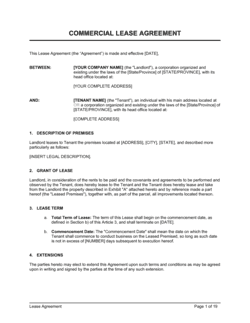
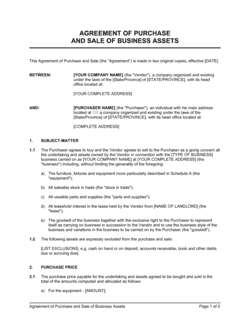
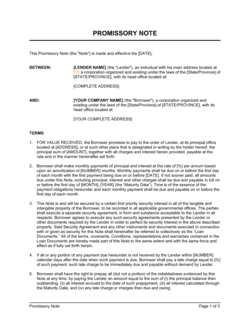
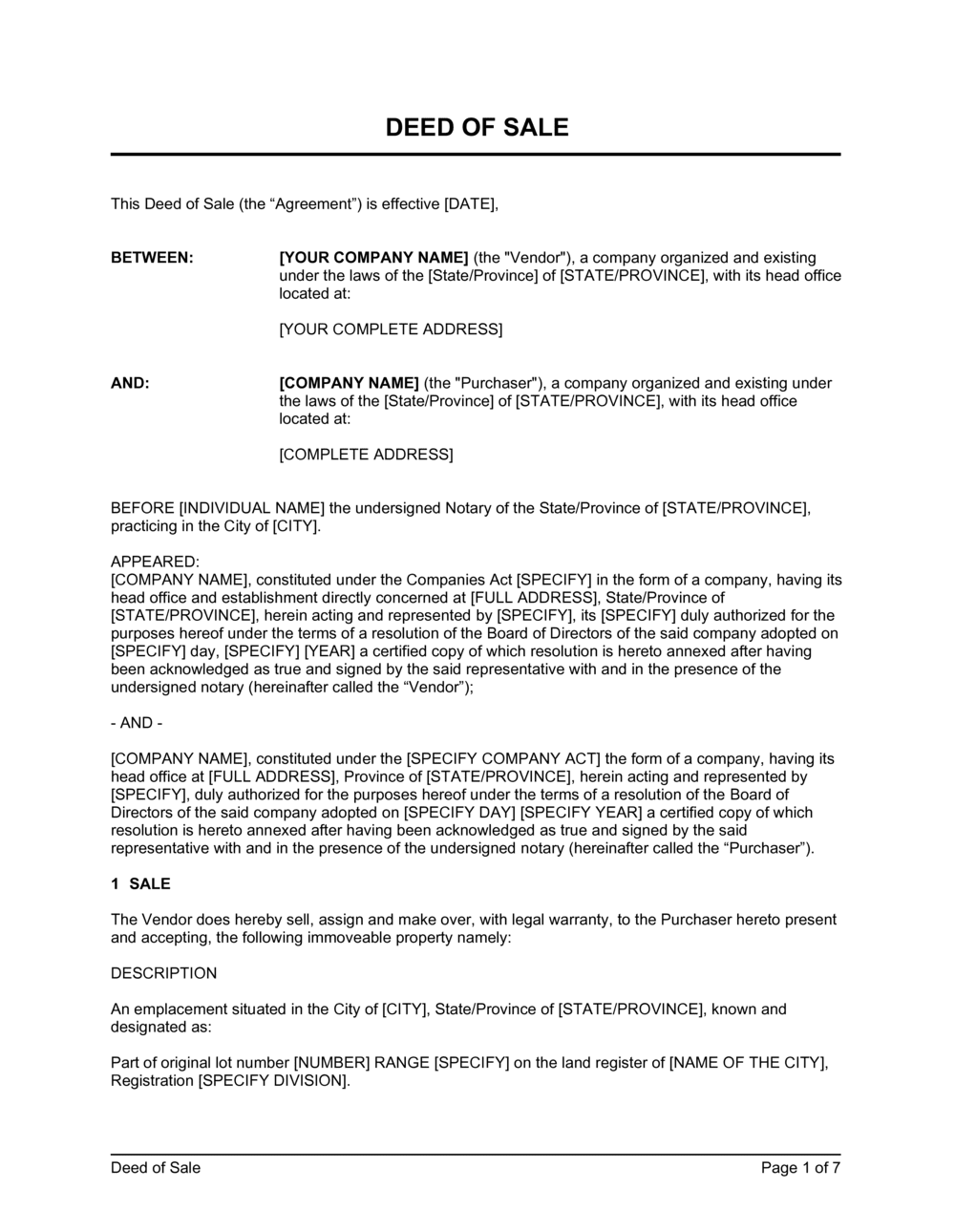
Deed of Sale Real Estate Property Template

Free Word download • Edit online • Save & share with Drive • Export to PDF

7 pages25–35 min to fillDifficulty: ComplexSignature requiredLegal review recommended
Learn more ↓
FreeDeed of Sale Real Estate Property Template

At a glance

What it is
A Deed of Sale for Real Estate Property is a legally binding contract that transfers ownership of real property from a seller to a buyer upon fulfillment of all agreed conditions. This free Word download covers every material term — parties, legal property description, purchase price, deposit, conditions of sale, seller warranties, closing procedure, risk transfer, and default remedies — and is formatted for notarization and registration with a land registry.
When you need it
Use it whenever residential or commercial real property changes hands: private sales between individuals, business-to-business property transfers, estate disposals, or investment property transactions where a formal, registrable instrument is required.
What's inside
Full legal identification of both parties and the property, purchase price and deposit structure, conditions precedent (financing, inspection, title search), seller warranties on title and encumbrances, closing and possession date, allocation of risk before and after closing, and remedies available to either party in the event of default or breach.

What is a Deed of Sale — Real Estate Property?

A Deed of Sale for Real Estate Property is a legally binding written contract that formally transfers ownership of real property — land, buildings, or both — from a seller to a buyer upon satisfaction of all agreed conditions and payment of the purchase price. It goes beyond a simple promise to sell: once notarized and registered with the applicable land registry or title office, it becomes the public instrument of title transfer and the authoritative record of the new owner's rights. The deed identifies both parties by their full legal names and capacities, describes the property using the official registry legal description, records the purchase price and deposit structure, sets out the conditions that must be met before closing, establishes seller warranties on title and physical condition, allocates risk between the parties, and defines the remedies available to each side in the event of default.

Why You Need This Document

Without a properly executed and registered deed of sale, a real estate transaction carries significant legal exposure for both parties regardless of how much money has changed hands. A buyer who pays a purchase price without a registrable deed holds no legal title — meaning a seller's creditor could register a lien against the property, a subsequent buyer could acquire title for value without notice, and the buyer's mortgage lender has no security to register against. A seller who transfers possession without a completed deed retains legal ownership and all associated tax, liability, and maintenance obligations. Courts in most jurisdictions will not enforce an oral agreement to sell real property, and a poorly drafted written agreement that fails for lack of a legal description, missing notarization, or unmet condition will leave both parties in costly litigation. This template gives you a professionally structured starting point with every material clause included — conditions, warranties, risk transfer, default remedies, and registration mechanics — so that the transaction closes cleanly, title is recorded in the buyer's name, and both parties have a clear written record of their respective rights and obligations.

Which variant fits your situation?

If your situation is…Use this template
Selling a residential home between private partiesDeed of Sale — Residential Property
Transferring commercial real estate between businessesCommercial Real Estate Purchase Agreement
Recording a binding offer before the full deed is draftedLetter of Intent — Real Estate
Leasing rather than selling real propertyCommercial Lease Agreement
Seller financing the purchase instead of a third-party lenderSeller Financing Agreement
Conveying property as part of a business asset saleBusiness Asset Purchase Agreement
Documenting a land-only transfer with no structuresDeed of Sale — Land

Common mistakes to avoid

❌ Using postal address instead of legal description

Why it matters: A postal address does not legally identify the parcel being transferred. Land registries will reject a deed that lacks a proper legal description, and an incorrect description can misdescribe the property conveyed.

Fix: Pull the exact legal description from the current title certificate or land registry record and copy it verbatim into the deed, including plan and lot numbers.

❌ Conditions of sale without waiver deadlines

Why it matters: An open-ended financing or inspection condition gives one or both parties an indefinite right to terminate, which courts have found renders the contract unenforceable for lack of certainty.

Fix: Assign a specific calendar date to every condition precedent and state whether each condition benefits the buyer, the seller, or both — making clear who may waive it.

❌ Deposit clause that is silent on refund terms

Why it matters: When a condition fails or a party defaults, an ambiguous deposit clause produces costly disputes about whether the deposit is refundable, forfeitable, or only recoverable by court order.

Fix: State explicitly: (a) the conditions under which the deposit is returned to the buyer, (b) the conditions under which it is forfeited to the seller, and (c) whether forfeiture is the exclusive remedy or simply one available remedy.

❌ Signing without notarization before registration

Why it matters: In virtually every common-law and civil-law jurisdiction, a deed of sale for real property must be notarized — or executed before a commissioner for oaths — before the land registry will accept it for registration. An unnotarized deed transfers no legal title.

Fix: Arrange notarization at the time of signing. Both parties should sign in front of the same notary where jurisdictional rules permit, and confirm the notary's licence is current in the relevant jurisdiction.

❌ No risk allocation clause between signing and closing

Why it matters: If the property is destroyed by fire or flood after signing but before closing, the absence of a risk clause leaves the parties' obligations determined by default rules that vary by jurisdiction — the buyer may be obligated to complete at full price for a property that no longer exists.

Fix: Include an express risk transfer clause specifying that risk of loss remains with the seller until the closing date, and require both parties to maintain insurance through their respective periods of risk.

❌ Choosing governing law that differs from the property's location

Why it matters: Real property is universally governed by the lex situs — the law of the jurisdiction where the land is physically situated. A governing-law clause pointing elsewhere is unenforceable and creates false expectations about rights and remedies.

Fix: Always set the governing law to the jurisdiction where the property is located. For cross-border transactions, seek advice from a lawyer licensed in that jurisdiction.

The 10 key clauses, explained

Parties and recitals

In plain language: Identifies the seller and buyer by full legal name, address, and capacity (individual, corporation, trustee, executor) and records the basic transaction premise.

Sample language
This Deed of Sale is entered into on [DATE] between [SELLER FULL LEGAL NAME], of [SELLER ADDRESS] ('Seller'), and [BUYER FULL LEGAL NAME], of [BUYER ADDRESS] ('Buyer'), for the sale and transfer of the Property described herein.

Common mistake: Using a common name or trade name instead of the registered legal name. A mismatch between the deed and the title registry record can block registration and require a corrective instrument.

Legal description of the property

In plain language: Provides the official registry-standard description of the land and any structures being conveyed, cross-referenced to the title certificate or plan number.

Sample language
The property being conveyed is legally described as: [LOT/PLAN DESCRIPTION], municipally known as [STREET ADDRESS], registered under Title/Certificate No. [REGISTRY NUMBER] in the Land Registry of [JURISDICTION].

Common mistake: Using only the postal address. Postal addresses are not legally sufficient for registration — a missing or incorrect legal description can void the deed or misdescribe what is actually transferred.

Purchase price and deposit

In plain language: States the total agreed purchase price, the deposit amount paid at signing, how the deposit is held (in trust or escrow), and the balance due at closing.

Sample language
The total purchase price is [PURCHASE PRICE] ([WRITTEN AMOUNT]), payable as follows: (a) deposit of [DEPOSIT AMOUNT] paid on execution and held in trust by [TRUST HOLDER]; (b) balance of [BALANCE] payable on closing.

Common mistake: Not specifying who holds the deposit and under what conditions it is refundable. An ambiguous deposit clause leads to disputes when a condition fails — leaving neither party certain of their rights.

Conditions of sale

In plain language: Lists each condition precedent that must be satisfied by a stated deadline before either party is bound to complete — typically financing, inspection, and title search.

Sample language
This Agreement is conditional upon: (a) Buyer obtaining mortgage financing of not less than [AMOUNT] at an interest rate not exceeding [RATE]% by [DATE]; (b) Buyer's inspection of the Property confirming no material defects by [DATE]; (c) Buyer's solicitor confirming clear title by [DATE].

Common mistake: Setting conditions without waiver deadlines. An open-ended condition effectively allows either party to walk away indefinitely — courts have held such provisions make the contract unenforceable for lack of certainty.

Seller warranties on title and condition

In plain language: Records the seller's representations that they own the property outright, that it is free of undisclosed encumbrances, and — where agreed — representations about the physical condition of the property.

Sample language
Seller warrants that: (a) Seller holds good and marketable title to the Property; (b) the Property is free and clear of all encumbrances except those disclosed in Schedule A; (c) Seller has no knowledge of any material latent defects not disclosed to Buyer.

Common mistake: Omitting latent defect disclosure language. In most jurisdictions, a seller's concealment of known material defects exposes them to rescission and damages even after closing — a disclosure clause also protects the seller by creating a record of what was disclosed.

Inclusions and exclusions

In plain language: Specifies which fixtures, appliances, and chattels are included in the purchase price and which items are excluded and to be removed by the seller before closing.

Sample language
Included in the purchase price: all permanently affixed fixtures, [LIST OF INCLUDED ITEMS]. Excluded and to be removed by Seller before closing: [LIST OF EXCLUDED ITEMS].

Common mistake: Leaving inclusions and exclusions vague — 'all fixtures' or 'as viewed.' Disputes over appliances, light fittings, and built-in furniture are among the most common post-closing complaints and are entirely avoidable with a specific list.

Closing, possession, and prorations

In plain language: Fixes the closing date, defines when the buyer takes physical possession, and establishes how property taxes, utilities, and strata or HOA fees are apportioned between the parties as of the closing date.

Sample language
Closing shall occur on [CLOSING DATE]. Possession shall be delivered to Buyer on [POSSESSION DATE] at [TIME]. Property taxes, strata levies, and utilities shall be prorated as of the Closing Date, with Seller responsible for all amounts accrued up to and including that date.

Common mistake: Setting the possession date the same as closing without accounting for transfer registration delays. If the title registration is delayed by even one business day, the buyer may occupy the property before having legal title — creating insurance and liability gaps.

Risk and insurance

In plain language: Allocates the risk of loss or damage to the property — from fire, flood, or other casualty — between the parties before and after the closing date, and specifies insurance obligations.

Sample language
Risk of loss or damage to the Property shall remain with Seller until the Closing Date. From the Closing Date forward, risk passes to Buyer. Seller shall maintain existing property insurance through the Closing Date; Buyer shall arrange insurance to take effect on the Closing Date.

Common mistake: No risk allocation clause at all. Without one, if the property is damaged between signing and closing, the parties' respective obligations are determined by jurisdiction-specific default rules — which vary widely and may not reflect the parties' expectations.

Default and remedies

In plain language: Defines what constitutes a default by either party, the notice required before exercising remedies, and the available remedies — deposit forfeiture, specific performance, or damages.

Sample language
If Buyer defaults, Seller may retain the deposit as liquidated damages and terminate this Agreement. If Seller defaults, Buyer may elect specific performance or recover the deposit plus proven damages. Either party must provide [X] days' written notice of default before exercising remedies.

Common mistake: Specifying deposit forfeiture as the sole remedy without clarifying whether it is the exclusive remedy. In some jurisdictions, courts have awarded damages beyond the deposit even where a forfeiture clause exists, unless the clause explicitly states it is exclusive.

Governing law, registration, and entire agreement

In plain language: Confirms which jurisdiction's law governs the deed, obligates both parties to execute any additional documents required for registration, and states that the written deed supersedes all prior negotiations.

Sample language
This Deed of Sale shall be governed by the laws of [JURISDICTION]. The parties shall execute all documents and take all steps required by [LAND REGISTRY / TITLE OFFICE] to effect registration. This Agreement constitutes the entire agreement and supersedes all prior representations and negotiations.

Common mistake: Choosing a governing jurisdiction that differs from where the property is located. Real property is governed by the lex situs — the law of the place where the land is situated — and a contrary choice of law clause is generally unenforceable.

How to fill it out

  1. 1

    Enter full legal names and capacities for both parties

    Use each party's exact registered legal name — individual, corporation, trust, or estate — along with their address and the capacity in which they are acting. Cross-reference the seller's name against the current title certificate.

    💡 If the seller is a corporation, confirm the signing officer's authority via a board resolution before execution — a deed signed without authority can be set aside.

  2. 2

    Insert the complete legal description of the property

    Copy the legal description verbatim from the current title certificate, plan of survey, or land registry record. Include the lot number, plan reference, and certificate or title number.

    💡 Never draft the legal description from memory or from a prior deed — descriptions can change following subdivision, consolidation, or boundary corrections.

  3. 3

    Set the purchase price, deposit amount, and trust holder

    State the total purchase price in both numerals and words. Specify the deposit amount, the name and firm of the trust holder (typically the buyer's or seller's lawyer), and the conditions under which the deposit is refundable.

    💡 In most jurisdictions the deposit should be held by a licensed professional in a designated trust account — not in the seller's personal bank account.

  4. 4

    Draft conditions of sale with firm waiver deadlines

    List each condition precedent — financing, inspection, title search, condominium document review — and assign a specific calendar date by which the condition must be satisfied or waived. Specify whether conditions benefit the buyer, the seller, or both.

    💡 Build in at least two business days of buffer between the last condition waiver deadline and the closing date to allow for document preparation.

  5. 5

    Complete the seller warranties and disclosure schedule

    Have the seller complete Schedule A disclosing all known encumbrances, easements, liens, and material defects. Confirm each warranty is accurate against the current title search results before signing.

    💡 A title insurance policy obtained by the buyer does not eliminate the need for seller warranties — it supplements them and covers risks neither party knew about.

  6. 6

    List inclusions and exclusions specifically

    Walk through the property and create an itemized list of every included fixture, appliance, and chattel. List separately every item the seller intends to remove. Both lists should be attached as a schedule and initialed by both parties.

    💡 Photograph all included items at signing to create a contemporaneous record — this is the single fastest way to resolve post-closing disputes.

  7. 7

    Fix the closing date, possession time, and proration basis

    Enter the closing date and the time and date of possession. Confirm whether possession coincides with or follows closing. Specify that taxes, strata fees, and utilities are prorated as of midnight on the closing date.

    💡 Avoid closing on a Friday — if registration is delayed, the buyer may wait the entire weekend without legal title and without recourse until Monday.

  8. 8

    Execute before a notary and submit for registration

    Both parties must sign in the presence of a licensed notary or commissioner for oaths as required by the governing jurisdiction. Submit the executed deed to the land registry or title office with the applicable registration fee within the required timeframe.

    💡 Some jurisdictions impose a transfer tax or stamp duty that must be paid at registration — confirm the applicable rate and who bears it before closing, and record this in the deed.

Frequently asked questions

What is a deed of sale for real estate?

A deed of sale for real estate is a legally binding written contract that transfers ownership of real property from a seller to a buyer upon completion of all agreed conditions and payment of the purchase price. It identifies both parties, precisely describes the land being conveyed, records the price and deposit, sets conditions and closing procedures, and — once notarized and registered — becomes the public record of the ownership transfer.

Is a deed of sale the same as a purchase agreement?

The terms are often used interchangeably for simpler transactions, but they can describe different instruments depending on the jurisdiction. In some systems a purchase agreement (or agreement of purchase and sale) is the conditional contract signed first, and the deed is the formal transfer instrument executed at closing. In others, a single deed of sale covers both functions. This template combines both into one document — covering conditions, warranties, and the formal conveyance.

Does a deed of sale need to be notarized?

In virtually all jurisdictions, yes. Land registries require notarization — or execution before a commissioner for oaths or equivalent officer — before they will accept a deed for registration. Without notarization, the deed is not registrable and transfers no legal title, even if both parties signed and money changed hands. Confirm the specific requirements of the land registry in the property's jurisdiction before execution.

What happens if a condition of sale is not met?

If a condition precedent — such as financing approval or a satisfactory inspection — is not met by its stated deadline, the party the condition benefits is typically entitled to waive the condition and proceed, or terminate the agreement and recover their deposit. If neither party waives the condition and the deadline passes, the contract is generally treated as terminated. A well-drafted deed specifies exactly who may waive each condition and what notice is required.

Who pays the real estate transfer tax?

Transfer tax, stamp duty, or land transfer tax obligations vary by jurisdiction and are often set by statute — meaning the deed cannot override the statutory allocation. In many US states, the buyer pays; in others, the seller pays or costs are split. In Canada, land transfer tax is typically the buyer's cost. In the UK, Stamp Duty Land Tax falls on the buyer. Confirm the applicable rate and statutory obligation for the property's jurisdiction before negotiating who bears the cost.

What is the difference between a deed of sale and a title?

A deed of sale is the contract that transfers ownership. A title — or title certificate — is the public record that confirms who owns the property following registration of the deed. The deed is the cause; the updated title is the effect. Until the deed is presented to the land registry and the title is updated, the transfer has not been completed in the eyes of the public record, and the buyer's ownership is not protected against third-party claims.

Can I use this template without a real estate lawyer?

For straightforward residential transactions in a single jurisdiction, a high-quality template provides a solid structural foundation. However, real estate deeds require jurisdiction-specific legal descriptions, must be executed in compliance with local formalities, and are subject to statutory rules that override contract terms. Most jurisdictions strongly recommend — and some effectively require — that both parties engage independent legal representation. A real estate lawyer typically charges $800–$2,500 for a residential closing and provides title search, registration, and trust account services the template itself cannot replace.

What warranties should a seller provide in a deed of sale?

At minimum, the seller should warrant that they hold good and marketable title, that the property is free of undisclosed encumbrances, and that they are aware of no material latent defects not disclosed in the agreement. Some transactions also include warranties about zoning compliance, the absence of outstanding work orders, and the accuracy of disclosed measurements. Buyers should obtain an independent title search and consider title insurance regardless of seller warranties, as warranties are only as valuable as the seller's ability to pay damages.

What is the difference between a deed of sale and a lease agreement?

A deed of sale permanently transfers ownership of the property from the seller to the buyer in exchange for the purchase price. A lease agreement grants the tenant a temporary right of possession and use for a defined term in exchange for rent, with ownership remaining with the landlord throughout. They are fundamentally different instruments: one conveys title, the other conveys a time-limited occupancy right.

How this compares to alternatives

vs Letter of Intent — Real Estate

A letter of intent records the preliminary agreed terms — price, deposit, and key conditions — before a formal deed is drafted. It is typically non-binding and does not transfer any property rights. The deed of sale is the binding instrument that supersedes the letter of intent. Use the LOI to align parties quickly; use the deed to close the transaction.

vs Commercial Lease Agreement

A lease agreement grants a tenant time-limited possession of real property in exchange for rent, with ownership remaining with the landlord. A deed of sale permanently transfers ownership to the buyer. They address fundamentally different objectives — occupancy versus conveyance — and are not interchangeable.

vs Business Asset Purchase Agreement

A business asset purchase agreement transfers a package of business assets — equipment, inventory, contracts, goodwill — which may or may not include real property. A deed of sale is the specific instrument required to convey real property within or alongside such a transaction. If real estate is included in a business asset sale, a separate deed of sale is typically required for land registry registration purposes.

vs Quitclaim Deed

A quitclaim deed transfers whatever interest the grantor holds in a property without any warranties of title — it conveys no guarantee that the grantor actually owns the property or that title is clear. A deed of sale includes seller warranties and conditions that protect the buyer. Quitclaim deeds are typically used between family members, to clear a defect, or in situations where no money changes hands and warranty risk is acceptable.

Industry-specific considerations

Residential real estate

Private home sales between individuals require plain-language conditions, specific inclusion lists, and residential tenancy act compliance where a tenant is in occupation at closing.

Commercial real estate

Commercial transactions add zoning and permitted-use warranties, environmental indemnities, assignment of existing leases, and GST/HST or VAT treatment of the sale price.

Real estate investment

Investors acquiring income properties need clauses covering tenant estoppel certificates, assignment of rents, and representations about current leases and arrears.

Construction and development

Developer lot sales require phased closing structures, occupancy permit conditions, homebuilder warranty program enrollment, and lien holdback provisions tied to completion milestones.

Jurisdictional notes

United States

Real property law is governed at the state level in the US, with significant variation in deed form, recording requirements, and transfer taxes. Most states require a warranty deed or grant deed for a sale with full title warranties; a quitclaim deed is insufficient for most arm's-length transactions. Deeds must be notarized and recorded with the county recorder or register of deeds. Many states impose a state and/or county transfer tax at rates ranging from 0.01% to 2.2% of the sale price. Title insurance is standard practice and typically required by lenders.

Canada

Real property is provincially regulated in Canada. Ontario, British Columbia, and Alberta operate Torrens-style land title systems requiring electronic registration through platforms such as Teraview (ON) or BC Online (BC). Quebec operates under civil law, where the deed of sale (acte de vente) must be executed before a notaire and is notarial in form — a common-law deed of sale is not registrable in Quebec. Provincial land transfer taxes apply in most provinces; Ontario and BC impose additional municipal land transfer taxes in Toronto and Vancouver respectively. Buyers in BC are subject to the Property Transfer Tax; Ontario buyers pay Land Transfer Tax with a first-time buyer rebate available up to a threshold.

United Kingdom

In England and Wales, the transfer of registered land is effected using Land Registry Form TR1, executed as a deed (signed, witnessed, and delivered). A standalone deed of sale is typically accompanied by a formal contract for sale exchanged by solicitors. Stamp Duty Land Tax (SDLT) is payable by the buyer at rates of 0–12% depending on value and property type; the rates and thresholds are updated periodically. Scotland uses a separate system (registers.scot) with its own Land and Buildings Transaction Tax. In Northern Ireland, HM Land Registry of Northern Ireland handles registration.

European Union

Real property conveyancing in EU member states is typically a notarial act — the notaire (France), Notar (Germany), or notaio (Italy) drafts and authenticates the deed, holds funds in escrow, and submits the deed for registration. The buyer cannot simply present a privately drafted template; the notary must prepare or approve the instrument. Transfer taxes and registration fees vary widely: France imposes droits de mutation of approximately 5.8% on older properties; Germany imposes Grunderwerbsteuer of 3.5–6.5% depending on the Land. GDPR applies to the processing of personal data in transaction documents.

Template vs lawyer — what fits your deal?

PathBest forCostTime
Use the templateSimple residential transactions between private parties in familiar jurisdictions with clear titleFree1–2 hours to complete; closing timeline set by conditions
Template + legal reviewResidential transactions involving financing, tenanted properties, or first-time buyers unfamiliar with local registration requirements$800–$2,500 (real estate lawyer for closing services)1–3 days for review; standard 30–60 day closing period
Custom draftedCommercial property sales, cross-border transactions, properties with environmental issues, or complex title defects$2,500–$10,000+ depending on transaction complexity2–6 weeks

Glossary

Legal Description
The precise, registry-standard identification of a parcel of land by lot number, plan reference, metes and bounds, or cadastral identifier — not a postal address.
Condition Precedent
A contractual requirement that must be satisfied before the transaction is legally obligated to complete — such as financing approval or a satisfactory property inspection.
Deposit
A sum paid by the buyer at signing, held in trust, that serves as partial payment and as evidence of the buyer's commitment to complete the purchase.
Closing Date
The specific calendar date on which ownership officially transfers, funds are released to the seller, and the buyer takes possession of the property.
Title
The legal evidence of a person's right to own and possess a specific parcel of real property, typically recorded in a public land registry.
Encumbrance
Any claim, lien, mortgage, easement, or restriction registered against a property title that may limit the owner's use or ability to sell freely.
Warranty of Title
A seller's legally binding promise that they hold clear, marketable title to the property and have the right to transfer it free of undisclosed encumbrances.
Risk Transfer
The contractual moment at which responsibility for loss or damage to the property shifts from the seller to the buyer — typically at closing or possession.
Notarization
The formal authentication of signatures on a deed by a licensed notary public or notarial officer, which is required in most jurisdictions before a deed can be registered.
Land Registry
The government office or system responsible for recording property ownership, transfers, and encumbrances to create a public, authoritative record of title.
Prorations
The apportionment of recurring property costs — such as property taxes, strata fees, or utility charges — between seller and buyer as of the closing date.
Earnest Money
In US practice, a deposit paid by the buyer to demonstrate good faith, held in escrow and credited toward the purchase price at closing or forfeited on default.

Part of your Business Operating System

This document is one of 3,000+ business & legal templates included in Business in a Box.

  • Fill-in-the-blanks — ready in minutes
  • 100% customizable Word document
  • Compatible with all office suites
  • Export to PDF and share electronically

Create your document in 3 simple steps.

From template to signed document — all inside one Business Operating System.
1
Download or open template

Access over 3,000+ business and legal templates for any business task, project or initiative.

2
Edit and fill in the blanks with AI

Customize your ready-made business document template and save it in the cloud.

3
Save, Share, Send, Sign

Share your files and folders with your team. Create a space of seamless collaboration.

Save time, save money, and create top-quality documents.

★★★★★

"Fantastic value! I'm not sure how I'd do without it. It's worth its weight in gold and paid back for itself many times."

Managing Director · Mall Farm
Robert Whalley
Managing Director, Mall Farm Proprietary Limited
★★★★★

"I have been using Business in a Box for years. It has been the most useful source of templates I have encountered. I recommend it to anyone."

Business Owner · 4+ years
Dr Michael John Freestone
Business Owner
★★★★★

"It has been a life saver so many times I have lost count. Business in a Box has saved me so much time and as you know, time is money."

Owner · Upstate Web
David G. Moore Jr.
Owner, Upstate Web

Run your business with a system — not scattered tools

Stop downloading documents. Start operating with clarity. Business in a Box gives you the Business Operating System used by over 250,000 companies worldwide to structure, run, and grow their business.

Start free · No credit card required