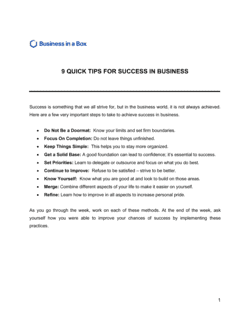
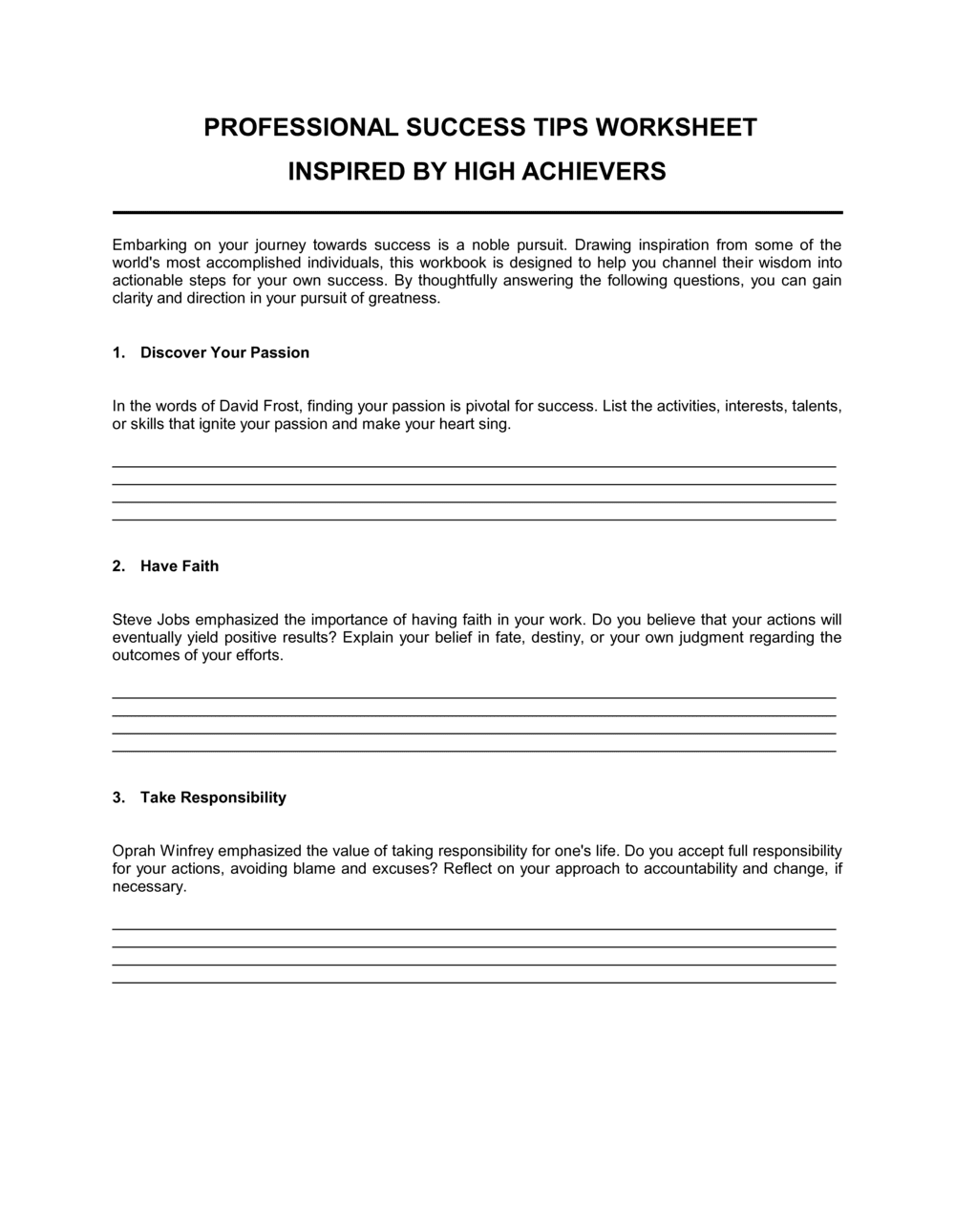
Worksheet Professional Success Tips

Free download • Use as a template • Print or share

3 pages20–30 min to useDifficulty: StandardSignature requiredLegal review recommended
Learn more ↓
FreeWorksheet Professional Success Tips Template

At a glance

What it is
A Worksheet Professional Success Tips is a structured guidance and accountability document that formalizes an employee's or professional's commitments to skill development, performance improvement, and career advancement. This free Word download provides a ready-to-edit framework that managers and HR teams use to align individual growth targets with organizational objectives, and that employees sign as a record of agreed priorities and milestones.
When you need it
Use it during onboarding, annual performance reviews, performance improvement discussions, or any structured career-development conversation where agreed actions, timelines, and accountability need to be documented in writing. It is especially valuable when a manager and employee need a shared reference point that both parties can revisit throughout the year.
What's inside
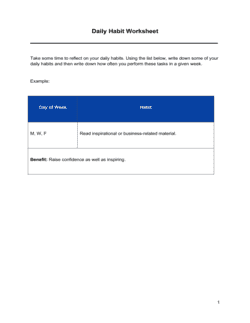
Core sections cover professional goals and timelines, identified skill gaps and development actions, communication and workplace behavior standards, mentorship or coaching commitments, progress checkpoints with measurable outcomes, and a mutual sign-off block confirming that both parties reviewed and agreed to the documented plan.

What is a Professional Success Tips Worksheet?

A Professional Success Tips Worksheet is a structured, mutually signed document that formalizes an employee's development commitments — professional goals, skill-gap actions, behavioral standards, mentorship arrangements, and accountability checkpoints — in a single written record agreed to by both the employee and their manager. Unlike informal feedback conversations or generic career-advice handouts, this worksheet creates a bilateral, documented agreement: the employee commits to specific actions by specific dates, and the employer commits to defined resources and support. That mutual accountability is what gives the document its operational and legal weight within the employment relationship.

Why You Need This Document

Without a signed professional success worksheet, development conversations remain verbal agreements with no enforceable record — and verbal agreements produce inconsistent outcomes, disputed recollections, and no paper trail when performance concerns escalate. Managers who skip formal documentation find themselves unable to demonstrate that an employee was given structured support before a disciplinary action, which is a critical gap in jurisdictions like Canada, the UK, and the EU where procedural fairness is required. Employees, equally, have no documented basis to hold their employer accountable for promised training budgets, mentorship access, or protected development time. A completed, signed worksheet closes both gaps: it protects the employer's procedural position, increases employee goal-completion rates by replacing informal conversations with written commitments, and creates the auditable development record that HR needs when evaluating promotion readiness, compensation changes, or — if it comes to it — termination justification.

Which variant fits your situation?

If your situation is…Use this template
Addressing a specific performance gap with formal corrective actionPerformance Improvement Plan (PIP)
Onboarding a new hire with 30/60/90-day milestones30-60-90 Day Plan
Conducting a structured annual performance reviewEmployee Performance Review
Documenting a long-term career path within the organizationIndividual Development Plan
Setting SMART goals for a specific quarter or project cycleGoal Setting Worksheet
Preparing a senior employee for a management or leadership roleLeadership Development Plan
Tracking training completion and competency sign-offsEmployee Training Plan

Common mistakes to avoid

❌ Vague, unmeasurable goal statements

Why it matters: Goals like 'be more proactive' or 'improve leadership' cannot be assessed at review time, making it impossible to determine whether the plan was completed and undermining any downstream HR action that relies on the document.

Fix: Rewrite each goal using the SMART framework: state the specific skill or behavior, define a measurable indicator of success, set a realistic target date, and confirm the goal is relevant to the employee's role.

❌ No interim checkpoint dates

Why it matters: A worksheet reviewed only once at year-end functions as a historical record, not an accountability tool. By the time non-completion is identified, there is no opportunity for course correction within the same cycle.

Fix: Schedule at least two formal checkpoint meetings at the time of signing and document the dates on the worksheet itself. Both parties should calendar them before leaving the initial meeting.

❌ Collecting only the manager's signature

Why it matters: An unsigned document cannot be used as evidence of mutual agreement if a dispute arises over what was discussed, committed, or offered during the development process.

Fix: Require the employee's signature before the worksheet is filed. If the employee declines to sign, note the refusal in writing and have a witness confirm it.

❌ Omitting employer resource commitments

Why it matters: A one-sided document that lists only employee obligations — with no corresponding employer commitment to provide budget, time, or support — reduces engagement and gives the employee grounds to argue they lacked the means to succeed.

Fix: Include a dedicated resources section that states, in specific dollar and hour terms, what the company will provide. Pre-approve the budget before the meeting so the commitment is real.

❌ Circulating the worksheet without a confidentiality clause

Why it matters: Development plans contain sensitive information about performance gaps and feedback. Sharing them without documented confidentiality protections exposes the employer to privacy complaints and damages the employee's willingness to participate honestly.

Fix: Add a confidentiality clause specifying who may access the document and under what circumstances before circulating any draft or completed version.

❌ Using the worksheet as a substitute for a formal PIP

Why it matters: A professional success worksheet is a developmental, forward-looking document. Using it to manage a serious performance deficiency without the structure and legal protections of a formal Performance Improvement Plan creates ambiguity about the severity of the situation and can weaken a subsequent termination defense.

Fix: If the issue involves conduct, repeated performance failures, or potential termination, transition to a formal PIP with legal review. Reserve the worksheet for genuine development conversations where no disciplinary outcome is anticipated.

The 10 key clauses, explained

Parties and Effective Date

In plain language: Identifies the employee by full legal name and role, the supervising manager or HR representative, and the date the worksheet takes effect.

Sample language
This Professional Success Tips Worksheet is entered into on [DATE] between [EMPLOYEE FULL NAME], [JOB TITLE], and [MANAGER/HR REPRESENTATIVE NAME], [TITLE], on behalf of [EMPLOYER LEGAL NAME] ('Company').

Common mistake: Using only a first name or nickname for the employee. If the document is later referenced in a disciplinary or legal proceeding, the party must be identifiable by legal name and role.

Professional Goals and Timelines

In plain language: States two to five specific professional goals the employee commits to achieving, each with a defined completion date and measurable success criterion.

Sample language
Goal 1: [GOAL DESCRIPTION]. Target Completion Date: [DATE]. Success Measure: [METRIC OR OBSERVABLE OUTCOME]. Goal 2: [GOAL DESCRIPTION]. Target Completion Date: [DATE]. Success Measure: [METRIC OR OBSERVABLE OUTCOME].

Common mistake: Writing goals in vague language like 'improve communication skills' without attaching a measurable outcome or deadline — making it impossible to assess completion at review time.

Identified Skill Gaps and Development Actions

In plain language: Documents the specific competency gaps identified through performance data or feedback, and the concrete actions — training, coaching, project assignments — the employee will take to close them.

Sample language
Identified Gap: [SKILL OR COMPETENCY]. Development Action: [SPECIFIC ACTIVITY, e.g., complete [COURSE NAME] by [DATE] / shadow [ROLE] on [PROJECT] by [DATE]]. Responsible Party: [EMPLOYEE / MANAGER / BOTH].

Common mistake: Identifying the gap without assigning responsibility. If it is unclear whether the employee or employer will fund and schedule training, the action item stalls.

Workplace Behavior and Communication Standards

In plain language: Outlines the specific professional conduct, collaboration habits, and communication norms the employee agrees to demonstrate, with reference to any applicable company policy.

Sample language
Employee commits to: (a) responding to internal communications within [X] business hours; (b) attending all scheduled team meetings with prepared contributions; (c) adhering to [COMPANY] Code of Conduct, Policy [NUMBER], as amended from time to time.

Common mistake: Attaching a laundry list of generic behaviors copied from an employee handbook. The clause should reflect the specific behaviors relevant to this employee's role and development area.

Mentorship and Coaching Commitments

In plain language: Records any agreed mentorship pairing, coaching sessions, or peer learning arrangements, including frequency, duration, and the responsible parties.

Sample language
Company will arrange [X] mentoring sessions per [month/quarter] with [MENTOR NAME / ROLE]. Employee agrees to prepare a written agenda for each session at least [48] hours in advance and to document action items within [24] hours of each meeting.

Common mistake: Listing a mentor without a session frequency or preparation commitment. Without structure, mentoring arrangements are rarely used and cannot be cited as a completed development action.

Progress Checkpoints and Review Schedule

In plain language: Establishes the dates on which the employee and manager will formally review progress, assess goal completion, and update the worksheet if circumstances change.

Sample language
Progress reviews will be conducted on [DATE 1], [DATE 2], and [DATE 3]. At each checkpoint, Manager and Employee will document completion status for each goal and action item and sign a progress notation.

Common mistake: Setting a single end-of-year review with no interim checkpoints. Without mid-cycle reviews, course corrections cannot be made in time to affect outcomes, and the document loses its accountability function.

Resources and Support Commitments

In plain language: States what the employer commits to providing — budget for training, access to tools, protected time, or internal sponsorship — to enable the employee to meet the plan's goals.

Sample language
Company will provide: (a) a professional development budget of up to $[AMOUNT] per calendar year for pre-approved training and certifications; (b) up to [X] hours per [week/month] of protected development time; (c) access to [TOOL / PLATFORM / RESOURCE].

Common mistake: Omitting the employer's commitments entirely and treating the worksheet as a one-sided obligation on the employee — which reduces buy-in and creates grounds for the employee to claim they lacked support if goals are not met.

Consequences and Escalation Path

In plain language: Describes what happens if the employee does not meet the agreed milestones — whether that triggers a formal PIP, a compensation review impact, or another documented outcome.

Sample language
If Employee fails to complete [SPECIFIC MILESTONE] by [DATE], Manager will initiate a formal review meeting within [10] business days to assess the gap and determine whether escalation to a Performance Improvement Plan is appropriate.

Common mistake: Leaving consequences unspecified. A worksheet with no stated outcome for non-completion has no enforcement value and is difficult to rely on in subsequent HR proceedings.

Confidentiality of Development Records

In plain language: Confirms that the contents of the worksheet and any associated feedback or progress notes are treated as confidential HR records, accessible only to specified parties.

Sample language
The contents of this Worksheet are confidential and shall be maintained in Employee's personnel file. Access is limited to Employee, [MANAGER NAME/TITLE], HR, and senior leadership on a need-to-know basis, except as required by law.

Common mistake: Circulating an unsigned draft to the employee's peers or team without a confidentiality clause in place — exposing the employer to privacy complaints and damaging the employee's confidence in the process.

Mutual Acknowledgment and Signature Block

In plain language: Both parties sign and date the document, confirming they reviewed, discussed, and agreed to all terms and that the employee had the opportunity to ask questions before signing.

Sample language
By signing below, Employee and Manager confirm that they have reviewed this Worksheet together, that Employee's questions have been addressed, and that both parties agree to the goals, actions, and timelines set out above. Employee: [SIGNATURE / DATE]. Manager: [SIGNATURE / DATE]. HR Representative (if applicable): [SIGNATURE / DATE].

Common mistake: Collecting only the manager's signature and treating the employee's copy as informational. Without the employee's signature, the document cannot be used as evidence of mutual agreement in a dispute.

How to fill it out

  1. 1

    Complete the parties block before the development conversation

    Enter the employee's full legal name, job title, manager's name and title, and today's date. Confirm the employer's legal entity name matches payroll records.

    💡 Prepare the header in advance so the meeting time is spent on substance — goals and actions — rather than administrative details.

  2. 2

    Identify two to five specific, measurable professional goals

    Work with the employee to draft goals that are SMART — tied to a specific outcome, a measurable metric, and a realistic completion date within the review cycle.

    💡 Ask the employee to draft their own goals before the meeting. Employee-authored goals show higher completion rates than manager-imposed ones.

  3. 3

    Document identified skill gaps with evidence

    For each gap, reference the specific performance data, feedback, or observation that identified it. Attach the source (e.g., Q1 performance review dated [DATE]) so the gap cannot be disputed later.

    💡 Limit gaps to two or three per cycle. More than three unfocused development targets typically results in none being completed.

  4. 4

    Assign a concrete development action to each gap

    Specify the activity (course, project, shadowing, certification), the completion date, who is responsible for scheduling or funding it, and how completion will be verified.

    💡 Include a course name, provider, and estimated duration rather than a generic 'attend training.' Specificity drives follow-through.

  5. 5

    State the employer's resource commitments explicitly

    Enter the development budget cap, the hours of protected time allocated, and any internal resources — mentors, tools, or platforms — the company is committing to provide.

    💡 Getting the budget amount pre-approved by the manager's manager before the meeting prevents commitments that cannot be honored.

  6. 6

    Set checkpoint dates and document the escalation path

    Calendar at least two interim review dates and record them in the worksheet. Write a specific, proportionate consequence for failing to meet key milestones by their stated dates.

    💡 Send calendar invites for all checkpoint dates immediately after signing. Meetings that are not calendared rarely happen.

  7. 7

    Review the completed worksheet with the employee and answer questions

    Walk through every section with the employee before asking for a signature. Document any clarifications or changes made during the discussion directly on the worksheet before execution.

    💡 Give the employee a signed copy on the same day. Delaying distribution erodes trust and can create claims that the employee never received or agreed to the plan.

  8. 8

    File the signed worksheet in the personnel record

    Store the fully executed original in the employee's confidential HR file, accessible only to authorized parties. Set a calendar reminder for the first checkpoint date.

    💡 Use Business in a Box's document storage to timestamp and archive the signed copy immediately — a dated digital record is easier to retrieve than a paper file in a filing cabinet.

Frequently asked questions

What is a professional success tips worksheet?

A professional success tips worksheet is a structured HR document that formalizes an employee's goals, skill development actions, behavioral commitments, and accountability checkpoints in a single written record. It is typically completed jointly by the employee and their manager during a performance or development conversation, then signed by both parties as evidence of mutual agreement. Unlike a performance improvement plan, it is developmental in intent — designed to support growth rather than address a formal deficiency.

Is a professional success worksheet legally binding?

When signed by both parties, a professional success worksheet is generally treated as a binding workplace agreement in most jurisdictions, creating enforceable commitments on both the employee and the employer. The employer's resource commitments — budget, protected time, mentoring — are particularly important to document accurately, as courts and employment tribunals have found employers in breach when they failed to deliver promised development support. Consider having HR or legal counsel review the document before distribution, especially when the plan is connected to a potential disciplinary outcome.

What is the difference between a professional success worksheet and a performance improvement plan?

A professional success worksheet is a forward-looking development tool used when an employee is meeting baseline expectations but needs support to grow, advance, or take on new responsibilities. A performance improvement plan (PIP) is a formal corrective document used when an employee is failing to meet minimum performance standards and faces potential disciplinary action, including termination, if the plan is not completed. Using a worksheet in a situation that warrants a PIP can undermine an employer's disciplinary position — the choice of document signals the seriousness of the situation.

Does a professional success worksheet need to be signed by both parties?

Yes. Both the employee and the manager should sign and date the completed worksheet before it is filed. The employee's signature confirms they reviewed the document, had the opportunity to ask questions, and agreed to its contents. Without a mutual signature, the document cannot be reliably used in subsequent HR proceedings to demonstrate what was discussed and agreed. If an employee refuses to sign, document the refusal in writing and have a witness confirm it.

How often should a professional success worksheet be updated?

The worksheet should be reviewed at every scheduled checkpoint — typically two to four times per year depending on the plan's duration. At each review, progress against each goal and action item should be documented in writing, and the parties should sign a progress notation. If circumstances change significantly — role change, reorganization, or material shift in business priorities — the worksheet should be formally amended and re-executed rather than informally adjusted.

Can I use a professional success worksheet for remote employees?

Yes. The worksheet functions equally well for remote workers. Ensure the document is executed using a recognized electronic signature method so the signed copy is timestamped and auditable. For remote employees, the development actions and checkpoint meetings should specify whether they are conducted by video call, and any protected development time commitments should account for time zone differences and home-office schedules.

What happens if goals in the worksheet are not achieved?

The worksheet should include an escalation clause specifying the review process triggered by non-completion of a milestone. Depending on the cause — lack of employer support, changed business conditions, or employee effort — the appropriate response may be to extend the timeline, revise the goals, initiate a formal PIP, or adjust the employee's role. The documented checkpoint record and any progress notations are critical evidence in any subsequent HR or legal proceeding about what occurred and why.

Do I need a lawyer to draft a professional success worksheet?

For standard development conversations with no disciplinary overlay, a high-quality template reviewed by HR is typically sufficient. Engage an employment lawyer when the worksheet is connected to a prior or ongoing performance issue that may lead to termination, when the employee is in a protected class and the plan could give rise to a discrimination claim, or when you operate in a heavily regulated jurisdiction with detailed written-procedure requirements. A 30-minute employment law review typically costs $150–$300 and is worthwhile for any plan with potential disciplinary consequences.

How is a professional success worksheet different from an offer letter or employment contract?

An offer letter and employment contract govern the terms of the employment relationship itself — compensation, duties, IP, and termination. A professional success worksheet operates within that relationship to document agreed development activities and accountability standards for a specific period. The worksheet does not modify the underlying employment contract but may be referenced in performance management proceedings as evidence of expectations communicated and resources offered.

How this compares to alternatives

vs Performance Improvement Plan

A performance improvement plan is a formal corrective document used when an employee is not meeting minimum standards and faces potential disciplinary consequences including termination. A professional success worksheet is developmental, used when an employee is meeting baseline expectations but needs structured support to grow. The two documents have different legal implications — using a worksheet when a PIP is warranted can weaken a subsequent termination defense.

vs Employee Performance Review

An employee performance review assesses past performance against defined criteria and produces a backward-looking rating or evaluation. A professional success worksheet is forward-looking — it documents what the employee will do next. The two documents complement each other: the review identifies gaps and ratings; the worksheet translates them into committed action.

vs Employment Contract

An employment contract governs the foundational terms of the employment relationship — compensation, duties, IP, and termination. A professional success worksheet operates within that relationship to document agreed development goals and accountability standards for a specific cycle. The worksheet does not modify the contract but may be referenced in performance management or legal proceedings.

vs Employee Training Plan

An employee training plan schedules and tracks completion of specific courses, certifications, or learning programs across a team or organization. A professional success worksheet is individualized — it combines development actions with behavioral commitments, goals, accountability checkpoints, and a bilateral sign-off. Training plans are operational delivery tools; worksheets are personalized accountability agreements.

Industry-specific considerations

Technology / SaaS

Skill development actions often reference specific technical certifications, programming language proficiency targets, or product knowledge milestones tied to quarterly OKR cycles.

Financial Services

Regulatory licensing obligations — such as FINRA Series exams or FCA certifications — are frequently embedded as required development actions with hard completion deadlines.

Healthcare

Credentialing renewals, CPD hours, and patient-communication competency standards are documented as mandatory development actions with compliance sign-off requirements.

Professional Services

Billable utilization targets, client relationship development milestones, and promotion-track competency frameworks are commonly embedded alongside behavioral commitments.

Retail / Hospitality

High turnover makes structured onboarding worksheets critical; goals typically cover product knowledge, upsell conversion rates, and service standard certifications within defined probationary windows.

Manufacturing

Safety certification completion, machine-specific competency sign-offs, and lean/Six Sigma training milestones are standard development actions embedded alongside production performance targets.

Jurisdictional notes

United States

In at-will states, a professional success worksheet generally does not create an implied contract of continued employment, but courts have found that detailed written commitments — especially resource and support promises — can create enforceable obligations. California's strict employee protections and privacy laws require particular care in how development records are stored and who may access them. Include an integration clause confirming the worksheet does not modify the underlying employment agreement.

Canada

Canadian employment law imposes a duty to accommodate and good-faith obligations on employers managing performance. A documented development worksheet showing that the employer provided structured support and resources is strong evidence in defending against constructive dismissal claims. In Quebec, documents shared with employees in the course of employment must be available in French under the Charter of the French Language. Provincial privacy statutes — including PIPEDA and provincial equivalents — govern how personal information in personnel files may be stored and disclosed.

United Kingdom

UK employment law requires employers to act reasonably in managing performance, and a well-documented development plan is a key element of demonstrating procedural fairness before any dismissal. ACAS Code of Practice on disciplinary and grievance procedures recommends giving employees written notice of concerns and an opportunity to improve. Under UK GDPR and the Data Protection Act 2018, development records are personal data — employees have subject access rights and the employer must have a lawful basis for processing and retaining them.

European Union

GDPR classifies employee development records as personal data subject to data minimization, purpose limitation, and retention period requirements. Employers must inform employees of how their development data is processed, stored, and for how long — typically addressed in an employee privacy notice. Member state employment laws — particularly in France, Germany, and the Netherlands — impose consultation requirements with works councils before introducing standardized performance or development documentation at an organizational level.

Template vs lawyer — what fits your deal?

PathBest forCostTime
Use the templateStandard employee development conversations with no disciplinary overlay, across any business sizeFree30–45 minutes per employee
Template + legal reviewPlans connected to prior performance concerns, employees in protected classes, or heavily regulated industries$150–$400 for an HR advisor or employment lawyer review1–2 days
Custom draftedSenior executives, situations with material termination risk, or multi-jurisdiction employment relationships$500–$2,000+3–7 days

Glossary

Professional Development Plan
A documented agreement between an employee and employer outlining the skills, behaviors, and milestones the employee will pursue over a defined period.
SMART Goals
Goals that are Specific, Measurable, Achievable, Relevant, and Time-bound — a standard framework for ensuring objectives are actionable and assessable.
Accountability Checkpoint
A scheduled review meeting or written progress report that confirms whether agreed actions have been completed by a stated date.
Competency Framework
An organizational map of the skills, behaviors, and knowledge required to perform effectively at each role level — used as a benchmark in development plans.
Performance Improvement Plan (PIP)
A formal document that identifies specific performance deficiencies, sets corrective actions and timelines, and establishes consequences for non-completion — legally distinct from a development worksheet.
360-Degree Feedback
A performance input process collecting observations from a person's manager, peers, direct reports, and sometimes clients — used to identify development priorities.
Key Performance Indicator (KPI)
A quantifiable metric tied to a role or goal, used to measure progress and success against a defined standard.
Mutual Acknowledgment
A signed statement by both employer and employee confirming they have reviewed, discussed, and agreed to the contents of the document.
Stretch Goal
A target that exceeds current demonstrated performance levels, designed to challenge the individual and build capability beyond the baseline.
Development Action
A specific, time-bound activity — such as completing a course, shadowing a colleague, or leading a project — designed to close an identified skill gap.

Part of your Business Operating System

This document is one of 3,000+ business & legal templates included in Business in a Box.

  • Fill-in-the-blanks — ready in minutes
  • 100% customizable Word document
  • Compatible with all office suites
  • Export to PDF and share electronically

Create your document in 3 simple steps.

From template to signed document — all inside one Business Operating System.
1
Download or open template

Access over 3,000+ business and legal templates for any business task, project or initiative.

2
Edit and fill in the blanks with AI

Customize your ready-made business document template and save it in the cloud.

3
Save, Share, Send, Sign

Share your files and folders with your team. Create a space of seamless collaboration.

Save time, save money, and create top-quality documents.

★★★★★

"Fantastic value! I'm not sure how I'd do without it. It's worth its weight in gold and paid back for itself many times."

Managing Director · Mall Farm
Robert Whalley
Managing Director, Mall Farm Proprietary Limited
★★★★★

"I have been using Business in a Box for years. It has been the most useful source of templates I have encountered. I recommend it to anyone."

Business Owner · 4+ years
Dr Michael John Freestone
Business Owner
★★★★★

"It has been a life saver so many times I have lost count. Business in a Box has saved me so much time and as you know, time is money."

Owner · Upstate Web
David G. Moore Jr.
Owner, Upstate Web

Run your business with a system — not scattered tools

Stop downloading documents. Start operating with clarity. Business in a Box gives you the Business Operating System used by over 250,000 companies worldwide to structure, run, and grow their business.

Start free · No credit card required