Worksheet Customer Retention Strategy

Free download β€’ Use as a template β€’ Print or share

4 pagesβ€’20–25 min to useβ€’Difficulty: Standard
Learn more ↓
FreeWorksheet Customer Retention Strategy Template

At a glance

What it is
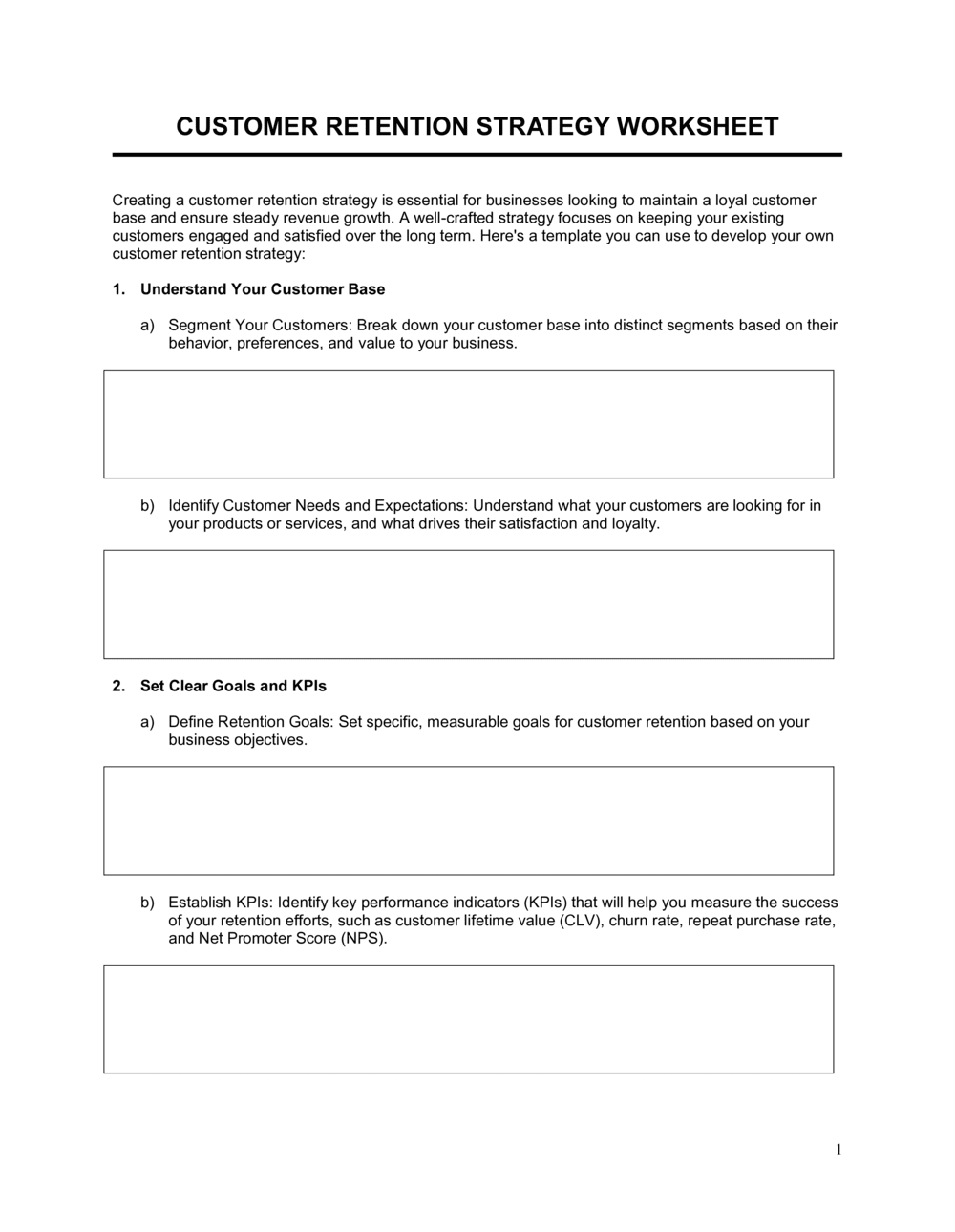
A Customer Retention Strategy Worksheet is a structured operational document that guides you through identifying churn causes, segmenting your existing customer base, defining loyalty and re-engagement tactics, and setting measurable retention KPIs. This free Word download gives you a ready-to-edit framework you can complete in a single planning session and share with your marketing, sales, and customer success teams.
When you need it
Use it when monthly churn is rising, when you're launching a loyalty program, or when you want to turn ad hoc retention efforts into a documented, repeatable strategy. It's also the right tool before a quarterly business review where customer health is on the agenda.
What's inside
The worksheet covers your retention baseline and churn analysis, customer segmentation, root-cause mapping, retention tactic selection, loyalty and reward program design, success metrics and KPIs, ownership assignments, and a 90-day action plan β€” everything in a single editable document.

What is a Customer Retention Strategy Worksheet?

A Customer Retention Strategy Worksheet is a structured operational document that guides a business through the full cycle of retention planning β€” from diagnosing why customers leave to assigning specific tactics, designing loyalty incentives, and setting measurable KPIs. Unlike a general marketing plan, it focuses exclusively on the customers you already have, treating them as a segmented portfolio of relationships at varying risk levels. The worksheet walks you through churn root-cause analysis, customer health scoring, tactic-to-segment matching, feedback channel design, and a 90-day execution plan, all in a single editable Word document.

Why You Need This Document

Every month a customer churns, you lose not just their current revenue but the full lifetime value they would have generated β€” and you add the cost of replacing them with a new acquisition. Studies consistently show that acquiring a new customer costs five to seven times more than retaining an existing one, yet most businesses invest the majority of their marketing budget in acquisition. Without a written retention strategy, churn-reduction efforts are reactive, inconsistent, and impossible to measure. Teams run win-back campaigns without knowing which customers to target, send NPS surveys with no follow-up process, and launch loyalty programs that don't move renewal rates because no one modeled the incentive size against actual switching costs. This worksheet forces the discipline of documenting what you know about why customers leave, who is most at risk right now, and exactly what each team member will do about it in the next 90 days β€” turning good intentions into a trackable plan.

Which variant fits your situation?

If your situation is…Use this template
Diagnosing why customers are leaving before building a planCustomer Exit Survey
Mapping the full customer journey to find drop-off pointsCustomer Journey Map
Running a structured quarterly review of customer health metricsCustomer Success Plan
Designing a formal loyalty rewards program with tiers and rulesLoyalty Program Policy
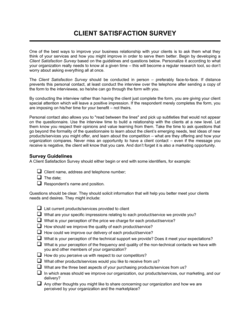
Tracking NPS, CSAT, and CES scores over timeCustomer Satisfaction Survey
Presenting retention results to leadership or a boardCustomer Retention Report
Building a full go-to-market plan that includes retentionMarketing Plan

Common mistakes to avoid

❌ Treating churn as a marketing problem only

Why it matters: Churn is a cross-functional symptom β€” product gaps, support failures, and sales overpromising all drive it. Marketing-only retention programs address the symptom without fixing the cause.

Fix: Use the root-cause section of the worksheet to identify which team owns each churn driver, then assign retention tactics across customer success, product, and support β€” not just marketing.

❌ Setting retention targets without a baseline

Why it matters: A target of '5% monthly churn' is meaningless if you don't know your current rate. Teams celebrate hitting an arbitrary number that may actually represent zero improvement.

Fix: Complete the retention baseline section first, then set targets as a percentage improvement over your current rate β€” e.g., 'reduce monthly churn by 25% from current [X]% within 90 days.'

❌ Assigning tactics with no named owner

Why it matters: Retention plans with shared or team-level ownership consistently stall. When everyone is responsible, no one is.

Fix: Assign a single named individual β€” not a team or role title β€” to each tactic in the 90-day action plan, along with a specific due date.

❌ Skipping the win-back section because churned customers seem like a lost cause

Why it matters: Win-back campaigns for recently churned customers (within 60–90 days) typically convert at 10–25%, far cheaper than acquiring a new customer from scratch.

Fix: Define win-back criteria, trigger timing, and a specific offer in the worksheet. Even a simple 60-day reactivation email with a discount pays back its cost many times over.

❌ Using the same feedback cadence for all customer tiers

Why it matters: Sending a quarterly NPS to a high-risk account that needs weekly attention signals indifference. At-risk customers interpret infrequent outreach as a sign that they are not valued.

Fix: Define tiered feedback and outreach cadences in the listening channels section β€” high-risk accounts get monthly or bi-monthly human touch; healthy accounts get automated quarterly surveys.

❌ Completing the worksheet once and filing it away

Why it matters: A retention strategy that is not revisited quarterly becomes a historical document, not a living plan. Market conditions, product changes, and competitor moves shift churn drivers within months.

Fix: Schedule a quarterly worksheet review at the same time you review your KPI dashboard. Update root causes, segment criteria, and tactics based on what the last 90 days of data showed.

The 9 key sections, explained

Retention baseline and current metrics

Churn analysis and root causes

Customer segmentation by retention risk

Retention tactics by segment

Loyalty and reward program design

Customer feedback and listening channels

Retention KPIs and measurement plan

Win-back and re-engagement plan

90-day action plan and ownership

How to fill it out

  1. 1

    Pull your retention baseline data before opening the worksheet

    Before filling in a single field, export your churn rate, retention rate, LTV, and NPS from your CRM, billing system, or analytics platform. The worksheet is only as useful as the data you feed it.

    πŸ’‘ Use a 90-day rolling average for churn rate rather than a single month's snapshot β€” one atypical month distorts the baseline significantly.

  2. 2

    Complete the churn analysis section using exit data

    Pull cancellation reasons from your CRM, exit survey responses, and the last 90 days of support tickets. Group root causes into no more than five categories to keep the analysis actionable.

    πŸ’‘ Weight root causes by revenue impact, not account count. Losing ten small accounts for the same reason as one enterprise account is very different problems.

  3. 3

    Segment your customer base by retention risk

    Define the criteria for high-risk, neutral, and healthy tiers. Apply the criteria to your active customer list and record the count and revenue at risk for each tier in the worksheet.

    πŸ’‘ If you don't have a formal health score, login frequency and days since last support ticket are reliable proxies that most CRMs can export in minutes.

  4. 4

    Assign at least one tactic to each segment

    For every segment tier, write at least one specific retention action β€” not a category like 'improve engagement' but a concrete step like 'send feature-adoption email sequence triggered at day 14 of no login.'

    πŸ’‘ Prioritize high-risk, high-revenue accounts for human-touch outreach first. Automation scales later; manual outreach validates which messages actually land.

  5. 5

    Design the loyalty program structure if applicable

    Decide whether a formal tier-based loyalty program makes sense for your business model. If yes, define the tiers, qualifying criteria, and rewards. If no, document the informal retention incentives you do offer.

    πŸ’‘ Test one loyalty mechanic with a small segment before rolling it out company-wide. Measure renewal rate in the test group versus a control group over 60 days.

  6. 6

    Define KPIs and assign a measurement owner

    For every metric in the KPIs section, write a specific numeric target and a deadline. Assign a single named owner β€” not a team β€” who is responsible for reporting it.

    πŸ’‘ Start with no more than four KPIs. A focused retention dashboard that everyone checks beats a comprehensive one that no one maintains.

  7. 7

    Build the 90-day action plan last

    Once every section is complete, translate the highest-priority items into the 90-day plan. For each action, set an owner, a due date, and a measurable success criterion.

    πŸ’‘ Limit the first 30 days to actions that require no new budget or tooling β€” quick wins build organizational momentum and validate the strategy's direction before committing resources.

Frequently asked questions

What is a customer retention strategy worksheet?

A customer retention strategy worksheet is a structured operational document that guides you through analyzing why customers leave, segmenting your base by risk level, selecting targeted retention tactics, designing loyalty incentives, and setting measurable KPIs β€” all in one organized template. It converts ad hoc retention instincts into a documented, repeatable plan that the full team can execute against.

How is a retention strategy worksheet different from a retention report?

A retention report looks backward β€” it summarizes churn rates, cohort performance, and revenue loss over a past period. A retention strategy worksheet looks forward β€” it identifies root causes, assigns tactics, and sets targets for improvement. You need both: use the report to feed data into the worksheet, then use the worksheet to build the plan that improves the next report's numbers.

What metrics should a customer retention strategy include?

At minimum: monthly and annual churn rate, customer retention rate, average LTV, NPS or CSAT score, and expansion revenue. More mature programs also track customer health scores by segment, CES, time-to-value for new customers, and the conversion rate of win-back campaigns. The worksheet helps you select the four to six metrics most relevant to your business model and assign owners to each.

Who should fill out a customer retention strategy worksheet?

The worksheet is most effective when completed collaboratively by the customer success lead, marketing manager, and product owner in a single working session. The customer success lead owns churn data and tactics; marketing owns loyalty programs and win-back campaigns; product owns feature-gap-driven churn. Input from all three prevents the strategy from addressing only one dimension of the problem.

How often should a customer retention strategy be updated?

Review and update the worksheet quarterly, aligned to your KPI review cycle. Revisit the churn root-cause section whenever you see a sudden spike in monthly churn, after a major product change, or when a significant competitor enters the market. A strategy that is more than six months old without a data refresh is likely addressing yesterday's churn drivers, not today's.

What is a realistic churn rate to target?

Benchmarks vary sharply by business model. SaaS companies typically target monthly churn below 2% for SMB-focused products and below 0.5% for enterprise. E-commerce businesses aim for annual repeat-purchase rates above 30–40%. Professional services firms track client retention above 85% annually. Use your current rate as the baseline and set an improvement target of 15–25% reduction within 90 days rather than chasing an industry benchmark that may not apply to your customer mix.

What is the difference between retention and loyalty?

Retention is preventing customers from leaving β€” it is defensive. Loyalty is motivating customers to spend more, refer others, and actively advocate for your brand β€” it is offensive. A retention strategy addresses churn drivers; a loyalty program builds positive engagement that makes customers less likely to consider leaving in the first place. The worksheet covers both because the strongest programs work on both dimensions simultaneously.

Can a small business use this worksheet without a CRM?

Yes. The worksheet is designed to work with whatever data you have. If you don't have a CRM, you can complete the baseline and segmentation sections using a customer list in a spreadsheet, billing records, and direct knowledge of your accounts. The tactics and action-plan sections require no software at all β€” they are planning tools, not data tools. A CRM makes the analysis faster and more accurate, but it is not a prerequisite for building a useful strategy.

How long does it take to complete the worksheet?

A focused team can complete the worksheet in a 2–3 hour working session, assuming retention baseline data is pulled in advance. Gathering the data β€” churn rate, exit survey responses, support ticket themes β€” takes an additional 1–2 hours for most businesses. Budget a full half-day for the first iteration; subsequent quarterly updates typically take 60–90 minutes once the structure is established.

How this compares to alternatives

vs Customer Journey Map

A customer journey map visualizes every touchpoint a customer experiences from awareness through renewal. A retention strategy worksheet uses that journey as an input but focuses specifically on diagnosing churn causes and assigning remediation tactics. Use the journey map to identify where friction occurs, then use the worksheet to turn those insights into an actionable retention plan.

vs Marketing Plan

A marketing plan covers acquisition, positioning, and campaigns across the full funnel β€” primarily focused on bringing new customers in. A retention strategy worksheet focuses exclusively on keeping existing customers. The two documents should share assumptions about LTV and CAC, but a marketing plan is not a substitute for a dedicated retention strategy.

vs Customer Success Plan

A customer success plan is typically a per-account document that outlines goals, milestones, and success criteria for a single customer relationship. A retention strategy worksheet operates at the portfolio level β€” it sets strategy across all customer segments, not for one account. CSMs use the worksheet to define their playbook, then apply that playbook through individual customer success plans.

vs Customer Satisfaction Survey

A customer satisfaction survey is a feedback-collection instrument β€” it gathers data on how customers feel about your product or service. A retention strategy worksheet consumes that data as one of its inputs, then structures it into a plan. The survey tells you what customers think; the worksheet tells you what to do about it.

Industry-specific considerations

SaaS / Technology

Feature adoption gaps, login frequency as a health-score input, trial-to-paid conversion retention, and net revenue retention as the primary KPI.

E-commerce / Retail

Repeat-purchase rate, post-purchase email sequences, win-back campaigns for 90-day lapsed buyers, and tiered loyalty reward structures.

Professional Services

Relationship-driven retention, QBR cadence for top-tier accounts, client satisfaction scoring after project milestones, and contract renewal lead time.

Healthcare / Wellness

Patient or member re-engagement campaigns, appointment completion rates as a retention proxy, and care continuity programs for high-risk patients.

Financial Services

Account dormancy triggers, product cross-sell as a retention lever, and regulatory constraints on win-back incentive structures.

Food & Beverage / Subscription

Skip and pause behavior as churn predictors, recipe variety and personalization as engagement drivers, and referral programs tied to renewal incentives.

Template vs pro β€” what fits your needs?

PathBest forCostTime
Use the templateSmall to mid-sized businesses building their first formal retention strategy or refreshing an existing oneFreeHalf-day working session (3–4 hours including data prep)
Template + professional reviewGrowth-stage companies with significant churn and a customer success team ready to implement a structured program$500–$2,000 for a customer success consultant review3–5 days including data analysis and consultant session
Custom draftedEnterprise businesses with complex multi-segment customer bases, large ARR at risk, or a retention program requiring integration with CRM and BI tooling$5,000–$20,000+ for a full retention audit and strategy engagement4–8 weeks

Glossary

Churn Rate
The percentage of customers who stop doing business with you in a given period, calculated as lost customers divided by total customers at the start of the period.
Customer Lifetime Value (LTV)
The total gross profit expected from a single customer over the entire duration of the relationship.
Net Promoter Score (NPS)
A survey metric that asks customers how likely they are to recommend you on a 0–10 scale; scores above 50 are generally considered strong.
Cohort Analysis
Tracking a group of customers acquired in the same period over time to see how their retention or revenue changes month by month.
Customer Health Score
A composite score β€” built from login frequency, feature usage, support tickets, and payment history β€” that predicts whether a customer is likely to renew or churn.
Win-Back Campaign
A targeted marketing sequence aimed at re-engaging customers who have lapsed or cancelled, typically offering an incentive to return.
Customer Segmentation
Dividing your customer base into distinct groups by behavior, revenue, industry, or tenure so you can tailor retention tactics to each group.
Expansion Revenue
Additional revenue generated from existing customers through upsells, cross-sells, or seat additions β€” a key lever that can outpace churn.
Customer Effort Score (CES)
A metric measuring how easy it is for customers to resolve an issue or complete a task; lower effort correlates with higher retention.
Retention Rate
The percentage of customers who remain active over a defined period, calculated as 100% minus churn rate.

Part of your Business Operating System

This document is one of 3,000+ business & legal templates included in Business in a Box.

  • Fill-in-the-blanks β€” ready in minutes
  • 100% customizable Word document
  • Compatible with all office suites
  • Export to PDF and share electronically

Create your document in 3 simple steps.

From template to signed document β€” all inside one Business Operating System.
1
Download or open template

Access over 3,000+ business and legal templates for any business task, project or initiative.

2
Edit and fill in the blanks with AI

Customize your ready-made business document template and save it in the cloud.

3
Save, Share, Send, Sign

Share your files and folders with your team. Create a space of seamless collaboration.

Save time, save money, and create top-quality documents.

β˜…β˜…β˜…β˜…β˜…

"Fantastic value! I'm not sure how I'd do without it. It's worth its weight in gold and paid back for itself many times."

Managing Director Β· Mall Farm
Robert Whalley
Managing Director, Mall Farm Proprietary Limited
β˜…β˜…β˜…β˜…β˜…

"I have been using Business in a Box for years. It has been the most useful source of templates I have encountered. I recommend it to anyone."

Business Owner Β· 4+ years
Dr Michael John Freestone
Business Owner
β˜…β˜…β˜…β˜…β˜…

"It has been a life saver so many times I have lost count. Business in a Box has saved me so much time and as you know, time is money."

Owner Β· Upstate Web
David G. Moore Jr.
Owner, Upstate Web

Run your business with a system β€” not scattered tools

Stop downloading documents. Start operating with clarity. Business in a Box gives you the Business Operating System used by over 250,000 companies worldwide to structure, run, and grow their business.

Start freeΒ Β·Β No credit card required