Bus Driver_School Job Description Template

Free Word download • Edit online • Save & share with Drive • Export to PDF

3 pages20–30 min to fillDifficulty: StandardSignature requiredLegal review recommended
Learn more ↓
FreeBus Driver_School Job Description Template

At a glance

What it is
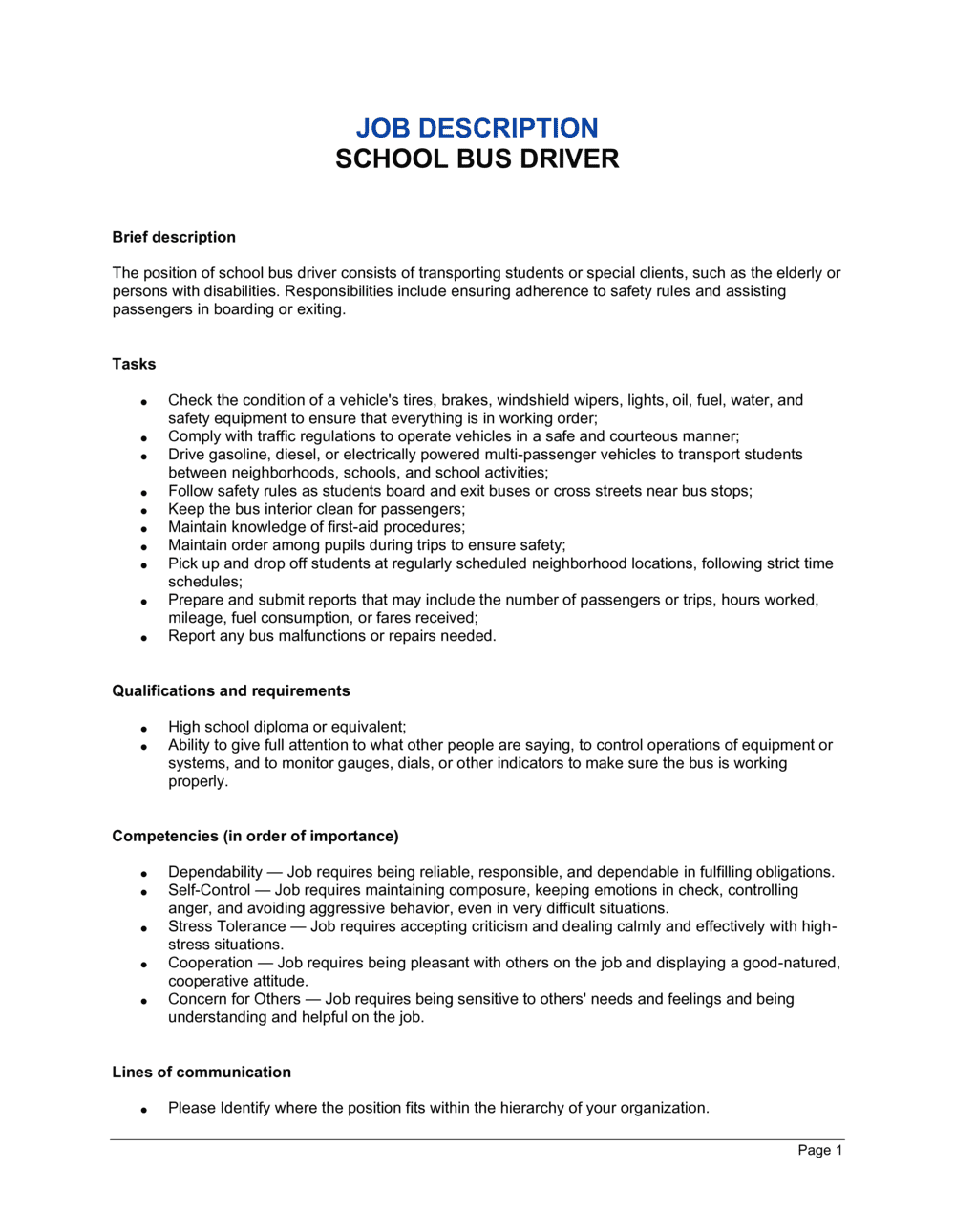
A Bus Driver School Job Description is a formal employment document that defines the duties, qualifications, licensing requirements, safety obligations, and compensation terms for a school bus driver role. This free Word download gives school districts, charter schools, and transportation contractors a structured, legally grounded starting point they can edit online and export as PDF for posting, onboarding, or personnel file retention.
When you need it
Use it when recruiting a new school bus driver, replacing an existing position, restructuring transportation department roles, or updating outdated descriptions to reflect current CDL, background check, and safety compliance requirements.
What's inside
Position title and reporting structure, summary of role purpose, detailed daily duties and responsibilities, required and preferred qualifications, licensing and certification requirements including CDL and passenger endorsements, physical demands, safety and conduct standards, and compensation and benefits overview.

What is a Bus Driver School Job Description?

A Bus Driver School Job Description is a formal employment document that defines the full scope of duties, qualifications, licensing requirements, safety obligations, physical demands, and compensation terms for a school bus driver position. Unlike a generic driver posting, this document is structured to address the specific legal and regulatory environment surrounding the transport of minors — including CDL endorsement requirements, pre-employment drug and background screening conditions, post-trip child-check obligations, and student conduct management responsibilities. When signed by both the employer and the new hire, it becomes part of the personnel record and can be introduced as evidence of the expected standard of care in negligence, disciplinary, or termination proceedings.

Why You Need This Document

Operating a school bus route without a documented, signed job description exposes a district or transportation contractor to compounding risks. If a driver is involved in a student injury incident and no written safety obligations exist in their file, establishing the standard of care the employer imposed becomes far harder in litigation. If a driver is terminated for failing to perform a post-trip sweep and no such duty was ever documented, the termination becomes legally contestable. Hiring without clearly stating CDL endorsement and background check requirements as conditions of employment creates both a compliance gap and a wrongful-offer-rescission risk when unqualified candidates are screened out after accepting. A well-drafted, jurisdiction-specific school bus driver job description eliminates these gaps before the driver ever turns a key — and this template gives you the structure to do it in under 30 minutes.

Which variant fits your situation?

If your situation is…Use this template
Hiring a full-time permanent school bus driver for a district routeBus Driver School Job Description
Engaging a substitute or on-call bus driver for occasional coverageSubstitute Bus Driver Job Description
Hiring a driver for charter or activity trips onlyCharter Bus Driver Job Description
Recruiting a driver-trainer responsible for certifying new hiresTransportation Trainer Job Description
Documenting terms of a full employment relationship post-hireEmployment Contract
Engaging an independent contractor driver rather than an employeeIndependent Contractor Agreement
Creating a combined offer letter and role summary for a new hireJob Offer Letter

Common mistakes to avoid

❌ Omitting CDL endorsement specifics

Why it matters: A candidate with a Class B CDL but no P or S endorsement cannot legally operate a school bus, yet will pass a basic CDL requirement screen. Pulling an unqualified driver from routes mid-week disrupts service and restarts hiring.

Fix: List the exact endorsements required — Class B or C CDL with Passenger (P) and School Bus (S) endorsements — and confirm them at the application screening stage before scheduling an interview.

❌ No post-trip child-check requirement in the duties list

Why it matters: The absence of a documented post-trip sweep obligation has contributed to children being left on buses. It also removes a key layer of employer legal defense in negligence claims.

Fix: Add an explicit post-trip inspection duty requiring the driver to walk the full length of the bus, check all seats including rear seats, and sign a daily post-trip log before locking the vehicle.

❌ Issuing a contingent offer without the screening conditions in writing

Why it matters: Revoking an offer after background or drug-test results come in — without written contingency language in the offer or job description — creates wrongful-termination or promissory-estoppel claims in several states.

Fix: State in the job description and offer letter that all offers are conditional on passing background, drug, and driving-record checks, and obtain the candidate's written acknowledgment before screening begins.

❌ No mention of split-shift structure in the schedule section

Why it matters: Candidates who discover the role is a 2–3 hour AM run and a 2–3 hour PM run with unpaid time in between frequently resign within 30 days. Each resignation restarts a 4–6 week CDL verification and background check process.

Fix: State the exact shift hours — for example, '6:30–9:00 AM and 2:30–5:00 PM' — and clarify whether between-run time is paid or unpaid before the candidate accepts the offer.

❌ Copying a generic driver description without school-specific safety obligations

Why it matters: A commercial delivery-driver job description adapted for school use omits student boarding procedures, IEP accommodation duties, emergency evacuation protocols, and mandatory incident-reporting timelines — creating compliance gaps.

Fix: Use a school-specific template and confirm the duties section covers: student conduct management, IEP and special-needs accommodation awareness, emergency evacuation drills, and mandatory reporting to school administration.

❌ Failing to update the description when licensing laws change

Why it matters: Several states have tightened CDL medical, background, and drug-testing standards since 2020. An outdated description may specify a lower standard than current law requires, creating liability if a driver is hired under the old criteria.

Fix: Set a calendar reminder to review and reissue the job description annually, cross-referencing current FMCSA rules, your state's DOT website, and any updates from your state's Department of Education.

The 9 key clauses, explained

Position title and reporting structure

In plain language: States the official job title, the department it belongs to, and the supervisor or manager the driver reports to directly.

Sample language
Position: School Bus Driver | Department: Transportation | Reports to: Director of Transportation / Fleet Manager | Classification: [Full-Time / Part-Time / Seasonal]

Common mistake: Listing an informal title like 'bus driver' instead of the official payroll classification — this creates a mismatch between the job description, offer letter, and personnel file that complicates workers' comp and unemployment claims.

Role summary and purpose

In plain language: A two-to-four sentence paragraph explaining the core purpose of the role — safe student transport — and the scope of responsibility.

Sample language
The School Bus Driver is responsible for the safe, timely, and courteous transportation of [SCHOOL/DISTRICT NAME] students along assigned routes. The Driver ensures compliance with all applicable federal, state, and local transportation laws and district safety policies at all times.

Common mistake: Writing a vague summary that omits the student-safety obligation. In a negligence claim, the absence of an explicit safety mandate in the job description weakens the employer's argument that safety was a primary duty.

Core duties and daily responsibilities

In plain language: A numbered or bulleted list of the specific tasks the driver performs each day — route driving, pre-trip inspection, student boarding and deboarding, incident reporting, and communication with dispatch.

Sample language
Duties include: (1) Operating a [TYPE] school bus over assigned routes on a published schedule; (2) Conducting pre-trip and post-trip vehicle inspections per [STATE] DOT standards; (3) Enforcing student conduct rules and reporting behavioral incidents to [SUPERVISOR]; (4) Completing all required logs, mileage records, and incident reports by end of shift.

Common mistake: Omitting post-trip inspection duties, including the child check procedure. Failure to document this obligation has contributed to tragedy — and to employer liability — in cases where a student was left on a bus.

Licensing and certification requirements

In plain language: Lists the specific licenses, endorsements, and certifications the candidate must hold or obtain before driving — CDL class, P and S endorsements, DOT physical, and any state-specific school bus certificate.

Sample language
Required: Valid Class [B/C] CDL with Passenger (P) and School Bus (S) endorsements; current DOT medical certificate; [STATE] school bus driver certificate; First Aid/CPR certification within [X] months of hire.

Common mistake: Listing a CDL without specifying the required endorsements — many CDL holders do not carry P and S endorsements, leading to unqualified hires who must be pulled from routes pending additional testing.

Background check and drug testing requirements

In plain language: States the mandatory pre-employment background check, sex offender registry search, and DOT drug and alcohol screening, and references the applicable federal and state mandates.

Sample language
All offers of employment are contingent upon successful completion of: (a) a criminal background check per [STATE EDUCATION CODE SECTION]; (b) a sex offender registry check; (c) a pre-employment DOT drug and alcohol screen per 49 CFR Part 382; and (d) a review of the applicant's DMV driving record for the preceding [3/5/7] years.

Common mistake: Failing to state that the offer is contingent on these checks. If screening language is absent or added after an offer is accepted, revoking an offer on background-check grounds creates wrongful-termination exposure in some states.

Physical demands and working conditions

In plain language: Describes the physical requirements of the role — seated driving for extended periods, lifting wheelchair-bound or special-needs students, exposure to weather — and any ADA-relevant accommodations language.

Sample language
Physical requirements include: ability to sit and operate a motor vehicle for up to [X] hours per shift; lift and secure mobility devices weighing up to [X] lbs; work in outdoor temperatures ranging from [X°F] to [X°F]; climb and descend bus steps repeatedly during loading and unloading.

Common mistake: Omitting specific weight or environmental thresholds. Vague physical requirements make it harder to apply a consistent ADA interactive-process analysis when a candidate requests accommodation.

Safety, conduct, and compliance standards

In plain language: States the behavioral and conduct expectations — zero tolerance for mobile device use while driving, alcohol and drug policy, student interaction standards, and mandatory incident reporting obligations.

Sample language
Driver shall: comply with all district safety policies and applicable traffic laws at all times; refrain from any use of a mobile device while the vehicle is in motion; report any accident, student injury, or vehicle defect to dispatch within [X] minutes; maintain professional conduct toward students, parents, and school staff.

Common mistake: Referencing a separate 'Employee Handbook' for conduct standards without incorporating the key obligations by reference in the job description itself — leaving the description silent on the standards most relevant to discipline and termination.

Compensation, schedule, and benefits

In plain language: States the pay rate or range, pay frequency, typical shift hours (split-shift is common for school routes), and eligibility for benefits — health, pension, or paid leave.

Sample language
Compensation: $[X.XX]–$[X.XX] per hour, commensurate with experience. Schedule: Typical split shift, [AM hours] and [PM hours], approximately [X] hours per day. Benefits: Eligible for [health/dental/vision], [pension/retirement contribution], and [X] days paid leave per year after [X] months of service.

Common mistake: Stating a salary without noting the split-shift structure. Candidates who discover the role is a split shift after accepting an offer frequently resign within 30 days, restarting the hiring and certification process.

Equal opportunity and accommodation statement

In plain language: A required EEO statement affirming the employer does not discriminate on protected characteristics and will provide reasonable accommodations to qualified applicants with disabilities.

Sample language
[EMPLOYER NAME] is an equal opportunity employer. We do not discriminate on the basis of race, color, religion, sex, national origin, age, disability, or any other characteristic protected by applicable law. Qualified applicants requiring reasonable accommodation should contact [HR CONTACT / EMAIL].

Common mistake: Omitting the accommodation contact method. A boilerplate EEO statement without an actionable accommodation process leaves the employer non-compliant with ADA Title I interactive-process obligations.

How to fill it out

  1. 1

    Insert the employer's legal name and department

    Replace all [EMPLOYER NAME] and [DISTRICT NAME] placeholders with the full registered legal name of the school district, charter school, or transportation contractor. Confirm the name matches payroll records.

    💡 Use the exact name on your workers' compensation policy — a mismatch can complicate claims if a driver is injured on the job.

  2. 2

    Confirm the applicable CDL class and endorsements

    Identify whether your buses require a Class B or Class C CDL based on GVWR, and confirm your state requires both P and S endorsements for school bus routes. Update the licensing clause accordingly.

    💡 Check your state's Department of Motor Vehicles and Department of Education websites — CDL class and endorsement requirements vary by state and bus weight class.

  3. 3

    Set the background check and screening conditions

    Enter the specific state education code section that mandates background checks for school bus drivers. Note the lookback period for DMV records — typically 3, 5, or 7 years depending on your state.

    💡 Some states require fingerprint-based background checks through a specific state agency — reference that agency by name so HR and candidates know exactly which process to follow.

  4. 4

    Specify the physical demands with numeric thresholds

    Enter the maximum lift weight for mobility devices, the expected hours of seated driving per shift, and the environmental conditions drivers will encounter — temperature ranges, outdoor exposure, and similar factors.

    💡 Consult your occupational health provider or district safety officer for the correct weight thresholds before finalizing — underestimating physical demands can expose you to ADA accommodation claims.

  5. 5

    Enter the compensation range and shift structure

    Input the hourly wage range, shift hours for both AM and PM runs, and total daily hours. Note whether the role is paid for time between runs or only active driving time — this distinction affects overtime calculations.

    💡 In many states, pay for 'waiting time' between split-shift runs is legally required if the driver cannot meaningfully leave the worksite. Confirm with a labor attorney or HR consultant before finalizing.

  6. 6

    Reference the applicable conduct policies by document title

    In the safety and conduct clause, name the specific district policy manual or employee handbook section — e.g., 'Transportation Department Policy Manual, Section 4.3' — rather than using a generic reference.

    💡 Document version and date references matter in disciplinary hearings. A vague 'as per policy' language allows employees to argue they were not on notice of a specific rule.

  7. 7

    Add the EEO contact and accommodation process

    Insert the HR director's name, email address, and phone number in the equal opportunity clause so candidates know exactly who to contact for accommodation requests.

    💡 Update this contact annually — a named HR contact who has left the organization and is no longer reachable is an ADA compliance risk.

  8. 8

    Have both parties sign and retain a copy

    Obtain the hiring manager's signature and the hired driver's signature on the finalized description, and retain a copy in the driver's personnel file alongside the offer letter and employment contract.

    💡 File the signed job description before the driver's first operating day — post-start-date signatures create consideration problems for any restrictive obligations embedded in the document.

Frequently asked questions

What is a school bus driver job description?

A school bus driver job description is a formal employment document that defines the duties, qualifications, licensing requirements, safety obligations, physical demands, and compensation for a school bus driver role. It is used by school districts, charter schools, and transportation contractors to recruit qualified candidates, establish enforceable performance standards, and create a documented baseline for discipline and termination decisions.

What qualifications should a school bus driver job description require?

At minimum, the description should require a valid CDL with Passenger (P) and School Bus (S) endorsements, a current DOT medical certificate, a clean driving record for the preceding three to seven years, a passed pre-employment drug and alcohol screen under 49 CFR Part 382, and a cleared criminal background and sex offender registry check. Many states add a state-specific school bus driver certificate and first-aid or CPR certification as mandatory requirements.

Is a school bus driver job description a legally binding document?

A job description is not typically a standalone employment contract, but when signed by both the employer and employee, it becomes part of the employment record and can be introduced as evidence in disciplinary, termination, or negligence proceedings. Obligations stated in the description — particularly safety duties and conduct standards — are generally enforceable and can establish the standard of care expected of the driver.

What CDL class and endorsements does a school bus driver need?

Most school buses require a Class B CDL with both the Passenger (P) and School Bus (S) endorsements. Smaller buses under 26,001 lbs GVWR carrying fewer than 16 passengers may fall under a Class C CDL requirement, depending on the state. Always confirm the required class and endorsements with your state's DMV and Department of Education, as requirements vary and are updated periodically.

Does a school bus driver job description need to mention drug testing?

Yes. Under FMCSA regulations at 49 CFR Part 382, all CDL holders in safety-sensitive functions — including school bus drivers — must pass a pre-employment DOT drug and alcohol test. The job description should state this requirement explicitly and note that the offer is contingent on a passed screen. Omitting it does not eliminate the legal obligation, but it does create a disclosure gap that complicates rescinding offers when screens come back positive.

What physical requirements are typical for a school bus driver role?

Typical physical requirements include the ability to sit and operate a vehicle for up to four hours per day in split shifts, lift and secure mobility devices or wheelchair equipment weighing up to 50 lbs, climb and descend bus steps repeatedly during boarding and deboarding, and work in outdoor temperatures across seasonal extremes. The DOT physical examination also imposes minimum vision, hearing, and cardiovascular standards that candidates must meet before receiving a medical certificate.

How often should a school bus driver job description be updated?

Review the description annually, at minimum. Key triggers for an earlier update include changes to FMCSA CDL or drug-testing regulations, updates to your state's school bus driver certification requirements, changes in your fleet (new bus weights or accessibility equipment), and any district policy revisions to safety or conduct standards. An outdated description that reflects lower standards than current law can create liability if a driver is hired or retained under the older criteria.

Should the job description reference an employee handbook?

Yes — but by specific title and section number, not as a generic reference. Citing 'Transportation Department Policy Manual, Section 4.3, revised January 2026' creates a clear paper trail for disciplinary proceedings. A vague 'as per company policy' reference allows employees to argue they were not on notice of a specific rule, weakening the employer's position in arbitration or unemployment hearings.

What is the difference between a school bus driver job description and an employment contract?

A job description defines the role's duties, qualifications, and performance standards. An employment contract governs the legal relationship — compensation, benefits, termination notice, severance, IP, and confidentiality. Both documents should be executed before the driver's first day, but they serve different purposes. Relying solely on a job description without a formal employment contract leaves termination notice obligations, severance, and restrictive covenants undefined — typically resolved by jurisdiction-specific statutory defaults.

How this compares to alternatives

vs Employment Contract

A job description defines role duties, qualifications, and performance expectations. An employment contract governs the full legal relationship — compensation, termination notice, severance, and restrictive covenants. A school bus driver needs both: the description establishes the standard of care and safety obligations; the contract enforces the terms of engagement. Using one without the other leaves material gaps.

vs Job Offer Letter

An offer letter confirms the role, start date, and compensation to secure the candidate's acceptance. A job description is the supporting document that details the full scope of duties and qualifications. The offer letter triggers the agreement; the job description governs what the driver is actually expected to do and can be admitted as evidence of the standard of care owed to students.

vs Independent Contractor Agreement

An independent contractor agreement engages a self-employed driver with no employment entitlements. For school bus drivers, misclassification is high-risk — the degree of control exercised over route timing, conduct with students, and safety protocols almost always satisfies the employee test under IRS and state labor standards. A job description with a signed employment contract is the appropriate framework for the vast majority of school driver arrangements.

vs General Bus Driver Job Description

A general commercial bus driver description covers adult passenger transport — charter, transit, or intercity — without the student-specific obligations that define a school route. It typically omits IEP accommodation duties, child-check post-trip requirements, mandatory reporting to school administration, and the School Bus (S) endorsement requirement. Using a general description for a school role creates material compliance and liability gaps.

Industry-specific considerations

K–12 Public Education

State education agency certification mandates, IEP accommodation duties, and district-wide conduct policies must all be incorporated by reference into the description.

Private and Charter Schools

Private schools often contract transportation externally, meaning the job description must align with both the school's conduct standards and the contractor's employment terms.

Transportation and Logistics

Third-party school bus contractors must comply with FMCSA CDL rules, DOT drug-testing programs, and school district conduct requirements simultaneously — the description must reflect all three layers.

Nonprofit and Community Organizations

Nonprofits operating after-school or community transport programs on school routes are often subject to the same CDL and background check requirements as public districts, even when funded privately.

Jurisdictional notes

United States

FMCSA regulations under 49 CFR Part 383 govern CDL standards nationally, and 49 CFR Part 382 mandates DOT drug and alcohol testing for all safety-sensitive CDL functions. State education agencies layer additional requirements — background check statutes, state bus driver certificates, and minimum age rules — that vary significantly. California, Texas, Florida, and New York each maintain their own school bus driver certification programs that must be reflected in any job description issued in those states.

Canada

School bus driver licensing in Canada is provincially regulated. Ontario requires a Class B or E licence with a School Purposes Bus (S) condition; British Columbia requires a Class 2 licence with a School Bus designation. Background check requirements for anyone working with children are set under provincial child welfare statutes and vary by province. Quebec employers must issue the job description in French for provincially regulated workplaces under the Charter of the French Language.

United Kingdom

UK school bus drivers require a Driver Certificate of Professional Competence (CPC) and a Passenger Carrying Vehicle (PCV) licence category D. Drivers transporting children must pass an enhanced Disclosure and Barring Service (DBS) check under the Safeguarding Vulnerable Groups Act 2006. The written statement of employment particulars must be provided on or before the first day of work. Employers must also comply with the Working Time Regulations 1998 regarding maximum driving hours.

European Union

EU school bus drivers must hold a Category D driving licence and comply with the Driver CPC Directive (2003/59/EC), requiring 35 hours of periodic training every five years. Child protection background check requirements are set by each member state — Germany, France, and the Netherlands each maintain their own criminal records clearance processes for roles involving minors. The EU Transparent and Predictable Working Conditions Directive requires written employment terms within seven days of the start date.

Template vs lawyer — what fits your deal?

PathBest forCostTime
Use the templateSchool districts and transportation contractors hiring standard full-time school bus drivers in a single US state or Canadian provinceFree20–30 minutes
Template + legal reviewDistricts operating in states with complex CDL or background check laws, contractors serving multiple jurisdictions, or employers with special-needs transport routes$200–$500 for an HR consultant or employment attorney review1–3 days
Custom draftedLarge district fleet operations, cross-state transportation contractors, or organizations subject to federal contractor equal employment obligations$800–$2,500+1–2 weeks

Glossary

CDL (Commercial Driver's License)
A federally required license in the US and equivalent in other jurisdictions permitting the holder to operate a vehicle over 26,001 lbs or carrying 16 or more passengers.
Passenger (P) Endorsement
An additional CDL endorsement required to transport passengers for hire or in organized group travel, including school routes.
School Bus (S) Endorsement
A CDL endorsement specific to operating a school bus that carries pre-K through grade 12 students, requiring additional testing on student safety procedures.
DOT Physical
A medical examination required by the US Department of Transportation to certify that a commercial driver is physically qualified to safely operate a commercial vehicle.
Pre-Employment Drug and Alcohol Screening
Federally mandated testing under 49 CFR Part 382 that all CDL holders must pass before operating a school bus or commercial vehicle in a safety-sensitive function.
Background Check
A review of criminal history, sex offender registry, and prior driving record required for anyone transporting minors, typically mandated by state education law.
Safety-Sensitive Function
Any duty directly related to the safe operation of a commercial vehicle — driving, pre-trip inspection, fueling — that triggers DOT drug and alcohol testing obligations.
Pre-Trip Inspection
A mandatory daily check of vehicle systems — brakes, lights, tires, mirrors, emergency exits, and first-aid equipment — that the driver must complete and document before operating the bus.
IEP Accommodation
A requirement under an Individualized Education Program for a student with disabilities that may affect how a driver boards, secures, or communicates with that student on the route.
At-Will Employment
Employment that either party may end at any time for any lawful reason — common in US states — which must be stated explicitly in the job description or accompanying contract to be enforceable.
FMCSA
The Federal Motor Carrier Safety Administration, the US agency that sets CDL, drug testing, and hours-of-service rules governing commercial vehicle operators including school bus drivers.

Part of your Business Operating System

This document is one of 3,000+ business & legal templates included in Business in a Box.

  • Fill-in-the-blanks — ready in minutes
  • 100% customizable Word document
  • Compatible with all office suites
  • Export to PDF and share electronically

Create your document in 3 simple steps.

From template to signed document — all inside one Business Operating System.
1
Download or open template

Access over 3,000+ business and legal templates for any business task, project or initiative.

2
Edit and fill in the blanks with AI

Customize your ready-made business document template and save it in the cloud.

3
Save, Share, Send, Sign

Share your files and folders with your team. Create a space of seamless collaboration.

Save time, save money, and create top-quality documents.

★★★★★

"Fantastic value! I'm not sure how I'd do without it. It's worth its weight in gold and paid back for itself many times."

Managing Director · Mall Farm
Robert Whalley
Managing Director, Mall Farm Proprietary Limited
★★★★★

"I have been using Business in a Box for years. It has been the most useful source of templates I have encountered. I recommend it to anyone."

Business Owner · 4+ years
Dr Michael John Freestone
Business Owner
★★★★★

"It has been a life saver so many times I have lost count. Business in a Box has saved me so much time and as you know, time is money."

Owner · Upstate Web
David G. Moore Jr.
Owner, Upstate Web

Run your business with a system — not scattered tools

Stop downloading documents. Start operating with clarity. Business in a Box gives you the Business Operating System used by over 250,000 companies worldwide to structure, run, and grow their business.

Free Forever Plan · No credit card required