Bus Driver_Transit and Intercity Job Description Template

Free Word download • Edit online • Save & share with Drive • Export to PDF

2 pages20–30 min to fillDifficulty: StandardSignature requiredLegal review recommended
Learn more ↓
FreeBus Driver_Transit and Intercity Job Description Template

At a glance

What it is
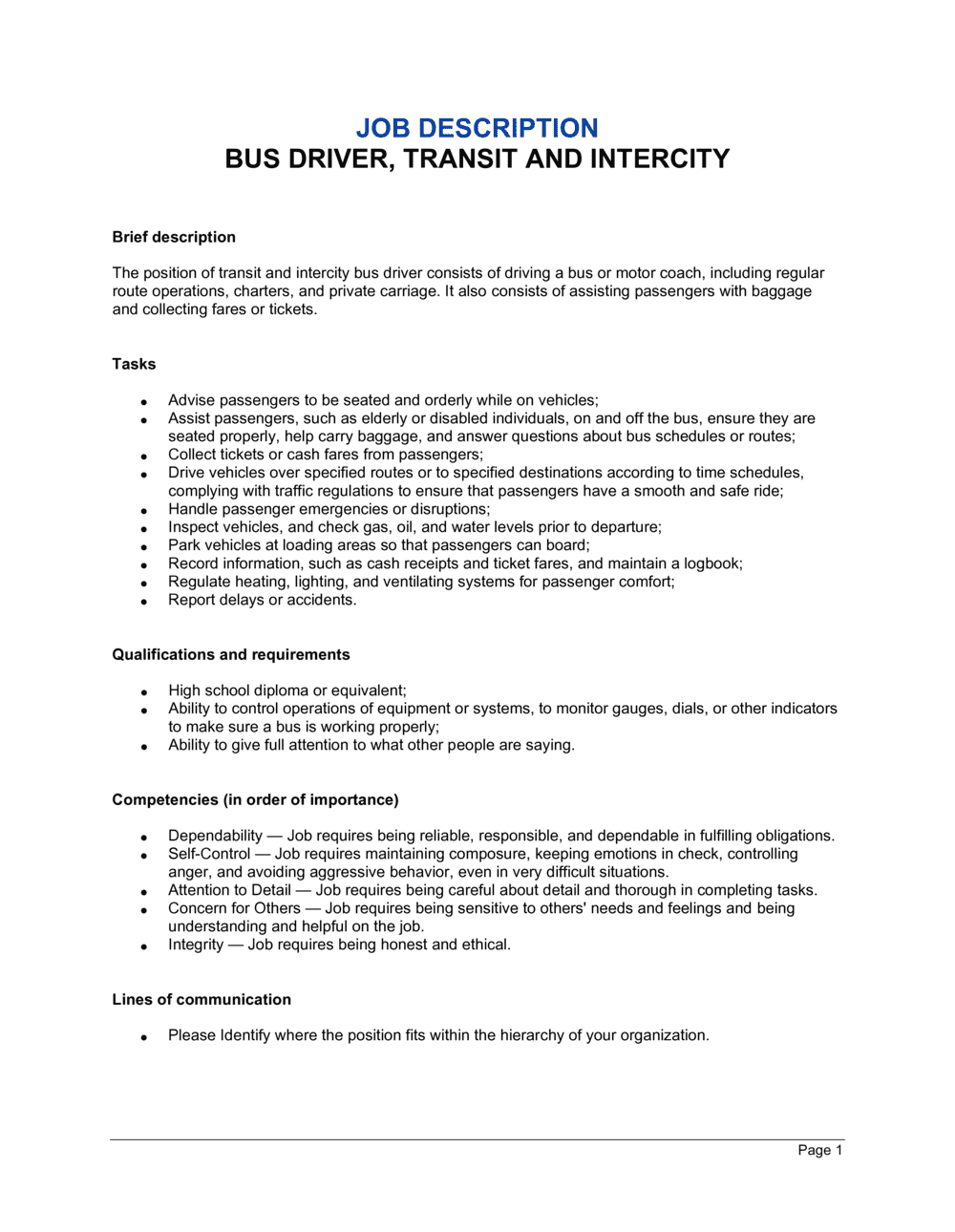
A Bus Driver Transit and Intercity Job Description is a legally structured employment document that defines the role, responsibilities, qualifications, licensing requirements, and performance expectations for bus drivers operating fixed-route transit or intercity coach services. This free Word download gives transportation employers a ready-to-edit template covering CDL requirements, safety protocols, scheduling obligations, and passenger service standards — exportable as PDF for use in hiring, onboarding, and HR compliance.
When you need it
Use it when recruiting a new transit or intercity bus driver, updating an existing role to reflect regulatory changes, or standardizing role definitions across a fleet operation. It is also required when integrating the position into a union agreement or responding to a labor audit.
What's inside
Position summary, reporting structure, essential duties and responsibilities, CDL and endorsement requirements, physical and medical standards, scheduling and hours-of-service obligations, safety and compliance clauses, and performance expectations. The document also includes passenger interaction standards and grounds for disciplinary action.

What is a Bus Driver Transit and Intercity Job Description?

A Bus Driver Transit and Intercity Job Description is a formally structured employment document that defines the duties, qualifications, legal compliance obligations, and performance standards for drivers operating fixed-route transit systems or scheduled intercity coach services. It specifies the required CDL class and endorsements, DOT medical certificate standards, federal hours-of-service limits, drug and alcohol testing obligations under FMCSA regulations, ADA passenger service requirements, and the grounds for disciplinary action. Unlike a general job posting, this document functions as a binding reference point for onboarding, performance management, labor audits, and regulatory inspections — and its signed acknowledgment block creates a documented record that the employer's expectations were communicated before the driver operated a vehicle.

Why You Need This Document

Operating without a formally documented job description exposes transit and motorcoach employers to liability on multiple fronts simultaneously. FMCSA and DOT auditors expect to find documented role definitions that align with hours-of-service records, drug-testing logs, and CDL verification files — gaps between what drivers are doing and what they were told to do undermine your compliance posture. ADA complaints filed by passengers against transit operators frequently turn on whether the driver's accessibility duties were clearly defined and communicated; a vague or absent job description removes your first line of defense. In wrongful-dismissal and arbitration proceedings, the absence of a signed job description allows employees to challenge whether a disciplinary standard was ever established. This template gives transportation employers a compliant, immediately usable starting point that reflects real FMCSA, ADA, and CDL requirements — reducing both regulatory exposure and the time HR spends constructing role documentation from scratch each time a driver position opens.

Which variant fits your situation?

If your situation is…Use this template
Hiring a driver for a fixed urban transit routeTransit Bus Driver Job Description
Recruiting a long-haul or interstate coach driverIntercity Bus Driver Job Description
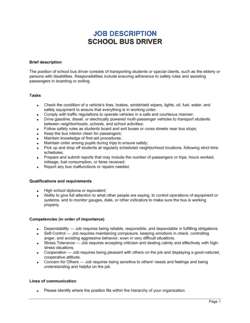
Documenting a school bus driver role with child-safety requirementsSchool Bus Driver Job Description
Hiring a driver-guide for tourism or charter servicesCharter Bus Driver Job Description
Onboarding a driver-trainer responsible for fleet safety instructionDriver Trainer Job Description
Defining a dispatcher role supporting bus operationsTransportation Dispatcher Job Description
Documenting a full-time CDL operator for a logistics or delivery fleetCommercial Driver Job Description

Common mistakes to avoid

❌ Omitting CDL endorsement specifics

Why it matters: A job description that lists 'valid CDL' without specifying the required class and endorsements can result in hiring a driver legally unqualified to operate the assigned vehicle — triggering FMCSA violations and insurance voids.

Fix: State the exact CDL class (A or B), all required endorsements (P, N, S as applicable), and the clean-MVR standard with a specific lookback period and violation threshold.

❌ Treating the job description as an employment contract

Why it matters: A signed job description without an at-will or collective-agreement disclaimer can be used by an employee to argue they were promised continued employment, converting at-will status into a just-cause termination requirement.

Fix: Include a clear disclaimer in the acknowledgment block stating the document does not create an employment contract and that employment is at-will or governed by a separate agreement.

❌ Using the freight HOS rule set for passenger carriers

Why it matters: Intercity bus drivers are subject to the 10-hour driving / 8-hour rest rule, not the 11/10 rule for property-carrying CMVs. Publishing the wrong limits creates a documented compliance gap that FMCSA inspectors can cite.

Fix: Confirm the applicable HOS rule set (49 CFR Part 395, passenger-carrying) before inserting hours limits, and reference the specific regulation in the scheduling clause.

❌ Skipping the FMCSA Drug and Alcohol Clearinghouse requirement

Why it matters: Federal law requires employers to query the Clearinghouse before a driver performs any safety-sensitive function. Omitting this step — and the obligation from the job description — exposes the employer to FMCSA penalties and negligent-hiring liability.

Fix: Add a clause requiring Clearinghouse pre-employment query and annual limited query, citing 49 CFR Part 382.701, and document each query in the driver's personnel file.

❌ Vague incident-reporting language

Why it matters: Language like 'report accidents promptly' does not create the specific post-accident testing window required by 49 CFR Part 382.303, which mandates testing within two hours of an accident (eight hours for alcohol).

Fix: State explicit reporting timelines — dispatch notification within 30 minutes, post-accident drug test within two hours, alcohol test within eight hours — to align with federal testing trigger rules.

❌ No progressive-discipline framework for performance violations

Why it matters: A job description that only lists termination-level offenses leaves the employer without a documented basis to discipline for first-time or moderate violations, increasing wrongful-dismissal exposure.

Fix: Include at least a brief progressive-discipline reference (verbal warning, written warning, suspension, termination) for performance and attendance issues, reserving immediate termination for safety-critical violations.

The 10 key clauses, explained

Position Summary and Reporting Structure

In plain language: Identifies the job title, the department or division the driver belongs to, and the supervisor they report to — establishing the chain of accountability.

Sample language
The [JOB TITLE] reports to the [SUPERVISOR TITLE] within the [DEPARTMENT/DIVISION] and is responsible for the safe, efficient, and courteous operation of [TRANSIT/INTERCITY] buses on assigned routes.

Common mistake: Listing only a job title with no reporting line. When a driver incident occurs, unclear accountability delays investigation and exposes the employer to negligent-supervision claims.

Essential Duties and Responsibilities

In plain language: Enumerates the specific operational tasks the driver must perform — route execution, passenger boarding, fare collection, schedule adherence, and incident reporting.

Sample language
Essential duties include: operating a [CLASS B/A] bus over assigned routes; collecting fares or verifying passes; assisting passengers with mobility devices; completing pre- and post-trip inspection reports; and reporting accidents, injuries, or route delays to dispatch within [X] minutes.

Common mistake: Using catch-all language like 'performs other duties as assigned' without listing the core tasks. ADA reasonable-accommodation analyses require a defined list of essential functions — a vague clause makes those assessments legally unreliable.

Licensing and Certification Requirements

In plain language: Specifies the minimum CDL class, required endorsements (Passenger, Air Brakes), and any state or provincial licensing additions required before the first shift.

Sample language
Candidate must hold a valid [STATE/PROVINCE] Class [A/B] Commercial Driver's License with Passenger (P) endorsement and Air Brakes (if applicable) at the time of hire. A clean Motor Vehicle Record with no more than [X] moving violations in the preceding [X] years is required.

Common mistake: Omitting the MVR standard. Hiring a driver with a disqualifying violation history without a documented MVR threshold exposes the employer to negligent hiring liability if an accident occurs.

Medical and Physical Standards

In plain language: Sets out the DOT physical examination requirement, the medical certificate renewal cycle, and the minimum physical capacities — lifting, vision, hearing — required to perform the role safely.

Sample language
Driver must maintain a current DOT Medical Examiner's Certificate (Form MCSA-5876), renewed every [24/12] months as required by FMCSA regulations. The role requires [X] lbs lifting capacity, corrected visual acuity of at least 20/40 in each eye, and ability to hear a forced whispered voice at 5 feet.

Common mistake: Setting physical standards without tying them to a specific essential function. Standards not linked to actual job requirements are vulnerable to ADA challenges as unnecessary qualifications.

Drug and Alcohol Testing Compliance

In plain language: Documents the employer's obligation to conduct pre-employment, random, post-accident, and reasonable-suspicion drug and alcohol testing, and the consequences of a positive result.

Sample language
As a safety-sensitive position under 49 CFR Part 382, [DRIVER TITLE] is subject to pre-employment, random, post-accident, and reasonable-suspicion drug and alcohol testing administered in accordance with [EMPLOYER] Drug and Alcohol Policy. A positive result or refusal to test is grounds for immediate removal from safety-sensitive duties.

Common mistake: Referencing a drug-testing policy without naming the specific regulation (49 CFR Part 382) that mandates it. Vague policy references make enforcement inconsistently defensible during DOT audits.

Hours-of-Service and Scheduling Obligations

In plain language: States the driver's standard shift structure, maximum driving hours per day and week under DOT HOS rules, on-call expectations, and overtime eligibility.

Sample language
Driver is scheduled for [SHIFT TYPE] shifts, [X] days per week. All operations must comply with FMCSA hours-of-service regulations, including a maximum of [10/11] hours of driving following [8/10] consecutive hours off duty. Overtime is paid at 1.5× the regular hourly rate for all hours worked beyond [40] per week, per applicable law.

Common mistake: Stating a shift schedule without referencing HOS limits. Drivers assigned overtime beyond federal limits are an unmanaged safety and regulatory liability — violations can result in out-of-service orders and fines.

Safety and Compliance Obligations

In plain language: Defines the driver's affirmative duties to follow traffic laws, employer safety policies, pre- and post-trip inspection requirements, and incident-reporting timelines.

Sample language
Driver shall conduct a pre-trip and post-trip vehicle inspection on each shift using [EMPLOYER]-approved forms, report all defects to maintenance before operating, comply with all applicable traffic laws and [EMPLOYER] safety policies, and report any accident, injury, passenger incident, or vehicle defect to dispatch within [30] minutes.

Common mistake: Omitting a specific incident-reporting timeline. 'Report promptly' is too vague — regulatory agencies and insurers require documented notification windows to process claims and investigations correctly.

Passenger Service and ADA Standards

In plain language: Sets behavioral expectations for passenger interactions — courtesy, wheelchair lift operation, priority seating enforcement — and ties them to the employer's ADA compliance obligations.

Sample language
Driver shall operate wheelchair lifts and ramps, announce stops as required by [ADA/49 CFR 37.167], enforce priority seating policies, and provide courteous, nondiscriminatory service to all passengers. Failure to operate accessibility equipment correctly is grounds for disciplinary action up to and including termination.

Common mistake: Treating ADA passenger-service duties as a soft courtesy standard rather than a binding legal obligation. ADA violations committed by drivers expose employers to federal complaints and civil suits that a vague 'be courteous' clause does not adequately address.

Performance Standards and Grounds for Discipline

In plain language: Lists measurable performance benchmarks — on-time rate, incident-free driving record, inspection completion rate — and identifies the behaviors that trigger progressive discipline or immediate termination.

Sample language
Driver is expected to maintain an on-time performance rate of at least [X]%, complete all required inspections, and operate without at-fault accidents. Grounds for immediate termination include: operating under the influence, abandoning a route without authorization, or providing false information on an accident report.

Common mistake: Listing only immediate-termination offenses without a progressive-discipline framework. Without defined disciplinary steps for lesser violations, employers face wrongful-dismissal claims when they terminate for a first-time moderate offense.

Acknowledgment and Signature Block

In plain language: Confirms that the employee has read, understood, and received a copy of the job description — creating a documented record that the employer's expectations were communicated before work began.

Sample language
I, [EMPLOYEE NAME], acknowledge that I have received, read, and understood this job description. I understand that this document does not constitute an employment contract and that my employment remains [at-will / subject to the terms of the applicable collective agreement]. Signature: _______________ Date: _______________

Common mistake: Omitting the at-will or union-agreement disclaimer from the acknowledgment block. Without it, a signed job description can be argued by the employee to constitute a guarantee of continued employment.

How to fill it out

  1. 1

    Enter the employer and position details

    Fill in the legal employer name, the specific job title (Transit Bus Driver, Intercity Coach Driver, etc.), the department, and the direct supervisor's title. Confirm the entity name matches your DOT operating authority registration.

    💡 Use the exact job title you will post on job boards — inconsistency between the job description and the posting complicates EEOC and DOT audit trails.

  2. 2

    Specify the CDL class, endorsements, and MVR standard

    Enter the required CDL class (A or B), all mandatory endorsements (P for passengers, N for air brakes if applicable), and the maximum number of moving violations or at-fault accidents permitted on the applicant's MVR.

    💡 Cross-reference your insurer's MVR standards before setting the threshold — your insurance policy may be stricter than the minimum DOT standard.

  3. 3

    Define the essential duties as a numbered list

    List every task a driver must perform on a typical shift: pre-trip inspection, route operation, fare or pass verification, wheelchair lift operation, incident reporting, and post-trip inspection. Separate essential from non-essential functions.

    💡 Keep essential functions to the tasks that, if removed, would fundamentally change the role. This list drives ADA reasonable-accommodation analysis.

  4. 4

    Set the DOT medical certificate requirement

    Specify the renewal cycle (24-month standard, or 12-month if the driver has a monitored medical condition) and the minimum physical standards for vision, hearing, and lifting capacity.

    💡 State that the offer of employment is contingent on a valid DOT medical certificate — this avoids onboarding a driver who then fails the physical.

  5. 5

    Insert the drug and alcohol testing clause with regulatory citations

    Reference 49 CFR Part 382 (FMCSA) for US drivers. List all testing trigger types: pre-employment, random, post-accident, reasonable suspicion, return-to-duty, and follow-up. Include the FMCSA Drug and Alcohol Clearinghouse query requirement.

    💡 The Clearinghouse query must occur before the first safety-sensitive function and annually thereafter — document this obligation explicitly so HR does not overlook it.

  6. 6

    Define the scheduling structure and HOS limits

    Enter the standard shift (day, split, swing, overnight), days per week, and the applicable HOS rule set (property-carrying or passenger-carrying). Note that intercity passenger carriers follow the 10-hour driving / 8-hour rest rule, not the 11/10 trucking rule.

    💡 Passenger-carrier HOS rules differ from freight rules — using the wrong limits in the job description creates confusion and potential compliance gaps.

  7. 7

    Complete the performance standards section

    Insert measurable benchmarks: on-time percentage, maximum preventable accidents per year, and inspection completion rate. Align these numbers with your existing performance-appraisal criteria.

    💡 Numbers you can't track consistently should not appear in the job description — unenforceable standards undermine the document's credibility in disciplinary proceedings.

  8. 8

    Obtain signature before the first shift

    Have the driver sign and date the acknowledgment block before their first day of operation. Provide them with a signed copy for their records and retain the original in their personnel file.

    💡 A signed job description is your first line of defense in a wrongful-dismissal claim — the absence of one is routinely exploited by claimants' attorneys.

Frequently asked questions

What is a bus driver transit and intercity job description?

A bus driver transit and intercity job description is a formal employment document that defines the role, responsibilities, qualifications, and legal compliance obligations for drivers operating scheduled transit or long-distance coach services. It specifies CDL requirements, DOT medical standards, hours-of-service limits, drug-testing obligations, ADA passenger service duties, and performance expectations. For transit employers, it also serves as a documented record of communicated expectations used in disciplinary proceedings and labor audits.

Is a job description a legally binding document?

A job description is generally not a standalone employment contract, but it creates enforceable obligations in several contexts. An employee who signs and acknowledges the document is bound by the duties and conduct standards it describes. Courts and arbitrators routinely use job descriptions as evidence in wrongful-dismissal, ADA accommodation, and wage-and-hour cases. Including a clear disclaimer that the document does not constitute an employment contract protects the employer's at-will rights where applicable.

What CDL class and endorsements are required for transit bus drivers?

Most transit and intercity bus drivers require a Class B CDL with a Passenger (P) endorsement at minimum. Drivers operating vehicles with air brakes must also hold the Air Brakes (N) endorsement or have it unrestricted on their license. Intercity operators running articulated coaches over 45 feet may require a Class A CDL in some states. Requirements vary by vehicle type, state, and employer policy, so always confirm with your state DMV and insurer.

Are bus drivers covered by DOT hours-of-service rules?

Yes. Bus drivers operating in interstate commerce or for transit systems subject to FMCSA jurisdiction are covered by the passenger-carrying hours-of-service rules under 49 CFR Part 395. These allow a maximum of 10 hours of driving after 8 consecutive hours off duty, with a 15-hour on-duty limit. These limits differ from the 11/10 rules that apply to freight drivers. Purely intrastate operations may be governed by state-specific HOS rules, which vary significantly.

What drug and alcohol testing is required for bus drivers?

Federal law under 49 CFR Part 382 requires CDL bus drivers in safety-sensitive positions to undergo pre-employment, random (minimum 10% of drivers annually for alcohol, 50% for drugs as of current rates), post-accident, reasonable-suspicion, return-to-duty, and follow-up testing. Employers must also query the FMCSA Drug and Alcohol Clearinghouse before hire and annually thereafter. State and provincial programs may impose additional requirements for publicly funded transit.

What ADA obligations apply to transit bus drivers?

Transit bus drivers are required to operate all accessibility equipment — wheelchair lifts, ramps, kneeling mechanisms — and must announce stops as required by 49 CFR 37.167. They must enforce priority seating policies and provide equal service to passengers with disabilities. Failure to meet these obligations exposes the employer to complaints filed with the FTA or DOJ, and civil litigation. The job description should frame these as binding legal duties, not soft customer-service guidelines.

Should a bus driver job description reference a collective bargaining agreement?

Yes, if the position is covered by a union contract. The job description should note that employment terms are governed by the applicable CBA and that the CBA controls in the event of any conflict. Omitting this reference can create confusion about which document governs discipline, scheduling, and wage rates. Many transit authorities use the job description as an operational supplement to the CBA rather than a standalone contract.

How often should a bus driver job description be updated?

Review the document at least annually and update it whenever federal or state regulations change — FMCSA hours-of-service updates, new ADA guidance, changes to CDL endorsement rules, or Clearinghouse requirement amendments. Update it immediately when the role materially changes (new route type, added vehicle class, new supervisor structure). Outdated job descriptions weaken disciplinary proceedings because employees can argue they were not informed of the changed expectation.

Does a bus driver job description need to be signed?

While no federal law mandates a signed job description, obtaining a signature is strongly recommended for transit and safety-sensitive roles. A signed acknowledgment creates a documented record that the driver received, read, and understood the duties and compliance requirements before their first shift. This record is critical in FMCSA audits, workers' compensation disputes, wrongful-dismissal claims, and ADA accommodation analyses. Execute the acknowledgment before day one of service.

How this compares to alternatives

vs Employment Contract

An employment contract is a binding bilateral agreement covering salary, benefits, IP, non-compete, and termination terms. A job description defines duties and performance standards but is not a contract of employment. Use a job description to document role expectations and a separate employment contract to establish legal obligations — they are complementary, not interchangeable.

vs Offer Letter

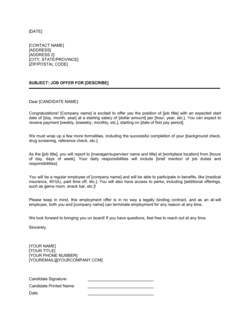
An offer letter communicates the terms of an employment offer — salary, start date, and reporting structure — to secure the candidate's acceptance. A job description details the day-to-day duties, qualifications, and compliance obligations of the role. The offer letter triggers acceptance; the job description governs ongoing performance expectations.

vs Driver Safety Policy

A driver safety policy is a company-wide document setting rules for all vehicle operators — fleet maintenance, accident reporting, and general road conduct. A bus driver job description is role-specific and covers CDL qualifications, HOS obligations, ADA duties, and passenger service standards for a named position. Both documents should be provided at onboarding and cross-referenced.

vs Independent Contractor Agreement

An independent contractor agreement engages a self-employed driver without employment entitlements — no benefits, no tax withholding, no FMCSA employer drug-testing obligation. Most transit and intercity bus operations legally require employee classification due to the level of operational control exercised. Misclassifying a transit driver as a contractor triggers DOT, IRS, and state labor penalties.

Industry-specific considerations

Public Transit Authorities

Municipally operated fleets require job descriptions that align with civil service classifications, union agreements, and FTA grant compliance documentation.

Private Motorcoach and Intercity Operators

Interstate coach operators must document FMCSA drug-testing, Clearinghouse queries, and HOS passenger-carrier compliance to maintain DOT operating authority.

School and Pupil Transportation

Adapting the transit template for school bus roles requires adding state-specific background check requirements, school bus (S) endorsement, and child-safety conduct standards.

Tourism and Charter Services

Charter operators need additional clauses covering multi-day trip scheduling, lodging policy during layovers, and tipping and gratuity handling consistent with IRS reporting obligations.

Jurisdictional notes

United States

Federal requirements under FMCSA (49 CFR Parts 382, 391, 395) govern CDL standards, drug and alcohol testing, medical certificates, and hours of service for interstate operators. The FMCSA Drug and Alcohol Clearinghouse query is mandatory before hire and annually. State intrastate HOS and CDL rules vary — California, Texas, and Florida each maintain additional requirements for transit operators. ADA obligations under 49 CFR Part 37 apply to any public transit service receiving federal funding.

Canada

Provincial transport ministries regulate commercial bus driver licensing — a Class 2 or equivalent licence is standard for transit and intercity operations. Transport Canada's National Safety Code Standard 9 governs hours of service, with passenger-carrier limits mirroring but not identical to FMCSA rules. Drug and alcohol testing is permissible for safety-sensitive roles but must comply with human rights legislation; blanket random testing programs have faced challenges under the Canadian Human Rights Act. Quebec operators must provide all employment documents in French.

United Kingdom

Bus drivers in the UK require a Category D licence (full-size bus) or D1 (minibus) issued by the DVLA, plus a Driver Certificate of Professional Competence (CPC) requiring 35 hours of periodic training every five years. The DVSA enforces driver hours under EC Regulation 561/2006, which sets a 9-hour daily driving limit extendable to 10 hours twice per week. Job descriptions must comply with the Equality Act 2010 when setting medical and physical standards. Post-Brexit, GB-specific tachograph and drivers' hours rules apply for domestic operations.

European Union

EU bus drivers must hold a Category D licence and a Driver CPC under Directive 2003/59/EC, requiring 35 hours of training every five years. EC Regulation 561/2006 governs driving and rest times for vehicles carrying more than nine passengers. GDPR applies to the collection and retention of driver medical, MVR, and drug-testing records — data minimization and defined retention periods must be documented. Member states may impose additional national requirements; Germany, France, and the Netherlands maintain supplementary driver qualification and rest-break rules.

Template vs lawyer — what fits your deal?

PathBest forCostTime
Use the templateSmall private operators, charter companies, and HR teams standardizing driver role documentation for non-union positionsFree30–45 minutes
Template + legal reviewTransit authorities integrating the description into a CBA, or operators in states with complex intrastate CDL or drug-testing rules$300–$700 for an employment or transportation attorney review2–5 business days
Custom draftedFTA-funded public transit systems, multi-state intercity operators, or employers subject to consent decrees or DOT corrective action plans$1,500–$4,000+2–4 weeks

Glossary

CDL (Commercial Driver's License)
A federally regulated license required in the US and Canada to operate vehicles over 26,001 pounds, or any vehicle carrying 16 or more passengers.
Passenger (P) Endorsement
An add-on to a CDL that authorizes the holder to transport 16 or more passengers, required for all transit and intercity bus drivers.
Hours of Service (HOS)
DOT-regulated limits on the number of hours a commercial driver may operate a vehicle before mandatory rest periods — typically 10 consecutive off-duty hours after 11 hours of driving.
Pre-Trip Inspection
A required safety check performed by the driver before each shift, covering brakes, tires, lights, fluid levels, and emergency equipment.
ADA Compliance
Legal obligations under the Americans with Disabilities Act requiring transit vehicles and operators to accommodate passengers with disabilities, including wheelchair lift operation and priority seating.
Drug and Alcohol Clearinghouse
A federally mandated database maintained by the FMCSA that records CDL holders' drug and alcohol program violations and must be queried before hiring.
Fixed-Route Service
A transit operation where buses run on a published schedule along a predetermined path with designated stops, as opposed to demand-responsive or charter service.
Intercity Service
Scheduled bus service connecting cities or regions, typically operating over longer distances than municipal transit and subject to interstate commerce regulations.
FMCSA (Federal Motor Carrier Safety Administration)
The US federal agency that regulates commercial motor vehicle safety, including hours-of-service rules, CDL standards, and drug-testing programs for bus operators.
Essential Functions
The core duties a position must perform, as defined under the ADA, used to determine whether a candidate can perform the job with or without reasonable accommodation.
Fitness for Duty
A determination that an employee meets the physical, cognitive, and medical standards required to safely perform their job — often verified through DOT medical examinations.

Part of your Business Operating System

This document is one of 3,000+ business & legal templates included in Business in a Box.

  • Fill-in-the-blanks — ready in minutes
  • 100% customizable Word document
  • Compatible with all office suites
  • Export to PDF and share electronically

Create your document in 3 simple steps.

From template to signed document — all inside one Business Operating System.
1
Download or open template

Access over 3,000+ business and legal templates for any business task, project or initiative.

2
Edit and fill in the blanks with AI

Customize your ready-made business document template and save it in the cloud.

3
Save, Share, Send, Sign

Share your files and folders with your team. Create a space of seamless collaboration.

Save time, save money, and create top-quality documents.

★★★★★

"Fantastic value! I'm not sure how I'd do without it. It's worth its weight in gold and paid back for itself many times."

Managing Director · Mall Farm
Robert Whalley
Managing Director, Mall Farm Proprietary Limited
★★★★★

"I have been using Business in a Box for years. It has been the most useful source of templates I have encountered. I recommend it to anyone."

Business Owner · 4+ years
Dr Michael John Freestone
Business Owner
★★★★★

"It has been a life saver so many times I have lost count. Business in a Box has saved me so much time and as you know, time is money."

Owner · Upstate Web
David G. Moore Jr.
Owner, Upstate Web

Run your business with a system — not scattered tools

Stop downloading documents. Start operating with clarity. Business in a Box gives you the Business Operating System used by over 250,000 companies worldwide to structure, run, and grow their business.

Free Forever Plan · No credit card required