1
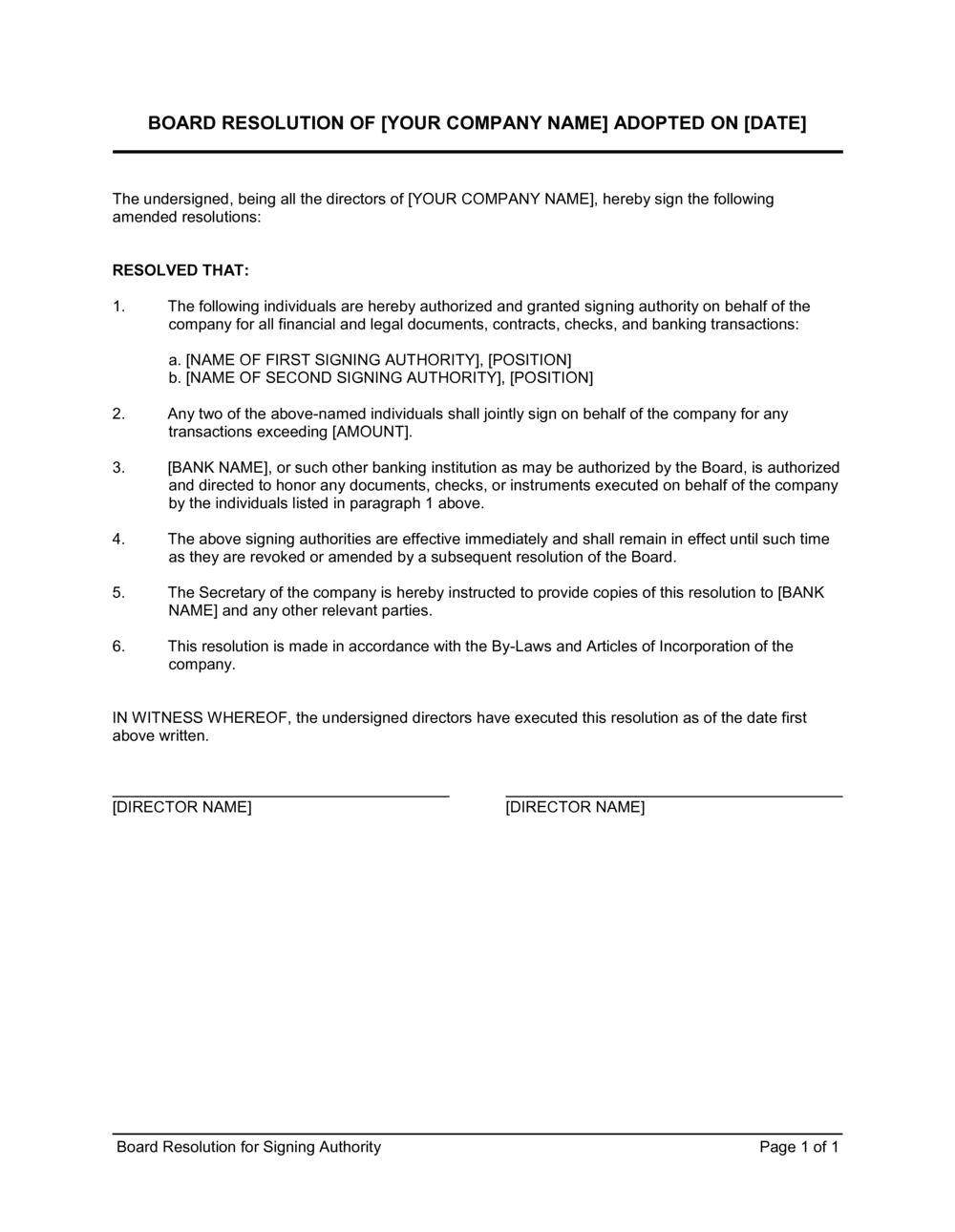
Enter the company's full legal name and jurisdiction
Insert the company's registered legal name exactly as it appears in the corporate registry, along with the jurisdiction of incorporation and entity type (e.g., Delaware corporation, Ontario limited company).
💡 Pull the name directly from a recent corporate registry certificate — even minor differences in punctuation or abbreviation can cause banks to reject the resolution.
2
Choose the method of board action
Decide whether the resolution is adopted at a formal board meeting (record the date, time, and location) or by unanimous written consent (all directors sign in lieu of a meeting). Both are valid in most jurisdictions; unanimous written consent is faster for small boards.
💡 Check your bylaws — some companies require a physical meeting for resolutions granting financial authority above a certain threshold.
3
Name each authorized signatory with their exact title
List each person's full legal name and current corporate title. For each signatory, specify whether they may sign alone or only with a co-signatory for transactions above a certain value.
💡 Include at least one alternate signatory so the company can act if the primary is unavailable. Name the alternate explicitly rather than relying on 'any officer.'
4
Define the scope and subject-matter limits
Specify which categories of documents the authority covers — contracts, banking instruments, government filings, real estate documents — and list any explicit exclusions such as equity issuances or constitutional amendments.
💡 Counterparties will read the scope section first to confirm it covers the specific document they need signed. Vague scopes generate follow-up requests and slow closings.
5
Set the dollar threshold
Enter the maximum transaction value one authorized signatory may execute alone. State the escalation requirement for transactions above that threshold — co-signature, CFO approval, or full board vote.
💡 Align the threshold with your existing internal delegation-of-authority policy. Inconsistency between the two creates audit findings and internal-control gaps.
6
Add banking-specific language if required
If the resolution will be used to open or operate bank accounts, insert the banking authorization clause. Contact your bank in advance — many have a specific required form or mandatory language that must appear verbatim.
💡 Request the bank's board resolution template before drafting. Some major banks will only accept their own form, not a third-party document.
7
Have the corporate secretary certify and directors sign
The corporate secretary completes the certification block confirming due adoption and quorum. Each director then signs the execution block. For a unanimous written resolution, collect all director signatures before distributing.
💡 Date each signature individually — not just the resolution header date. Some registries require that all signatures be dated within a defined window of the resolution date.
8
File in the minute book and distribute certified copies
Retain the original signed resolution in the corporate minute book. Provide certified copies (signed by the corporate secretary) to any bank, counterparty, or registry that requests proof of authority.
💡 Keep a log of which parties have received a copy. If authority is later revoked, you will need to notify each party that holds a copy.