General Power of Attorney Template

Free Word download β€’ Edit online β€’ Save & share with Drive β€’ Export to PDF

3 pagesβ€’25–30 min to fillβ€’Difficulty: Complexβ€’Signature requiredβ€’Legal review recommended
Learn more ↓
FreeGeneral Power of Attorney Template

At a glance

What it is
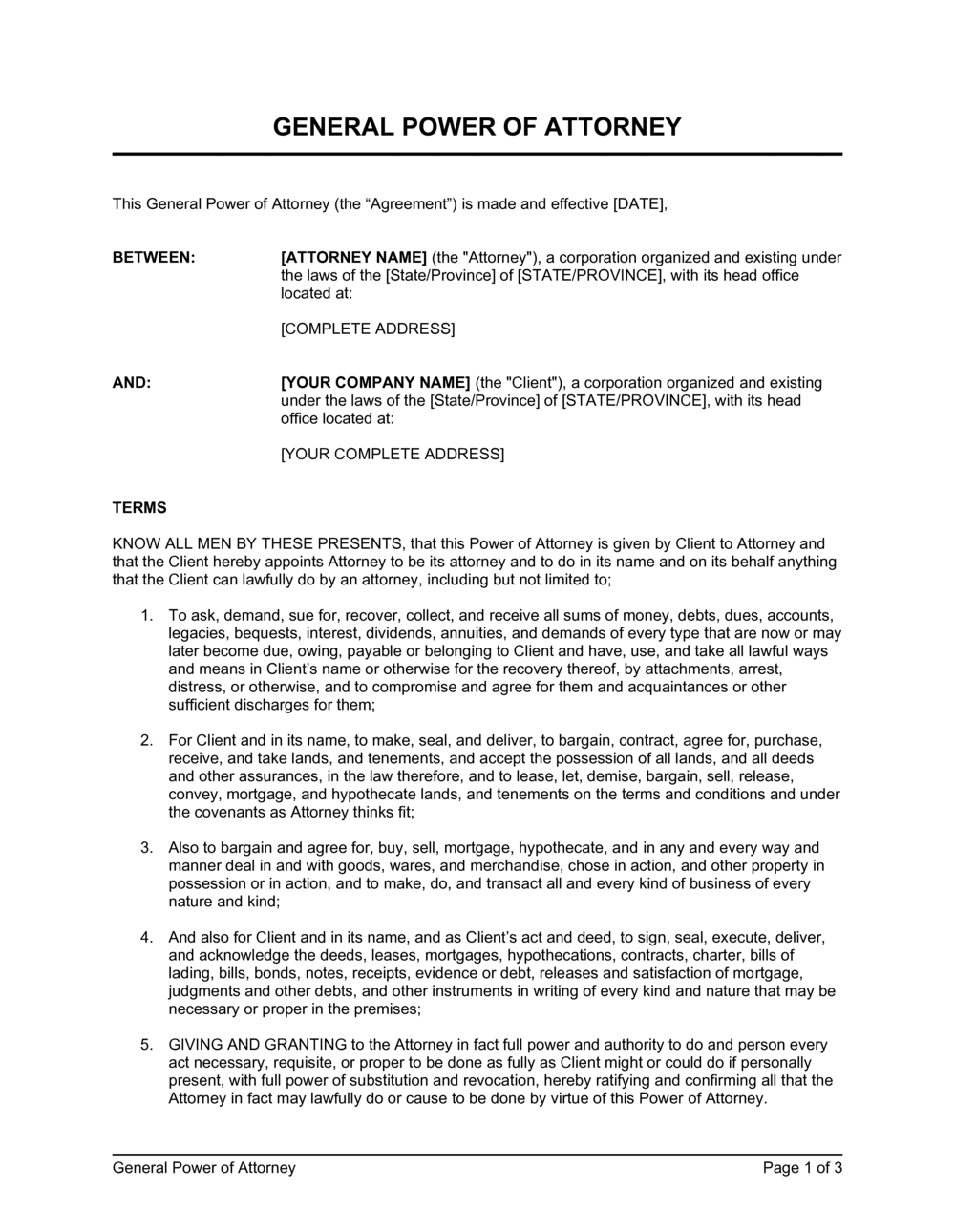
A General Power of Attorney is a legally binding document in which one person (the Principal) grants another person or entity (the Agent, also called Attorney-in-Fact) broad authority to act on their behalf in financial, business, legal, and property matters. This free Word download covers all standard grant-of-authority provisions and can be edited online and exported as PDF for notarization and filing.
When you need it
Use it when a business owner, executive, or individual needs to authorize another party to manage financial accounts, execute contracts, handle real estate transactions, or conduct business dealings during an absence, incapacity, or logistical constraint. It is also commonly used for international transactions where the Principal cannot be physically present to sign.
What's inside
Identification of Principal and Agent, a broad grant of authority covering financial and business matters, optional durability clause, effective date and termination conditions, Agent's acceptance and duties, revocation provisions, notarization block, and witness signature lines.

What is a General Power of Attorney?

A General Power of Attorney is a legally binding instrument in which a Principal grants a designated Agent (also called an Attorney-in-Fact) broad authority to act on their behalf across financial, legal, real estate, and business matters. Unlike a limited power of attorney β€” which restricts the Agent to a single transaction β€” a general POA covers a wide range of ongoing activities, from managing bank accounts and signing contracts to filing tax returns and handling real estate dealings. The document functions as a legal stand-in: third parties who deal with the Agent in good faith are entitled to treat the Agent's actions as the Principal's own, as long as the POA is properly executed and has not been revoked.

Why You Need This Document

Without a properly executed general power of attorney, no bank, government registry, or business counterpart is legally required to accept instructions from anyone other than the Principal β€” regardless of personal relationship or verbal authorization. That means a business owner who travels internationally without one cannot have a colleague sign an urgent contract on their behalf. An adult child cannot manage a parent's financial accounts during a medical crisis without court intervention, which can take months and cost thousands of dollars in legal fees. A real estate investor cannot close a time-sensitive transaction if they cannot be physically present. A general power of attorney eliminates all of these gaps in a single executed document β€” and when drafted with a durability clause, it remains in force precisely when the Principal needs it most. This template gives you a professionally structured starting point covering every critical clause, ready to be tailored to your circumstances and executed before a notary.

Which variant fits your situation?

If your situation is…Use this template
Authority must survive the Principal's incapacity or cognitive declineDurable Power of Attorney
Authority limited to a single real estate transactionLimited (Special) Power of Attorney
Authority limited to healthcare and medical decisions onlyMedical Power of Attorney
Granting authority only during a defined period or tripTemporary Power of Attorney
Corporate resolution granting signing authority to an officerCorporate Resolution
Agent must manage finances but not healthcare decisionsFinancial Power of Attorney
Authority required specifically for a vehicle title transferVehicle Power of Attorney

Common mistakes to avoid

❌ Vague grant of authority

Why it matters: A broad statement like 'all my affairs' without enumerated powers causes banks and registries to reject the document, leaving the Agent unable to act when it matters most.

Fix: List each category of authority explicitly β€” banking, real estate, taxes, business operations β€” using separate lettered sub-clauses so institutions can match the power to the action requested.

❌ Omitting the durability clause when long-term planning is the goal

Why it matters: Without durability language, the POA terminates automatically on the Principal's incapacity in most jurisdictions β€” precisely the moment it is most needed.

Fix: Include explicit durability language ('this POA shall not be affected by subsequent disability or incapacity') whenever the document is intended for estate planning or medical scenarios.

❌ Failing to execute before a notary and two witnesses

Why it matters: An improperly witnessed or unnotarized POA is rejected by virtually every bank, title company, and government registry β€” rendering it legally useless regardless of content.

Fix: Always execute the document in front of a licensed notary public and two disinterested adult witnesses, and confirm the jurisdiction's specific execution requirements before the signing appointment.

❌ Granting unlimited gifting authority to the Agent

Why it matters: Unlimited self-gifting authority has been used by Agents to transfer the Principal's entire estate to themselves β€” financial elder abuse frequently originates here.

Fix: Cap gifts to the Agent or Agent's relatives at the annual IRS gift-tax exclusion amount and add explicit language prohibiting gifts that exceed that cap without a separate written instrument.

❌ No named successor Agent

Why it matters: If the sole Agent dies, becomes incapacitated, or refuses to act, the POA becomes unexercisable β€” and obtaining a replacement may be impossible if the Principal has already lost capacity.

Fix: Name at least one successor Agent by full legal name in the document, and confirm their willingness to serve before execution.

❌ Delivering the POA to the Agent before it is needed

Why it matters: A General POA grants broad, immediate authority the moment it is in the Agent's hands. Early delivery creates a window for unauthorized use before the Principal intends the powers to activate.

Fix: Retain the executed original with a trusted third party β€” an attorney or bank vault β€” and deliver it to the Agent only when the triggering circumstances arise.

The 10 key clauses, explained

Identification of Principal and Agent

In plain language: States the full legal names, addresses, and relationship of both the Principal and the Agent β€” establishing who is granting authority and who is receiving it.

Sample language
I, [PRINCIPAL FULL LEGAL NAME], residing at [PRINCIPAL ADDRESS] ('Principal'), hereby appoint [AGENT FULL LEGAL NAME], residing at [AGENT ADDRESS] ('Agent' or 'Attorney-in-Fact'), to act on my behalf as set forth in this General Power of Attorney.

Common mistake: Using a nickname or trade name instead of the Principal's full legal name. Financial institutions and government offices match names exactly against identity documents; a mismatch causes the POA to be rejected.

Grant of Authority

In plain language: Lists the specific categories of actions the Agent is authorized to take β€” banking, investment management, real estate, business operations, tax filings, and contract execution.

Sample language
Agent is authorized to: (a) manage and transact on any financial account held by Principal; (b) buy, sell, lease, or encumber real property; (c) execute contracts on Principal's behalf; (d) file tax returns and represent Principal before tax authorities; and (e) operate and manage Principal's business interests.

Common mistake: Using a single vague sentence like 'to handle all my affairs' instead of enumerated powers. Many banks and registries refuse to honor a POA that does not specifically list the power being exercised.

Durability Clause

In plain language: States whether the power of attorney survives the Principal's incapacity β€” without this clause, most jurisdictions automatically terminate the POA if the Principal loses mental capacity.

Sample language
This Power of Attorney shall not be affected by subsequent disability or incapacity of the Principal. / This Power of Attorney is NOT durable and shall terminate immediately upon the Principal's incapacity.

Common mistake: Omitting the durability clause entirely and assuming the POA survives incapacity by default. In most US states and Canadian provinces, a POA without explicit durability language terminates upon incapacity β€” defeating the purpose of long-term planning.

Effective Date and Triggering Conditions

In plain language: Specifies when the Agent's authority begins β€” immediately upon signing, on a future date, or only upon a defined triggering event such as the Principal's certified incapacity.

Sample language
This Power of Attorney shall become effective immediately upon execution. / This Power of Attorney shall become effective upon delivery to Agent of a written certification from a licensed physician that Principal is unable to manage their own affairs.

Common mistake: Leaving the effective date blank or undefined. An undated POA creates ambiguity about whether the Agent's authority has begun, which banks and counterparties resolve by refusing to honor the document.

Agent's Duties and Fiduciary Standard

In plain language: Establishes that the Agent must act solely in the Principal's best interests, keep accurate records, avoid self-dealing, and act consistently with how the Principal would act if able.

Sample language
Agent shall act in the best interests of Principal, keep complete records of all actions taken, avoid conflicts of interest, and shall not benefit personally from any transaction conducted under this Power of Attorney except as expressly authorized.

Common mistake: No fiduciary duties clause at all. Without it, the Agent's obligations are defined only by statute β€” which varies by jurisdiction and may offer weaker protections against Agent misconduct.

Successor Agent

In plain language: Names a backup agent who assumes authority if the primary Agent is unwilling or unable to act, preventing a lapse in the Principal's coverage.

Sample language
If [AGENT FULL NAME] is unable or unwilling to serve, I appoint [SUCCESSOR AGENT FULL NAME], residing at [ADDRESS], as successor Agent with all the same powers granted herein.

Common mistake: Naming only one Agent with no successor. If the Agent dies, becomes incapacitated, or declines to act, the POA becomes unusable β€” and obtaining a new one may be impossible if the Principal has already lost capacity.

Limitation and Exclusion of Powers

In plain language: Carves out specific powers the Agent is expressly NOT authorized to exercise β€” such as making gifts to themselves, changing beneficiary designations, or creating a new will on the Principal's behalf.

Sample language
Notwithstanding the foregoing, Agent shall not: (a) make gifts of Principal's property to Agent or Agent's family members exceeding $[AMOUNT] per year; (b) amend or revoke any trust established by Principal; or (c) change Principal's beneficiary designations without express written consent.

Common mistake: Granting unlimited gifting authority to the Agent without a cap. Unlimited self-gifting authority has been used to drain entire estates; most jurisdictions impose default caps, but explicit limitations in the document are more protective.

Revocation Clause

In plain language: Specifies how the Principal can cancel the POA and what steps are required to notify the Agent and relevant third parties of the revocation.

Sample language
Principal may revoke this Power of Attorney at any time by delivering written notice of revocation to Agent. Revocation is effective upon Agent's receipt of written notice. Principal shall also notify any third party relying on this Power of Attorney of such revocation.

Common mistake: No revocation procedure specified. Without clear revocation language, a third party who deals with the Agent in good faith after oral revocation may still bind the Principal to those transactions.

Indemnification of Third Parties

In plain language: Protects banks, registries, and counterparties who act in good faith on the Agent's instructions from liability β€” increasing the likelihood that institutions will honor the POA.

Sample language
Any third party dealing with Agent in reliance on this Power of Attorney, and without notice of its revocation or termination, is fully protected in dealing with Agent as if this Power of Attorney were still in full force and effect.

Common mistake: Omitting third-party protection language. Without it, institutions are more likely to demand their own proprietary POA forms or refuse to act β€” causing costly delays.

Governing Law and Execution Block

In plain language: States the jurisdiction whose law governs the POA, followed by signature lines for the Principal, notary public, and witnesses.

Sample language
This Power of Attorney shall be governed by the laws of [STATE / PROVINCE / COUNTRY]. Executed this [DATE] by: [PRINCIPAL SIGNATURE LINE] | Acknowledged before me, [NOTARY NAME], Notary Public, on [DATE]. | Witness: [WITNESS 1 SIGNATURE] [WITNESS 2 SIGNATURE].

Common mistake: Choosing a governing law that has no connection to where the Principal lives or where the powers will be exercised. Some jurisdictions refuse to honor POAs governed by foreign law without a separate apostille or legalization process.

How to fill it out

  1. 1

    Enter the Principal's and Agent's full legal names and addresses

    Use each party's name exactly as it appears on government-issued identification. Include full mailing addresses. If the Agent is a corporation, include the registered entity name and jurisdiction of formation.

    πŸ’‘ Cross-check the Agent's name spelling against a copy of their government ID before finalizing β€” a single character mismatch gives banks grounds to refuse the document.

  2. 2

    Define the scope of authority

    Review the grant-of-authority clause and check or delete each category of power. Grant only the powers the Agent actually needs. If the Agent will manage bank accounts but not real estate, remove or cross out the real estate authority.

    πŸ’‘ Narrowing authority reduces the risk of misuse and increases the chance that specific institutions β€” particularly banks β€” will accept the document without requiring their own form.

  3. 3

    Choose durable or non-durable status

    Decide whether authority should survive the Principal's incapacity. For long-term estate planning or elderly Principal scenarios, include the durability clause. For a short-term business delegation, a non-durable POA is typically more appropriate.

    πŸ’‘ If in doubt between durable and non-durable, a durable POA with a defined end date gives the most flexibility without leaving permanent open-ended authority.

  4. 4

    Set the effective date and any triggering conditions

    Enter today's date for immediate effectiveness, or specify a future date or triggering event. If springing effectiveness is desired, describe the triggering condition precisely and identify who certifies that the condition has been met.

    πŸ’‘ Avoid vague triggers like 'when I am unable to act.' Specify a formal certification mechanism β€” a written statement from two licensed physicians is the common standard.

  5. 5

    Name a successor agent

    Identify at least one alternate Agent by full legal name and address. Confirm they are willing to serve before finalizing the document.

    πŸ’‘ Contact the successor Agent before signing to confirm their availability and willingness β€” discovering they are unavailable after the Principal has lost capacity is not recoverable.

  6. 6

    Add any limitations on Agent's authority

    Specify any powers explicitly excluded β€” gifting caps, prohibition on changing beneficiaries, or restriction from self-dealing transactions β€” in the limitations clause.

    πŸ’‘ Setting a dollar cap on self-gifting (e.g., no more than $[ANNUAL EXCLUSION AMOUNT] per year) is the single most important limitation for protecting the Principal's estate.

  7. 7

    Execute before a notary public and two witnesses

    Sign in front of a licensed notary and two disinterested adult witnesses. Witnesses must not be the Agent, a successor Agent, or a beneficiary of the Principal's estate.

    πŸ’‘ Schedule the notary appointment before the signing day and confirm they accept walk-ins or allow remote online notarization if available in your jurisdiction.

  8. 8

    Distribute certified copies to relevant institutions

    Provide a certified copy to each financial institution, government registry, or business counterpart where the Agent will act. Keep the original in a secure location known to a trusted third party.

    πŸ’‘ Some financial institutions require the POA to have been executed within the past 6 or 12 months β€” date the document as recently as practicable before delivering it.

Frequently asked questions

What is a general power of attorney?

A general power of attorney is a legal document in which a Principal grants an Agent broad authority to manage financial, legal, real estate, and business affairs on their behalf. Unlike a limited or special POA, it covers a wide range of actions rather than a single transaction. It is used when the Principal needs comprehensive delegation of authority due to absence, travel, or incapacity planning.

What is the difference between a general and a durable power of attorney?

A general power of attorney terminates automatically if the Principal becomes mentally incapacitated, unless explicit durability language is included. A durable power of attorney contains specific language stating that authority survives incapacity β€” making it the appropriate instrument for long-term estate planning. In practice, most estate planning attorneys recommend making any general POA durable to avoid a gap in coverage.

Does a general power of attorney need to be notarized?

Yes, in virtually every jurisdiction a power of attorney must be signed before a licensed notary public and, in many states and provinces, two disinterested witnesses as well. Without notarization, financial institutions and government registries will typically refuse to honor the document. Some jurisdictions also require recording with a county or land registry office when real estate transactions are involved.

Can a general power of attorney be revoked?

Yes. The Principal can revoke a power of attorney at any time while they have legal capacity, by delivering written notice of revocation to the Agent. To be fully effective, revocation should also be communicated to every institution or third party that has been relying on the document. Recording a formal revocation notice with the county recorder is advisable when real property powers were granted.

When does a general power of attorney expire?

A general (non-durable) power of attorney terminates upon the Principal's death, upon the Principal's incapacity (unless durable), upon expiration of a stated end date, or upon formal revocation by the Principal. Some financial institutions also impose informal expiration policies β€” refusing documents older than 6 to 12 months β€” regardless of whether the document itself contains an end date.

What powers should NOT be included in a general power of attorney?

Most jurisdictions prohibit or strictly regulate certain powers even in a general POA: the Agent typically cannot create or amend the Principal's will, make unlimited gifts to themselves, change insurance beneficiary designations unless expressly authorized, or transfer the Principal's property to satisfy the Agent's personal debts. Granting these powers without explicit safeguards is the most common source of elder financial abuse under POA arrangements.

Can a business use a power of attorney?

Yes. Businesses regularly use general powers of attorney to authorize officers, managers, or attorneys to execute contracts, manage bank accounts, handle regulatory filings, and close real estate transactions on behalf of the company. A corporate POA is typically authorized by a Board resolution and executed by an officer with signing authority. Third parties often require a certified copy of the authorizing resolution alongside the POA itself.

Do I need a lawyer to create a general power of attorney?

For straightforward delegations β€” a business owner authorizing a manager to handle banking for 60 days β€” a high-quality template is typically sufficient. Legal review is strongly recommended when the POA is intended to survive incapacity, involves significant assets or real property, will be used across multiple jurisdictions, or involves an elderly Principal where abuse risk is elevated. A lawyer review typically costs $300–$800 and is worth it for any document granting long-term or broad financial authority.

What is the difference between a general and a limited power of attorney?

A general power of attorney grants broad authority across financial, legal, and business categories. A limited (or special) power of attorney restricts authority to a single transaction or category β€” for example, authorizing an Agent to close one specific real estate sale. Use a limited POA whenever the scope of needed authority is narrow and defined; use a general POA when comprehensive, ongoing authority is required.

How this compares to alternatives

vs Limited (Special) Power of Attorney

A limited power of attorney grants authority for a single defined transaction or category β€” closing one property sale, managing one bank account, or filing one set of tax returns. A general power of attorney covers all financial and business matters simultaneously. Use a limited POA when the scope of delegation is narrow and specific; use a general POA when the Agent needs ongoing, comprehensive authority across multiple domains.

vs Corporate Resolution

A corporate resolution is a board-approved internal document authorizing a named officer to take a specific corporate action β€” signing a lease, opening a bank account, or entering a financing arrangement. A general power of attorney is an external-facing instrument that third parties rely on to accept the Agent's authority. Both documents are often used together: the resolution authorizes the officer internally, and the POA provides external evidence of that authority.

vs Authorization Letter

An authorization letter is an informal document delegating narrow, temporary authority β€” collecting a package, attending a single meeting, or picking up documents. It carries no legal presumption of authority and is not accepted by banks, registries, or government offices. A general power of attorney is a formal legal instrument with notarization and witness requirements that institutions are legally required to respect.

vs Living Trust

A living trust transfers legal ownership of assets to a trustee for management during the grantor's life and distribution upon death β€” avoiding probate. A general power of attorney grants an Agent authority to act on the Principal's behalf but does not transfer ownership and terminates on death. The two instruments serve different planning functions and are often used together: the POA manages assets outside the trust; the trust manages those transferred into it.

Industry-specific considerations

Real Estate

Investors and buyers use general POAs to authorize attorneys or brokers to execute purchase agreements, mortgage documents, and closing paperwork when they cannot attend in person β€” particularly common in cross-border property transactions.

Financial Services

Banks and investment firms require a notarized general POA β€” often on their own form β€” before allowing an Agent to trade securities, access accounts, or execute wire transfers on a client's behalf.

Small Business and Entrepreneurship

Business owners use general POAs to authorize a trusted manager or attorney to sign contracts, file permits, and manage banking during extended travel, medical leave, or international expansion.

Healthcare and Elder Care

Adult children and care coordinators rely on durable general POAs to manage a parent's financial accounts, insurance claims, and business interests when cognitive decline begins β€” making early execution critical.

International Trade and Import/Export

Importers and exporters grant local agents POA authority to clear customs, sign shipping documents, and negotiate terms with foreign counterparts where the Principal's physical presence is impractical.

Legal and Professional Services

Law firms and accounting practices use corporate POAs to authorize specific attorneys or accountants to appear before tax authorities, sign regulatory filings, and execute settlements on behalf of business clients.

Jurisdictional notes

United States

POA law is governed at the state level; most states have adopted versions of the Uniform Power of Attorney Act (UPOAA), but execution requirements β€” notarization, witness count, and statutory form language β€” vary. California, New York, and Florida each require statutory form language or specific acknowledgment wording or the POA may be rejected. Non-durable POAs terminate on incapacity by default; durability requires explicit language. The FTC's elder financial abuse rules create additional compliance considerations for financial institutions honoring POAs.

Canada

Powers of attorney are governed by provincial legislation β€” Ontario's Substitute Decisions Act, British Columbia's Power of Attorney Act, and Quebec's Civil Code each impose different execution and capacity requirements. In Quebec, the document must be in French or bilingual and notarized before a notary (notaire) in the civil law tradition. Most common-law provinces require two witnesses who are not the Attorney or the Attorney's spouse. A 'Continuing Power of Attorney for Property' is the Canadian equivalent of a durable POA.

United Kingdom

In England and Wales, a general power of attorney is governed by the Powers of Attorney Act 1971 and is suitable for short-term business delegation. For authority that survives incapacity, a Lasting Power of Attorney (LPA) β€” registered with the Office of the Public Guardian β€” is required. Scotland uses a Continuing Power of Attorney under the Adults with Incapacity (Scotland) Act 2000. Unregistered POAs are not accepted by financial institutions for incapacity planning.

European Union

POA law differs significantly across EU member states. France, Germany, Spain, and Italy each have distinct notarial and form requirements; many require the document to be notarized in the jurisdiction where it will be used. The Hague Convention apostille process is typically required for POAs crossing EU borders. GDPR considerations arise when the Agent handles personal data on the Principal's behalf β€” financial institutions may require a data processing addendum alongside the POA.

Template vs lawyer β€” what fits your deal?

PathBest forCostTime
Use the templateBusiness owners granting short-term, defined financial authority to a trusted manager or attorney in a single jurisdictionFree20–30 minutes
Template + legal reviewDurable POAs for estate planning, documents involving significant assets, or use across multiple US states or provinces$300–$8001–3 days
Custom draftedComplex cross-border authority, high-net-worth estate planning, corporate POAs for regulated industries, or situations involving vulnerable or elderly Principals$800–$3,000+1–2 weeks

Glossary

Principal
The person who creates the power of attorney and grants authority to the Agent to act on their behalf.
Agent (Attorney-in-Fact)
The person or entity authorized by the Principal to act on their behalf under the terms of the power of attorney.
Grant of Authority
The specific clause that lists the powers being transferred from Principal to Agent β€” financial, legal, real estate, or business powers.
Durable Power of Attorney
A power of attorney that remains in effect if the Principal becomes mentally incapacitated, requiring explicit durability language to achieve this effect.
Springing Power of Attorney
A power of attorney that only becomes effective upon the occurrence of a specified triggering event, such as the Principal's incapacity.
Revocation
The formal act by which the Principal cancels the power of attorney and withdraws the Agent's authority, typically done in writing and delivered to the Agent and relevant third parties.
Notarization
Certification by a licensed notary public that the Principal's signature is genuine and was made voluntarily β€” required for a power of attorney to be accepted by most financial institutions and government registries.
Fiduciary Duty
The legal obligation of the Agent to act in the Principal's best interests, avoid conflicts of interest, and not misuse the authority granted.
Third-Party Acceptance
The willingness of banks, registries, or counterparties to honor the power of attorney β€” some institutions require their own forms or a recently dated document.
Witness
A disinterested adult who observes the Principal signing the document and attests that the signature was made freely and without duress.
Incapacity
A state in which the Principal lacks the legal or mental capacity to make informed decisions β€” a general (non-durable) POA terminates automatically upon incapacity.

Part of your Business Operating System

This document is one of 3,000+ business & legal templates included in Business in a Box.

  • Fill-in-the-blanks β€” ready in minutes
  • 100% customizable Word document
  • Compatible with all office suites
  • Export to PDF and share electronically

Create your document in 3 simple steps.

From template to signed document β€” all inside one Business Operating System.
1
Download or open template

Access over 3,000+ business and legal templates for any business task, project or initiative.

2
Edit and fill in the blanks with AI

Customize your ready-made business document template and save it in the cloud.

3
Save, Share, Send, Sign

Share your files and folders with your team. Create a space of seamless collaboration.

Save time, save money, and create top-quality documents.

β˜…β˜…β˜…β˜…β˜…

"Fantastic value! I'm not sure how I'd do without it. It's worth its weight in gold and paid back for itself many times."

Managing Director Β· Mall Farm
Robert Whalley
Managing Director, Mall Farm Proprietary Limited
β˜…β˜…β˜…β˜…β˜…

"I have been using Business in a Box for years. It has been the most useful source of templates I have encountered. I recommend it to anyone."

Business Owner Β· 4+ years
Dr Michael John Freestone
Business Owner
β˜…β˜…β˜…β˜…β˜…

"It has been a life saver so many times I have lost count. Business in a Box has saved me so much time and as you know, time is money."

Owner Β· Upstate Web
David G. Moore Jr.
Owner, Upstate Web

Run your business with a system β€” not scattered tools

Stop downloading documents. Start operating with clarity. Business in a Box gives you the Business Operating System used by over 250,000 companies worldwide to structure, run, and grow their business.

Free Forever PlanΒ Β·Β No credit card required