Board Resolution Approving Sale of Shares Template

Free Word download • Edit online • Save & share with Drive • Export to PDF

1 page20–30 min to fillDifficulty: StandardSignature requiredLegal review recommended
Learn more ↓
FreeBoard Resolution Approving Sale of Shares Template

At a glance

What it is
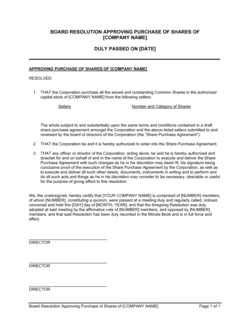
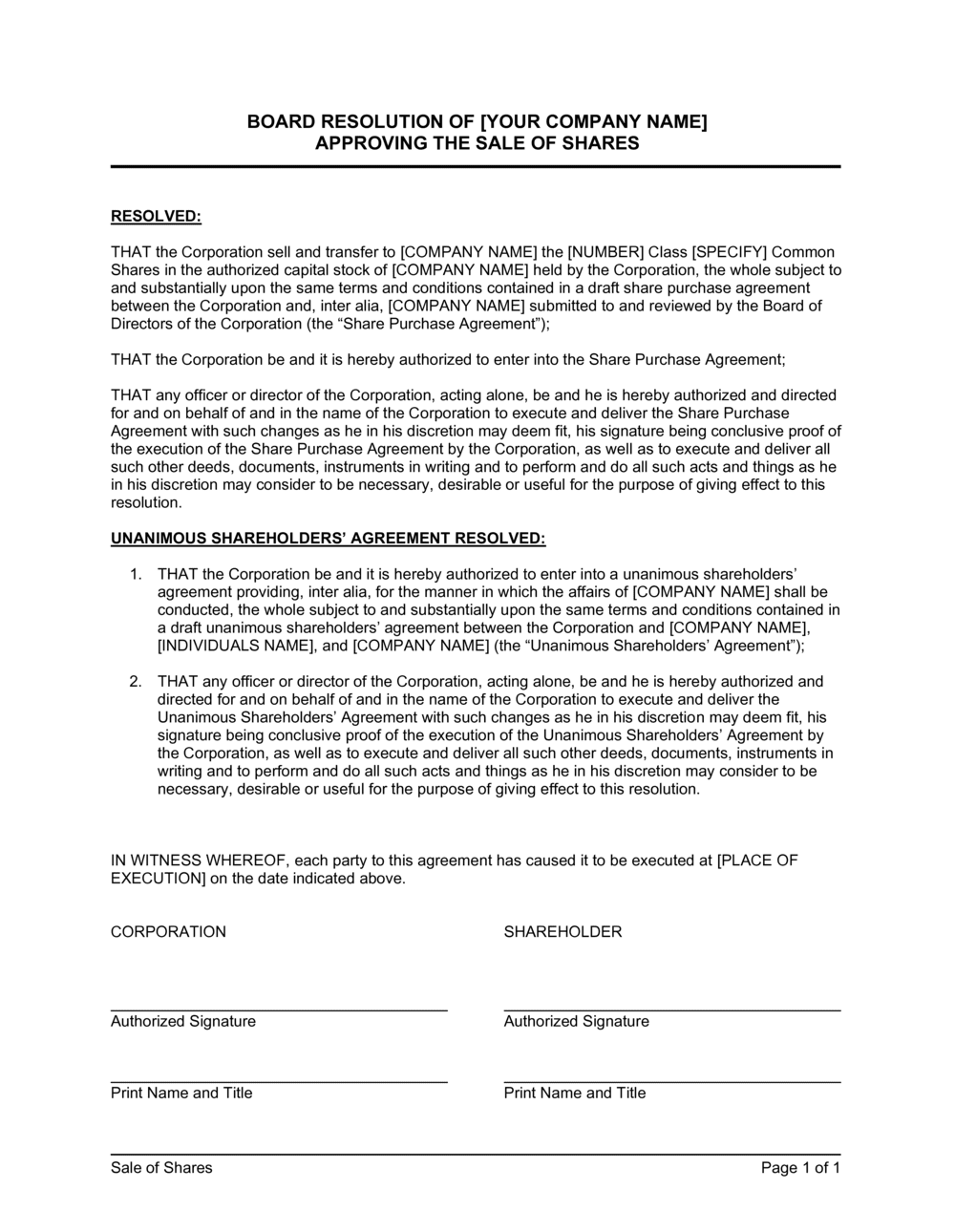
A Board Resolution Approving Sale of Shares is a formal corporate governance document in which the board of directors votes to authorize the company to sell, issue, or transfer shares of stock. This free Word download gives you a ready-to-edit resolution covering new share issuances, treasury share dispositions, and consent-required transfers under a shareholders' agreement or company bylaws — exportable as PDF and signable by all directors.
When you need it
Use it whenever a share transaction requires documented board authority — including issuing new equity to investors or employees, selling treasury shares, approving a shareholder's request to transfer shares to a third party, or satisfying a pre-emptive-rights process under the company's governing documents.
What's inside
Recitals establishing board authority, identification of the shares being authorized, the price or valuation basis, conditions precedent to closing, officer authorization to execute transaction documents, and director signatures confirming unanimous or majority approval.

What is a Board Resolution Approving Sale of Shares?

A Board Resolution Approving Sale of Shares is a formal corporate governance document in which a company's directors vote to authorize the issuance, sale, or transfer of shares of the company's stock. It records the board's legal authority for the transaction, identifies the shares being sold, states the price and conditions, addresses pre-emptive rights, and delegates authority to officers to execute all necessary closing documents. The resolution becomes a permanent entry in the company's minute book and serves as the definitive evidence of corporate authorization — for the buyer, the company's bank, future investors, and any regulatory authority that requires proof of valid share title.

Board resolutions are required for new share issuances to investors or employees, sales of treasury shares, and approvals of shareholder-to-shareholder transfers where the bylaws or a shareholders' agreement requires board consent before a transfer may proceed. Even where not strictly mandated by the governing documents, a resolution is considered best practice because it protects directors personally against claims of unauthorized action and creates the documented paper trail that legal due diligence will require in every subsequent financing or acquisition.

Why You Need This Document

Without a board resolution, a share transaction has no documented corporate authority behind it — and that gap surfaces at the worst possible time. Investors conducting due diligence on a Series A or acquisition will request certified copies of the resolutions authorizing every prior share issuance; a missing resolution can require a retroactive shareholders' meeting, delay closing by weeks, and in some cases make defective share title impossible to cure cleanly. Buyers who receive shares without a valid board authorization may not hold clear title, creating grounds for rescission. In the US, proceeding without documenting the securities law exemption exposes the company to buyer rescission rights and SEC enforcement. In Canada and the UK, filing deadlines for exempt distribution reports and Companies House allotment notices run from the closing date — not from when you remember to file.

This template gives you a jurisdiction-aware, attorney-reviewed starting point that covers every material element — authority, share description, pricing basis, pre-emptive rights, conditions precedent, officer delegation, securities compliance, and share register update — so you can adopt a clean, complete resolution in under an hour for straightforward transactions, and walk into legal review with a solid draft for complex ones.

Which variant fits your situation?

If your situation is…Use this template
Issuing new shares to an angel or venture capital investorBoard Resolution Approving Sale of Shares
Approving a shareholder's transfer to a third-party buyerBoard Resolution Approving Transfer of Shares
Granting stock options to employees under an equity planBoard Resolution Approving Stock Option Plan
Repurchasing shares from a departing founder or employeeBoard Resolution Approving Share Buyback
Authorizing a rights offering or pre-emptive share issuanceBoard Resolution Approving Rights Issue
Issuing shares as consideration in an acquisitionBoard Resolution Approving Share-for-Share Exchange
Documenting a unanimous written resolution in lieu of a meetingUnanimous Written Consent of the Board of Directors

Common mistakes to avoid

❌ Authorizing more shares than are unissued

Why it matters: A resolution that exceeds the company's authorized share capital is void as to the excess. Closing on it exposes directors to personal liability and creates defective title that must be unwound.

Fix: Pull the articles of incorporation and current cap table before drafting. If the authorized limit is insufficient, amend the articles — with shareholder approval — before adopting the resolution.

❌ Skipping the pre-emptive rights analysis

Why it matters: A shareholder who holds unwaived pre-emptive rights can challenge the transaction, seek an injunction, or demand dilution compensation after the fact — potentially unwinding a completed funding round.

Fix: Before every new issuance, identify all rights holders, send the required offer notice, and either collect signed waivers or wait out the notice period before the board votes.

❌ Naming an officer by name instead of by title

Why it matters: If the named individual has left the company or changed roles by the time of closing, the delegation of authority is invalid — requiring a new resolution and potentially delaying the transaction.

Fix: Always delegate to the office, not the person: 'the Chief Executive Officer of the Company, and any successor to such office, is hereby authorized.'

❌ Omitting the securities exemption identification

Why it matters: Every private share sale must rely on a documented exemption from registration. Proceeding without one creates an unregistered securities offering — a violation that can trigger rescission rights for the buyer and regulatory sanctions.

Fix: Identify the specific exemption, confirm buyer qualification (e.g., accredited investor status), and file required notices (Form D, exempt distribution report) within the applicable deadline.

❌ Failing to record the quorum and vote

Why it matters: A resolution adopted at a meeting that lacked quorum, or where the vote count was not documented, is procedurally defective. Legal due diligence on a later financing or M&A transaction will flag it.

Fix: Record the number of directors present, the number constituting a quorum under the bylaws, and the vote tally (for, against, abstaining) at the top of every resolution adopted at a meeting.

❌ Not updating the share register after closing

Why it matters: The share register is the legal record of ownership. An outdated register creates conflicting evidence of title, complicates dividend payments, and stalls future financings or audits that require a certified cap table.

Fix: Build share register and cap table updates into the closing checklist — treat them as a closing deliverable, not a post-closing administrative task.

The 10 key clauses, explained

Recitals and authority

In plain language: Establishes that the board has the power to authorize the transaction, citing the company's articles of incorporation, bylaws, and applicable corporate statute.

Sample language
WHEREAS, [COMPANY NAME] (the 'Company') is a [ENTITY TYPE] organized under the laws of [JURISDICTION]; and WHEREAS, the board of directors (the 'Board') is authorized under the Company's [BYLAWS / ARTICLES] and [APPLICABLE STATUTE] to authorize the issuance and sale of shares of the Company's capital stock;

Common mistake: Citing the wrong corporate statute or an outdated bylaw section — if the resolution references a provision that was amended, the authority chain breaks and the transaction may need to be re-authorized.

Description of shares authorized

In plain language: Identifies precisely which shares are being sold or transferred — class, series, number of shares, and CUSIP or certificate number if applicable.

Sample language
RESOLVED, that the Company is hereby authorized to issue and sell [NUMBER] shares of [CLASS] Stock, [SERIES], at a purchase price of $[PRICE] per share (the 'Shares'), to [BUYER NAME] (the 'Purchaser').

Common mistake: Stating a share count that exceeds the remaining authorized-but-unissued shares — the resolution is void as to any excess, and closing on an over-authorization exposes directors to personal liability.

Purchase price and valuation basis

In plain language: States the per-share price, the total consideration, and — where required — the basis for concluding the price is fair value (e.g., a 409A valuation for US companies).

Sample language
RESOLVED, that the Board determines the per-share price of $[PRICE] to be the fair market value of the Shares as of [DATE], based on [409A VALUATION / BOARD DETERMINATION / INDEPENDENT APPRAISAL], and hereby approves such price as adequate consideration.

Common mistake: Omitting the valuation basis for below-market or equity-plan issuances. The IRS requires a 409A valuation to support exercise prices for US stock options; missing documentation triggers immediate income recognition and penalties for option holders.

Pre-emptive rights waiver or compliance

In plain language: Confirms either that existing shareholders have waived or do not hold pre-emptive rights with respect to the transaction, or that the required notice and offer period has been completed.

Sample language
RESOLVED, that the Board confirms that [the holders of pre-emptive rights under the Shareholders' Agreement have waived such rights in writing / the required [X]-day pre-emptive rights notice period expired on [DATE] without any shareholder exercising such rights] with respect to the Shares.

Common mistake: Proceeding without documenting the pre-emptive rights analysis at all. If a shareholder later asserts unwaived pre-emptive rights, the transaction can be unwound — taking a funding round or acquisition with it.

Conditions precedent to closing

In plain language: Lists the specific conditions that must be satisfied before the share transaction closes — such as payment, regulatory filings, or delivery of executed documents.

Sample language
RESOLVED, that the issuance of the Shares is conditioned upon: (a) receipt by the Company of the full purchase price of $[TOTAL AMOUNT] in immediately available funds; (b) execution of a [SUBSCRIPTION AGREEMENT / SHARE PURCHASE AGREEMENT] in form approved herein; and (c) [ANY REGULATORY APPROVAL / FILING].

Common mistake: Listing conditions precedent in a vague or open-ended way — for example, 'subject to completion of due diligence.' If a condition is not objectively verifiable, one party can assert it was never satisfied and halt the closing.

Officer authorization

In plain language: Delegates authority to one or more named officers to execute all documents, make required filings, and take any other actions necessary to complete the transaction.

Sample language
RESOLVED, that the [CEO / President / CFO] of the Company, and each of them acting alone, is hereby authorized and directed to execute and deliver, on behalf of the Company, such agreements, instruments, certificates, and documents as may be necessary or desirable to consummate the transaction authorized herein.

Common mistake: Naming a specific officer by name rather than by title — if that person has resigned or changed roles by closing, the authority delegation fails and the transaction requires a new resolution.

Update of corporate records and cap table

In plain language: Directs the corporate secretary or officer to update the share register, issue share certificates (or book-entry records), and file any required notices with the company's registrar.

Sample language
RESOLVED, that the Secretary of the Company is hereby directed to record the issuance of the Shares in the Company's share register, update the capitalization table accordingly, and issue share certificates (or book-entry notation) to [BUYER NAME] promptly following closing.

Common mistake: Treating the share register update as an administrative afterthought. An outdated cap table creates conflicting records of ownership that can derail future financings, audits, and M&A transactions.

Regulatory and securities law compliance

In plain language: Confirms the board's determination that the issuance qualifies for an applicable securities exemption and directs the appropriate filings — such as Form D in the US or an exempt distribution report in Canada.

Sample language
RESOLVED, that the Board determines that the issuance of the Shares qualifies as an exempt transaction under [RULE 506(b) / REGULATION D / SECTION 4(a)(2)] of the Securities Act of 1933, as amended, and that the appropriate officers are authorized to file any required notices, including Form D, within the time required by applicable law.

Common mistake: Assuming that a private share sale is automatically exempt from securities registration. The exemption must be specifically identified and documented — and the conditions (e.g., accredited investor status) verified and recorded before closing.

Ratification of prior actions

In plain language: Ratifies any actions already taken by officers or directors in connection with the transaction before the resolution was formally adopted.

Sample language
RESOLVED, that all actions taken by the officers and directors of the Company prior to the date hereof in connection with the transactions contemplated by these resolutions are hereby ratified, confirmed, and approved in all respects.

Common mistake: Omitting the ratification clause when officers negotiated term sheets or signed letters of intent before the board formally met. Without it, those prior commitments may lack corporate authority and could be challenged by the counterparty or a later acquirer.

Effectiveness and certification

In plain language: States when the resolution takes effect, provides for the corporate secretary to certify a copy for delivery to banks, transfer agents, or counterparties, and confirms the quorum and vote.

Sample language
This resolution is adopted by [unanimous written consent / vote of the Board at a duly called meeting at which a quorum was present] as of [DATE]. The Secretary is authorized to certify a copy of these resolutions to any third party requiring evidence of the Board's authorization.

Common mistake: Failing to record the vote count and quorum confirmation. If only some directors signed or the meeting lacked quorum, the resolution is invalid — a deficiency that typically surfaces during legal due diligence on a subsequent financing or sale.

How to fill it out

  1. 1

    Confirm the company's authorized share capital

    Check the articles of incorporation or certificate of incorporation to confirm the total authorized shares, the share classes available, and how many remain unissued. The resolution cannot authorize issuance of shares beyond the authorized limit.

    💡 Pull the current cap table and cross-reference it with the articles before drafting — a five-minute check prevents a void resolution.

  2. 2

    Identify the shares, buyer, and consideration

    Enter the exact class, series, and number of shares being sold, the full legal name of the buyer, and the per-share price and total consideration. If consideration is non-cash, describe it specifically.

    💡 For equity-plan grants, confirm you have a current 409A valuation report dated within 12 months — document the valuation basis in the resolution to satisfy IRS requirements.

  3. 3

    Address pre-emptive rights

    Review the shareholders' agreement and bylaws to determine whether existing shareholders hold pre-emptive rights. Either obtain signed waivers before the board meeting or document that the required notice period has elapsed with no exercise.

    💡 Collect waivers in writing — even a countersigned email from each rights holder — and attach them as an exhibit to the resolution.

  4. 4

    Set the conditions precedent

    List every specific, objectively verifiable condition that must be satisfied before the shares are issued — payment amount, agreement execution, regulatory filing, or accredited investor confirmation. Vague conditions create closing risk.

    💡 Mirror the conditions precedent in the share purchase or subscription agreement so both documents are consistent.

  5. 5

    Identify the authorized officer by title

    Delegate execution authority to a named title — CEO, President, or CFO — not to an individual by name, so the authorization survives personnel changes between resolution and closing.

    💡 If the transaction is material, authorize two officers acting jointly to provide an additional layer of internal control.

  6. 6

    Confirm the securities law exemption

    Identify the specific exemption on which the company is relying — Regulation D Rule 506(b), Section 4(a)(2), a Canadian prospectus exemption, or another applicable provision — and ensure buyer qualification is verified and documented before closing.

    💡 For Regulation D offerings, set a reminder to file Form D within 15 days of the first sale — the penalty is a one-year ban from using Regulation D in that state.

  7. 7

    Obtain director signatures and confirm quorum

    Have all directors sign the resolution, or if a formal meeting is held, record the vote count and confirm that a quorum was present. For unanimous written consent, all directors with voting rights must sign.

    💡 Use Business in a Box eSign to timestamp each director's signature and store the executed resolution in the company's digital minute book automatically.

  8. 8

    Update the share register and cap table at closing

    Once all closing conditions are satisfied, direct the corporate secretary to record the new shares in the share register, update the cap table, and issue certificates or book-entry records to the buyer.

    💡 Send the buyer a certified copy of the resolution together with the share certificate — it documents their title to the shares and satisfies most lender and future-investor requirements.

Frequently asked questions

What is a board resolution approving sale of shares?

A board resolution approving sale of shares is a formal corporate document in which the directors of a company vote to authorize the issuance, sale, or transfer of shares of the company's stock. It records the board's authority, identifies the shares and parties involved, sets the price and conditions, and delegates authority to officers to complete the transaction. Without it, a share transaction typically lacks valid corporate authorization and may be challenged or unwound.

When is a board resolution required to sell or transfer shares?

A board resolution is typically required whenever a company issues new shares to investors or employees, sells treasury shares, or approves a shareholder's request to transfer shares to a third party where the bylaws or shareholders' agreement requires board consent. Even where not strictly mandated, adopting a resolution creates a documented authority trail that protects directors personally and satisfies legal due diligence in future financings and acquisitions.

Can a board resolution be adopted without a formal meeting?

Yes. In most jurisdictions, directors may adopt a resolution by unanimous written consent — without convening a meeting — provided all directors entitled to vote sign the written consent. This is the most common method for routine share transactions in private companies. However, if unanimous consent is not possible, a duly noticed meeting with quorum present is required, and the vote must be recorded in the minutes.

What is the difference between a board resolution and a shareholders' resolution for share sales?

A board resolution authorizes the company to proceed with a share transaction as a corporate action. A shareholders' resolution approves actions that require shareholder consent under the articles or applicable law — such as authorizing additional share capital, approving a new share class, or waiving pre-emptive rights collectively. Many transactions require both: a shareholders' resolution to create the authority, and a board resolution to exercise it for a specific transaction.

Does a board resolution need to be notarized?

In most jurisdictions, a board resolution does not need to be notarized to be valid. Director signatures on the resolution, confirmed by a certificate of the corporate secretary, are generally sufficient for domestic transactions and most lenders. Some cross-border transactions, foreign regulatory filings, or real estate transfers involving corporate shares may require notarization or apostille — consult local counsel when the resolution will be submitted to a foreign authority.

What happens if the board approves a share sale that exceeds the authorized share capital?

Any purported issuance of shares beyond the company's authorized capital is void as a matter of corporate law in most jurisdictions. The buyer receives no valid title to the excess shares, and directors who approved the over-authorization may face personal liability. The fix is to amend the articles of incorporation — with shareholder approval — to increase authorized capital before adopting the board resolution.

What securities law filings are required after a board-approved share sale?

In the US, a private placement relying on Regulation D requires a Form D filing with the SEC within 15 days of the first sale, plus state blue-sky notice filings in states where investors are located. In Canada, an exempt distribution report must be filed with provincial securities regulators within 10 days of closing. In the UK and EU, the applicable exemption must be documented and in some cases notified to the relevant regulator. Consult securities counsel to confirm the specific obligations for your transaction.

How long should a board resolution be kept on file?

Board resolutions should be retained permanently as part of the company's minute book. Corporate records of share issuances are referenced in every future financing round, M&A transaction, and regulatory audit — sometimes years or decades later. Most jurisdictions require companies to maintain corporate records for at least 7–10 years, but for foundational documents like share authorizations, indefinite retention is the standard practice.

Do I need a lawyer to prepare a board resolution approving a share sale?

For straightforward domestic share issuances — such as a seed round to accredited investors or a new partner joining a private company — a well-drafted template is typically sufficient for the resolution itself. Legal review is strongly recommended when the transaction involves complex terms (liquidation preferences, anti-dilution), cross-border buyers, regulated industries, or a securities exemption that requires careful qualification. A 1–2 hour lawyer review typically costs $300–$800 and is worth it for any transaction above $100K.

How this compares to alternatives

vs Shareholders' Resolution

A shareholders' resolution records a decision made by the company's owners rather than its directors — typically required to authorize new share classes, increase authorized capital, or waive pre-emptive rights collectively. A board resolution then exercises the authority shareholders created. Many share transactions require both documents in sequence.

vs Share Purchase Agreement

A share purchase agreement is the binding contract between buyer and seller governing price, representations, warranties, and closing mechanics. A board resolution authorizes the company to enter into and perform that agreement. The resolution is internal corporate authority; the agreement is the external contractual obligation — both are required for a complete transaction record.

vs Unanimous Written Consent of the Board

A unanimous written consent achieves the same corporate authorization as a board resolution but without a formal meeting — all directors sign a single document instead of voting at a duly noticed meeting. Use the written consent for routine or time-sensitive transactions; use a formal meeting resolution when not all directors can be reached or when the transaction warrants deliberation on the record.

vs Stock Option Agreement

A stock option agreement grants an individual the right to purchase shares at a fixed price in the future — it does not itself authorize the underlying share issuance. The board resolution approves the option plan and the pool of shares reserved for it; the option agreement documents each individual grant. Both documents are required to establish a valid equity incentive program.

Industry-specific considerations

Technology / SaaS

Seed and Series A issuances to institutional investors, SAFE note conversions, and ESOP grants require board resolutions at each step to maintain a clean cap table for future due diligence.

Financial Services

Regulatory licensing conditions may require prior approval from a financial regulator before shares can be issued to new investors, making the board resolution one step in a multi-stage approval process.

Real Estate

Special purpose vehicle (SPV) share issuances to co-investors require board resolutions that also address any first-refusal rights among existing SPV members and any lender consent requirements.

Professional Services

Admitting a new equity partner often involves issuing shares or units to an individual who is also an employee, requiring the resolution to address both the employment relationship and the equity grant terms simultaneously.

Jurisdictional notes

United States

Board authority to issue shares is governed by the state of incorporation — typically Delaware's DGCL or the applicable state business corporation act. New equity issuances to investors must rely on a federal securities exemption (most commonly Regulation D Rule 506(b) or 506(c)) and require a Form D filing with the SEC within 15 days of the first sale. State blue-sky filings may also be required. For equity plan grants, a 409A valuation is required to support the exercise price and avoid adverse tax consequences for option holders under IRC Section 409A.

Canada

Federal corporations under the CBCA and provincial corporations under provincial business corporations acts each have specific rules on director authority to issue shares and pre-emptive rights. Private placements must rely on a prospectus exemption — most commonly the accredited investor or offering memorandum exemption — and require an exempt distribution report filed with provincial securities regulators within 10 days of closing. Quebec companies must ensure resolutions and related documents are available in French for Quebec-resident shareholders.

United Kingdom

Under the Companies Act 2006, directors of a UK private company generally require specific authority granted in the articles or by ordinary shareholder resolution to allot new shares. Pre-emptive rights under Section 561 CA 2006 must be disapplied by special resolution or through a specific disapplication provision in the articles before new shares can be issued to non-existing shareholders. Share allotments must be filed at Companies House using Form SH01 within one month of the allotment date.

European Union

EU member states implement share issuance rules differently, but most require board authority to be granted in the articles or by a general meeting resolution, with pre-emptive rights protections for existing shareholders that must be formally disapplied. Germany requires notarized shareholder consent for GmbH share transfers. France imposes a right of first refusal on SARL share transfers. Cross-border issuances to EU investors may trigger prospectus requirements under the EU Prospectus Regulation if the offering does not qualify for an applicable exemption.

Template vs lawyer — what fits your deal?

PathBest forCostTime
Use the templateStraightforward domestic share issuances to accredited investors or new partners in a private company with no complex termsFree30–60 minutes
Template + legal reviewTransactions above $100K, cross-border buyers, ESOP grants requiring 409A support, or companies with existing shareholders' agreements$300–$8001–2 days
Custom draftedInstitutional funding rounds with preferred share terms, regulated industries requiring prior regulatory consent, or multi-jurisdiction transactions$1,500–$5,000+1–2 weeks

Glossary

Board Resolution
A formal written record of a decision made by a company's board of directors, creating documented authority for a specific corporate action.
Authorized Shares
The maximum number of shares a company is permitted to issue under its articles of incorporation or certificate of incorporation.
Issued and Outstanding Shares
Shares that have been formally sold or granted to shareholders and currently held by them — the subset of authorized shares that have been distributed.
Treasury Shares
Shares previously issued to shareholders that the company has repurchased and holds internally — they may be reissued or cancelled.
Pre-emptive Rights
A contractual or statutory right giving existing shareholders the first opportunity to purchase new shares before they are offered to outside parties, preserving their ownership percentage.
Shareholders' Agreement
A private contract among shareholders — and often the company — governing share transfers, tag-along and drag-along rights, board composition, and other equity-related matters.
Share Transfer Restriction
A provision in bylaws, articles, or a shareholders' agreement that limits or conditions a shareholder's ability to sell or transfer shares without board or shareholder approval.
Consideration
The price or other value exchanged for the shares — which may be cash, property, services, or a promissory note, depending on applicable corporate law.
Unanimous Written Consent
A procedure allowing directors or shareholders to approve a resolution without a formal meeting, provided all entitled parties sign the written consent document.
Capitalization Table (Cap Table)
A spreadsheet recording all equity owners, share classes, quantities held, and the resulting ownership percentages — updated after every share transaction.
Closing Conditions
Specific requirements — such as regulatory approval, payment of consideration, or delivery of executed documents — that must be satisfied before a share transaction legally closes.

Part of your Business Operating System

This document is one of 3,000+ business & legal templates included in Business in a Box.

  • Fill-in-the-blanks — ready in minutes
  • 100% customizable Word document
  • Compatible with all office suites
  • Export to PDF and share electronically

Create your document in 3 simple steps.

From template to signed document — all inside one Business Operating System.
1
Download or open template

Access over 3,000+ business and legal templates for any business task, project or initiative.

2
Edit and fill in the blanks with AI

Customize your ready-made business document template and save it in the cloud.

3
Save, Share, Send, Sign

Share your files and folders with your team. Create a space of seamless collaboration.

Save time, save money, and create top-quality documents.

★★★★★

"Fantastic value! I'm not sure how I'd do without it. It's worth its weight in gold and paid back for itself many times."

Managing Director · Mall Farm
Robert Whalley
Managing Director, Mall Farm Proprietary Limited
★★★★★

"I have been using Business in a Box for years. It has been the most useful source of templates I have encountered. I recommend it to anyone."

Business Owner · 4+ years
Dr Michael John Freestone
Business Owner
★★★★★

"It has been a life saver so many times I have lost count. Business in a Box has saved me so much time and as you know, time is money."

Owner · Upstate Web
David G. Moore Jr.
Owner, Upstate Web

Run your business with a system — not scattered tools

Stop downloading documents. Start operating with clarity. Business in a Box gives you the Business Operating System used by over 250,000 companies worldwide to structure, run, and grow their business.

Start free · No credit card required