Assignment of Shares Template

Free Word download β€’ Edit online β€’ Save & share with Drive β€’ Export to PDF

1 pageβ€’20–30 min to fillβ€’Difficulty: Standardβ€’Signature requiredβ€’Legal review recommended
Learn more ↓
FreeAssignment of Shares Template

At a glance

What it is
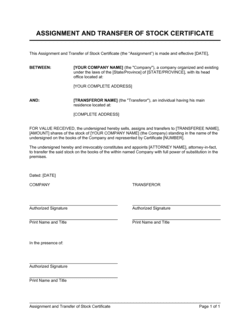
An Assignment of Shares is a short legal instrument by which a current shareholder (the assignor) formally transfers ownership of a specified number of shares to another party (the assignee). This free Word download captures the share class, quantity, consideration paid, representations by both parties, and the mechanics for updating the company's share registry β€” all in a single executable document.
When you need it
Use it any time shares change hands outside of a public exchange β€” whether in a private company sale, a founder equity transfer, a gift to a family member, or an investor buyout. It is also required when a shareholders' agreement mandates a right of first refusal process and the company needs a standalone transfer instrument to close the transaction.
What's inside
Assignor and assignee identification, share class and exact number of shares, purchase price or other consideration, representations and warranties from both parties, consent and waiver provisions, registry update instructions, and signature blocks for all required parties.

What is an Assignment of Shares?

An Assignment of Shares is a short legal instrument by which a registered shareholder (the assignor) formally transfers ownership of a specified number of shares in a private company to another party (the assignee). The document names both parties, identifies the share class and exact quantity being transferred, records the consideration exchanged, includes representations and warranties from both sides confirming good title and capacity, and sets out the mechanics for updating the company's share register. Unlike a full share purchase agreement β€” which covers the acquisition of an entire company with extensive commercial representations β€” an assignment of shares is designed for standalone private transfers where the deal terms are already agreed and the parties simply need a clean, executable instrument to move title.

Why You Need This Document

A handshake or an email confirming a share sale does not change legal ownership. Until a properly executed assignment is delivered, the share registry updated, and any required consents obtained, the assignor remains the registered shareholder of record β€” entitled to vote, receive dividends, and be treated as the owner for all corporate and tax purposes. Without a written assignment, the assignee has no documented evidence of ownership to present to future investors, acquirers, or courts. Failing to document and complete the ROFR waiver process exposes the assignor to a claim from existing shareholders who could seek to unwind the transfer. Missing the board approval step in companies whose articles require it renders the transfer void under the applicable corporate statute. This template gives both parties a complete, enforceable record of the transfer β€” from the agreed consideration through to the registry update deadline β€” closing every gap that an informal exchange leaves open.

Which variant fits your situation?

If your situation is…Use this template
Transferring shares for a negotiated purchase price between two private partiesAssignment of Shares (Sale)
Transferring the entire issued share capital of a company in an acquisitionShare Purchase Agreement
Documenting a shareholder's rights and obligations before a transfer occursShareholders Agreement
Issuing new shares to an incoming investor rather than transferring existing onesStock Subscription Agreement
Granting an option to purchase shares at a future date or priceStock Option Agreement
Pledging shares as collateral for a loan without transferring ownershipShare Pledge Agreement
Transferring shares as part of a buy-sell triggered by a shareholder's deathBuy-Sell Agreement

Common mistakes to avoid

❌ Transferring shares without checking the shareholders' agreement first

Why it matters: Most shareholders' agreements contain ROFR, co-sale, or consent-to-transfer clauses. Ignoring them exposes the assignor to a damages claim and may allow existing shareholders to unwind the transfer entirely.

Fix: Read the shareholders' agreement and the company's articles before drafting the assignment. Obtain all required waivers and consents in writing and attach them to the executed document.

❌ Omitting the encumbrance representation from the assignor's warranties

Why it matters: If the shares are pledged as collateral, the secured lender holds a prior claim. The assignee may receive shares the company's registry cannot legally update, leaving them with no enforceable ownership.

Fix: Include a clear representation that the shares are free of all liens, charges, pledges, and encumbrances. Require the assignor to discharge any pledge before the effective date.

❌ Describing shares by percentage rather than exact number

Why it matters: Percentages shift the moment the company issues additional shares. If a new funding round closes between signing and the registry update, the assignee receives fewer shares than intended and has no written basis to compel correction.

Fix: Always state the exact integer share count. If the economic intent is a percentage, convert it to a share count as of a specified record date and state both figures.

❌ Backdating the effective date to shift a tax event into a prior period

Why it matters: In the US, Canada, the UK, and the EU, backdating a share transfer to move a capital gain or stamp-duty liability into a prior tax year is considered fraud or tax evasion and carries criminal penalties.

Fix: Use the actual date the conditions precedent are satisfied as the effective date. If timing is tax-sensitive, consult a tax adviser before signing rather than altering the date after the fact.

❌ Skipping board approval when the articles require it

Why it matters: A transfer executed without required board approval is typically void under the applicable corporate statute, meaning the assignee is not a shareholder of record and has no voting rights, dividend entitlement, or exit proceeds.

Fix: Review the articles and pass the required board resolution before the effective date. Attach the resolution to the minute book alongside the executed assignment.

❌ Failing to issue a new share certificate after the transfer

Why it matters: Without a new certificate in the assignee's name and a matching registry entry, third parties β€” including future investors and acquirers β€” will treat the original certificate as controlling, creating a title dispute that can stall a subsequent sale.

Fix: Include an explicit registry-update and certificate-issuance clause with a deadline, and confirm completion in writing before closing any subsequent transaction involving those shares.

The 9 key clauses, explained

Parties and recitals

In plain language: Identifies the assignor and assignee by full legal name, entity type, and jurisdiction, and sets out the background to the transfer.

Sample language
This Assignment of Shares is entered into on [DATE] between [ASSIGNOR FULL LEGAL NAME], a [ENTITY TYPE] incorporated in [JURISDICTION] ('Assignor'), and [ASSIGNEE FULL LEGAL NAME], a [ENTITY TYPE] incorporated in [JURISDICTION] ('Assignee').

Common mistake: Using a trade name or nickname instead of the registered legal entity name β€” the transfer will not match registry records, making the update impossible without a correction.

Description of shares being transferred

In plain language: Specifies exactly which shares are moving: the company whose shares are involved, the share class, and the precise number of shares.

Sample language
Assignor hereby assigns and transfers to Assignee [NUMBER] shares of [SHARE CLASS] stock in [COMPANY FULL LEGAL NAME] (the 'Company'), representing approximately [X]% of the issued and outstanding shares of that class as of the date of this Agreement.

Common mistake: Describing shares by percentage only instead of an exact number β€” if new shares are issued between signing and registry update, the percentage shifts and the transfer is ambiguous.

Consideration

In plain language: States the price or other value the assignee is paying for the shares and when and how payment will be made.

Sample language
In consideration of the sum of $[AMOUNT] (the 'Purchase Price'), payable by [METHOD β€” wire transfer / certified cheque] on or before [DATE], the receipt and sufficiency of which Assignor hereby acknowledges, Assignor agrees to the transfer set out in this Agreement.

Common mistake: Leaving consideration blank or stating 'good and valuable consideration' without a dollar amount β€” courts in several jurisdictions treat this as evidence the transfer was a gift, with different tax and creditor implications.

Assignor representations and warranties

In plain language: The assignor confirms they legally own the shares, that the shares are free of liens or encumbrances, that no third-party consent is required (or that it has been obtained), and that the transfer does not violate any agreement.

Sample language
Assignor represents and warrants that: (a) Assignor is the registered and beneficial owner of the Shares free and clear of all liens, pledges, and encumbrances; (b) Assignor has full authority to transfer the Shares; (c) no consent, waiver, or approval of any third party is required that has not already been obtained.

Common mistake: Omitting the encumbrance representation β€” if the shares are pledged as loan collateral, the lender may have a prior claim that voids the transfer.

Assignee representations and warranties

In plain language: The assignee confirms they have the capacity and authority to accept the shares and, where required, that they are an accredited or eligible investor under applicable securities law.

Sample language
Assignee represents and warrants that: (a) Assignee has full legal capacity and authority to acquire the Shares; (b) the acquisition of the Shares does not violate any applicable law or agreement to which Assignee is a party; (c) [if applicable] Assignee is an 'accredited investor' as defined under [APPLICABLE SECURITIES LAW].

Common mistake: Skipping assignee representations entirely β€” if the assignee later turns out to be ineligible to hold shares (e.g., a foreign national in a restricted sector), the company and the assignor both face liability.

Consent and waiver of pre-emptive rights

In plain language: Confirms that existing shareholders have waived their right of first refusal, pre-emption rights, or any other consent required under the shareholders' agreement or the company's constitution.

Sample language
The Company and each shareholder entitled to a right of first refusal or pre-emptive right in respect of the Shares hereby waives such right with respect to the transfer contemplated by this Agreement, as evidenced by the countersignature of [COMPANY NAME] and the attached consent letters.

Common mistake: Proceeding to transfer without documenting the ROFR waiver β€” if an existing shareholder later claims they were entitled to buy the shares first, the transfer can be unwound.

Effective date and conditions precedent

In plain language: States when the transfer takes legal effect β€” typically on the date all conditions are met, including payment of consideration and board approval β€” and lists any conditions that must be satisfied first.

Sample language
This Assignment shall become effective on the date that: (a) this Agreement has been duly executed by both parties; (b) the Purchase Price has been received in full; and (c) the board of directors of the Company has approved the transfer in accordance with the Company's articles of incorporation ('Effective Date').

Common mistake: Backdating the effective date without a legitimate reason β€” in most jurisdictions, backdating a share transfer to move a tax event into a prior period is a criminal offence.

Registry update obligation

In plain language: Requires the company to update its share register to reflect the assignee as the new registered holder promptly after the effective date and to issue any required share certificates.

Sample language
The Company shall, within [5] business days of the Effective Date, update its register of members to record Assignee as the registered holder of the Shares, cancel any existing share certificate issued to Assignor in respect of the Shares, and issue a new share certificate to Assignee.

Common mistake: No deadline for the registry update β€” if the company delays, the assignee has no mechanism to compel action and may be denied voting rights or dividend payments in the interim.

Governing law and dispute resolution

In plain language: Specifies which jurisdiction's law governs the agreement and how disputes are resolved β€” typically the jurisdiction where the company is incorporated.

Sample language
This Agreement is governed by the laws of [STATE / PROVINCE / COUNTRY]. Any dispute arising out of or in connection with this Agreement shall be resolved by [binding arbitration / litigation] in the courts of [JURISDICTION], and the parties hereby submit to the exclusive jurisdiction of those courts.

Common mistake: Choosing a governing law that differs from the company's incorporation jurisdiction β€” securities transfer rules are set by corporate statute in the place of incorporation, creating a direct conflict.

How to fill it out

  1. 1

    Identify all parties by their full legal names

    Enter the assignor's and assignee's complete registered legal names β€” for individuals, their full legal name as on government ID; for entities, the exact name on the corporate registry filing. Include entity type and jurisdiction of incorporation.

    πŸ’‘ Pull the exact entity name from the company's share register rather than the company's website β€” trade names differ from registered names more often than you'd expect.

  2. 2

    Specify the share class and exact number of shares

    State the full name of the share class (e.g., 'Class A Common Shares') and the precise integer number of shares being transferred. Do not substitute a percentage for a share count.

    πŸ’‘ Cross-reference the assignor's existing share certificate or the company's cap table to confirm both the class name and the available share count before drafting.

  3. 3

    State the consideration with a dollar amount

    Enter the exact purchase price in a named currency. If the transfer is a gift, use nominal consideration (e.g., $1.00 CAD) and note it explicitly so there is no ambiguity about intent. Include the payment method and deadline.

    πŸ’‘ For gift transfers to family members, check whether the jurisdiction deems the transfer to occur at fair market value for tax purposes regardless of the stated price.

  4. 4

    Confirm and document the ROFR waiver

    Review the shareholders' agreement and the company's articles to identify every pre-emptive right or right of first refusal triggered by this transfer. Collect written waivers from each entitled shareholder and attach them to the executed assignment.

    πŸ’‘ If the shareholders' agreement requires a formal ROFR offer process, complete and document that process before circulating the assignment for signature β€” not after.

  5. 5

    Obtain board or director approval

    Most private company constitutions require board approval of share transfers. Pass a board resolution approving the transfer and file it with the company's minute book before or on the effective date.

    πŸ’‘ Some articles give the board discretion to refuse a transfer β€” confirm the articles do not include such a refusal right before signing the assignment, or obtain board pre-approval in writing.

  6. 6

    Execute with all required signatures

    Both assignor and assignee must sign. If the company is a party to the waiver or registry-update clause, an authorized officer must countersign on behalf of the company. Confirm whether witnesses or notarization are required in the governing jurisdiction.

    πŸ’‘ Execute on or before the intended effective date β€” never backdate. If the closing is delayed, amend the effective-date clause rather than altering the signature date.

  7. 7

    Update the share register and issue new certificates

    Once the effective date conditions are met, instruct the company secretary or registered agent to update the share register, cancel the assignor's certificate, and issue a new certificate to the assignee within the deadline stated in the agreement.

    πŸ’‘ Keep a certified copy of the executed assignment in the company's minute book alongside the updated register β€” both will be requested in any future due diligence or audit.

Frequently asked questions

What is an assignment of shares?

An assignment of shares is a legal document by which a registered shareholder transfers ownership of a specified number of shares in a private company to another party. It records the assignor's and assignee's details, the share class and count, the consideration paid, representations by both parties, and the steps required to update the company's share registry. It is distinct from a full share purchase agreement in that it is typically a short instrument used for straightforward private transfers rather than complex M&A transactions.

When do I need an assignment of shares instead of a share purchase agreement?

Use an assignment of shares for relatively simple transfers between two parties β€” a departing founder selling back to the company, an investor gifting shares to a family trust, or a shareholder exiting a small private company. Use a full share purchase agreement when the transaction involves a material acquisition, complex representations and warranties about the company's business, indemnities, escrow arrangements, or regulatory approvals. The assignment is the instrument; the share purchase agreement is the full deal document.

Does an assignment of shares need to be notarized?

Notarization is not required for a share assignment in most jurisdictions, including the US, Canada, and the UK. However, some foreign jurisdictions β€” notably certain EU civil-law countries like Germany and France β€” require notarization or other formalities for share transfers to be legally effective. If any party is located in or the company is incorporated in a civil-law jurisdiction, confirm local requirements before signing.

What taxes apply to a share transfer?

Tax treatment depends on jurisdiction and structure. In the US, the assignor typically realizes a capital gain or loss equal to the difference between the sale price and the adjusted cost basis of the shares. In Canada, 50% of the capital gain is included in income at the assignor's marginal rate. In the UK, Stamp Duty of 0.5% of the consideration is payable by the assignee on transfers of certificated shares. In the EU, treatment varies by member state. Consult a tax adviser before completing any transfer where the tax consequences are material.

Can a shareholder refuse to transfer shares?

Yes. Many private company constitutions give the board of directors discretion to decline to register a transfer β€” for example, to prevent shares passing to a competitor or an insolvent party. Additionally, shareholders' agreements frequently contain rights of first refusal that must be offered and waived before a transfer can proceed. Always review both documents before assuming a transfer can close on your preferred timeline.

What is the right of first refusal and how does it affect a share transfer?

A right of first refusal (ROFR) is a contractual right held by existing shareholders to purchase the selling shareholder's shares at the offered price before those shares can be sold to an outside party. Transferring shares without completing the ROFR process β€” typically a written notice period of 15 to 30 days β€” entitles the ROFR holders to damages or, in some jurisdictions, to have the transfer set aside. Document each waiver in writing and attach it to the executed assignment before closing.

Does the company need to sign the assignment of shares?

The company is not always a party to the core transfer between assignor and assignee, but it is typically required to countersign the registry-update clause and any consent or waiver provisions. In practice, having an authorized officer of the company sign confirms board approval and creates a clear record that the company acknowledges the new registered holder β€” which prevents future disputes about when ownership effectively changed.

How long does a share transfer take to complete?

A straightforward domestic transfer with no ROFR complications typically takes 3 to 10 business days from the date of signing to the issuance of a new share certificate. Delays arise most often from incomplete ROFR processes, missing board resolutions, or failure to pay stamp duty before submission. Cross-border transfers involving regulatory approvals or foreign ownership restrictions can take 4 to 12 weeks.

What happens to the original share certificate after the transfer?

Once the transfer is effective, the assignor's original share certificate is cancelled. The company secretary should physically mark it 'cancelled' and retain it in the minute book alongside the executed assignment for audit purposes. A new certificate is then issued to the assignee showing their name, the share class, and the number of shares. Failure to cancel the original creates a risk that the assignor could fraudulently transfer the same shares a second time.

How this compares to alternatives

vs Share Purchase Agreement

A share purchase agreement is a comprehensive acquisition document covering representations about the company's business, indemnities, conditions to closing, and post-closing obligations β€” appropriate for M&A transactions. An assignment of shares is a short transfer instrument used when the deal terms are already agreed or the transfer is straightforward; it records the mechanics of ownership change without the full commercial negotiation framework.

vs Shareholders Agreement

A shareholders' agreement governs the ongoing relationship between shareholders β€” voting rights, dividend policy, ROFR, drag-along, and board composition. An assignment of shares executes a single transfer event within the framework that the shareholders' agreement establishes. You need the shareholders' agreement in place first; the assignment is the transaction document used when a transfer actually occurs.

vs Stock Option Agreement

A stock option agreement grants the right to purchase shares at a fixed price at a future date β€” no shares change hands at signing. An assignment of shares transfers existing shares immediately upon execution and payment of consideration. Options are used to incentivize employees and advisers; assignments transfer already-issued shares between parties who have agreed to transact now.

vs Buy-Sell Agreement

A buy-sell agreement pre-establishes the triggers, valuation method, and process for share transfers between shareholders β€” typically activated by death, disability, retirement, or voluntary exit. An assignment of shares is the closing instrument used to execute the actual transfer once a buy-sell trigger has been activated. The buy-sell agreement is the plan; the assignment is the deed.

Industry-specific considerations

Technology and SaaS

Founder share transfers on departure trigger vesting cliffs, ROFR obligations to co-founders, and IP assignment confirmations that are typically bundled with the share assignment in a single closing package.

Professional Services

Equity transfers in law firms, accountancy practices, and consulting partnerships often carry regulatory restrictions on non-professional ownership, requiring a pre-transfer eligibility check before the assignment can proceed.

Family Business and Private Equity

Succession-driven share gifts to children or trusts require careful consideration of deemed-disposition rules, valuation at fair market value, and the interaction with any existing buy-sell agreement triggered by the transfer.

Financial Services

Regulated entities such as broker-dealers, investment advisers, and insurer subsidiaries often require regulatory pre-approval of any change in ownership above a threshold percentage before a share assignment becomes effective.

Jurisdictional notes

United States

Share transfers in US corporations are governed by the corporate statute of the state of incorporation β€” most commonly Delaware, where the DGCL governs transfer mechanics and board approval rights. Federal securities law (Rule 144 under the Securities Act) restricts the resale of unregistered shares by affiliates. No federal stamp duty applies, but some states impose a transfer tax. Consult state-specific rules if the company is incorporated outside Delaware.

Canada

Share transfers in federally incorporated corporations are governed by the Canada Business Corporations Act; provincial corporations fall under the relevant provincial statute (e.g., the Ontario Business Corporations Act). The assignor typically triggers a capital gain taxed at the inclusion rate in effect at the time of transfer. Quebec requires that certain corporate documents, including share transfers, comply with the Civil Code and may need to be in French for provincially regulated entities.

United Kingdom

Transfers of shares in UK private companies are governed by the Companies Act 2006 and the company's articles of association. Stamp Duty of 0.5% of the consideration is payable by the transferee on transactions above Β£1,000, and the transfer must be stamped by HMRC before the registry update is valid. Articles of private companies frequently include pre-emption rights and board refusal rights that must be checked before the assignment is executed.

European Union

Transfer formalities vary significantly across EU member states. Germany requires a notarized deed for GmbH share transfers; France requires enregistrement with the tax authority and levies a transfer tax of 3% of the consideration for shares in an SARL or SA. The Netherlands and Luxembourg have lighter formalities for BV and SARL transfers but still require notarial involvement in most cases. Always verify the applicable corporate statute and tax regime in the specific member state before drafting.

Template vs lawyer β€” what fits your deal?

PathBest forCostTime
Use the templateSimple domestic transfers between two private parties with no regulatory complications and a shareholders' agreement already in placeFree30–60 minutes
Template + legal reviewTransfers involving significant value, complex ROFR processes, or cross-border parties where tax and stamp-duty implications need confirmation$400–$9002–5 business days
Custom draftedTransfers in regulated industries, those tied to M&A transactions, or assignments involving disputed valuations, escrow, or deferred consideration$1,500–$5,000+1–3 weeks

Glossary

Assignor
The current registered shareholder who is transferring ownership of shares to another party.
Assignee
The party receiving ownership of the shares being transferred under the assignment.
Share Class
A category of shares with defined rights β€” such as common, preferred, Class A, or Class B β€” each carrying specific voting, dividend, and liquidation entitlements.
Consideration
The price or other value exchanged for the shares β€” can be cash, a promissory note, other securities, or nominal consideration such as $1 for a gift transfer.
Share Registry (Register of Members)
The official company record listing every shareholder, the number and class of shares they hold, and the date of each transfer.
Right of First Refusal (ROFR)
A shareholder-agreement provision requiring a selling shareholder to offer shares to existing shareholders before transferring to an outside party.
Transfer Restrictions
Contractual or statutory limits on who may receive shares and under what conditions β€” commonly found in shareholders' agreements, articles of incorporation, and bylaws.
Stamp Duty
A government tax levied on the transfer of shares in certain jurisdictions β€” notably the UK and some Canadian provinces β€” calculated as a percentage of the consideration paid.
Beneficial Ownership
The right to enjoy the economic benefits of shares β€” dividends, sale proceeds β€” even when legal title is held by a nominee or trustee.
Drag-Along Right
A majority-shareholder right to compel minority shareholders to join a sale of the company on the same terms, preventing holdouts from blocking a transaction.
Warranty
A contractual statement of fact made by a party at the time of signing β€” for example, that the assignor owns the shares free of any encumbrance β€” which gives rise to a damages claim if false.

Part of your Business Operating System

This document is one of 3,000+ business & legal templates included in Business in a Box.

  • Fill-in-the-blanks β€” ready in minutes
  • 100% customizable Word document
  • Compatible with all office suites
  • Export to PDF and share electronically

Create your document in 3 simple steps.

From template to signed document β€” all inside one Business Operating System.
1
Download or open template

Access over 3,000+ business and legal templates for any business task, project or initiative.

2
Edit and fill in the blanks with AI

Customize your ready-made business document template and save it in the cloud.

3
Save, Share, Send, Sign

Share your files and folders with your team. Create a space of seamless collaboration.

Save time, save money, and create top-quality documents.

β˜…β˜…β˜…β˜…β˜…

"Fantastic value! I'm not sure how I'd do without it. It's worth its weight in gold and paid back for itself many times."

Managing Director Β· Mall Farm
Robert Whalley
Managing Director, Mall Farm Proprietary Limited
β˜…β˜…β˜…β˜…β˜…

"I have been using Business in a Box for years. It has been the most useful source of templates I have encountered. I recommend it to anyone."

Business Owner Β· 4+ years
Dr Michael John Freestone
Business Owner
β˜…β˜…β˜…β˜…β˜…

"It has been a life saver so many times I have lost count. Business in a Box has saved me so much time and as you know, time is money."

Owner Β· Upstate Web
David G. Moore Jr.
Owner, Upstate Web

Run your business with a system β€” not scattered tools

Stop downloading documents. Start operating with clarity. Business in a Box gives you the Business Operating System used by over 250,000 companies worldwide to structure, run, and grow their business.

Free Forever PlanΒ Β·Β No credit card required