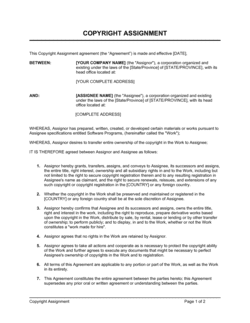
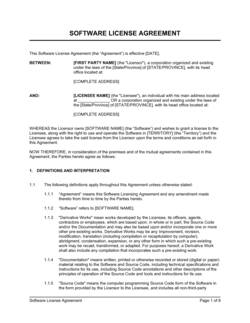
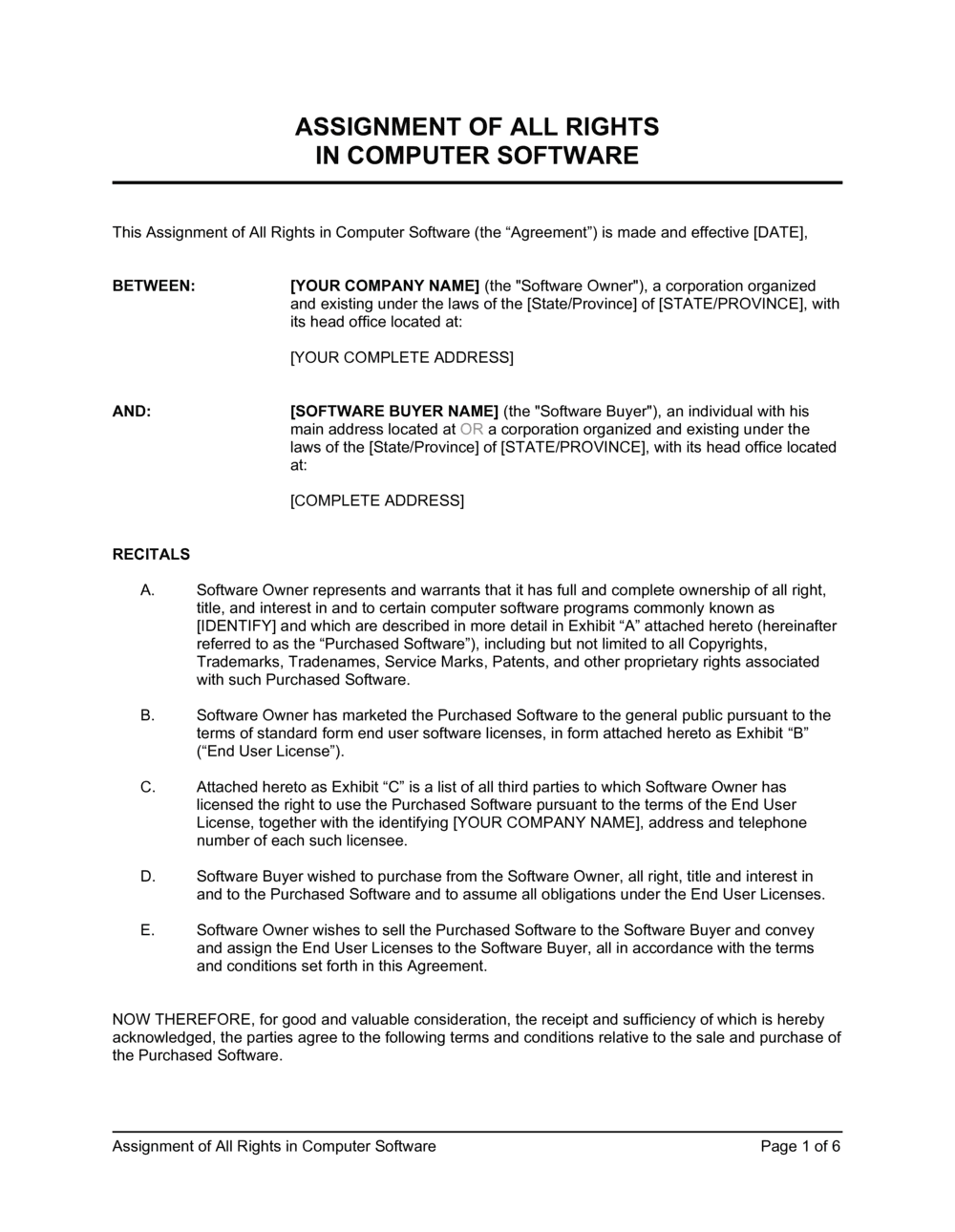
Assignment of All Rights in Computer Software Template

Free Word download • Edit online • Save & share with Drive • Export to PDF

6 pages25–35 min to fillDifficulty: ComplexSignature requiredLegal review recommended
Learn more ↓
FreeAssignment of All Rights in Computer Software Template

At a glance

What it is
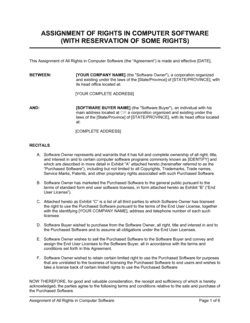
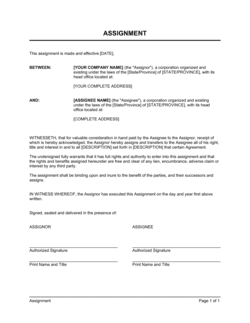
An Assignment of All Rights in Computer Software is a legally binding agreement through which an assignor (typically a developer or software company) transfers full and exclusive ownership of a software program — including all copyrights, patents, trade secrets, and related IP — to an assignee (typically a buyer or commissioning company). This free Word download covers all core transfer clauses, representations, warranties, and consideration terms; edit it online and export as PDF for execution.
When you need it
Use it when acquiring software built by a third-party developer or agency, when an employee or contractor has created software outside a standard IP assignment clause, or when a company is divesting a software product as part of a sale or restructuring. It is also required when a founder assigns pre-incorporation software to a newly formed entity.
What's inside
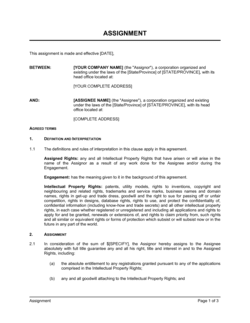
Parties and recitals, a precise description of the software being assigned, the scope of rights transferred (copyright, patents, source code, documentation, and derivative works), representations and warranties by the assignor, consideration and payment terms, moral rights waiver, and governing law and dispute resolution clauses.

What is an Assignment of All Rights in Computer Software?

An Assignment of All Rights in Computer Software is a legally binding agreement through which an assignor — typically a developer, agency, or prior owner — permanently and irrevocably transfers full intellectual property ownership of a software program to an assignee. The transfer is comprehensive: it covers copyright in the source and object code, any applicable patent rights, trade secrets embedded in the architecture or algorithms, related documentation, and the right to create derivative works. Unlike a software license, which grants permission to use the software while the licensor retains ownership, an assignment extinguishes the assignor's rights entirely and makes the assignee the sole legal owner of the software and all related IP.

This type of agreement is essential any time money changes hands for software that one party builds and another party wants to own outright. Without a signed, written assignment, the developer — whether an independent contractor, an agency, or even a co-founder — typically retains copyright in the code they wrote, regardless of how much the other party paid for the work.

Why You Need This Document

The absence of a properly executed software assignment is one of the most common and costly IP errors discovered during startup due diligence and M&A transactions. Investors conducting a Series A review routinely find that core platform code was written by a contractor under an agreement with no IP assignment clause, or that a co-founder built the MVP before the company was incorporated and never formally transferred ownership. In both scenarios, the company does not legally own its own product — and the funding round stalls or falls through entirely until the chain of title is cleaned up.

Beyond the fundraising context, operating without a clean software assignment exposes the acquirer to infringement claims from prior contributors, inability to enforce the software's copyrights against competitors, and open-source compliance liabilities that can require public disclosure of proprietary source code. This template provides a complete, enforceable assignment covering all rights, representations, and warranties needed to establish clean title — and includes the further assurances clause that obligates the assignor to cooperate with copyright registrations and any future enforcement actions after the deal closes.

Which variant fits your situation?

If your situation is…Use this template
Transferring ownership of software built by a freelance developerAssignment of All Rights in Computer Software
Licensing software without transferring ownershipSoftware License Agreement
Engaging a developer before work begins with an IP assignment clauseIndependent Contractor Agreement
Assigning only specific copyright — not patents or trade secretsCopyright Assignment Agreement
Transferring software as part of a full business acquisitionAsset Purchase Agreement
Protecting software source code as confidential during negotiationsNon-Disclosure Agreement
Assigning IP created by an employee during employmentEmployment Contract with IP Assignment

Common mistakes to avoid

❌ Assigning copyright only, omitting patent and trade secret rights

Why it matters: Software may be protected simultaneously by copyright, patents, and trade secret law. An assignment limited to copyright leaves the assignor free to license the underlying patent or disclose the trade secret to competitors.

Fix: Use broad IP assignment language covering 'all right, title, and interest, including all copyrights, patents, trade secrets, and other intellectual property rights' throughout the world.

❌ No open-source component disclosure

Why it matters: Software incorporating GPL, AGPL, or LGPL components carries copyleft obligations that can require the assignee to release their own source code. Undisclosed open-source creates significant downstream legal and commercial risk.

Fix: Require the assignor to attach a software bill of materials (SBOM) as an exhibit and warrant that all open-source components are identified, with their license terms disclosed.

❌ Skipping the chain of title verification

Why it matters: If prior contractors, employees, or co-founders contributed to the software without executing their own IP assignments, the assignor may not hold clear title — meaning the entire assignment transfers incomplete rights.

Fix: Require the assignor to represent that all contributors have assigned their rights, and request copies of prior assignment agreements or contractor IP clauses before closing.

❌ Omitting the further assurances clause

Why it matters: After the deal closes, the assignee may need the assignor's cooperation to register the copyright, record the assignment with a patent office, or respond to an infringement challenge. Without a contractual obligation to assist, the assignor may refuse.

Fix: Include a further assurances clause requiring the assignor to execute any additional documents and cooperate with government filings at the assignee's reasonable request and expense.

❌ No confidentiality obligation on the assignor post-closing

Why it matters: The assignor retains detailed knowledge of the codebase architecture, algorithms, and technical design. Without a post-assignment confidentiality obligation, they can share this with competitors or use it in competing products.

Fix: Add a confidentiality clause binding the assignor to keep all technical information, source code, and documentation confidential for a defined period — typically 3–5 years — after closing.

❌ Nominal or undocumented consideration

Why it matters: Reciting '$1 and other good and valuable consideration' is technically sufficient in some jurisdictions but creates a weak evidentiary record and can be challenged if the assignor later claims the assignment was not genuinely voluntary.

Fix: State the actual purchase price in the agreement. If the assignment is part of a broader transaction, reference the total deal value and describe how this assignment fits within it.

The 10 key clauses, explained

Parties and recitals

In plain language: Identifies the assignor and assignee by full legal name and entity type, and summarizes the background context — why the assignment is taking place.

Sample language
This Assignment of All Rights in Computer Software ('Agreement') is made as of [DATE] between [ASSIGNOR LEGAL NAME], a [STATE/PROVINCE] [ENTITY TYPE] ('Assignor'), and [ASSIGNEE LEGAL NAME], a [STATE/PROVINCE] [ENTITY TYPE] ('Assignee').

Common mistake: Using trade names or doing-business-as names instead of registered legal entity names. If the named assignor does not hold legal title, the assignment cannot transfer clean ownership.

Description and identification of the software

In plain language: Precisely describes the software being assigned — name, version, functionality, and all associated components including source code, object code, documentation, and development tools.

Sample language
Assignor hereby assigns to Assignee all rights in the software known as '[SOFTWARE NAME]', version [X.X], including all source code, object code, algorithms, documentation, test suites, build scripts, and associated materials described in Exhibit A.

Common mistake: Using a generic description like 'the software' without an attached exhibit. Vague identification creates disputes about what was actually transferred, especially for software with multiple modules or versions.

Scope of rights transferred

In plain language: States that the assignor is transferring every conceivable IP right — copyright, patent rights, trade secrets, trademarks, and the right to create derivative works — worldwide and in perpetuity.

Sample language
Assignor irrevocably assigns to Assignee all right, title, and interest in and to the Software, including all copyrights, patent rights, trade secret rights, trademark rights, and any other intellectual property rights, throughout the world, in perpetuity.

Common mistake: Limiting the assignment to copyright only. A software program may also be covered by patents and trade secret law; omitting these rights leaves the assignee with incomplete ownership that competitors or the assignor can later exploit.

Derivative works and improvements

In plain language: Confirms that the assignment covers not only the current version but all future modifications, enhancements, and derivative works the assignor has already created or will create from the software.

Sample language
The assignment includes all derivative works, improvements, enhancements, and modifications to the Software created by Assignor prior to the Effective Date, whether or not separately identified in Exhibit A.

Common mistake: Limiting the assignment to the current version without capturing prior iterations or in-progress work. A developer who retains rights to an earlier version may rebuild competing software from that foundation.

Representations and warranties

In plain language: The assignor confirms they own the rights being transferred, the software does not infringe third-party IP, no conflicting licenses have been granted, and the software was created without unauthorized third-party contributions.

Sample language
Assignor represents and warrants that: (a) Assignor is the sole owner of all rights assigned herein; (b) the Software does not infringe any third-party intellectual property rights; (c) no conflicting licenses, liens, or encumbrances exist on the Software; and (d) no open-source components are incorporated that would affect Assignee's ownership.

Common mistake: No open-source disclosure warranty. Software containing GPL or AGPL-licensed components can impose copyleft obligations that require the assignee to release their own code — a material defect the assignor must disclose.

Consideration and payment

In plain language: States the price paid for the assignment, the payment schedule, and any conditions precedent to payment — such as delivery of complete source code.

Sample language
In consideration for this Assignment, Assignee shall pay Assignor the sum of $[AMOUNT] USD, payable as follows: [PAYMENT SCHEDULE]. Payment is conditioned upon Assignor's delivery of all materials listed in Exhibit A.

Common mistake: Reciting nominal or no consideration (e.g., '$1 and other good and valuable consideration'). While this may be technically valid in some jurisdictions, it can be challenged as inadequate consideration and creates a weak enforcement record.

Moral rights waiver

In plain language: The assignor waives any moral rights they hold in the software — particularly relevant in jurisdictions like Canada, the UK, France, and Germany — so the assignee can modify, rebrand, or alter the software without the original author's consent.

Sample language
To the fullest extent permitted by applicable law, Assignor irrevocably waives all moral rights in the Software, including the right of attribution and the right to object to modifications or derivative works.

Common mistake: Omitting the moral rights waiver entirely for international assignments. In France, Germany, and Quebec, moral rights are inalienable by statute — the waiver reduces risk even where full waiver is not enforceable, and signals intent.

Further assurances

In plain language: Requires the assignor to sign any additional documents, execute government filings, or take any further steps reasonably needed to perfect the assignee's ownership of the software.

Sample language
Assignor agrees to execute and deliver, at Assignee's reasonable request and expense, any additional documents and instruments necessary to perfect, record, or enforce Assignee's rights in the Software in any jurisdiction.

Common mistake: No further assurances clause. Without it, the assignee may have no contractual basis to compel the assignor to assist with copyright office registrations or patent assignments after the deal closes.

Confidentiality

In plain language: Obligates both parties to keep the software's source code, technical details, and the terms of the assignment confidential — critical when the software is a core competitive asset.

Sample language
Each party shall keep confidential the terms of this Agreement and all technical information, source code, and documentation relating to the Software, and shall not disclose such information to any third party without prior written consent.

Common mistake: Skipping confidentiality on the basis that the assignee now owns the software. The assignor retains knowledge of the codebase — without a confidentiality obligation, they can freely share architectural details or approach the assignee's competitors.

Governing law and dispute resolution

In plain language: Specifies which jurisdiction's law governs the agreement and how disputes are resolved — litigation, arbitration, or mediation — and where proceedings must take place.

Sample language
This Agreement is governed by the laws of [STATE / PROVINCE / COUNTRY]. Any dispute arising hereunder shall be resolved by binding arbitration in [CITY] under the rules of [AAA / JAMS / applicable body], except that either party may seek injunctive relief in any court of competent jurisdiction.

Common mistake: Choosing a governing law jurisdiction that has no connection to either party. Courts in some jurisdictions will decline to apply a chosen law that is purely arbitrary, reverting to the forum's own conflict-of-laws rules.

How to fill it out

  1. 1

    Identify both parties with their full legal names

    Enter the assignor's and assignee's registered legal entity names, jurisdictions of incorporation, and principal addresses. Confirm names against corporate registry filings before signing.

    💡 If the assignor is a natural person (solo developer), include their full legal name and country of residence — this matters for moral rights analysis under applicable law.

  2. 2

    Describe the software precisely in Exhibit A

    List every component being transferred: software name, version number, repository URL or commit hash, documentation files, build configurations, and any related trademarks. Attach the exhibit to the agreement before signing.

    💡 Include a SHA-256 hash of the source code archive at the time of signing. This creates an immutable record of exactly what was delivered and eliminates later disputes about version completeness.

  3. 3

    Confirm and document the chain of title

    Verify that the assignor holds clean title to all components — including any modules built by prior contractors or employees. If third parties contributed, obtain written confirmations or prior assignment agreements before proceeding.

    💡 Request a full list of all contributors to the codebase and any open-source libraries used. GPL v3 or AGPL components can impose downstream obligations that materially affect the assignee's rights.

  4. 4

    Set the consideration amount and payment conditions

    Enter the purchase price, payment schedule, and any conditions — such as delivery of complete source code or passing acceptance tests — that must be met before each payment is released.

    💡 Structure payment as a deposit on signing and final payment on verified delivery rather than full payment upfront. This gives the assignee leverage to enforce complete handover.

  5. 5

    Review and tailor the representations and warranties

    Read each warranty carefully against what you know about the software's history. Add a specific warranty covering open-source license disclosure and confirm no third-party IP claims are outstanding.

    💡 Ask the assignor to attach a software bill of materials (SBOM) as an exhibit — this documents every library and its license and supports the warranty of non-infringement.

  6. 6

    Include the moral rights waiver for international assignments

    Confirm whether the assignor is based in or the agreement is governed by a jurisdiction that recognizes moral rights (Canada, UK, EU member states). Ensure the waiver clause is present and explicitly covers the right of attribution and right of integrity.

    💡 In France, moral rights cannot be fully waived by statute — include the waiver regardless, as it evidences intent and limits claims in jurisdictions where partial waiver is recognized.

  7. 7

    Select governing law based on the parties' locations

    Choose the jurisdiction where the assignee is based or where the software will primarily be used. Confirm the choice with legal counsel if the parties are in different countries.

    💡 For US-based assignments, specify the state — not just 'United States' — as copyright and contract law varies by state in some respects and arbitration venue must be specific.

  8. 8

    Execute and file with the relevant copyright office

    Both parties must sign the agreement — in wet ink or with a valid e-signature. After execution, consider recording the assignment with the US Copyright Office or the relevant national registry to put third parties on notice of the ownership change.

    💡 In the US, recording an assignment with the Copyright Office costs $105 per title and creates a public record that protects against subsequent conflicting transfers — well worth the investment for commercially significant software.

Frequently asked questions

What is an assignment of all rights in computer software?

An assignment of all rights in computer software is a legal agreement through which the current rights holder — typically a developer, agency, or prior owner — permanently transfers full intellectual property ownership of a software program to a new owner. The transfer covers copyright, patent rights, trade secrets, and related IP, and is worldwide and permanent. Once executed, the assignor retains no rights to the software and the assignee becomes the sole owner.

When do I need a software rights assignment agreement?

You need one any time you are paying for software to be built and want to own the result outright rather than merely license it. Common triggers include: buying a custom application from a development agency, acquiring a software product as part of a business purchase, formalizing ownership of software built by a contractor outside a standard employment or contractor IP clause, or assigning pre-incorporation software from a founder to a new company before a fundraising round.

What is the difference between a software assignment and a software license?

A software assignment permanently transfers ownership — after it closes, the original developer has no rights to the software. A software license grants permission to use the software under defined conditions while the licensor retains ownership. If you need to use the software exclusively, modify it freely, sublicense it, or sell it, you need an assignment. If the developer will continue to use or sell the same software to others, a license is the appropriate structure.

Does a software assignment need to be in writing?

Yes. Copyright assignments must be in writing and signed by the assignor to be enforceable under US copyright law (17 U.S.C. § 204(a)), the UK Copyright, Designs and Patents Act 1988, and similar statutes in most jurisdictions. An oral agreement to assign software rights is generally not legally effective, even if the developer has been paid in full.

What happens if the developer used open-source libraries in the software?

Open-source libraries carry their own license terms that survive a software assignment. Components licensed under copyleft licenses such as GPL v3 or AGPL require any modified or derivative version to be released under the same license — which can effectively prevent commercialization of proprietary software. Before executing an assignment, require the assignor to provide a full software bill of materials (SBOM) identifying every library and its license, and have counsel assess any copyleft risk.

What are moral rights and why do they matter in a software assignment?

Moral rights are non-economic rights that allow a creator to claim authorship and object to modifications or uses that damage their reputation. They exist in Canada, the UK, France, Germany, and most EU member states. Unlike economic rights, moral rights cannot be fully waived by statute in some jurisdictions. A software assignment should include an express moral rights waiver so the assignee can modify, rebrand, or alter the software without the original author's objection — even where the waiver is only partially effective by law.

Can an employee's software be assigned under this agreement?

Software created by an employee within the scope of their employment typically belongs to the employer automatically under the work-made-for-hire doctrine in the US and equivalent provisions in other jurisdictions — no separate assignment is needed. However, if the software was created outside the scope of employment, on personal time, or using personal equipment in a jurisdiction that protects employee inventions, an explicit assignment agreement is required. California Labor Code § 2870 limits employer claims to off-duty inventions that use no company resources.

Do I need a lawyer to execute a software assignment?

For routine assignments of moderate-value software between clear parties with a clean chain of title, a high-quality template is a practical starting point. Engage a lawyer when the software is a core business asset worth more than $50,000, when patent rights are involved, when there are open-source compliance questions, when the parties are in different countries, or when a prior contractor or employee chain of title is uncertain. A targeted 1–2 hour review typically costs $400–$800 and is worthwhile for any commercially significant software asset.

How this compares to alternatives

vs Software License Agreement

A software license grants the licensee the right to use the software under defined conditions while the original owner retains all IP rights. An assignment permanently transfers ownership — the assignor walks away with no residual rights. If the developer intends to sell or license the same software to others, a license is the correct structure; if the buyer needs exclusive control, use an assignment.

vs Independent Contractor Agreement

An independent contractor agreement engages a developer for project-based work and typically includes an IP assignment clause, but that clause transfers only the rights created during the specific engagement. A standalone software assignment is used after the fact — when a contractor agreement had no IP clause, when software predates the engagement, or when a comprehensive transfer document is required for a transaction or due diligence process.

vs Non-Disclosure Agreement

An NDA protects confidential information shared during negotiations but transfers no rights. Parties negotiating a software acquisition often execute an NDA first to allow the buyer to inspect the source code, then follow it with a software assignment once terms are agreed. Both documents are typically needed — the NDA does not substitute for the assignment.

vs Asset Purchase Agreement

An asset purchase agreement covers the transfer of an entire business's assets — inventory, contracts, customer lists, equipment, and IP as a bundle. A software assignment is a focused IP-transfer instrument used when only the software itself is being acquired, or as a scheduled exhibit within a broader asset purchase. For software-only transactions, the standalone assignment is cleaner and faster to execute.

Industry-specific considerations

Technology / SaaS

Core platform IP assignments between co-founders and the legal entity are routinely required by Series A investors as a condition of funding, making chain-of-title verification critical.

Financial Services / Fintech

Proprietary trading algorithms and risk models are typically assigned from developer to firm with enhanced confidentiality terms and specific patent-right transfer language given their competitive sensitivity.

Healthcare / MedTech

Software embedded in medical devices may require FDA 510(k) documentation that names the legal owner — an executed assignment is a prerequisite for regulatory submissions that list the acquiring entity.

Professional Services / Agencies

Development agencies building client-commissioned software use assignment agreements to formally hand over ownership upon final payment, distinguishing commissioned work from their own reusable frameworks and toolkits.

Jurisdictional notes

United States

Under 17 U.S.C. § 204(a), a copyright assignment must be in writing and signed by the assignor to be valid. The work-made-for-hire doctrine (17 U.S.C. § 101) automatically vests copyright in the employer for software created by employees within the scope of employment, but not for independent contractors. Recording the assignment with the US Copyright Office ($105 per title) protects against subsequent conflicting transfers. California Labor Code § 2870 limits an employer's ability to claim rights to software developed entirely on the employee's own time without company resources.

Canada

Under the Copyright Act (R.S.C. 1985, c. C-42), an assignment of copyright must be in writing and signed by the owner. Canada recognizes moral rights, which cannot be assigned but can be waived — a written moral rights waiver should accompany every assignment. In Quebec, civil law principles apply alongside the federal Copyright Act, and French-language contracts may be required for provincially regulated employers. Software created by an employee in the course of employment vests in the employer by default; contractor-created software requires an explicit assignment.

United Kingdom

Under the Copyright, Designs and Patents Act 1988, a copyright assignment must be in writing and signed by or on behalf of the assignor. Moral rights exist for software authors but can be waived by contract. Software created by an employee in the course of employment belongs to the employer automatically (s.11 CDPA 1988); contractor-created software belongs to the contractor absent a written assignment. Post-Brexit, the UK operates its own IP registration system separate from the EU, and assignments of registered rights should be recorded with the UK Intellectual Property Office.

European Union

The EU Software Directive (2009/24/EC) harmonizes copyright protection for computer programs across member states, but assignment formalities and moral rights treatment vary. France, Germany, and the Netherlands impose strong moral rights protections — French moral rights are inalienable by statute and cannot be fully waived. In Germany, copyright in software cannot be fully assigned; instead, an exclusive, irrevocable, unlimited license may be used to achieve a similar commercial outcome. GDPR compliance obligations transfer with the software if it processes personal data, and the assignee assumes controller or processor responsibilities from closing.

Template vs lawyer — what fits your deal?

PathBest forCostTime
Use the templateStraightforward domestic software transfers between clear parties with a verified chain of title and no patent or open-source complicationsFree30–60 minutes
Template + legal reviewMid-value software assets, cross-border assignments, open-source component questions, or uncertain chain of title involving prior contractors$400–$8002–5 days
Custom draftedHigh-value software acquisitions, software with active patents, assignments as part of M&A transactions, or regulated industries (medical device, fintech)$2,000–$8,000+1–3 weeks

Glossary

Assignor
The party transferring ownership of the software rights — typically the developer, agency, or current rights holder.
Assignee
The party receiving full ownership of the software rights — typically the buyer, employer, or commissioning company.
Intellectual Property (IP)
Legal rights protecting creations of the mind, including copyrights, patents, trade secrets, and trademarks.
Copyright
Automatic legal protection for original software code and documentation that prevents unauthorized copying or distribution.
Source Code
The human-readable version of a software program, as opposed to compiled object code — typically the most valuable component of a software assignment.
Derivative Works
New software created by modifying, adapting, or building upon the original program — an assignment of all rights should explicitly include future derivative works.
Moral Rights
Rights in some jurisdictions allowing the creator to be identified as the author and to object to modifications — often waived in commercial software assignments.
Consideration
The payment or other value exchanged for the assignment — without documented consideration, the assignment may be unenforceable in many jurisdictions.
Work Made for Hire
A US copyright doctrine under which software created by an employee within the scope of employment automatically belongs to the employer, without a separate assignment.
Escrow (Source Code Escrow)
An arrangement where source code is deposited with a neutral third party and released to the assignee only upon defined trigger events, such as the assignor's insolvency.
Warranty of Non-Infringement
A representation by the assignor that the software does not infringe any third-party patent, copyright, or trade secret.
Chain of Title
The documented sequence of ownership transfers establishing that the current assignor has the legal authority to transfer rights free of third-party claims.

Part of your Business Operating System

This document is one of 3,000+ business & legal templates included in Business in a Box.

  • Fill-in-the-blanks — ready in minutes
  • 100% customizable Word document
  • Compatible with all office suites
  • Export to PDF and share electronically

Create your document in 3 simple steps.

From template to signed document — all inside one Business Operating System.
1
Download or open template

Access over 3,000+ business and legal templates for any business task, project or initiative.

2
Edit and fill in the blanks with AI

Customize your ready-made business document template and save it in the cloud.

3
Save, Share, Send, Sign

Share your files and folders with your team. Create a space of seamless collaboration.

Save time, save money, and create top-quality documents.

★★★★★

"Fantastic value! I'm not sure how I'd do without it. It's worth its weight in gold and paid back for itself many times."

Managing Director · Mall Farm
Robert Whalley
Managing Director, Mall Farm Proprietary Limited
★★★★★

"I have been using Business in a Box for years. It has been the most useful source of templates I have encountered. I recommend it to anyone."

Business Owner · 4+ years
Dr Michael John Freestone
Business Owner
★★★★★

"It has been a life saver so many times I have lost count. Business in a Box has saved me so much time and as you know, time is money."

Owner · Upstate Web
David G. Moore Jr.
Owner, Upstate Web

Run your business with a system — not scattered tools

Stop downloading documents. Start operating with clarity. Business in a Box gives you the Business Operating System used by over 250,000 companies worldwide to structure, run, and grow their business.

Start free · No credit card required