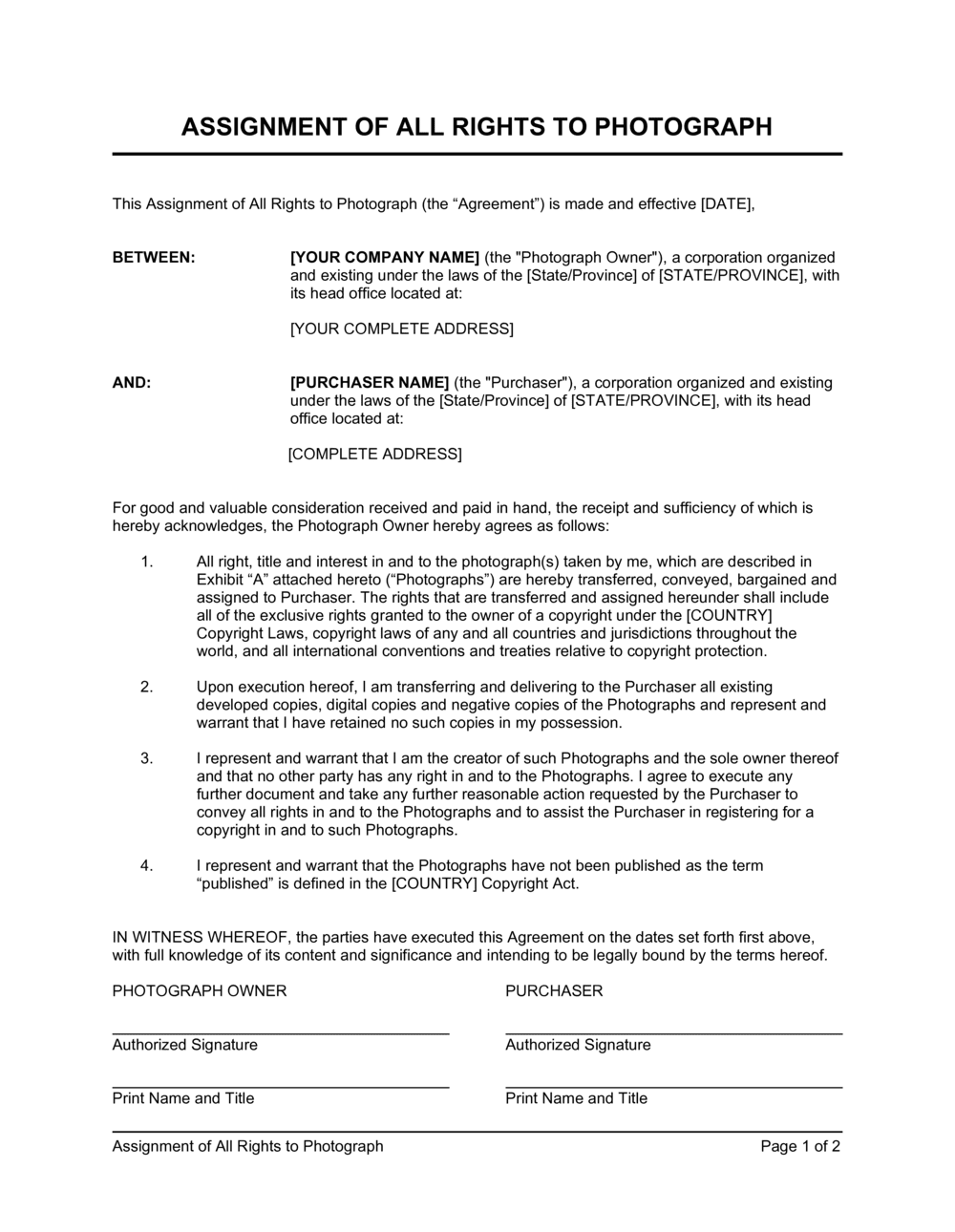
Assignment of All Rights to Photograph Template

Free Word download β€’ Edit online β€’ Save & share with Drive β€’ Export to PDF

2 pagesβ€’20–30 min to fillβ€’Difficulty: Standardβ€’Signature requiredβ€’Legal review recommended
Learn more ↓
FreeAssignment of All Rights to Photograph Template

At a glance

What it is
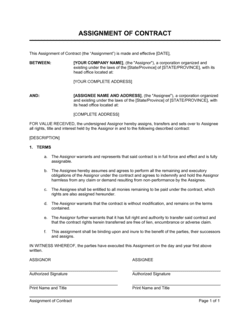
An Assignment of All Rights to Photograph is a legally binding agreement in which a photographer or copyright holder (the assignor) permanently transfers all intellectual property rights in one or more photographs to another party (the assignee). This free Word download lets you document the transfer of ownership clearly, covering copyright, moral rights waivers, and the right to reproduce, modify, and commercialize the images β€” edit online and export as PDF for execution.
When you need it
Use it when a business purchases original photographs from a freelance photographer, when an employer needs to confirm that work-product images created by a contractor belong to the company, or when an individual sells photographic works and wants a clean, enforceable record of the transfer. It is also common in mergers and acquisitions when a portfolio of image assets changes hands.
What's inside
Identification of the assignor and assignee, a precise description of the photographs being assigned, the scope of rights transferred (including copyright, reproduction, distribution, and derivative works), any consideration paid, representations and warranties by the assignor, a moral rights waiver, and governing law.

What is an Assignment of All Rights to Photograph?

An Assignment of All Rights to Photograph is a legally binding agreement in which the copyright owner of one or more photographs β€” typically the photographer who created them β€” permanently transfers every intellectual property right in those images to another party. The document covers the full bundle of copyright interests: the right to reproduce, distribute, display, modify, and create derivative works from the photographs, worldwide and in perpetuity. Unlike a photography license, which allows defined use while the photographer retains ownership, an assignment is a complete and permanent ownership transfer β€” after execution, the assignee steps into the position of copyright holder as if they had created the work themselves.

Why You Need This Document

Without a signed, written assignment, copyright in a photograph remains with the photographer by default β€” regardless of what was paid, agreed verbally, or stated in an invoice. An assignee operating on the assumption of ownership who has not executed a formal agreement is exposed on multiple fronts: competitors can license the same images from the original photographer, the photographer can restrict how the assignee modifies or distributes the work, and a future investor or acquirer's due diligence team will flag the missing chain of title as an unresolved IP risk that can delay or kill a transaction. In Canada, the UK, and the EU, moral rights add a further layer of exposure β€” photographers can object to modifications or demand attribution unless those rights have been explicitly waived in writing. A properly executed assignment, with a schedule that precisely identifies every photograph transferred, closes each of these gaps for the cost of a short document and a brief review.

Which variant fits your situation?

If your situation is…Use this template
Granting limited usage rights without giving up ownershipPhotography License Agreement
Hiring a photographer for a specific event or projectPhotography Services Agreement
Transferring copyright in written, musical, or general creative worksAssignment of All Rights (General)
Assigning rights to software or digital content rather than photographsIntellectual Property Assignment Agreement
Obtaining a model's consent to use their likeness in photographsModel Release Form
Allowing a third party to use images under defined conditions for a set periodImage License Agreement
Commissioning original photography as an employer with work-for-hire intentWork for Hire Agreement

Common mistakes to avoid

❌ Imprecise identification of the photographs

Why it matters: Disputes about which images are covered can render the assignment unenforceable for specific files, leaving the assignee without clear ownership of images they have already used commercially.

Fix: Attach a schedule listing every image by file name, subject description, and date taken. For large volumes, reference a shared digital folder with a fixed, dated file listing.

❌ Omitting the moral rights waiver

Why it matters: In Canada, the UK, and the EU, moral rights survive a copyright assignment unless separately waived. The assignee can face claims if they modify, crop, or republish images without crediting the original photographer.

Fix: Include an explicit moral rights waiver clause and tailor it to the governing jurisdiction. For international use, include waivers under all relevant national laws by name.

❌ No representations about model or property releases

Why it matters: An assignee who publishes photographs of identifiable people without valid model releases inherits right-of-publicity and privacy liability that no copyright assignment can extinguish.

Fix: Add a warranty requiring the assignor to confirm that all necessary model and property releases are in place, and attach copies of those releases to the agreement as exhibits.

❌ Relying on an invoice or email chain instead of a signed assignment

Why it matters: An invoice noting 'all rights transferred' or an email confirming the same is not a reliable substitute for a formal written assignment. Courts in most jurisdictions require clear, unambiguous written evidence to transfer copyright.

Fix: Always execute a standalone assignment agreement regardless of what is documented in invoices or correspondence. The cost of doing so is far lower than litigating ambiguous rights years later.

❌ No further assurances clause

Why it matters: Without it, if the assignee needs the assignor to sign additional documents to register the transfer with a copyright office, the assignor has no contractual obligation to cooperate.

Fix: Include a standard further assurances clause requiring the assignor to execute any additional instruments needed to record or perfect the assignment, at the assignee's reasonable request and expense.

❌ Choosing an unconnected governing law jurisdiction

Why it matters: A contract governed by a jurisdiction where neither party operates may be unenforceable in a practical forum, and courts in the parties' home jurisdictions may apply their own law regardless of the contract's choice.

Fix: Choose the governing law of the jurisdiction where the assignee is incorporated or primarily operates. For cross-border agreements, confirm that the chosen law is recognized in both parties' home jurisdictions.

The 9 key clauses, explained

Identification of parties

In plain language: Names the assignor and assignee as legal entities or individuals, including addresses and the date of the agreement.

Sample language
This Assignment of All Rights to Photograph (the 'Agreement') is entered into as of [DATE] by and between [ASSIGNOR FULL NAME / ENTITY], located at [ADDRESS] ('Assignor'), and [ASSIGNEE FULL NAME / ENTITY], located at [ADDRESS] ('Assignee').

Common mistake: Using a trade name or social media handle instead of the photographer's legal name. If enforcement becomes necessary, the contract may be difficult to connect to the correct legal person.

Description and identification of the photographs

In plain language: Precisely identifies which photographs are being assigned β€” by title, file name, date taken, subject matter, or an attached schedule.

Sample language
Assignor hereby assigns to Assignee all rights in and to the photographs listed in Schedule A attached hereto, including [DESCRIPTION OF SUBJECT / FILE NAMES / DATES TAKEN] (collectively, the 'Photographs').

Common mistake: Using vague language like 'all photographs taken during the project.' If the scope is disputed later, a court will need to determine which images were captured during that project β€” specific identification eliminates that risk.

Assignment of copyright and all rights

In plain language: The core clause transferring every copyright interest β€” reproduction, distribution, display, performance, and the right to create derivative works β€” to the assignee, worldwide and in perpetuity.

Sample language
Assignor hereby irrevocably assigns to Assignee, its successors and assigns, the entire right, title, and interest in and to the Photographs, including all copyright and all rights of reproduction, distribution, display, modification, and creation of derivative works, in all media now known or hereafter developed, throughout the world, for the full term of copyright protection.

Common mistake: Omitting 'in all media now known or hereafter developed.' Without this phrase, the assignee may need to renegotiate rights for new distribution formats β€” digital, streaming, VR β€” that emerge after the contract is signed.

Consideration and payment

In plain language: States the price paid for the assignment and when it is due, confirming that value has been exchanged to make the contract binding.

Sample language
In consideration of the assignment of rights set forth herein, Assignee shall pay Assignor the sum of $[AMOUNT] ([AMOUNT IN WORDS] Dollars), due and payable on [DATE / upon execution / net [X] days].

Common mistake: Listing $0 or 'one dollar' as a formality without noting other consideration already exchanged (such as the photography services fee). Courts in some jurisdictions will scrutinize nominal consideration more closely in disputes.

Moral rights waiver

In plain language: The assignor waives any moral rights β€” including the right of attribution and the right to object to modifications β€” to the extent permitted by applicable law.

Sample language
To the extent permitted by applicable law, Assignor irrevocably waives all moral rights, including the right of attribution and the right to object to derogatory treatment of the Photographs, in favor of Assignee and any subsequent owner of the rights.

Common mistake: Omitting a moral rights waiver entirely. In Canada, the UK, and the EU, moral rights survive copyright assignment unless expressly waived β€” leaving the assignee exposed to claims if they crop, recolor, or modify the images without crediting the original photographer.

Representations and warranties

In plain language: The assignor confirms they are the sole owner of the copyright, that no third parties have any interest in the work, and that the images do not infringe any existing copyright, trademark, or right of publicity.

Sample language
Assignor represents and warrants that: (a) Assignor is the sole and exclusive owner of all rights assigned herein; (b) the Photographs do not infringe any third party's intellectual property, privacy, or publicity rights; and (c) Assignor has full authority to enter into and perform this Agreement.

Common mistake: No warranty that visible third-party subjects have provided model releases. If identifiable people appear in the photographs and releases are absent, the assignee inherits the risk of right-of-publicity claims.

Indemnification

In plain language: Requires the assignor to defend and compensate the assignee if a third party brings a claim arising from a breach of the assignor's representations β€” for example, a model suing over an unlicensed likeness.

Sample language
Assignor agrees to indemnify, defend, and hold harmless Assignee and its officers, directors, and agents from any claims, damages, or expenses (including reasonable attorneys' fees) arising out of any breach of Assignor's representations and warranties in this Agreement.

Common mistake: One-sided indemnification that only covers the assignor's representations but not the assignee's downstream use. For a balanced agreement, consider mutual indemnification covering each party's own acts.

Further assurances

In plain language: Requires the assignor to sign any additional documents or take further actions reasonably needed to perfect the copyright transfer β€” such as filing a copyright assignment with a national registry.

Sample language
Assignor agrees to execute and deliver, upon Assignee's request, any additional documents or instruments reasonably necessary to effectuate, record, or confirm the assignment of rights set forth in this Agreement, including any documents required by [COPYRIGHT OFFICE / RELEVANT REGISTRY].

Common mistake: Skipping this clause entirely. Without it, if the assignee later wants to register the assignment with the US Copyright Office or a national IP registry, they may have no contractual right to compel the assignor to cooperate.

Governing law and dispute resolution

In plain language: Specifies which jurisdiction's law governs the agreement and how disputes will be resolved β€” arbitration, mediation, or litigation in a named court.

Sample language
This Agreement shall be governed by and construed in accordance with the laws of [STATE / PROVINCE / COUNTRY], without regard to conflict-of-law principles. Any dispute arising hereunder shall be resolved by [binding arbitration / mediation / litigation] in [CITY, JURISDICTION].

Common mistake: Choosing a governing law jurisdiction where neither party operates. A court in a third location may decline jurisdiction, and the chosen law may be unfamiliar to any practical enforcer of the agreement.

How to fill it out

  1. 1

    Identify the parties with their legal names

    Enter the assignor's and assignee's full legal names β€” for individuals, the name on government-issued ID; for entities, the registered corporate name. Include current addresses for both.

    πŸ’‘ If the photographer operates through a business entity, confirm whether the copyright is held by the individual or the entity β€” this determines who signs as assignor.

  2. 2

    Describe the photographs precisely

    List every image being assigned in Schedule A using file names, descriptions, dates taken, and subject matter. Attach digital thumbnails or reference a shared folder if the volume is large.

    πŸ’‘ Assign a unique identifier to each image in the schedule β€” even a sequential number β€” so there is no ambiguity about which files are included if the assignment is ever challenged.

  3. 3

    Confirm the scope of rights transferred

    Verify that the assignment clause covers all rights worldwide, in perpetuity, in all media including future formats. If the assignee only needs rights in specific territories or for a fixed term, adjust the clause accordingly.

    πŸ’‘ A full buyout (worldwide, perpetual) is simpler to administer than a limited assignment. If budget is the reason for limiting scope, consider whether a perpetual license is more practical than a partial assignment.

  4. 4

    Enter the consideration amount and payment schedule

    State the total payment, broken down by milestone if applicable (e.g., 50% on signing, 50% on delivery). If the fee for the photography services was already paid under a separate agreement, note that reference here.

    πŸ’‘ Even if the photography services contract already includes a rights transfer, a standalone assignment agreement creates a cleaner chain of title for the assignee's IP records.

  5. 5

    Include a moral rights waiver appropriate for the jurisdiction

    For agreements governed by Canadian, UK, or EU law, add an explicit moral rights waiver. For US-governed agreements, include it anyway to cover any international distribution of the images.

    πŸ’‘ Some photographers object to blanket moral rights waivers. A compromise is to waive attribution requirements for commercial use but retain credit for editorial or fine-art contexts.

  6. 6

    Attach or reference model and property releases

    If identifiable people or private properties appear in the photographs, confirm that releases are in place and either attach them to the agreement or reference them by document name and date.

    πŸ’‘ Collect releases before signing the assignment β€” discovering a missing release after payment creates leverage for the assignor to demand more money.

  7. 7

    Execute before both parties sign

    Both the assignor and assignee must sign and date the agreement. In jurisdictions that permit it, e-signatures are valid for copyright assignments. Keep an executed copy in your IP records.

    πŸ’‘ Record the assignment with the US Copyright Office (Form CA) or equivalent national registry if the images have significant commercial value β€” registration strengthens enforceability and establishes public notice of the transfer.

  8. 8

    File the assignment in your IP asset register

    After execution, update your internal IP register with the photograph identifiers, assignor details, assignment date, and any purchase price. This supports due diligence in future fundraising or M&A transactions.

    πŸ’‘ Institutional investors and acquirers routinely request IP chain-of-title documentation during due diligence β€” a complete register means no last-minute scramble to locate signed agreements.

Frequently asked questions

What is an assignment of all rights to photograph?

An assignment of all rights to photograph is a written legal agreement in which the copyright owner of one or more photographs permanently transfers every intellectual property right in those images to another party. Unlike a license, which grants permission to use images under defined conditions, an assignment is a full ownership transfer β€” the assignee becomes the new copyright holder with the right to reproduce, modify, distribute, and commercialize the photographs without restriction.

Does a paid photography invoice automatically transfer copyright?

No. In most jurisdictions β€” including the US, Canada, the UK, and the EU β€” paying for photography services does not transfer copyright to the client. The photographer retains copyright unless the work qualifies as work for hire under statute, or unless a written assignment agreement is signed. Relying on an invoice or verbal agreement to establish ownership is unreliable and often fails in disputes.

Are moral rights affected by a photograph rights assignment?

In the US, moral rights for photographs are limited β€” the Visual Artists Rights Act applies only to fine-art prints in limited editions of 200 or fewer, not to commercial photography. In Canada, the UK, and the EU, photographers retain moral rights (right of attribution and right of integrity) even after assigning copyright, unless those rights are separately and explicitly waived in writing. Omitting a moral rights waiver in an international agreement is a common and costly mistake.

Can an assignment of photograph rights be reversed?

Generally, no β€” a properly executed assignment is a permanent transfer. However, US copyright law provides a statutory termination right allowing authors to reclaim assigned works after 35 years (for post-1978 works) under 17 U.S.C. Β§203, regardless of what the contract says. This right cannot be contracted away. In practice, this is most relevant for commercially significant photographic works with long-term value.

Do I need to register a photograph rights assignment with the Copyright Office?

Registration is not required for a copyright assignment to be valid in the US. However, recording the assignment with the US Copyright Office provides constructive notice to third parties and gives the assignee priority over any subsequent conflicting assignment. For photographs with significant commercial value, recording with the Copyright Office (Form CA) or the equivalent national registry is strongly recommended.

What happens if the photographer has already licensed the images to a third party?

An assignee takes the copyright subject to any pre-existing licenses the assignor has already granted β€” those licenses generally survive the assignment and bind the new owner. This is why the representations and warranties clause is critical: the assignor should warrant that no conflicting licenses exist, and the assignee should conduct basic due diligence before signing. Discovering an existing exclusive license after executing an assignment can significantly limit the value of what was transferred.

Is an electronic signature valid for a photograph rights assignment?

In most jurisdictions, yes. Under the US ESIGN Act and UETA, and under comparable laws in Canada, the UK, and the EU, electronic signatures are generally valid for copyright assignments. The agreement must still be in writing β€” a physical or electronic document β€” and both parties must sign. Some national copyright registries require ink signatures or notarization to record an assignment, so check local requirements before relying solely on an e-signature for filing purposes.

Should a separate assignment be used even if the photography services contract mentions rights transfer?

Yes, in most cases. A standalone assignment creates a clean, unambiguous chain of title that is easier to reference in due diligence, easier to record with copyright registries, and less prone to interpretation disputes than a rights-transfer clause buried in a services agreement. Institutional investors and acquirers routinely request separate IP assignment documents as part of deal diligence, and producing one retroactively is far more difficult than executing it at the time of the original transaction.

How this compares to alternatives

vs Photography License Agreement

A photography license grants specific usage rights for a defined period and purpose while the photographer retains copyright ownership. An assignment permanently transfers full ownership to the buyer. Use a license when you need limited, defined usage at a lower cost; use an assignment when you need unrestricted, permanent control or when you plan to resell or sublicense the images.

vs Work for Hire Agreement

A work for hire agreement establishes that the commissioning party owns copyright from the moment the work is created β€” no separate transfer is needed. An assignment is used after the fact, when copyright already vests in the photographer and must be transferred. If you are commissioning new photography, a work for hire agreement is often preferable; if photography has already been created and paid for, an assignment is the correct document.

vs Assignment of All Rights (General)

A general intellectual property assignment covers any type of original work β€” written content, software, music, or designs β€” while this template is purpose-built for photographs, including specific provisions for moral rights waivers, model release warranties, and image identification by file. Use the general assignment for non-photographic works; use this template when the subject matter is photographic images.

vs Model Release Form

A model release grants the photographer or assignee permission to use the likeness of an identifiable person in the photographs. It does not transfer copyright β€” it addresses right-of-publicity and privacy rights held by the subject. An assignment of photograph rights and a model release are complementary documents, not substitutes: you typically need both when the images include recognizable individuals.

Industry-specific considerations

Marketing and Advertising

Agencies and brand teams acquire full ownership of campaign photography to enable unrestricted use across paid media, OOH, and future brand assets without renegotiating rights each time.

Publishing and Media

Publishers acquiring editorial or cover photography need a full assignment to sublicense images to syndication partners, foreign editions, and digital archives without returning to the original photographer.

E-commerce and Retail

Product photography assigned outright eliminates per-channel licensing complexity and gives retailers the flexibility to use images across their own sites, marketplaces, and wholesale partner listings.

Technology / SaaS

Startups undergoing investor due diligence or acquisition need clean IP chain of title for all visual assets, including UI screenshots, product photography, and marketing imagery produced by contractors.

Jurisdictional notes

United States

Under the US Copyright Act (17 U.S.C. Β§204), a copyright assignment must be in writing and signed by the assignor to be valid. Moral rights for photographs are limited under VARA to fine-art prints of 200 or fewer β€” commercial photography is excluded. Authors retain a statutory right to terminate assignments after 35 years under Β§203, regardless of contractual language. Recording the assignment with the US Copyright Office (Form CA) provides constructive notice and priority over later conflicting assignments.

Canada

Under the Copyright Act (R.S.C. 1985, c. C-42), copyright assignments must be in writing and signed by the assignor. Moral rights β€” including attribution and integrity β€” survive any assignment unless expressly waived in writing; a waiver clause is essential. For photographs created before January 1, 1999, the copyright term and ownership rules differ. Quebec's Civil Code may affect enforcement of contractual provisions for Quebec-based assignors.

United Kingdom

Under the Copyright, Designs and Patents Act 1988, an assignment of copyright must be in writing and signed by or on behalf of the assignor to be effective. Moral rights for photographers β€” specifically the right of attribution and the right of integrity β€” apply to photographs and survive assignment unless waived. Future copyright (rights in works not yet created) can be assigned by agreement under UK law. Post-Brexit, EU copyright harmonization directives no longer automatically apply.

European Union

EU copyright law is harmonized through directives (notably 2001/29/EC and 2019/790/EU) but implemented at member-state level, so formality requirements vary. Most EU member states require written form for effective copyright assignments. Moral rights are strongly protected across the EU and generally cannot be waived in some member states (France, Germany) β€” consult local counsel before relying on a blanket waiver. The Digital Single Market Directive (2019/790) introduced new author remuneration rights that may limit the effect of broad buyout agreements in certain member states.

Template vs lawyer β€” what fits your deal?

PathBest forCostTime
Use the templateFreelance photographers and small businesses handling standard commercial photography buyouts at arm's lengthFree15–30 minutes
Template + legal reviewCross-border assignments, high-value image portfolios, or agreements where identifiable subjects appear and release status is uncertain$200–$5001–3 days
Custom draftedMajor brand or media acquisitions, M&A transactions involving significant image asset portfolios, or assignments in heavily regulated jurisdictions$1,000–$3,500+1–2 weeks

Glossary

Assignor
The party who currently holds the copyright in the photograph and is transferring those rights to another party.
Assignee
The party receiving full ownership of the copyright and all related rights in the photograph.
Copyright
An exclusive legal right that gives the creator of an original work control over its reproduction, distribution, display, and creation of derivative works.
Work for Hire
A legal doctrine under which copyright in a work created by an employee within the scope of employment β€” or by a contractor under a written agreement β€” belongs to the employer or commissioning party from the outset.
Moral Rights
Rights that protect an author's personal connection to their work, including the right of attribution and the right to object to changes that harm their reputation β€” recognized in Canada, the EU, and the UK, but not universally in the US.
Derivative Work
A new work based on or adapted from an existing work β€” such as cropping, colorizing, or compositing a photograph β€” that requires permission from the copyright owner to create.
Consideration
Something of value exchanged between the parties to make a contract legally binding β€” typically a payment amount, but can also be services or other benefits.
Representations and Warranties
Statements of fact made by a party at the time of signing, on which the other party relies β€” for example, the assignor's warranty that they own the rights being transferred and that the work does not infringe any third party's IP.
Perpetual Assignment
A transfer of rights that lasts for the full term of copyright protection β€” typically the author's life plus 70 years in most major jurisdictions β€” with no expiry date.
Chain of Title
A documented history of ownership transfers for a copyright, establishing that the current assignee holds clear and unencumbered rights to use the work.

Part of your Business Operating System

This document is one of 3,000+ business & legal templates included in Business in a Box.

  • Fill-in-the-blanks β€” ready in minutes
  • 100% customizable Word document
  • Compatible with all office suites
  • Export to PDF and share electronically

Create your document in 3 simple steps.

From template to signed document β€” all inside one Business Operating System.
1
Download or open template

Access over 3,000+ business and legal templates for any business task, project or initiative.

2
Edit and fill in the blanks with AI

Customize your ready-made business document template and save it in the cloud.

3
Save, Share, Send, Sign

Share your files and folders with your team. Create a space of seamless collaboration.

Save time, save money, and create top-quality documents.

β˜…β˜…β˜…β˜…β˜…

"Fantastic value! I'm not sure how I'd do without it. It's worth its weight in gold and paid back for itself many times."

Managing Director Β· Mall Farm
Robert Whalley
Managing Director, Mall Farm Proprietary Limited
β˜…β˜…β˜…β˜…β˜…

"I have been using Business in a Box for years. It has been the most useful source of templates I have encountered. I recommend it to anyone."

Business Owner Β· 4+ years
Dr Michael John Freestone
Business Owner
β˜…β˜…β˜…β˜…β˜…

"It has been a life saver so many times I have lost count. Business in a Box has saved me so much time and as you know, time is money."

Owner Β· Upstate Web
David G. Moore Jr.
Owner, Upstate Web

Run your business with a system β€” not scattered tools

Stop downloading documents. Start operating with clarity. Business in a Box gives you the Business Operating System used by over 250,000 companies worldwide to structure, run, and grow their business.

Start freeΒ Β·Β No credit card required