1
Identify both parties with full legal names
Enter the assignor's and assignee's complete registered legal names, entity types, and jurisdictions of formation. For individuals, use the full legal name as it appears on government ID.
💡 Run a quick corporate registry check before drafting — using a parent company name when the IP actually sits in a subsidiary creates a chain-of-title gap that surfaces in due diligence.
2
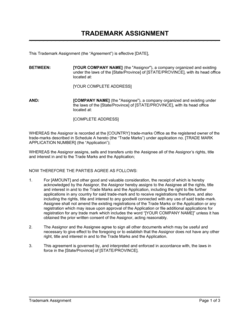
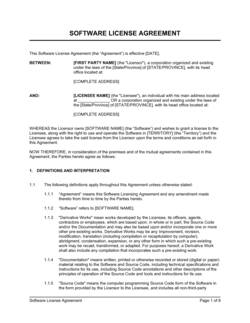
Complete Schedule A with a precise software description
List the software by name, version, repository URL or commit hash, and a description of all components being transferred — source code, object code, APIs, documentation, test suites, and any derivative works.
💡 For active codebases, include a Git repository reference (e.g., commit SHA at the date of assignment) so the exact state of the code at transfer is unambiguous.
3
State the consideration clearly
Enter the actual payment amount, the delivery mechanism (wire, check, or equity), and when it is due. If consideration has already been received as part of a prior services engagement, state that explicitly.
💡 Avoid $1 nominal consideration if any real value is changing hands. In a dispute, a court may treat it as a gift rather than a binding contract.
4
Review and tailor the representations and warranties
Confirm with the assignor whether any open-source components, third-party libraries, or prior licenses are embedded in the software and reflect those accurately in the warranties section or a disclosure schedule.
💡 Run an open-source license scan (e.g., FOSSA, Black Duck) before execution — undisclosed GPL or AGPL components are the most common IP surprise in software M&A.
5
Decide whether a license-back is needed
If the assignor needs to continue using the software — to maintain existing clients, complete a portfolio, or support a transition period — draft a license-back with a precise scope, term, and permitted use.
💡 Set an explicit end date on the license-back or a written-notice termination right; indefinite license-backs erode the value of the assignment in future transactions.
6
Include a moral rights waiver for international assignments
If either party is based in Canada, the UK, or an EU member state, include an explicit waiver of moral rights. Confirm the assignor signs the waiver section separately if your jurisdiction requires distinct acknowledgment.
💡 In France, moral rights cannot be waived at all — if the assignor is French, consult local counsel about what alternative protections are available.
7
Select governing law aligned to both parties
Choose a governing law with a genuine connection to at least one party. State arbitration or litigation preference and name the venue city.
💡 Delaware is a common governing-law choice for US software assignments because its courts have deep commercial IP precedent, even if neither party is located there.
8
Execute before both parties move on
Obtain wet or electronic signatures from authorized signatories of both parties. For companies, confirm the signatory has board authority to execute IP transfers — many corporate charters require board approval above a threshold value.
💡 File a copyright registration with the US Copyright Office (Form TX) after execution — recording an assignment creates a public record that protects the assignee against subsequent good-faith purchasers.