Employee Proprietary Rights Acknowledgment Template

Free Word download • Edit online • Save & share with Drive • Export to PDF

2 pages20–30 min to fillDifficulty: StandardSignature requiredLegal review recommended
Learn more ↓
FreeEmployee Proprietary Rights Acknowledgment Template

At a glance

What it is
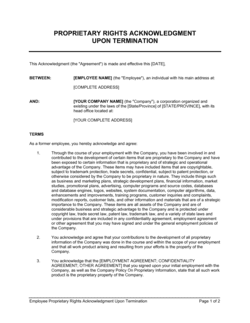
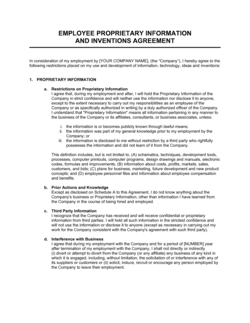
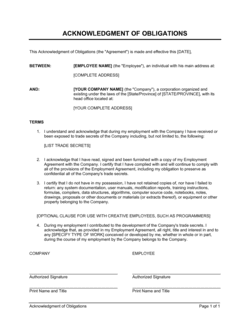
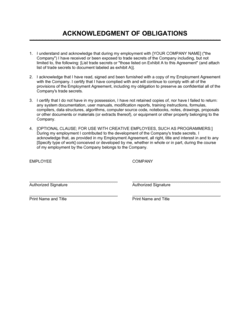
An Employee Proprietary Rights Acknowledgment is a legally binding document signed by an employee that assigns to the employer all inventions, work product, and intellectual property created in connection with their role, and confirms their confidentiality obligations regarding trade secrets and proprietary information. This free Word download covers IP assignment, prior inventions disclosure, non-disclosure, and post-employment obligations in a single document you can edit online and export as PDF.
When you need it
Use it before or on an employee's first day of work — at onboarding — for any hire who will create, access, or build on company technology, data, processes, or proprietary information. It is especially critical for engineering, product, design, research, and sales roles where competitive information is routinely handled.
What's inside
Definitions of proprietary and confidential information, full IP and invention assignment to the employer, a prior inventions carve-out schedule, non-disclosure obligations during and after employment, return-of-materials obligations upon separation, and a governing law clause.

What is an Employee Proprietary Rights Acknowledgment?

An Employee Proprietary Rights Acknowledgment is a legally binding document signed by an employee — typically at onboarding — that transfers to the employer full ownership of all inventions, work product, and intellectual property created in connection with the employee's role, and formally confirms the employee's obligations to protect the company's trade secrets and confidential information. It combines an IP assignment, a work-made-for-hire declaration, a prior inventions carve-out, non-disclosure obligations, a moral rights waiver, and return-of-materials requirements into a single enforceable instrument. Unlike a casual offer letter or a brief IP clause buried in an employment contract, a standalone acknowledgment provides the documentary depth that investors, acquirers, and courts require when ownership of valuable technology or confidential data is contested.

Why You Need This Document

Without a signed Employee Proprietary Rights Acknowledgment, your company's most valuable assets — source code, algorithms, product designs, trade secrets, and research outputs — may not legally belong to you. Work-made-for-hire doctrine covers only certain categories of works and has real limits; statutory defaults in Canada, the UK, and the EU are narrower than most employers assume; and an employee who never signed an assignment agreement can legitimately challenge your ownership at the worst possible moment — during a funding round, an acquisition, or a patent dispute. The consequences are concrete: M&A due diligence stalls when IP ownership records are incomplete, investors discount valuations when chain-of-title cannot be established, and litigation over employee-created inventions routinely costs more than the entire product development budget. This template gives you a professionally structured, jurisdiction-aware acknowledgment that closes the ownership gap for every new hire — in the 15 minutes it takes to complete and countersign before their first day.

Which variant fits your situation?

If your situation is…Use this template
Onboarding a new full-time employee in a technical or product roleEmployee Proprietary Rights Acknowledgment
Engaging an independent contractor who will create IP for the companyIndependent Contractor IP Assignment Agreement
Protecting confidential information shared with a prospective hire or partnerNon-Disclosure Agreement (NDA)
Covering IP assignment as part of a comprehensive employment contractEmployment Contract
Restricting a departing employee from soliciting clients or joining competitorsNon-Compete Agreement
Documenting IP assignment for a C-suite executive with equityExecutive Employment Agreement
Capturing assignment of a specific invention or software project after the factInvention Assignment Agreement

Common mistakes to avoid

❌ Executing the document after the employee's start date

Why it matters: An employee who has already begun work provided no new consideration for post-start restrictions. Courts in common-law jurisdictions have voided IP assignment and confidentiality clauses signed weeks or months into employment on exactly this basis.

Fix: Execute the acknowledgment before or on the employee's first day. If the agreement must be signed post-start, provide documented additional consideration — a cash bonus, salary increase, or extra PTO — at the time of signing.

❌ Omitting the prior inventions schedule

Why it matters: Without a documented carve-out, an employee can claim after separation that a valuable invention predates their employment — and with no contemporaneous record, the dispute turns on credibility rather than documentation.

Fix: Require every employee to complete Schedule A, even if they write 'None.' A completed blank schedule eliminates ambiguity and is far easier to enforce than a missing one.

❌ Using an overbroad IP assignment that ignores statutory inventor protections

Why it matters: California Labor Code §2870 and equivalent statutes in Delaware, Illinois, Minnesota, and Washington prohibit assigning inventions created entirely on the employee's own time with no company resources. Courts in those states void overbroad clauses, sometimes taking other provisions with them.

Fix: Include a statutory carve-out paragraph that mirrors the applicable law for every state or province where employees work. This protects the rest of the clause while complying with local requirements.

❌ Setting a fixed expiry on confidentiality obligations

Why it matters: A two- or three-year confidentiality term allows an employee to disclose genuine trade secrets the moment the clock expires — undermining the indefinite protection trade secret law would otherwise provide.

Fix: Draft confidentiality obligations to survive termination with no fixed end date for trade secrets and proprietary information. Non-confidential information can have a shorter protection window if needed.

❌ Skipping the moral rights waiver for international employees

Why it matters: In Canada, the UK, and most EU countries, moral rights exist independently of copyright ownership. An IP assignment without a moral rights waiver leaves the employee able to claim attribution or object to modifications of their work — a real obstacle in software, creative, and product development contexts.

Fix: Add a moral rights waiver clause for any employee working outside the US. Confirm the waiver language meets the specific requirements of the applicable jurisdiction.

❌ No return-of-materials certification requirement

Why it matters: An obligation to return or delete data is unenforceable in practice if there is no written confirmation mechanism. Former employees who retain copies of source code, customer lists, or financial models on personal devices are nearly impossible to pursue without documented evidence that they failed to certify deletion.

Fix: Require the employee to sign and return a written certification of deletion within five business days of separation. Include this as a condition of receiving any severance payment.

The 9 key clauses, explained

Definitions of Proprietary and Confidential Information

In plain language: Sets out precisely what information is covered by the agreement — trade secrets, technical data, business strategies, customer information, financials, and any other non-public material the employee encounters in their role.

Sample language
'Proprietary Information' means any information or data of [COMPANY NAME] that is not generally known to the public, including but not limited to technical data, source code, product plans, customer lists, pricing, financial data, and business strategies disclosed to Employee in connection with their employment.

Common mistake: Relying on a vague 'everything is confidential' definition rather than a specific enumerated list. Courts apply a reasonableness standard — an overbroad definition can render the entire clause unenforceable.

IP and Invention Assignment

In plain language: Transfers to the employer full ownership of all inventions, developments, software, designs, and other work product created by the employee in connection with their role — including work done outside business hours if it relates to the company's business.

Sample language
Employee hereby irrevocably assigns to [COMPANY NAME] all right, title, and interest — including all patent, copyright, trade secret, and other intellectual property rights — in and to any Invention or Work Product created, developed, or conceived by Employee, alone or jointly, during the term of employment and relating to the Company's business or resulting from work performed for the Company.

Common mistake: Limiting assignment to work performed 'on company premises or during working hours.' Employees working remotely or on personal devices at night may create valuable IP entirely outside this narrow scope.

Work Made for Hire Declaration

In plain language: Declares that all qualifying works created by the employee are works made for hire under applicable copyright law, so copyright vests in the employer from the moment of creation — with the assignment clause acting as a fallback if work-made-for-hire status does not apply.

Sample language
To the extent permitted by applicable law, all Work Product created by Employee within the scope of employment shall be considered 'works made for hire' owned by [COMPANY NAME]. To the extent any Work Product does not qualify as a work made for hire, Employee hereby assigns all copyright and related rights to [COMPANY NAME].

Common mistake: Relying solely on work-made-for-hire doctrine without a separate assignment clause. Work-made-for-hire applies only to specific categories of works under US copyright law — the assignment clause is essential as a backstop.

Prior Inventions Disclosure and Carve-Out

In plain language: Requires the employee to list any inventions, works, or IP they created before employment that they wish to exclude from the assignment — protecting the employee's pre-existing work while making clear that everything else belongs to the employer.

Sample language
Employee has attached hereto as Schedule A a complete list of all inventions or works in which Employee claims prior ownership as of the date of this Agreement. If Schedule A is blank or not attached, Employee represents that there are no prior inventions to disclose. All inventions not listed are subject to full assignment under this Agreement.

Common mistake: Omitting the prior inventions schedule entirely. Without it, the employee may later claim that a valuable invention pre-existed employment — and with no documented carve-out, the dispute is resolved on credibility alone.

Confidentiality Obligations

In plain language: Prohibits the employee from disclosing or using the company's proprietary information for any purpose outside their employment — both during and after the employment relationship ends.

Sample language
During and after the term of employment, Employee shall hold all Proprietary Information in strict confidence, shall not disclose it to any third party without prior written consent of [COMPANY NAME], and shall use it solely to perform their duties for the Company.

Common mistake: Drafting confidentiality obligations that expire after a fixed term — e.g., two years post-employment. Trade secret protections under the Defend Trade Secrets Act and equivalent laws are indefinite; a fixed expiry can undercut statutory protections.

No Conflicting Obligations

In plain language: The employee represents that they are not bound by any prior agreement — with a former employer, university, or other party — that would prevent them from performing their role, assigning IP, or sharing information they bring to the job.

Sample language
Employee represents that they are not subject to any agreement, obligation, or restriction that would prevent them from entering this Agreement, performing their duties for [COMPANY NAME], or assigning the rights described herein. Employee shall not use or disclose any confidential information of any prior employer in performing their duties.

Common mistake: Skipping this clause and discovering — post-litigation — that the employee's prior employer claims ownership of IP the employee brought to the new role or created using knowledge from their previous position.

Moral Rights Waiver

In plain language: In jurisdictions that recognize moral rights (Canada, UK, EU), the employee waives any right to claim authorship attribution or object to modifications, licensing, or removal of any work product assigned under the agreement.

Sample language
To the fullest extent permitted by applicable law, Employee irrevocably waives all moral rights in and to all Work Product assigned to [COMPANY NAME], including the right to attribution and the right to object to any modification, use, or non-use of such Work Product.

Common mistake: Omitting the moral rights waiver for international employees. In Canada, the UK, and most EU member states, moral rights exist independently of copyright and must be explicitly waived — assignment alone does not extinguish them.

Return of Materials and Data

In plain language: Requires the employee to return or certifiably destroy all company property, data, documents, and devices upon termination — or at any earlier request — and confirm in writing that no proprietary information is retained on personal devices.

Sample language
Upon termination of employment or upon request by [COMPANY NAME], Employee shall promptly return all documents, data, devices, and other materials containing or embodying Proprietary Information, and shall permanently delete any copies stored on personal devices or cloud accounts, certifying such deletion in writing within [5] business days of separation.

Common mistake: No mechanism to verify deletion from personal devices or cloud accounts. Without a written certification requirement, enforcement after separation is practically impossible.

Governing Law and Severability

In plain language: Specifies the jurisdiction whose laws govern the agreement and includes a severability clause so that if any single provision is found unenforceable, the rest of the agreement remains in effect.

Sample language
This Agreement shall be governed by the laws of [STATE / PROVINCE / COUNTRY]. If any provision is held invalid or unenforceable by a court of competent jurisdiction, that provision shall be modified to the minimum extent necessary to make it enforceable, and all remaining provisions shall remain in full force and effect.

Common mistake: Choosing a governing law with no meaningful connection to where the employee works. California applies its own law regardless of what the contract states, and will void IP assignment provisions that conflict with California Labor Code §2870.

How to fill it out

  1. 1

    Identify the parties and effective date

    Enter the employer's full registered legal entity name and the employee's full legal name as it appears on government-issued ID. Set the effective date to the employee's first day of employment — not the date the document was drafted.

    💡 Using a trade name instead of the registered corporate entity can create enforcement ambiguity. Pull the exact name from your corporate registry filing.

  2. 2

    Customize the definition of proprietary information

    Review the enumerated list of covered information categories and add any industry-specific items — e.g., clinical trial data for healthcare, trading algorithms for fintech, or formulation data for manufacturing — that are central to your business.

    💡 A definition that is specific to your business is more likely to withstand a legal challenge than a generic boilerplate definition.

  3. 3

    Tailor the IP assignment scope

    Confirm whether the assignment covers only work performed during business hours and on company systems, or all work relating to the company's business regardless of when and where it was done. For most tech and product roles, the broader scope is appropriate.

    💡 For employees in states with inventor-protection statutes (California, Delaware, Illinois, Minnesota, North Carolina, Washington), the assignment cannot extend to inventions developed entirely on the employee's own time with no company resources — ensure the clause respects these carve-outs.

  4. 4

    Have the employee complete Schedule A (prior inventions)

    Give the employee time — before signing — to list any pre-existing inventions, works, or IP they wish to exclude from the assignment. If they have nothing to disclose, they should write 'None' and sign the schedule.

    💡 An employee who lists nothing but later claims a prior invention faces a far harder evidentiary burden. The completed schedule protects both parties.

  5. 5

    Include the moral rights waiver if operating internationally

    For employees working in Canada, the UK, the EU, or other jurisdictions that recognize moral rights, confirm the moral rights waiver clause is present and not deleted from the template.

    💡 If your company operates in multiple countries, use country-specific addenda rather than a single global template to ensure each clause meets local requirements.

  6. 6

    Set the governing law

    Choose the jurisdiction that corresponds to where the employee works — not just where the company is incorporated. Courts in California, Quebec, and several EU member states apply local law regardless of the governing-law clause.

    💡 If the employee works in a different state or country from the company's headquarters, have a local employment lawyer confirm the governing law choice is defensible.

  7. 7

    Execute before the employee's first day

    Both parties must sign before or on the first day of employment. In common-law jurisdictions, signing after work has begun requires fresh consideration — a documented benefit such as a signing bonus, salary increase, or additional PTO — to ensure enforceability.

    💡 Use a timestamped electronic signature to create an unambiguous record of when execution occurred. Store the fully executed copy in your HR system immediately.

  8. 8

    Deliver a copy to the employee

    Provide the employee with a fully executed copy of the agreement for their records. In several jurisdictions — including the UK and many EU member states — failing to provide the employee a copy is itself a statutory violation.

    💡 Keep both the signed agreement and the completed Schedule A in the employee's personnel file and in a separate IP ownership register for future due diligence or investor review.

Frequently asked questions

What is an Employee Proprietary Rights Acknowledgment?

An Employee Proprietary Rights Acknowledgment is a legally binding document signed by an employee that assigns to the employer all intellectual property and work product created in connection with the employee's role, and confirms the employee's obligations to protect the company's trade secrets and confidential information. It is typically signed at onboarding and covers IP assignment, prior inventions carve-out, confidentiality, and return-of-materials obligations — all in a single document.

When should this document be signed?

It must be signed before or on the employee's first day of work. In common-law jurisdictions — including most US states, Canada, the UK, and Australia — signing after employment begins requires fresh consideration to be enforceable. The offer of employment itself constitutes sufficient consideration when the agreement is executed before work starts. Waiting even a few days creates a material legal risk for the employer.

Is an Employee Proprietary Rights Acknowledgment the same as an NDA?

No, though the two documents overlap on confidentiality. An NDA is primarily a standalone confidentiality agreement preventing disclosure of specific information — it does not assign IP ownership. An Employee Proprietary Rights Acknowledgment goes further: it transfers all rights in inventions and work product to the employer, covers work-made-for-hire, requires a prior inventions disclosure, and imposes return-of-materials obligations. Many employers use both documents together.

Can an employer own inventions an employee creates at home on personal devices?

It depends on jurisdiction and the scope of the assignment clause. In most US states, an employer can assign inventions created at home if they relate to the company's business or result from company information the employee used. However, California, Delaware, Illinois, Minnesota, and Washington prohibit assigning inventions developed entirely on the employee's own time, with no company equipment, and unrelated to current or demonstrably anticipated company work. The agreement must include a statutory carve-out for those states.

What is the prior inventions schedule and why does it matter?

The prior inventions schedule is a list attached to the agreement where the employee discloses any inventions, works, or IP they created before their employment that they want to exclude from the employer's assignment. If the employee writes nothing and signs, they later face a very difficult argument that any specific invention pre-dated employment. For employers, a completed schedule creates a clean IP ownership record that investors and acquirers rely on during due diligence.

What are moral rights and do they need to be addressed?

Moral rights are rights recognized in most countries outside the US that allow a creator to claim authorship of their work and object to modifications or uses they find objectionable — independent of who owns the copyright. In Canada, the UK, and EU member states, an IP assignment alone does not extinguish moral rights. The acknowledgment must include an explicit moral rights waiver for employees in those jurisdictions. US copyright law does not recognize broad moral rights for works outside fine art, so a waiver is less critical for US-only employees.

How does this document interact with an employment contract?

Many employment contracts include a brief IP assignment clause, but it is typically less detailed than a standalone proprietary rights acknowledgment. Some employers embed the full acknowledgment as a schedule to the employment contract; others execute them as separate documents. Both approaches are valid — what matters is that the employee signs the detailed acknowledgment and that it is executed before work begins. If the employment contract and the acknowledgment conflict, the more specific document typically governs.

Do I need a lawyer to prepare this document?

For standard domestic hires at or below senior management level, a well-drafted template is usually sufficient. Engage an employment lawyer when the employee works in a jurisdiction with inventor-protection statutes (California, Illinois, Washington), when the role involves highly sensitive IP in a competitive market, when the employee is a senior executive with complex prior inventions, or when the employer operates across multiple jurisdictions requiring country-specific clauses. A 1–2 hour template review typically costs $300–$600 and is a low-cost insurance policy given the stakes.

What happens to IP ownership if this document is never signed?

Without a signed acknowledgment, IP ownership reverts to default statutory rules — which vary significantly by jurisdiction and work type. In the US, the work-made-for-hire doctrine covers some employee-created works, but it does not cover inventions or works outside the employment scope. In the UK and Canada, statutory rules assign certain employee inventions to the employer, but the boundaries are narrower than most employers assume. Missing documentation creates gaps that surface — often expensively — during M&A due diligence or patent disputes.

How should this document be stored after signing?

Keep the fully executed original — including the completed Schedule A — in the employee's personnel file and in a central IP ownership register. Many companies maintain a separate folder of executed acknowledgments specifically for investor and acquirer due diligence. Electronic signatures with timestamps are accepted in most jurisdictions and are easier to produce during diligence than paper originals. Backup copies should be stored in a system that is not accessible to the employee after separation.

How this compares to alternatives

vs Non-Disclosure Agreement (NDA)

An NDA protects confidential information from unauthorized disclosure but does not transfer ownership of inventions or work product to the employer. An Employee Proprietary Rights Acknowledgment goes further — it assigns all IP, requires a prior inventions disclosure, and imposes return-of-materials obligations. For employees who will create IP, the acknowledgment is the essential document; an NDA alone is insufficient.

vs Employment Contract (IP clause)

Most standard employment contracts include a brief IP assignment clause, but it lacks the specificity of a standalone acknowledgment — no prior inventions schedule, no moral rights waiver, and no detailed return-of-materials mechanism. A standalone proprietary rights acknowledgment provides the depth that investors and acquirers expect to see during due diligence. Both documents can coexist, with the acknowledgment as a signed schedule to the employment contract.

vs Non-Compete Agreement

A non-compete restricts where a departing employee can work after leaving — it does not address who owns the IP they created during employment. An Employee Proprietary Rights Acknowledgment secures ownership of work product and trade secrets while the employee is employed. The two documents serve different functions and are typically executed together at onboarding.

vs Independent Contractor Agreement

An independent contractor agreement with an IP assignment clause transfers ownership of project deliverables from a self-employed contractor to the hiring company. Unlike an employee acknowledgment, it does not rely on work-made-for-hire doctrine, making explicit assignment language more critical. If a contractor is later found to be a misclassified employee, the contractor agreement's IP provisions may be challenged — reinforcing the need to correctly classify workers before choosing which document to use.

Industry-specific considerations

Technology / SaaS

Covers source code, algorithms, APIs, training data, and product roadmaps; assignment scope typically extends to work done remotely on personal devices given distributed team structures.

Biotech / Life Sciences

Research outputs, laboratory notebooks, compound formulations, and clinical data are covered; prior inventions disclosure is critical for scientists moving between research institutions and commercial employers.

Financial Services / Fintech

Proprietary trading algorithms, risk models, and client data strategies require careful definition; the confidentiality clause typically extends to regulatory and compliance information alongside standard trade secrets.

Creative / Marketing Agencies

Copyright assignment covers designs, copy, brand assets, and campaign strategies; moral rights waivers are especially important for designers and copywriters who may later assert attribution rights.

Manufacturing / Engineering

Process patents, manufacturing methods, and equipment designs are core assets; prior inventions disclosure is frequently complex for engineers with long careers spanning multiple employers.

Professional Services / Consulting

Methodologies, client frameworks, and proprietary tools developed on client engagements must be explicitly covered; the document should address work product created on client premises or using client systems.

Jurisdictional notes

United States

The Defend Trade Secrets Act (18 U.S.C. § 1836) provides federal civil remedies for trade secret misappropriation. IP assignment clauses must respect state inventor-protection statutes in California (Labor Code §2870), Delaware, Illinois (765 ILCS 1060/2), Minnesota, North Carolina, and Washington — all of which prohibit assigning inventions developed entirely on the employee's own time with no company resources. California also voids non-disclosure provisions that purport to prevent employees from disclosing wage information or reporting illegal activity.

Canada

Canadian common law generally vests employer ownership of IP created by employees in the course of their employment duties, but the boundaries are narrower than many employers assume — IP created outside the scope of duties may belong to the employee. Quebec's Civil Code applies distinct rules from common-law provinces. Moral rights under the Copyright Act cannot be assigned but must be waived; a specific waiver clause is required. French-language requirements apply in Quebec for provincially regulated employers.

United Kingdom

The Patents Act 1977 (s.39) and Copyright, Designs and Patents Act 1988 (s.11) automatically assign to the employer inventions and works created in the normal course of employment, but the statutory scope has limits — inventions made outside normal duties or with no company resources may belong to the employee. Moral rights exist under the CDPA and must be explicitly waived; assignment alone is insufficient. Employers must provide employees a written statement of employment particulars on or before day one, and the acknowledgment is typically incorporated into that documentation.

European Union

Most EU member states grant employers ownership of employee inventions made in the course of employment, but many — including Germany, France, and the Netherlands — require the employer to pay additional compensation to the employee for particularly valuable inventions. Moral rights are strongly protected across the EU and cannot be assigned; a waiver clause is required but its scope varies by member state. The GDPR applies to any personal data processed in connection with the acknowledgment or the employee's work product, including return-of-data obligations upon separation.

Template vs lawyer — what fits your deal?

PathBest forCostTime
Use the templateStandard domestic full-time hires below senior management level in a single US state or Canadian provinceFree15 minutes per hire
Template + legal reviewEmployees in California, Illinois, or Washington; hires in Canada, UK, or EU; senior technical roles with complex prior inventions$300–$6001–3 days
Custom draftedMulti-jurisdiction teams, biotech or deep-tech IP with patent exposure, M&A-ready companies building a clean IP ownership record$1,000–$3,500+1–2 weeks

Glossary

Proprietary Information
Any non-public data, knowledge, or material belonging to the employer — including trade secrets, business plans, customer lists, pricing, and technology — that has economic value because it is not generally known.
IP Assignment
A contractual transfer of ownership of intellectual property rights — including patents, copyrights, and trade secrets — from the creator (employee) to the employer.
Work Made for Hire
A US copyright doctrine under which certain works created by an employee within the scope of employment are automatically owned by the employer, not the individual creator.
Prior Inventions
Inventions, works, or developments the employee created before their employment that are carved out of the assignment clause and listed in a disclosure schedule.
Trade Secret
Confidential business information that provides a competitive edge and is protected by law as long as reasonable steps are taken to keep it secret — no registration required.
Moral Rights
Rights recognized in some jurisdictions allowing creators to claim authorship and object to modifications of their work, distinct from economic copyright. Employees typically waive these in an IP acknowledgment.
Inventive Step / Non-Obviousness
A patentability standard requiring that an invention not be obvious to a person skilled in the relevant field — relevant when the employer intends to patent assigned inventions.
Return of Materials
A contractual obligation requiring the employee to return or destroy all company property, data, and confidential materials upon termination or at the employer's request.
Residuals
Knowledge retained in the unaided memory of an employee after working with confidential information — some agreements include a clause clarifying what residuals the employee may retain and use post-employment.
Consideration
The legal exchange of value that makes a contract enforceable — for an IP acknowledgment signed at hire, the offer of employment itself constitutes consideration.

Part of your Business Operating System

This document is one of 3,000+ business & legal templates included in Business in a Box.

  • Fill-in-the-blanks — ready in minutes
  • 100% customizable Word document
  • Compatible with all office suites
  • Export to PDF and share electronically

Create your document in 3 simple steps.

From template to signed document — all inside one Business Operating System.
1
Download or open template

Access over 3,000+ business and legal templates for any business task, project or initiative.

2
Edit and fill in the blanks with AI

Customize your ready-made business document template and save it in the cloud.

3
Save, Share, Send, Sign

Share your files and folders with your team. Create a space of seamless collaboration.

Save time, save money, and create top-quality documents.

★★★★★

"Fantastic value! I'm not sure how I'd do without it. It's worth its weight in gold and paid back for itself many times."

Managing Director · Mall Farm
Robert Whalley
Managing Director, Mall Farm Proprietary Limited
★★★★★

"I have been using Business in a Box for years. It has been the most useful source of templates I have encountered. I recommend it to anyone."

Business Owner · 4+ years
Dr Michael John Freestone
Business Owner
★★★★★

"It has been a life saver so many times I have lost count. Business in a Box has saved me so much time and as you know, time is money."

Owner · Upstate Web
David G. Moore Jr.
Owner, Upstate Web

Run your business with a system — not scattered tools

Stop downloading documents. Start operating with clarity. Business in a Box gives you the Business Operating System used by over 250,000 companies worldwide to structure, run, and grow their business.

Start free · No credit card required