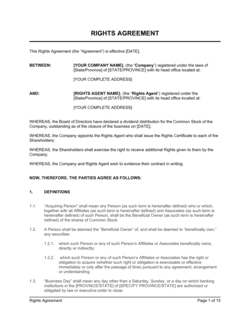
Registration Rights Agreement Template

Free Word download • Edit online • Save & share with Drive • Export to PDF

11 pages30–40 min to fillDifficulty: ComplexSignature requiredLegal review recommended
Learn more ↓
FreeRegistration Rights Agreement Template

At a glance

What it is
A Registration Rights Agreement is a legally binding contract between a company and one or more investors that obligates the company to register the investors' shares with the SEC — or an equivalent securities regulator — so those shares can be freely sold in the public market. This free Word download gives you a structured starting point covering demand rights, piggyback rights, S-3 shelf registration, lockup provisions, and indemnification, which you can edit online and export as PDF for execution.
When you need it
Use it when closing a venture capital, private equity, or strategic investment round where investors require a path to liquidity through a future IPO or secondary offering. It is also executed alongside a stockholders' agreement or as part of a Series A through Series D preferred stock financing.
What's inside
Demand registration rights, piggyback registration rights, S-3 shelf registration rights, lockup and holdback obligations, registration procedures and expenses, indemnification and contribution, and term and termination provisions covering when rights expire or are cut back.

What is a Registration Rights Agreement?

A Registration Rights Agreement is a legally binding contract between a company and its investors that obligates the company to register the investors' shares under applicable securities laws — in the US, with the Securities and Exchange Commission — so those shares can be freely bought and sold in the public market. Without this agreement, shares acquired in a private placement are classified as restricted securities and can only be resold under narrow exemptions, leaving investors with no practical liquidity until an IPO or acquisition. The agreement grants specific types of rights — demand, piggyback, and shelf registration — each giving investors a different degree of control over when and how their shares enter the public market. It also governs the mechanics of the registration process itself: who pays, how underwriter cutbacks are handled, what lockup obligations apply, and when the rights expire.

Why You Need This Document

Institutional investors — venture capital funds, private equity firms, and family offices — will not close a preferred stock financing without a registration rights agreement in place. Without it, investors have no contractual mechanism to achieve liquidity other than waiting for an acquisition, leaving their capital locked indefinitely. For the company, a poorly drafted or missing agreement creates a worse problem: investors who believe they have rights they cannot enforce will renegotiate at the worst possible time — during IPO preparation or a follow-on round — when the company has no leverage. Specific gaps carry specific costs: an undefined registrable securities clause excludes SAFE and convertible note holders, generating claims at conversion; an uncapped investor counsel fee provision can cost $100,000 or more in a single registration; an unlimited investor indemnification clause will be rejected by every institutional fund counsel who reviews it. This template gives you a market-standard starting point that closes all four of those gaps and reflects the terms institutional investors expect to see, reducing negotiation time and protecting both sides through the company's lifecycle from Series A to IPO.

Which variant fits your situation?

If your situation is…Use this template
Series A or B preferred stock financing with institutional lead investorRegistration Rights Agreement (Venture)
Late-stage growth round with multiple investor classes requiring priority cutbacksRegistration Rights Agreement (Multi-Series)
Investor needs rights alongside full governance and transfer provisionsStockholders Agreement
Early convertible note round where registration rights attach on conversionConvertible Note Agreement
Company preparing for IPO and needing to amend or terminate existing rightsRegistration Rights Amendment Agreement
Secondary share sale requiring a resale shelf registrationInvestor Rights Agreement
Angel round with simplified piggyback-only rightsSimple Agreement for Future Equity (SAFE)

Common mistakes to avoid

❌ Omitting convertible instrument shares from the registrable securities definition

Why it matters: Investors holding SAFEs, convertible notes, or warrants that convert after the agreement is signed will have no registration rights coverage, triggering renegotiation or litigation at the worst possible time — during IPO preparation.

Fix: Define Registrable Securities to include all shares issued or issuable upon conversion or exercise of any security outstanding as of or after the date of the agreement, and update the definition with each new financing round.

❌ No cap on investor counsel fee reimbursement

Why it matters: Multiple investor groups each retaining separate counsel for a single registration can generate six-figure legal bills that the company must pay, consuming a material portion of the offering proceeds.

Fix: Cap reimbursable investor legal fees at a fixed dollar amount per registration — $20,000 to $30,000 is standard — and require all investors to be represented by a single designated counsel.

❌ Unlimited investor indemnification exposure

Why it matters: An investor who indemnifies the company without a cap on their liability faces exposure far exceeding the proceeds they received from the registered sale, which no institutional investor will accept and which courts regularly reform.

Fix: Cap each investor's indemnification obligation at the net proceeds that investor actually received from the sale of their Registrable Securities in the specific offering giving rise to the claim.

❌ Granting demand rights without a minimum share threshold

Why it matters: A holder of 0.5% of shares can compel the company to undertake a full SEC registration process costing $200,000 or more in legal, accounting, and filing fees for a share lot worth far less.

Fix: Require that demand requests come from holders of at least 20% of outstanding Registrable Securities in aggregate, ensuring only meaningful investors can trigger the process.

❌ No holdback obligation on insiders outside the agreement

Why it matters: If officers, directors, and large shareholders not party to the registration rights agreement sell freely during the lockup window, investor lockup obligations become commercially meaningless and underwriters will refuse to proceed.

Fix: Include an explicit company covenant to obtain equivalent lockup agreements from all officers, directors, and holders of 1% or more of outstanding shares before any registered offering.

❌ Tying termination solely to IPO completion

Why it matters: Registration rights that survive an IPO leave the company managing ongoing registration obligations for shareholders whose shares are already freely tradeable in the public market, creating unnecessary administrative and legal cost.

Fix: Add a Rule 144 freely-tradeable fallback as a co-equal termination trigger: rights terminate when a holder can sell all their shares without volume restriction within any 90-day window under Rule 144.

The 10 key clauses, explained

Definitions and registrable securities

In plain language: Defines all key terms — including which specific shares constitute 'Registrable Securities' — so the scope of the agreement is unambiguous from the outset.

Sample language
'Registrable Securities' means shares of Common Stock issued or issuable upon conversion of the Series [A/B/C] Preferred Stock held by the Investors, until such shares (a) have been registered and sold to the public, (b) may be sold without volume restriction under Rule 144, or (c) have been transferred in a transaction in which registration rights were not assigned.

Common mistake: Defining registrable securities too narrowly — excluding shares issuable on conversion of future instruments like SAFEs or convertible notes — so later investors receive no coverage under the agreement.

Demand registration rights

In plain language: Grants qualifying investors the right to compel the company to file a registration statement, subject to minimum ownership thresholds, caps on the number of demands, and blackout periods.

Sample language
Holders of at least [X]% of the Registrable Securities may deliver a written demand requesting that the Company file a Registration Statement covering the resale of no fewer than [Y] shares. The Company shall use commercially reasonable efforts to file within [90] days of such demand. The Company shall not be obligated to effect more than [2] Demand Registrations in any 12-month period.

Common mistake: Setting no minimum share threshold for triggering a demand, which lets minor investors force costly SEC registration processes for small share lots.

Piggyback registration rights

In plain language: Allows investors to include their shares whenever the company files a registration statement for itself or for another shareholder, subject to underwriter cutback.

Sample language
If the Company proposes to register any of its securities under the Securities Act (other than on Form S-4 or Form S-8), the Company shall give written notice to all Holders at least [20] days prior to filing, offering each Holder the opportunity to include Registrable Securities in such registration.

Common mistake: Failing to exclude Form S-4 and S-8 registrations from piggyback rights, which triggers investor notice obligations for every employee stock plan and merger registration the company files.

S-3 shelf registration rights

In plain language: Grants investors the right to request repeated short-form registrations on Form S-3 once the company is eligible, reducing cost and filing time for secondary sales.

Sample language
After the Company becomes eligible to use Form S-3, Holders of at least [X]% of Registrable Securities may request registration on Form S-3 for offerings of at least $[1,000,000] in aggregate. The Company shall not be obligated to file more than [2] S-3 registrations in any 12-month period.

Common mistake: Omitting a minimum offering-size threshold for S-3 requests, leaving the company exposed to repeated small-lot shelf filings that cost more in legal and accounting fees than the shares are worth.

Underwriter cutback and priority

In plain language: Establishes the order of priority when an underwriter requires a reduction in the number of shares included in a registered offering — typically company shares first, then investors pro rata.

Sample language
If the managing underwriter advises that the total number of shares to be included in the offering exceeds the Maximum Offering Size, the Company shall include shares in the following priority: (i) shares the Company proposes to sell, (ii) Registrable Securities of the Investors, allocated pro rata by number of Registrable Securities held.

Common mistake: Inverting the cutback priority so investor shares are cut before company shares — this is commercially unacceptable to institutional investors and will be rejected in negotiation.

Lockup and holdback obligations

In plain language: Requires investors to refrain from selling shares during a defined window around an IPO or registered offering, and obligates the company to impose the same restriction on all other significant shareholders.

Sample language
Each Holder agrees not to sell, transfer, or otherwise dispose of any Registrable Securities for a period of [180] days following the effective date of the Company's IPO registration statement, subject to any earlier release granted by the managing underwriter. The Company shall use commercially reasonable efforts to obtain equivalent lockup agreements from all officers, directors, and holders of 1% or more of outstanding shares.

Common mistake: Omitting the 'equivalent lockup' obligation on other shareholders, leaving investors subject to a lockup while insiders who are not party to the agreement sell freely into the same window.

Registration procedures and expenses

In plain language: Details the mechanics of how registrations are conducted — filing timelines, the company's obligations to maintain effectiveness, investor cooperation duties — and allocates registration costs between the company and investors.

Sample language
The Company shall bear all Registration Expenses in connection with any Demand or Piggyback Registration, including SEC filing fees, legal fees of one counsel for the Holders not to exceed $[25,000] per registration, and printing costs. Underwriting discounts and commissions attributable to the Registrable Securities shall be borne by the selling Holders.

Common mistake: Agreeing to pay investors' legal fees with no cap, exposing the company to open-ended expense obligations when multiple investor groups each retain separate counsel for a single registration.

Indemnification and contribution

In plain language: The company indemnifies investors for losses arising from material misstatements in the registration statement; investors indemnify the company for misstatements in information they supplied; a contribution fallback applies if indemnification is unavailable.

Sample language
The Company agrees to indemnify each Holder against any losses, claims, damages, or liabilities arising out of any untrue or alleged untrue statement of a material fact contained in the Registration Statement, or any omission of a material fact required to be stated therein. Each Holder agrees to indemnify the Company against losses arising from any untrue statement in written information furnished by such Holder expressly for use in the Registration Statement.

Common mistake: Drafting investor indemnification as unlimited in scope — courts and institutional investors consistently require investor indemnification to be capped at the net proceeds the investor received from the registered sale.

Assignment of registration rights

In plain language: Specifies whether and how investors can transfer their registration rights to subsequent purchasers of their shares, typically subject to minimum transfer size and advance written notice to the company.

Sample language
Registration rights under this Agreement may be assigned by a Holder to a transferee who acquires at least [500,000] Registrable Securities, provided that (a) the Company is given written notice at the time of transfer, and (b) the transferee agrees in writing to be bound by this Agreement.

Common mistake: Permitting assignment of rights to any transferee without a minimum share threshold, which fragments registration rights across dozens of small holders and makes demand calculations administratively unworkable.

Term and termination

In plain language: States when registration rights expire — typically upon an IPO, a change of control, or when shares become freely tradeable under Rule 144 — and the conditions under which the agreement terminates entirely.

Sample language
The registration rights set forth in this Agreement shall terminate as to any Holder when (a) the Company has completed a Qualified IPO and all Registrable Securities held by such Holder may be sold under Rule 144 within a 90-day period without volume limitation, or (b) the Company has effected [3] Demand Registrations covering all Registrable Securities.

Common mistake: Tying termination solely to an IPO without including a Rule 144 freely-tradeable fallback, which leaves technically active registration obligations outstanding for years after the company goes public.

How to fill it out

  1. 1

    Identify the parties and define registrable securities

    Enter the company's full legal name and jurisdiction of incorporation. List each investor entity by legal name and specify the exact series and class of shares — including shares issuable on conversion of any outstanding notes or SAFEs — that constitute Registrable Securities.

    💡 Run the cap table before drafting to confirm every instrument that converts to common stock is captured in the definition — gaps here are the most common source of investor disputes post-IPO.

  2. 2

    Set demand registration thresholds and limits

    Enter the minimum percentage of Registrable Securities required to trigger a demand (typically 20–30% for Series A, 15% for later rounds), the maximum number of demands per year, and the minimum aggregate offering size that must be included.

    💡 Two demand registrations per 12-month period is the market standard for most VC-backed companies — granting more opens the company to repeated SEC filings at the investors' discretion.

  3. 3

    Define the piggyback notice period and cutback priority

    Set the advance notice window — typically 20 days — that the company must give investors before filing a registration. Then specify the cutback priority order in writing so underwriter reductions are applied consistently.

    💡 Make cutback priority explicit in a numbered list rather than prose — ambiguous language here generates litigation when an IPO oversubscription forces reductions.

  4. 4

    Confirm S-3 eligibility conditions and request limits

    Insert the minimum offering-size threshold for S-3 requests (commonly $1M) and cap the number of S-3 filings per year. Add a note that S-3 rights only activate once the company has been a reporting company for at least 12 months.

    💡 If the company is not yet SEC-registered, include a placeholder provision that S-3 rights become effective on the first date the company is eligible to use Form S-3.

  5. 5

    Complete the lockup and holdback provisions

    Set the lockup duration (180 days is standard for IPO lockups; 90 days for follow-on offerings). Add the obligation on the company to obtain equivalent lockup agreements from all officers, directors, and 1%+ shareholders.

    💡 Include a 'market standoff' clause requiring investors to sign a separate lockup agreement with the underwriter if requested — investment banks often require their own form rather than relying on the registration rights agreement.

  6. 6

    Allocate registration expenses with a fee cap

    Specify that the company bears all registration expenses except underwriting discounts on investor shares. Cap reimbursable investor counsel fees at a fixed dollar amount — $20,000 to $30,000 per registration is typical — and require a single counsel to represent all investors collectively.

    💡 Requiring a single counsel for all investors on a registration eliminates coordination delays and prevents the company from receiving conflicting legal demands during a time-sensitive SEC filing window.

  7. 7

    Draft the indemnification and contribution fallback

    Include mutual indemnification: the company indemnifies investors for company-side misstatements; investors indemnify the company for misstatements in information they supply. Add a contribution clause capping investor liability at net proceeds received.

    💡 The contribution clause becomes operative when a court or regulator determines that indemnification is unavailable — omitting it leaves both parties without a fallback allocation of loss.

  8. 8

    Set assignment conditions and termination triggers

    Enter the minimum share count required for a valid assignment of rights (500,000 shares or 1% of outstanding is typical). Specify all termination triggers: Rule 144 freely-tradeable status, a qualified IPO, a change of control, or expiration of a fixed term (commonly 10 years from agreement date).

    💡 Include a 'deemed termination' clause providing that rights terminate automatically without a formal amendment once all Registrable Securities are freely tradeable — this avoids the administrative burden of executing a termination agreement post-IPO.

Frequently asked questions

What is a registration rights agreement?

A registration rights agreement is a contract between a company and its investors that obligates the company to register the investors' shares under securities law — typically with the SEC — so those shares can be freely sold in the public market. Without this agreement, investors who hold restricted shares acquired in a private placement have limited ability to sell them. Registration rights are a standard component of venture capital and private equity financings and are typically executed alongside a preferred stock purchase agreement and stockholders agreement.

What is the difference between demand and piggyback registration rights?

Demand registration rights give qualifying investors the power to compel the company to file a registration statement at the investors' request, regardless of whether the company has its own offering planned. Piggyback rights are more passive — they allow investors to include their shares in a registration the company has already decided to initiate for its own purposes. Demand rights are more valuable and more difficult to negotiate; piggyback rights are nearly universal in institutional rounds.

When are registration rights typically granted?

Registration rights are almost always granted at the closing of a preferred stock financing round — Series A, B, C, or later — as a condition of investment. Institutional venture capital and private equity investors require them as a standard term. They are occasionally included in convertible note or SAFE financings as rights that attach upon conversion. Angel rounds and seed-stage investments sometimes include piggyback-only rights to keep the document simple.

Are registration rights required by law?

No. Registration rights are entirely contractual — no law requires a company to grant them. However, they are a market-standard expectation in institutional venture and private equity financing. Refusing to grant any form of registration rights will typically block a financing from closing with a professional fund. The specific terms — number of demands, thresholds, lockup duration — are negotiated, but the existence of the rights is generally non-negotiable with institutional investors.

What happens to registration rights when a company goes public?

At an IPO, demand and piggyback rights typically become exercisable for the first time — the company finally has a mechanism to register shares for public resale. However, most investors are subject to a 180-day lockup immediately following the IPO, during which they cannot sell. After the lockup expires, investors can exercise their rights to have shares registered, or in many cases their shares become freely tradeable under Rule 144 and the registration rights terminate automatically under the agreement's termination clause.

What is a cutback in the context of registration rights?

A cutback occurs when the managing underwriter for a registered offering determines that including all requested investor shares would adversely affect the offering price or market. The underwriter requires a reduction in the number of shares included, and the registration rights agreement specifies the order of priority in which different holders' shares are cut back. Typically, company shares have first priority, followed by investors pro rata based on their respective holdings. Getting the cutback priority wrong is one of the most contentious negotiating points in any registration rights agreement.

Do registration rights transfer when an investor sells their shares?

Registration rights are generally not freely transferable — they transfer only under the specific conditions set out in the assignment clause of the agreement. Most agreements require that the transferee acquire a minimum number of shares (commonly 500,000 or 1% of outstanding), receive written notice to the company, and sign a joinder agreeing to be bound by the agreement. Transfers that do not meet these conditions do not carry registration rights, which is why buyers of large blocks of private company shares routinely require confirmation of rights assignment at closing.

What is the lockup period and why does it apply to investors with registration rights?

The lockup period — typically 90 to 180 days after an IPO — prohibits all significant shareholders, including those with registration rights, from selling shares without the underwriter's consent. Underwriters impose lockups to prevent a flood of insider shares from depressing the stock price immediately after listing. Even though investors have registration rights, those rights cannot be exercised during the lockup window. The registration rights agreement typically includes a holdback clause formalizing this obligation and requiring the company to enforce equivalent lockups on all officers, directors, and large shareholders.

How much does it cost to comply with a registration rights demand?

A full demand registration — including SEC counsel, auditors, filing fees, and printing — typically costs a company $150,000 to $400,000 for an initial filing and $50,000 to $150,000 for subsequent S-3 shelf registrations. These costs are generally borne by the company under the agreement, with investors paying only the underwriting discounts on their own shares. This is why minimum threshold requirements for triggering a demand — both in terms of holder percentage and aggregate offering size — are critical to a well-drafted agreement.

How this compares to alternatives

vs Stockholders Agreement

A stockholders agreement governs voting rights, board composition, transfer restrictions, drag-along and tag-along rights, and pre-emption rights. A registration rights agreement deals exclusively with the mechanics of registering shares for public resale. The two documents complement each other and are almost always executed together at a financing closing, but they address entirely different investor protections.

vs Investor Rights Agreement

An investor rights agreement is a broader document that bundles registration rights with additional protective covenants — information rights, pro-rata rights in future rounds, and ROFR on founder share transfers. A standalone registration rights agreement covers only the registration mechanics. Early-stage companies often consolidate these into one document; later-stage deals frequently separate them as the investor group becomes more complex.

vs Convertible Note Agreement

A convertible note agreement governs the terms of a debt instrument that converts to equity upon a qualifying financing. Registration rights do not typically attach at the note stage — they are granted in the equity round triggered by conversion. Some convertible notes include a provision that registration rights will be granted upon conversion; others leave this to be negotiated at the Series A.

vs SAFE (Simple Agreement for Future Equity)

A SAFE is a lightweight instrument that converts to preferred stock at a future priced round and does not itself create registration rights. Registration rights are granted in the preferred stock financing documents executed when the SAFE converts. Sophisticated SAFE holders sometimes negotiate side letters at the SAFE stage that pre-commit the company to granting specific registration rights upon conversion.

Industry-specific considerations

Technology / SaaS

Multi-series investor stacks require careful priority ordering across Series A through D holders, with S-3 shelf rights critical for secondary sales before a delayed IPO.

Biotech / Life Sciences

Long development timelines mean registration rights often remain active for 7–10 years before an IPO is viable, making termination-on-freely-tradeable-status clauses essential to avoid perpetual obligations.

Financial Services / Fintech

Regulatory approval requirements can delay IPO timelines unpredictably, so demand registration rights often include extended blackout periods tied to regulatory review windows.

Consumer Goods / Retail

Seasonal revenue patterns mean registration blackout periods are frequently negotiated around earnings releases and major retail event windows to avoid adverse disclosure timing.

Jurisdictional notes

United States

Registration rights are governed by the Securities Act of 1933 and SEC rules, including Rule 144 and Forms S-1 and S-3. State blue sky laws have largely been preempted for covered securities, but Delaware corporate law governs board approval procedures for registration obligations. The FTC's beneficial ownership reporting rules and SEC Rule 10b-5 liability framework apply to any registered offering, making indemnification clauses particularly critical for US issuers.

Canada

In Canada, registration rights relate to prospectus filing obligations under provincial securities legislation administered by the CSA. National Instrument 44-102 governs shelf distributions, the Canadian equivalent of S-3 shelf registrations. Companies listing on the TSX or TSX Venture Exchange must comply with exchange policies on resale restrictions, and Quebec investors may require French-language disclosure documents in addition to English filings.

United Kingdom

UK registration rights agreements address admission to trading on the London Stock Exchange or AIM and the preparation of a prospectus under the UK Prospectus Regulation (retained post-Brexit). FCA rules govern prospectus content and liability, and investor indemnification provisions must align with the Financial Services and Markets Act 2000. Lockup obligations in the UK are typically 180 days for Main Market IPOs and 12 months for AIM admissions under Rule 7.

European Union

EU registration rights involve prospectus obligations under the EU Prospectus Regulation (Regulation 2017/1129), which sets harmonized disclosure requirements across member states. GDPR affects the personal data of investors disclosed in prospectus filings. Member state variations remain significant — Germany, France, and the Netherlands have differing local implementing rules — and cross-border offerings require coordination with each national competent authority where shares will be marketed.

Template vs lawyer — what fits your deal?

PathBest forCostTime
Use the templateSeed and angel rounds with a single lead investor using a standard piggyback-only structureFree1–2 hours
Template + legal reviewSeries A and B closings with institutional investors requiring demand rights and full SEC registration mechanics$1,000–$3,0003–5 days
Custom draftedLate-stage multi-series rounds, complex cutback priority stacks, cross-border investor groups, or pre-IPO restructurings$5,000–$20,000+2–4 weeks

Glossary

Demand Registration
A right allowing qualifying investors to compel the company to file a registration statement with the SEC so their shares can be sold publicly.
Piggyback Registration
A right allowing investors to include their shares in a registration statement the company has already decided to file for its own account or for another investor.
S-3 Shelf Registration
A registration on SEC Form S-3 that allows eligible companies to register a large block of securities and sell them in tranches over time without filing a new registration statement each time.
Cutback
A reduction in the number of shares an investor may include in a registered offering, imposed by the managing underwriter when market demand does not support the full amount.
Lockup Period
A contractually agreed window — typically 90 to 180 days after an IPO — during which shareholders may not sell or transfer their shares without the underwriter's written consent.
Holdback
An obligation on investors to refrain from selling shares in the open market during a specified period around a registered offering, even if their own shares are not included.
Indemnification
A contractual obligation by the company to reimburse investors (and vice versa) for losses arising from material misstatements or omissions in a registration statement.
Registration Statement
A formal filing with the SEC — typically on Form S-1 for an IPO or Form S-3 for secondary offerings — that discloses material information and permits public resale of securities.
Registrable Securities
The specific class and series of shares covered by the agreement and eligible for registration, as defined in the agreement — typically common stock issued upon conversion of preferred shares.
Underwritten Offering
A registered securities sale in which an investment bank commits to purchase shares from the company or selling shareholders and resells them to the public, bearing distribution risk.
Form S-1
The SEC registration form used by companies filing for an initial public offering, requiring comprehensive disclosure of financials, risk factors, and business operations.
Pro Rata
Proportional allocation of shares in a registered offering among holders based on their respective ownership percentages when a cutback is applied.

Part of your Business Operating System

This document is one of 3,000+ business & legal templates included in Business in a Box.

  • Fill-in-the-blanks — ready in minutes
  • 100% customizable Word document
  • Compatible with all office suites
  • Export to PDF and share electronically

Create your document in 3 simple steps.

From template to signed document — all inside one Business Operating System.
1
Download or open template

Access over 3,000+ business and legal templates for any business task, project or initiative.

2
Edit and fill in the blanks with AI

Customize your ready-made business document template and save it in the cloud.

3
Save, Share, Send, Sign

Share your files and folders with your team. Create a space of seamless collaboration.

Save time, save money, and create top-quality documents.

★★★★★

"Fantastic value! I'm not sure how I'd do without it. It's worth its weight in gold and paid back for itself many times."

Managing Director · Mall Farm
Robert Whalley
Managing Director, Mall Farm Proprietary Limited
★★★★★

"I have been using Business in a Box for years. It has been the most useful source of templates I have encountered. I recommend it to anyone."

Business Owner · 4+ years
Dr Michael John Freestone
Business Owner
★★★★★

"It has been a life saver so many times I have lost count. Business in a Box has saved me so much time and as you know, time is money."

Owner · Upstate Web
David G. Moore Jr.
Owner, Upstate Web

Run your business with a system — not scattered tools

Stop downloading documents. Start operating with clarity. Business in a Box gives you the Business Operating System used by over 250,000 companies worldwide to structure, run, and grow their business.

Start free · No credit card required