Computer Lease Agreement Template

Free Word download β€’ Edit online β€’ Save & share with Drive β€’ Export to PDF

2 pagesβ€’25–30 min to fillβ€’Difficulty: Standardβ€’Signature requiredβ€’Legal review recommended
Learn more ↓
FreeComputer Lease Agreement Template

At a glance

What it is
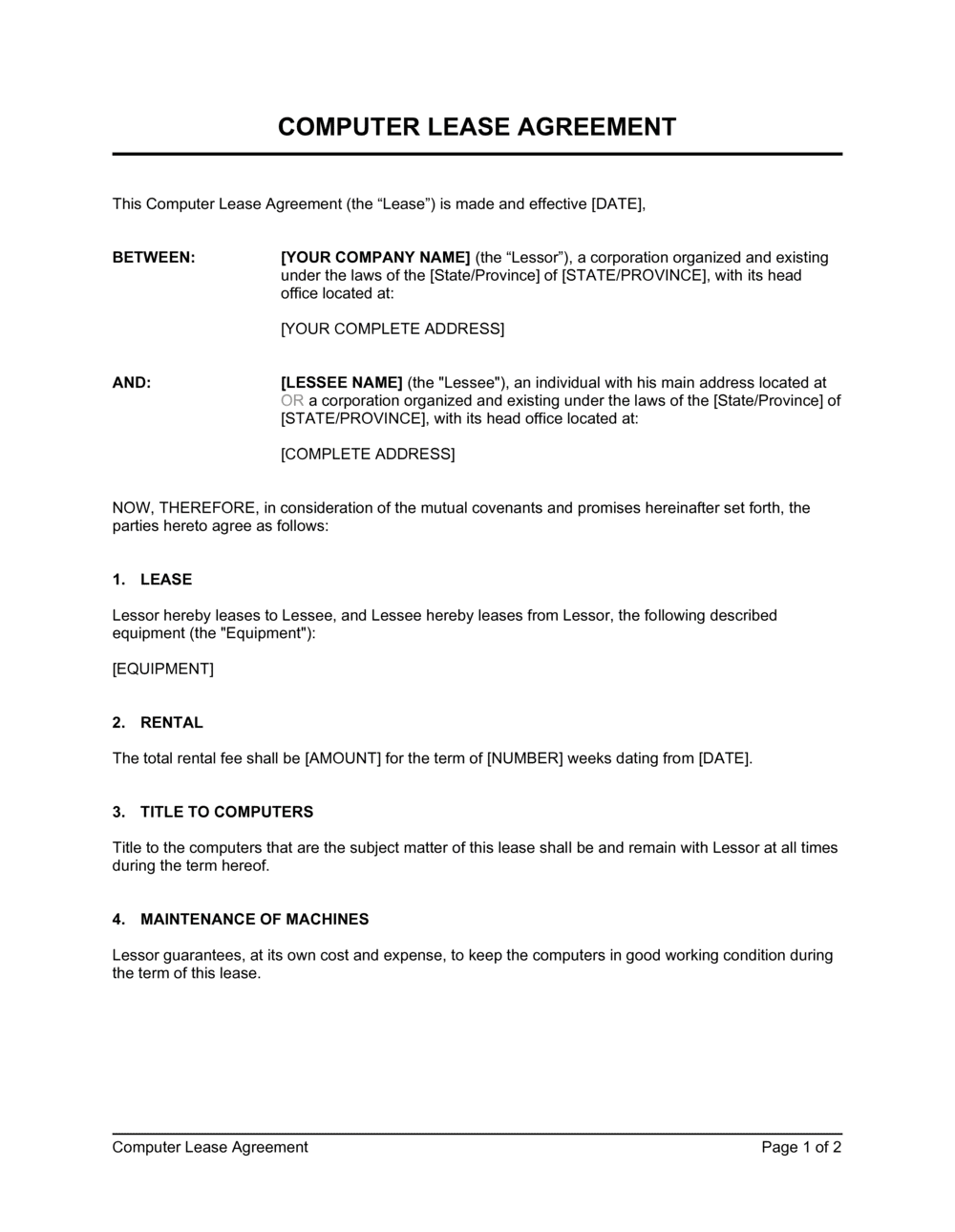
A Computer Lease Agreement is a legally binding contract between an equipment owner (lessor) and a business or individual (lessee) that governs the use of computers or related hardware for a defined term in exchange for periodic payments. This free Word download covers equipment identification, payment schedule, maintenance responsibilities, insurance, and return conditions in a single structured document you can edit online and export as PDF.
When you need it
Use it whenever a business leases computers, servers, or peripherals either from a vendor or to another party β€” whether for a fixed project term, a rolling monthly arrangement, or a multi-year fleet deployment. It is equally necessary when a lessor wants enforceable obligations governing how their hardware is used, maintained, and returned.
What's inside
Equipment description and serial numbers, lease term and renewal options, monthly payment amount and late-fee provisions, maintenance and repair obligations, insurance requirements, permitted use restrictions, default and remedy clauses, and end-of-term return or purchase options.

What is a Computer Lease Agreement?

A Computer Lease Agreement is a legally binding contract between a hardware owner (the lessor) and a business or individual (the lessee) that formally grants the right to possess and use specified computer equipment for a defined term in exchange for periodic payments. Unlike a simple rental receipt or informal arrangement, this agreement identifies each device by serial number, allocates maintenance and insurance obligations, sets default and repossession remedies, and governs precisely what happens at the end of the term β€” whether the equipment is returned, renewed, or purchased. It applies equally to a single laptop loaned to a remote contractor and to a multi-hundred-unit fleet deployment across a corporate office.

The agreement draws on established personal property lease law β€” UCC Article 2A in the United States, provincial PPSA frameworks in Canada, and national commercial codes across the EU and UK β€” to create enforceable obligations that protect both sides of the transaction. When properly drafted, it eliminates the ambiguity that informal equipment-lending arrangements invariably produce: who pays for a cracked screen, what happens to company data on a returned device, and whether a holdover lessee owes rent at the original or an elevated rate.

Why You Need This Document

Without a signed computer lease agreement, both parties operate on assumptions that diverge the moment anything goes wrong. A lessee who damages equipment and hands it back claiming "normal wear and tear" has no written standard to be held to. A lessor who repossesses hardware after a missed payment without a clear default-and-remedy clause may face a conversion claim. Company data left on returned devices β€” customer records, financial files, proprietary code β€” creates GDPR, HIPAA, or trade-secret liability that no informal handshake arrangement addresses.

Beyond disputes, the absence of a written agreement affects insurance claims, tax treatment, and priority in insolvency. Lessors who fail to register their interest under provincial PPSA rules in Canada can lose their hardware to a secured creditor if the lessee becomes insolvent. In the EU, any arrangement involving hardware that has processed personal data requires documented data-handling obligations to satisfy GDPR. This template closes all of these gaps in under 30 minutes, giving both parties a clear, enforceable record of exactly what was leased, on what terms, and what each side owes if circumstances change.

Which variant fits your situation?

If your situation is…Use this template
Leasing a full fleet of computers and servers to a corporate clientEquipment Lease Agreement
Short-term rental of a single laptop or workstation for an event or projectComputer Lease Agreement (Short-Term)
Lease with an option for the lessee to purchase at end of termLease-to-Own Agreement
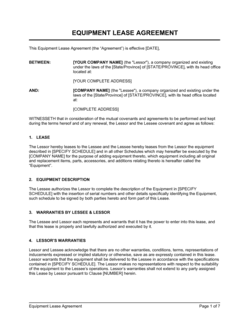
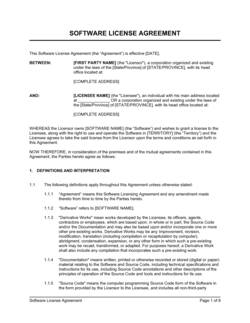
Leasing software licenses alongside the hardwareSoftware License Agreement
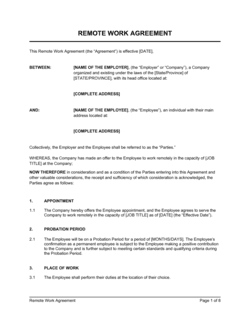
Providing computers to employees for remote work under company policyRemote Work Agreement
Leasing office equipment including printers, phones, and peripheralsOffice Equipment Lease Agreement
Financing hardware purchase via installments rather than a true leaseInstallment Payment Agreement

Common mistakes to avoid

❌ Describing equipment without serial numbers

Why it matters: Generic descriptions like 'two MacBook Pros' leave no way to prove which specific units were leased if one is damaged, stolen, or swapped β€” making damage claims and insurance filings nearly impossible.

Fix: List every device with its make, model, serial number, and condition in a signed Schedule A attached to the agreement at execution.

❌ No cure period before declaring default

Why it matters: An immediate-repossession clause without a notice-and-cure period is frequently unenforceable, and attempting self-help repossession without legal authority exposes the lessor to conversion or trespass claims.

Fix: Provide at least 10 days' written notice for payment defaults and 15 days for other breaches before exercising repossession rights.

❌ Omitting a data-wiping requirement in the return clause

Why it matters: Returned computers containing confidential business data create serious privacy and regulatory liability for both parties β€” GDPR fines, HIPAA penalties, and trade-secret exposure have all resulted from improperly returned leased hardware.

Fix: Include an explicit data-wiping clause specifying a recognized standard (NIST 800-88 or equivalent) and require written certification before or at return.

❌ No insurance requirement or additional insured designation

Why it matters: If the lessee's premises suffer a fire or theft and the lessor is not named as additional insured, the lessor has no direct claim against the lessee's insurer and may be left with only an unsecured contract claim.

Fix: Require the lessee to carry property coverage equal to full replacement value, name the lessor as additional insured, and demand a certificate of insurance before handing over any equipment.

❌ Auto-renewal clause with no notice deadline

Why it matters: Lessees who miss an undisclosed or unclear notice window find themselves bound to a renewed lease term they cannot afford or no longer need, leading to disputes and default.

Fix: State the auto-renewal notice period explicitly β€” 30 days is standard β€” and send the lessee a reminder email 45 days before the deadline as a matter of practice.

❌ Choosing a governing law with no connection to either party

Why it matters: Courts in the lessee's home state or country may apply local commercial protection laws regardless of the contractual choice β€” meaning your chosen jurisdiction's law simply does not apply when you try to enforce.

Fix: Choose the governing law of the state or country where the equipment is physically located or where the lessee is incorporated, and confirm that jurisdiction's law is consistent with your key remedies.

The 10 key clauses, explained

Parties, Equipment Description, and Identification

In plain language: Names the lessor and lessee as legal entities and precisely identifies every piece of leased equipment by make, model, serial number, and condition at handover.

Sample language
This Computer Lease Agreement is entered into on [DATE] between [LESSOR LEGAL NAME] ('Lessor') and [LESSEE LEGAL NAME] ('Lessee'). Lessor agrees to lease to Lessee the following equipment: [MAKE / MODEL], Serial No. [SERIAL NUMBER], in [NEW / REFURBISHED] condition, as further described in Schedule A.

Common mistake: Describing equipment only by generic category ('three laptops') without serial numbers. If a unit is damaged or disputed at return, there is no way to establish which specific item the contract covered.

Lease Term and Renewal

In plain language: States the exact start and end dates of the lease and specifies whether it auto-renews, converts to month-to-month, or terminates without further notice at expiry.

Sample language
The lease term commences on [START DATE] and expires on [END DATE] ('Initial Term'). Unless either party provides written notice of termination at least [30] days before expiry, this Agreement shall automatically renew for successive [30]-day periods under the same terms.

Common mistake: Omitting an auto-renewal clause entirely β€” or including one without a notice period. Lessees who miss renewal deadlines find themselves locked into another full term; lessors lose hardware they expected returned.

Rent, Payment Schedule, and Late Fees

In plain language: Sets the monthly or periodic lease payment amount, due date, accepted payment methods, and the late-fee rate applied to overdue balances.

Sample language
Lessee shall pay Lessor a monthly lease fee of $[AMOUNT] due on the [DAY] of each calendar month. Payments not received within [5] business days of the due date shall incur a late fee of [1.5]% of the overdue amount per month until paid in full.

Common mistake: Stating a payment amount without specifying the currency, due date, or late-fee mechanism. Disputes over when payment is 'late' are among the most common triggers for equipment lease litigation.

Security Deposit

In plain language: Requires the lessee to pay a refundable deposit held by the lessor as security against damage, unpaid rent, or unreturned equipment.

Sample language
Upon execution of this Agreement, Lessee shall deposit $[AMOUNT] with Lessor as a security deposit. The deposit shall be refunded within [30] days of the lease term end, less any deductions for unpaid rent or damage beyond fair wear and tear.

Common mistake: Not specifying the conditions and timeline for deposit return. Lessees who receive no deposit back and no itemized deduction list within a reasonable period have limited recourse without this language.

Permitted Use and Location

In plain language: Restricts the lessee's use of the equipment to defined business purposes and a specified location, and prohibits subletting, relocation, or unauthorized modification.

Sample language
Lessee shall use the Equipment solely for [BUSINESS PURPOSE] at [ADDRESS]. Lessee shall not sublet, assign, modify, or relocate the Equipment without Lessor's prior written consent. Unauthorized software installation that voids manufacturer warranty is expressly prohibited.

Common mistake: No location or use restriction at all, leaving the lessor unable to enforce against a lessee who moves equipment abroad, sublets it, or installs software that voids the manufacturer warranty β€” all of which affect resale value.

Maintenance, Repair, and Risk of Loss

In plain language: Allocates responsibility for routine maintenance and accidental damage between the parties, and states which party bears the risk if equipment is stolen, destroyed, or rendered unusable.

Sample language
Lessee shall maintain the Equipment in good working order and shall be responsible for all repairs arising from misuse or negligence. Risk of loss or damage to the Equipment passes to Lessee upon delivery and remains with Lessee until the Equipment is returned to and accepted by Lessor.

Common mistake: Failing to state when risk of loss transfers. Courts have held that without an explicit transfer clause, the lessor retains risk during transit β€” meaning the lessor bears loss from a shipping accident the lessee caused.

Insurance

In plain language: Requires the lessee to maintain property and liability insurance covering the full replacement value of the equipment throughout the lease term, with the lessor named as an additional insured.

Sample language
Lessee shall maintain, at its own expense, property insurance covering the Equipment for no less than its full replacement value of $[AMOUNT] and commercial general liability insurance of at least $[AMOUNT] per occurrence. Lessor shall be named as additional insured. Proof of coverage shall be provided within [5] business days of request.

Common mistake: No specific coverage amount and no requirement to name the lessor as additional insured. An uninsured loss leaves the lessor holding an unrecoverable claim against a lessee who may be judgment-proof.

Default and Remedies

In plain language: Defines what constitutes a default β€” missed payments, breach of use restrictions, insolvency β€” and grants the lessor the right to repossess equipment, accelerate outstanding rent, and seek damages.

Sample language
Lessee shall be in default upon: (a) failure to pay rent within [10] days of its due date; (b) breach of any material term not cured within [15] days of written notice; or (c) Lessee's insolvency or assignment for the benefit of creditors. Upon default, Lessor may immediately repossess the Equipment and accelerate all remaining rent payments as a liquidated sum.

Common mistake: No cure period before declaring default. Courts in most jurisdictions will refuse to enforce an immediate repossession right if the lessee was never given notice and a reasonable opportunity to cure a non-payment breach.

End-of-Term Return and Purchase Option

In plain language: Specifies the condition in which equipment must be returned, the return logistics, and any option the lessee has to purchase the equipment at an agreed price at lease end.

Sample language
On or before the final day of the lease term, Lessee shall return the Equipment to Lessor at [ADDRESS] in the same condition as received, subject to fair wear and tear. Lessee shall have the option to purchase the Equipment for $[PURCHASE OPTION PRICE] by providing written notice no later than [30] days before lease expiry.

Common mistake: Omitting data-wiping requirements in the return clause. Returned computers containing the lessee's confidential data β€” or, in a lessee-as-lessor scenario, the lessor's β€” create privacy liability that a simple 'good condition' return clause does not address.

Governing Law, Dispute Resolution, and Entire Agreement

In plain language: Names the jurisdiction whose law governs the contract, sets the mechanism for resolving disputes (arbitration, mediation, or court), and confirms the written agreement supersedes all prior discussions.

Sample language
This Agreement is governed by the laws of [STATE / PROVINCE / COUNTRY]. Any dispute shall be submitted to binding arbitration in [CITY] under the rules of [AAA / JAMS]. This Agreement constitutes the entire agreement between the parties and supersedes all prior representations, proposals, and understandings.

Common mistake: Choosing a governing law with no connection to where either party is located or where the equipment is used. Several US states and EU member countries apply local consumer or commercial protection laws regardless of the contractual choice-of-law clause.

How to fill it out

  1. 1

    Identify both parties with their full legal entity names

    Enter the registered legal name, address, and contact information for both the lessor and lessee. If the lessee is an individual rather than a company, include their full legal name and government-issued ID type.

    πŸ’‘ Confirm the lessee's legal entity name matches their incorporation documents β€” a mismatch creates enforceability problems if you need to collect on default.

  2. 2

    Complete Schedule A with precise equipment descriptions

    List every device covered by the agreement with its make, model, serial number, condition (new or refurbished), and estimated replacement value. Attach photos of existing cosmetic damage at time of handover.

    πŸ’‘ Photograph every item at pickup and delivery β€” timestamped images are the most effective evidence in return-condition disputes.

  3. 3

    Set the lease term, start date, and renewal mechanics

    Enter the exact commencement and expiry dates. Decide whether the lease auto-renews monthly, requires affirmative renewal, or terminates automatically, and write the required notice period accordingly.

    πŸ’‘ For leases longer than 12 months, include a technology-refresh clause allowing the lessee to swap aging units for newer models without renegotiating the full agreement.

  4. 4

    Define rent, payment due date, and late-fee terms

    State the monthly fee amount, the specific calendar day it is due, accepted payment methods, and the late-fee rate. Specify the currency for any cross-border arrangement.

    πŸ’‘ A 1.5% per month late fee (18% per annum) is standard and generally enforceable in most US states; confirm the usury ceiling in your jurisdiction before exceeding this.

  5. 5

    Set the security deposit amount and return conditions

    State the deposit amount, how it is held (commingled or in a separate account), the deadline for return after lease end, and the exhaustive list of permissible deductions.

    πŸ’‘ Itemizing permissible deductions in advance β€” unpaid rent, damage beyond fair wear and tear, missing accessories β€” eliminates the most common post-lease disputes.

  6. 6

    Specify insurance requirements and name the lessor as additional insured

    Enter the minimum coverage amounts for property and liability insurance, require the lessor to be named as additional insured, and set a deadline for the lessee to furnish proof of coverage.

    πŸ’‘ Request a certificate of insurance from the lessee before handing over equipment β€” not after. Once the hardware leaves your possession, you have no leverage.

  7. 7

    Confirm the data-wiping and return protocol

    Add an explicit data-wiping requirement to the return clause, specifying the standard (e.g., NIST 800-88) and requiring written certification of completion before or at return.

    πŸ’‘ A data-wipe certification requirement protects both parties β€” the lessee's confidential data and any residual customer data don't end up on a refurbished machine sold to a third party.

  8. 8

    Sign before equipment is transferred

    Both parties must sign the agreement β€” and any Schedule A β€” before the equipment changes hands. Use Business in a Box eSign to timestamp execution and store the fully-executed copy automatically.

    πŸ’‘ Countersigned agreements with a delivery receipt attached (noting serial numbers and condition) create an airtight chain of custody from day one.

Frequently asked questions

What is a computer lease agreement?

A computer lease agreement is a legally binding contract between a hardware owner (lessor) and a business or individual (lessee) that grants the right to use specified computer equipment for a defined term in exchange for periodic payments. It identifies the equipment by serial number, sets the rent and payment schedule, allocates maintenance and insurance responsibilities, and governs what happens at the end of the term β€” return, renewal, or purchase.

What is the difference between leasing and buying computer equipment?

Buying transfers ownership and the full cost appears on the balance sheet immediately. Leasing preserves cash flow by spreading payments over the term and, depending on the lease structure, may be treated as an operating expense rather than a capital asset. Leasing also allows businesses to refresh technology at end of term rather than owning depreciated hardware. The trade-off is that the total cost of a lease typically exceeds the purchase price over the same period.

Do I need a lawyer to draft a computer lease agreement?

For straightforward leases of standard commercial hardware between two businesses, a high-quality template is generally sufficient. Consider engaging a lawyer when the equipment has a replacement value above $25,000, the lessee is in a different country, the agreement includes complex purchase options or residual-value guarantees, or the hardware will process regulated data (personal health information, financial records) with significant compliance implications.

What happens if leased computer equipment is damaged or stolen?

Under a properly drafted agreement, risk of loss passes to the lessee upon delivery and the lessee is responsible for repair or replacement. The lessee's required property insurance should cover the full replacement value. If the lessee lacks adequate insurance, the lessor can pursue contract damages up to the equipment's replacement value. This is why requiring proof of insurance before handover β€” not after β€” is critical.

Can a computer lease agreement include a purchase option?

Yes. A lease-to-own or lease-with-option structure allows the lessee to purchase the equipment at a predetermined price β€” often the residual or fair market value β€” by providing written notice before the lease expires. The purchase option price and notice deadline must be stated explicitly in the agreement. If no option price is set in writing, disputes over fair market value are common at end of term.

What should the return clause in a computer lease agreement include?

The return clause should specify the condition required (same as received, subject to fair wear and tear), who bears return shipping costs, the return address and deadline, a data-wiping requirement with a recognized standard such as NIST 800-88, and the process for the lessor to inspect and accept the returned equipment. Missing the data-wiping requirement is the most overlooked β€” and most consequential β€” gap in most standard templates.

What is the difference between an operating lease and a finance lease for computers?

An operating lease is a short-to-medium-term arrangement where the lessee uses the equipment and returns it at end of term, recognizing payments as operating expenses. A finance lease (capital lease) transfers substantially all risks and rewards of ownership to the lessee β€” typically with a nominal purchase option β€” and is recorded as an asset and liability on the lessee's balance sheet under IFRS 16 and ASC 842. The classification affects tax treatment, financial ratios, and reporting obligations.

How long can a computer lease agreement last?

Computer lease terms typically run 12 to 36 months, reflecting the useful life and depreciation curve of the hardware. Shorter terms (6–12 months) suit event-based or project deployments. Longer terms (48–60 months) are used for servers and infrastructure but are uncommon for end-user devices given how quickly computing hardware becomes obsolete. Most agreements include an auto-renewal provision converting the lease to month-to-month at a premium rate if neither party acts at expiry.

Is a computer lease agreement enforceable if the lessee is an individual rather than a business?

Generally yes, but consumer protection laws in many jurisdictions impose additional requirements when the lessee is a natural person rather than a registered business entity. In the US, consumer leases of personal property are regulated by the Consumer Leasing Act if the lease term exceeds four months. In the EU, consumer contracts must meet minimum transparency and fairness standards under the Unfair Contract Terms Directive. A template designed for B2B leases should be reviewed by a lawyer before use in a consumer context.

How this compares to alternatives

vs Equipment Lease Agreement

A general equipment lease agreement covers any category of tangible personal property β€” vehicles, machinery, furniture, or electronics. A computer lease agreement is narrower in scope but adds technology-specific provisions that a general equipment lease omits: permitted software, data-wiping obligations, cybersecurity requirements, and hardware obsolescence clauses. Use the general form for mixed-asset leases; use this template when computers and IT hardware are the primary subject.

vs Software License Agreement

A software license agreement governs the right to use intellectual property β€” code, applications, and platforms β€” without transferring possession of any physical object. A computer lease agreement governs the physical hardware itself. When a business needs both hardware and software, separate agreements are typically required, though a computer lease can reference a parallel software license by attachment.

vs Independent Contractor Agreement

An independent contractor agreement governs a service relationship; it does not address equipment ownership or custody. When a business provides equipment to a contractor, a computer lease agreement β€” or an equipment-use addendum β€” should be executed alongside the services agreement to establish who bears risk of loss, maintenance obligations, and return requirements for company-owned hardware.

vs Remote Work Agreement

A remote work agreement sets the terms of a remote employment or contractor arrangement, including general expectations around company-provided equipment. It is not a standalone lease β€” it does not identify specific hardware by serial number, set a payment schedule, or include default and repossession remedies. A computer lease agreement (or equipment-use addendum) should be executed separately whenever company hardware of significant value is transferred to an off-site worker.

Industry-specific considerations

Technology / SaaS

Short 12–24 month terms aligned to hardware refresh cycles; data-wiping certifications mandatory given customer data processed on devices; BYOD vs. company-owned hardware policy integration.

Healthcare

HIPAA data-security requirements embedded in the permitted-use and return clauses; equipment used in clinical settings often requires FDA-compliant maintenance schedules; longer terms for diagnostic workstations.

Financial Services

SOC 2 and PCI-DSS compliance obligations require explicit data-handling provisions; hardware used to process payment or trading data needs enhanced insurance and chain-of-custody documentation.

Education

Large-volume fleet leases for student devices with volume pricing; FERPA-driven data-wiping requirements; end-of-term purchase options common to retain devices for multi-year programs.

Professional Services

Short-term project-based leases for consultants on client sites; confidentiality provisions critical given access to client data; portable equipment requiring explicit location-flexibility clauses.

Manufacturing

Industrial ruggedized hardware with different maintenance and wear standards; on-site repair obligations for equipment integrated into production lines; longer lease terms to match capital planning cycles.

Jurisdictional notes

United States

Computer leases are governed by UCC Article 2A in most states, which sets default rules for personal property lease rights, remedies, and risk of loss. Consumer leases (lessee is an individual, not a business) with terms over four months must comply with the federal Consumer Leasing Act disclosure requirements. Non-judicial self-help repossession after default is permitted in most states only if it can be accomplished without breaching the peace β€” attempting to repossess hardware by force or deception exposes the lessor to tort liability.

Canada

In Canada, personal property leases are governed by provincial Personal Property Security Acts (PPSA), which require lessors with terms exceeding one year to register a financing statement to protect their priority interest against the lessee's creditors. Unregistered lessors may lose their hardware to a secured creditor in an insolvency. Quebec's Civil Code applies different rules from common-law provinces, including specific provisions on nominate contracts of lease.

United Kingdom

UK computer leases are primarily governed by the Consumer Credit Act 1974 (for consumer arrangements) and general contract law. The Consumer Rights Act 2015 imposes fairness and transparency requirements on contract terms, particularly for standard-form business-to-consumer agreements. Retention of title and repossession rights must be clearly stated to be enforceable; courts scrutinize penalty clauses and may reduce disproportionate liquidated-damages provisions.

European Union

EU member states apply varying national commercial code provisions to equipment leases, but GDPR creates an overlay obligation for any lease arrangement where the lessee processes personal data on the hardware. A data-processing addendum or explicit data-wiping clause is effectively required under GDPR Article 28 when the lessor is a controller and the hardware has processed personal data. The Unfair Contract Terms Directive (93/13/EEC) limits the use of one-sided default and penalty clauses in consumer and small-business contracts.

Template vs lawyer β€” what fits your deal?

PathBest forCostTime
Use the templateB2B computer leases for standard commercial hardware valued under $10,000 between domestic partiesFree20–30 minutes
Template + legal reviewLeases above $10,000, cross-border arrangements, or hardware processing regulated data (health, financial, education records)$300–$700 (1–2 hour attorney review)2–5 business days
Custom draftedLarge fleet deployments, leases with complex residual-value or purchase-option structures, or lessors building a recurring commercial leasing program$1,500–$4,000+1–3 weeks

Glossary

Lessor
The party that owns the computer equipment and grants the lessee the right to use it in exchange for periodic payments.
Lessee
The party that takes possession of and uses the leased computer equipment under the terms of the agreement.
Lease Term
The defined period during which the lessee is entitled to use the equipment, stated as a start date and end date or a duration in months.
Operating Lease
A lease treated as an expense rather than a capital purchase, typically for shorter terms where the lessee returns the equipment at the end β€” common for computers that depreciate quickly.
Finance Lease (Capital Lease)
A lease structured so the lessee assumes most risks and rewards of ownership, often with a purchase option at end of term β€” recognized as a liability on the lessee's balance sheet.
Residual Value
The estimated market value of the equipment at the end of the lease term, which may determine the purchase-option price or lessor's end-of-term recovery.
Default
A breach of the lease agreement β€” such as missed payments or unauthorized modification of equipment β€” that triggers the lessor's right to repossess the hardware and claim damages.
Permitted Use
The contractually defined scope of activities for which the lessee may use the leased equipment, excluding unauthorized modifications, subletting, or use outside agreed locations.
Indemnification
A clause requiring one party β€” typically the lessee β€” to compensate the other for losses, damages, or legal claims arising from their use of the leased equipment.
Holdover Period
A period after the lease term expires during which the lessee continues to possess the equipment, typically converting to a month-to-month arrangement at a higher rate.
Fair Wear and Tear
Normal, expected deterioration of equipment from ordinary use over the lease term, as distinguished from damage the lessee is liable to repair or compensate.
UCC Article 2A
The section of the Uniform Commercial Code governing personal property leases in most US states, setting default rules for equipment lease rights and remedies.

Part of your Business Operating System

This document is one of 3,000+ business & legal templates included in Business in a Box.

  • Fill-in-the-blanks β€” ready in minutes
  • 100% customizable Word document
  • Compatible with all office suites
  • Export to PDF and share electronically

Create your document in 3 simple steps.

From template to signed document β€” all inside one Business Operating System.
1
Download or open template

Access over 3,000+ business and legal templates for any business task, project or initiative.

2
Edit and fill in the blanks with AI

Customize your ready-made business document template and save it in the cloud.

3
Save, Share, Send, Sign

Share your files and folders with your team. Create a space of seamless collaboration.

Save time, save money, and create top-quality documents.

β˜…β˜…β˜…β˜…β˜…

"Fantastic value! I'm not sure how I'd do without it. It's worth its weight in gold and paid back for itself many times."

Managing Director Β· Mall Farm
Robert Whalley
Managing Director, Mall Farm Proprietary Limited
β˜…β˜…β˜…β˜…β˜…

"I have been using Business in a Box for years. It has been the most useful source of templates I have encountered. I recommend it to anyone."

Business Owner Β· 4+ years
Dr Michael John Freestone
Business Owner
β˜…β˜…β˜…β˜…β˜…

"It has been a life saver so many times I have lost count. Business in a Box has saved me so much time and as you know, time is money."

Owner Β· Upstate Web
David G. Moore Jr.
Owner, Upstate Web

Run your business with a system β€” not scattered tools

Stop downloading documents. Start operating with clarity. Business in a Box gives you the Business Operating System used by over 250,000 companies worldwide to structure, run, and grow their business.

Start freeΒ Β·Β No credit card required