Software License Agreement Template

Free Word download • Edit online • Save & share with Drive • Export to PDF

8 pages30–40 min to fillDifficulty: ComplexSignature requiredLegal review recommended
Learn more ↓
FreeSoftware License Agreement Template

At a glance

What it is
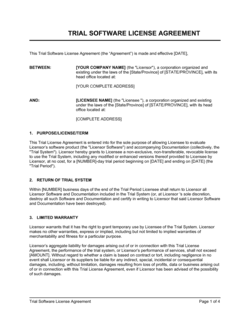
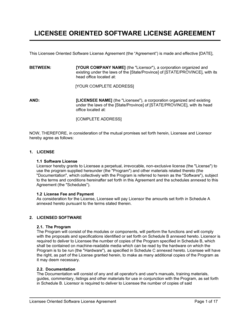
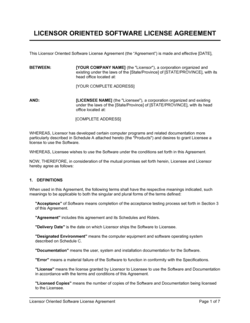
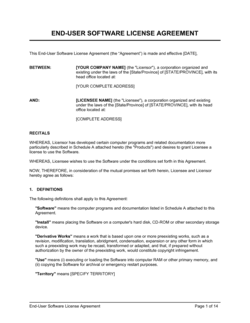
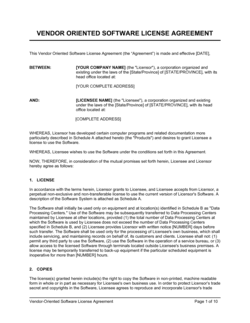
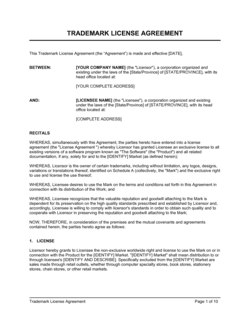
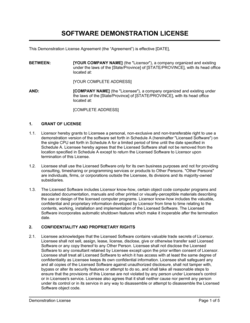
A Software License Agreement is a legally binding contract between a software owner (licensor) and a user or business (licensee) that defines exactly how the software may be used, copied, modified, and distributed. This free Word download covers grant of license, restrictions, IP ownership, warranties, liability limits, and termination in a single document you can edit online and export as PDF.
When you need it
Use it whenever you distribute proprietary software, grant a business customer access to your platform, or receive software from a vendor whose default terms do not match your operational or legal requirements.
What's inside
Grant of license and permitted use, scope and user restrictions, intellectual property ownership and assignments, warranties and disclaimers, limitation of liability, confidentiality, audit rights, support and maintenance terms, termination conditions, and governing law and dispute resolution.

What is a Software License Agreement?

A Software License Agreement is a legally binding contract between a software owner (the licensor) and a user or organization (the licensee) that defines the precise terms under which the software may be installed, accessed, copied, and used. Unlike a sale, a software license never transfers ownership of the underlying code — the licensor retains all intellectual property rights while granting the licensee a defined, conditional right to use the product. The agreement specifies who may use the software, on how many devices or for how many users, for what purposes, at what price, and for how long — and it establishes what happens when those boundaries are crossed or the relationship ends.

Why You Need This Document

Distributing or deploying software without a signed license agreement leaves both parties dangerously exposed. A licensor without one has no enforceable mechanism to prevent a licensee from copying the software to unlimited devices, sublicensing it to third parties, reverse-engineering the source code, or continuing to use it after a relationship breaks down. A licensee without one has no documented entitlement to the software at all — meaning the licensor could revoke access at any time with no legal recourse. Beyond access rights, the absence of warranty disclaimers and limitation of liability clauses means that a single bug causing business disruption could generate uncapped damages claims. For SaaS companies licensing to business customers, the gap is even sharper: without a signed agreement, data handling obligations, audit rights, and termination procedures are undefined, creating compliance exposure under GDPR, HIPAA, and equivalent frameworks. This template gives licensors and licensees a clear, enforceable foundation that protects IP ownership, caps financial exposure, and eliminates the ambiguity that makes software disputes expensive to resolve.

Which variant fits your situation?

If your situation is…Use this template
Distributing packaged consumer or business software at point of saleEnd User License Agreement (EULA)
Granting access to a cloud-hosted SaaS platform via subscriptionSaaS Subscription Agreement
Licensing software source code to another developer or organizationSource Code License Agreement
Granting a partner the right to redistribute or bundle softwareSoftware Reseller Agreement
Transferring all rights to software permanently to a buyerSoftware Assignment Agreement
Commissioning a contractor to build custom software for your companySoftware Development Agreement
Providing an open-source project under a permissive or copyleft licenseOpen Source Contributor License Agreement

Common mistakes to avoid

❌ Granting an exclusive license unintentionally

Why it matters: Omitting the word 'non-exclusive' from the grant clause can allow a licensee to argue they hold the sole right to use the software, blocking the licensor from licensing it to anyone else.

Fix: Always include 'non-exclusive' in the grant clause unless you are deliberately and knowingly granting an exclusive license with corresponding premium pricing.

❌ No post-termination deletion requirement

Why it matters: Without an obligation to delete or certify destruction of all copies, a terminated licensee faces no concrete legal duty to stop using the software, making enforcement practically difficult.

Fix: Add a clause requiring the licensee to certify in writing within 10 business days of termination that all copies of the software have been permanently deleted or returned.

❌ Warranty language that promises error-free performance

Why it matters: Promising that software will be 'free from defects' or 'uninterrupted' sets a standard no software can meet, giving the licensee grounds for a breach claim on the first incident.

Fix: Limit the warranty to material conformance with the documentation during a defined period (30–90 days) and specify that the exclusive remedy is defect correction or fee refund.

❌ Omitting a feedback and suggestions assignment clause

Why it matters: A customer who submits detailed feature requests or bug reports may claim co-authorship of resulting code under copyright law in some jurisdictions, creating an IP ownership dispute.

Fix: Include a clause stating that all feedback, suggestions, and improvement ideas provided by the licensee are irrevocably assigned to the licensor as work product.

❌ Using a limitation of liability clause without conspicuous formatting

Why it matters: Several US states and UK consumer protection rules require disclaimers and liability caps to be prominently displayed; a clause buried in standard-size text may be struck down as unenforceable.

Fix: Format all warranty disclaimers and liability limitation clauses in ALL CAPS or bold type, and place them in a visually distinct section of the agreement.

❌ No audit right for multi-user or enterprise licenses

Why it matters: Without an audit right, a licensor has no contractual mechanism to verify whether the licensee has exceeded their licensed user count or deployed the software beyond the agreed scope.

Fix: Include an audit right allowing the licensor to inspect relevant records once per year on reasonable notice, with costs borne by the licensee if underpayment of more than 5% is discovered.

The 10 key clauses, explained

Parties and recitals

In plain language: Identifies the licensor and licensee as legal entities, states the effective date, and briefly describes the software being licensed.

Sample language
This Software License Agreement ('Agreement') is entered into as of [EFFECTIVE DATE] between [LICENSOR LEGAL NAME], a [STATE/COUNTRY] [ENTITY TYPE] ('Licensor'), and [LICENSEE LEGAL NAME], a [STATE/COUNTRY] [ENTITY TYPE] ('Licensee'). Licensor owns and wishes to license the software described in Exhibit A ('Software').

Common mistake: Using a trade name or product brand instead of the registered legal entity name. If enforcement is ever needed, the contracting party must match the legal entity that owns the IP.

Grant of license

In plain language: Specifies the exact rights granted — non-exclusive, non-transferable, limited to a defined number of users or installations — and the permitted purposes.

Sample language
Licensor grants Licensee a non-exclusive, non-transferable, revocable license to install and use the Software solely for Licensee's internal business purposes on up to [NUMBER] authorized devices during the Term.

Common mistake: Omitting 'non-exclusive' and 'non-transferable.' Without these qualifiers, a licensee could argue they hold an exclusive right or the right to assign the license to another company.

Restrictions on use

In plain language: Lists what the licensee cannot do — reverse engineer, decompile, sublicense, modify, resell, or use the software outside the licensed scope.

Sample language
Licensee shall not: (a) reverse engineer, decompile, or disassemble the Software; (b) sublicense, sell, or transfer the Software to any third party; (c) use the Software to develop a competing product; or (d) remove or alter any proprietary notices.

Common mistake: Listing generic restrictions copied from consumer EULAs without tailoring them to the specific use case. A B2B enterprise license needs restrictions calibrated to integration, API access, and data export — not just 'don't copy the disc.'

Intellectual property ownership

In plain language: Confirms that the licensor retains all copyright, patents, and trade secrets in the software, and that any feedback or suggestions the licensee provides become the licensor's property.

Sample language
Licensor retains all right, title, and interest in and to the Software, including all intellectual property rights. Nothing in this Agreement transfers ownership of the Software or any portion thereof to Licensee. Any feedback provided by Licensee regarding the Software is hereby assigned to Licensor.

Common mistake: Omitting the feedback assignment clause. Without it, a customer who suggests a feature may assert co-ownership of the resulting code under copyright law in some jurisdictions.

Fees, payment, and license term

In plain language: States the license fee or subscription price, payment schedule, renewal terms, and the duration of the license — perpetual, annual, or otherwise.

Sample language
Licensee shall pay the License Fee of $[AMOUNT] per [YEAR / MONTH] within [30] days of invoice. This Agreement commences on [START DATE] and continues for [TERM], renewing automatically for successive [1-YEAR] periods unless either party provides [60] days' written notice of non-renewal.

Common mistake: Using auto-renewal language without specifying a meaningful notice period for cancellation. Courts in several jurisdictions have voided auto-renewal clauses where the notice period was so short as to be unreasonable.

Warranties and disclaimer

In plain language: States any limited warranty the licensor provides — typically that the software will perform materially as documented — and disclaims all other warranties.

Sample language
Licensor warrants that the Software will perform materially in accordance with the Documentation for [90] days from delivery ('Warranty Period'). EXCEPT AS STATED ABOVE, THE SOFTWARE IS PROVIDED 'AS IS.' LICENSOR DISCLAIMS ALL OTHER WARRANTIES, INCLUDING IMPLIED WARRANTIES OF MERCHANTABILITY AND FITNESS FOR A PARTICULAR PURPOSE.

Common mistake: Writing an overly broad warranty that promises the software will be error-free or uninterrupted. No software is error-free; this language gives the licensee grounds to terminate and claim damages on the first bug report.

Limitation of liability

In plain language: Caps the total damages either party can claim under the agreement — typically at the fees paid in the prior 12 months — and excludes indirect and consequential damages.

Sample language
IN NO EVENT SHALL EITHER PARTY'S AGGREGATE LIABILITY EXCEED THE FEES PAID BY LICENSEE IN THE [12] MONTHS PRECEDING THE CLAIM. NEITHER PARTY SHALL BE LIABLE FOR INDIRECT, INCIDENTAL, CONSEQUENTIAL, OR PUNITIVE DAMAGES, EVEN IF ADVISED OF THE POSSIBILITY OF SUCH DAMAGES.

Common mistake: Failing to write the limitation clause in ALL CAPS or otherwise conspicuous text. Several US states (including Texas) require conspicuous formatting for liability disclaimers to be enforceable against consumers.

Confidentiality

In plain language: Obliges both parties to protect the other's non-public information — source code, pricing, documentation, and business data — from disclosure to third parties.

Sample language
Each party agrees to hold the other's Confidential Information in strict confidence and not to disclose it to any third party without prior written consent. 'Confidential Information' excludes information that is publicly known, independently developed, or rightfully received from a third party.

Common mistake: Relying solely on a separate NDA and omitting confidentiality from the license agreement itself. If the NDA expires or is superseded, the license agreement must stand on its own to protect source code and proprietary documentation.

Termination

In plain language: Defines when either party may end the agreement — for cause on material breach, for convenience on notice, or automatically on insolvency — and what the licensee must do upon termination.

Sample language
Either party may terminate this Agreement for cause upon [30] days' written notice if the other party materially breaches and fails to cure within [30] days. Upon termination, Licensee shall immediately cease all use of the Software and certify in writing that all copies have been deleted or destroyed.

Common mistake: No post-termination obligations for the licensee. Without a deletion or return requirement, a licensee may continue using the software indefinitely after termination, with no clear legal mechanism to stop them.

Governing law and dispute resolution

In plain language: Specifies which jurisdiction's law governs the agreement and whether disputes go to arbitration, mediation, or court — and where.

Sample language
This Agreement is governed by the laws of [STATE / PROVINCE / COUNTRY], without regard to conflict-of-law principles. Any dispute shall be resolved by binding arbitration administered by [AAA / JAMS / ICC] in [CITY], except that either party may seek injunctive relief in any court of competent jurisdiction.

Common mistake: Choosing a governing law in a jurisdiction with no meaningful connection to either party. Courts in some US states and EU member countries will apply local law regardless of the contract's choice-of-law clause, especially for consumer-facing software.

How to fill it out

  1. 1

    Identify the parties using legal entity names

    Enter the full registered legal name, state or country of incorporation, and entity type (LLC, Inc., Ltd.) for both licensor and licensee. Add the effective date of the agreement.

    💡 Cross-reference your corporate registry or certificate of incorporation to confirm the exact legal name before the document is signed.

  2. 2

    Define the software in Exhibit A

    Attach a schedule that identifies the software by name, version number, and a brief functional description. If the license covers a SaaS platform, specify the URL and any included modules or tiers.

    💡 Vague software descriptions create scope disputes. Specify version numbers — or state 'all versions released during the Term' — so there is no ambiguity about what is covered.

  3. 3

    Specify the license scope and user limits

    Choose the license type — named-user, concurrent-user, site-wide, or OEM — and enter the maximum permitted user count, device count, or installation locations. State whether internal use only or commercial redistribution is permitted.

    💡 If the licensee is a corporation, clarify whether affiliates and subsidiaries are included in the license scope or require separate agreements.

  4. 4

    Set fees, payment terms, and renewal structure

    Enter the license fee, billing frequency, payment due date relative to invoice, and the auto-renewal notice period. For multi-year deals, specify annual escalation clauses if applicable.

    💡 State the currency explicitly for any cross-border arrangement. USD and CAD, or GBP and EUR, are easy to confuse on international invoices.

  5. 5

    Configure the warranty period and scope

    Enter the warranty period (typically 30–90 days) and confirm what the warranty covers — that the software will perform materially as documented. Add the exclusive remedy (e.g., correction of defects or refund) if the warranty is breached.

    💡 Keep the warranty narrow and specific. A 90-day functionality warranty is defensible; an open-ended promise that software is 'fit for purpose' creates unlimited exposure.

  6. 6

    Set the limitation of liability cap

    Enter the liability cap amount — typically the fees paid in the prior 12 months — and confirm that indirect and consequential damages are excluded for both parties.

    💡 Format the disclaimer and limitation clause in ALL CAPS or bold to meet conspicuous-notice requirements in US and UK jurisdictions.

  7. 7

    Choose governing law and dispute resolution forum

    Select the governing jurisdiction and confirm whether disputes go to arbitration, mediation, or litigation. Enter the arbitration body (e.g., AAA, JAMS, or ICC) and the seat city.

    💡 For US-based SaaS companies licensing to EU customers, be aware that GDPR data processing terms may need to be added as a separate data processing agreement — the license agreement alone is insufficient.

  8. 8

    Execute before deployment or access is granted

    Both parties must sign the agreement before the licensee installs the software or receives access credentials. For click-wrap EULAs, the acceptance mechanism must be logged with a timestamp.

    💡 Use an e-signature tool to timestamp execution and retain a fully-executed copy. Oral agreements to proceed before signing are unenforceable for IP-related restrictions in most jurisdictions.

Frequently asked questions

What is a software license agreement?

A software license agreement is a legally binding contract between the software owner (licensor) and a user or organization (licensee) that defines the terms under which the software may be installed, accessed, and used. It confirms that the licensor retains IP ownership, specifies permitted use and user limits, sets payment terms, and addresses warranties, liability, and termination — without transferring any ownership of the software itself.

What is the difference between a software license agreement and an EULA?

A software license agreement is typically a negotiated B2B contract between two identified parties — the licensor and a named business customer. An end user license agreement (EULA) is a standardized, non-negotiated agreement presented to individual end users at installation or sign-up, usually accepted by clicking 'I Agree.' EULAs cover consumer and small-business software broadly; a software license agreement governs enterprise, OEM, or custom deployment arrangements where terms are specifically negotiated.

Do I need a software license agreement if I already have terms of service?

Terms of service govern the general use of a website or online platform and focus on acceptable use, data handling, and content policies. A software license agreement specifically addresses IP ownership, installation rights, user limits, warranty disclaimers, and software-specific restrictions. For any arrangement where a licensee installs software on their own infrastructure or receives API access for integration purposes, a dedicated software license agreement provides more comprehensive and enforceable protection than terms of service alone.

What happens if a licensee exceeds the number of licensed users?

Exceeding the licensed user count is typically a material breach of the agreement, giving the licensor the right to invoice for the additional users, suspend access, or terminate the contract after a cure period. Without an audit right clause, however, the licensor has no contractual mechanism to discover or verify the overage. Including an audit right and a true-up pricing schedule at contract execution gives both parties clear expectations and avoids disputes.

Can a licensee sublicense or transfer the software to another company?

No — unless the agreement explicitly permits it. Most software license agreements restrict sublicensing and assignment to protect the licensor's pricing structure and customer relationships. A licensee seeking to extend access to affiliates, subsidiaries, or third-party contractors should negotiate explicit language covering those scenarios before signing, not after. Without such language, granting third-party access is a breach of contract.

Is a software license agreement enforceable internationally?

Generally yes, when properly drafted with a choice-of-law clause and a dispute resolution mechanism. However, certain jurisdictions impose mandatory consumer protections and data handling requirements that override contractual terms — the EU's GDPR requires a separate data processing agreement for any personal data processed through the software, regardless of what the license agreement says. Engaging local counsel when licensing into the EU, Canada, or Australia is advisable for commercial arrangements above low transaction values.

What is source code escrow and when should I require it?

Source code escrow is an arrangement where the licensor deposits the software's source code with a neutral third party, who releases it to the licensee only if the licensor ceases operations, enters insolvency, or fails to maintain the software as required. Licensees running mission-critical business operations on third-party software should negotiate escrow as a condition of any multi-year enterprise license, particularly when the vendor is a startup or privately held company with no track record of stability.

What should the limitation of liability cap be set at?

The most common cap in B2B software license agreements is the total fees paid by the licensee in the 12 months preceding the claim. For high-value enterprise deals, licensees often push for a higher cap — one to three times annual fees — especially where the software underpins revenue-critical operations. Licensors of consumer-facing software should check jurisdiction- specific minimums: some EU member states and Canadian provinces prohibit liability exclusions that leave consumers without a meaningful remedy.

Does a software license agreement need to be signed by both parties?

Yes, for a negotiated B2B agreement to be fully enforceable. Click-wrap agreements accepted digitally by an authorized representative are generally enforceable in the US, UK, and Canada, but a countersigned agreement provides stronger evidentiary footing in disputes, particularly for high- value or multi-year enterprise arrangements. For agreements involving IP assignment, audit rights, or non-standard restrictions, wet or electronic signatures from authorized signatories on both sides are strongly recommended.

How this compares to alternatives

vs Software Development Agreement

A software development agreement governs the creation of custom software — who owns the resulting code, the development timeline, milestones, and acceptance testing. A software license agreement governs how existing software may be used after it is built. You typically need a development agreement first, then a license agreement to govern how the finished product is distributed or deployed.

vs SaaS Subscription Agreement

A SaaS subscription agreement governs cloud-hosted software accessed over the internet, where the licensee never installs or hosts the software themselves. A software license agreement typically covers on-premise installation or hybrid deployments. SaaS agreements place more emphasis on uptime SLAs, data portability, and service credits, while license agreements focus on installation rights and version control.

vs Non-Disclosure Agreement

An NDA protects confidential information shared during discussions or evaluations but does not grant any rights to use the software. A software license agreement grants usage rights and includes confidentiality obligations as one of several clauses. For a software evaluation or proof-of-concept engagement, you typically need both — an NDA first, then a license agreement if the relationship proceeds.

vs Independent Contractor Agreement

An independent contractor agreement governs the relationship with a developer or consultant building or maintaining the software and determines IP ownership of what they create. A software license agreement governs what a third party may do with the finished software product. Both documents may be needed simultaneously: the contractor agreement to secure IP ownership, the license agreement to distribute the resulting product.

Industry-specific considerations

SaaS / Technology

API rate limits, data processing addendums for GDPR compliance, uptime SLA references, and per-seat or usage-based pricing tiers integrated into the license grant.

Financial Services

Regulatory compliance obligations, audit trail requirements, enhanced data security standards, and indemnification for financial loss resulting from software errors.

Healthcare / MedTech

HIPAA business associate agreement requirements, FDA software classification considerations, and heightened liability caps given patient-safety implications.

Manufacturing and Industrial

Embedded or OEM licensing for software integrated into physical products, firmware update rights, field-deployment restrictions, and export control compliance clauses.

Jurisdictional notes

United States

Software licensing in the US is governed primarily by state contract law and the Copyright Act. The Uniform Computer Information Transactions Act (UCITA) has been adopted only in Maryland and Virginia; most states apply general UCC and common-law principles. Warranty disclaimers and limitation of liability clauses must be 'conspicuous' — typically ALL CAPS — to be enforceable in many states. California's consumer protection laws impose additional restrictions on click-wrap EULAs for consumer-facing software.

Canada

Canada has no federal equivalent to the US Copyright Act's software licensing provisions; licensing is governed by the Copyright Act (federal) and provincial contract law. Quebec's Civil Code applies distinct rules from common-law provinces, and consumer contracts must be in French for Quebec-based end users under the Charter of the French Language. PIPEDA and provincial privacy laws (including Quebec Law 25) impose data handling obligations that typically require a separate data processing addendum for any software processing personal information.

United Kingdom

Software licensing in the UK is governed by the Copyright, Designs and Patents Act 1988 and general contract law. The Unfair Contract Terms Act 1977 and the Consumer Rights Act 2015 impose reasonableness requirements on exclusion and limitation clauses, particularly in consumer-facing agreements. Post-Brexit, UK GDPR operates separately from EU GDPR and requires its own data processing terms for software processing personal data of UK residents. Software-as-a-service arrangements may also attract VAT obligations depending on the customer's location.

European Union

The EU Software Directive (2009/24/EC) grants licensees the right to make a backup copy and to observe, study, and test the software's functioning without restriction, regardless of contractual prohibitions. GDPR requires a separate Data Processing Agreement for any software handling EU residents' personal data; the license agreement alone is insufficient. Liability exclusion clauses in consumer contracts are heavily restricted under the Unfair Terms in Consumer Contracts Directive, and several member states (Germany, France, Netherlands) impose additional mandatory protections that override contractual terms.

Template vs lawyer — what fits your deal?

PathBest forCostTime
Use the templateIndependent developers and early-stage SaaS companies licensing to small business customers under standard termsFree30–60 minutes
Template + legal reviewSaaS companies licensing to enterprise customers, multi-jurisdiction deployments, or arrangements involving sensitive data or IP$500–$1,5002–5 days
Custom draftedOEM licensing, embedded software in regulated industries, cross-border enterprise agreements, or arrangements with material indemnification exposure$2,000–$8,000+2–4 weeks

Glossary

Licensor
The party that owns the software and grants permission to another party to use it under defined terms.
Licensee
The party that receives the right to use the software under the terms set out in the agreement.
Grant of License
The clause that formally conveys to the licensee the specific rights — personal, non-exclusive, non-transferable, for example — under which the software may be used.
Intellectual Property (IP) Ownership
A clause confirming that the licensor retains all copyright, patents, trade secrets, and other IP rights in the software, regardless of customization or integration by the licensee.
Permitted Use
The specific purposes, user counts, devices, or locations for which the licensee is authorized to run the software.
Warranty Disclaimer
A clause stating that the software is provided 'as is' without warranties of merchantability, fitness for a particular purpose, or non-infringement — limiting the licensor's liability for defects.
Limitation of Liability
A cap — typically the fees paid in the prior 12 months — on the total damages either party can recover under the agreement.
Audit Right
The licensor's contractual right to inspect the licensee's systems or records to verify that software usage complies with the license scope and user limits.
Sublicense
Permission granted by the licensee to a third party to use the software — prohibited by default in most license agreements unless explicitly authorized.
Termination for Cause
The right to end the agreement immediately if the other party materially breaches the contract — such as exceeding licensed user counts or reverse-engineering the software.
Escrow (Source Code Escrow)
An arrangement where the software's source code is held by a neutral third party and released to the licensee only if the licensor ceases operations or fails to maintain the software.
Indemnification
A clause requiring one party to compensate the other for losses arising from specific events — typically, the licensor indemnifying the licensee against third-party IP infringement claims.

Part of your Business Operating System

This document is one of 3,000+ business & legal templates included in Business in a Box.

  • Fill-in-the-blanks — ready in minutes
  • 100% customizable Word document
  • Compatible with all office suites
  • Export to PDF and share electronically

Create your document in 3 simple steps.

From template to signed document — all inside one Business Operating System.
1
Download or open template

Access over 3,000+ business and legal templates for any business task, project or initiative.

2
Edit and fill in the blanks with AI

Customize your ready-made business document template and save it in the cloud.

3
Save, Share, Send, Sign

Share your files and folders with your team. Create a space of seamless collaboration.

Save time, save money, and create top-quality documents.

★★★★★

"Fantastic value! I'm not sure how I'd do without it. It's worth its weight in gold and paid back for itself many times."

Managing Director · Mall Farm
Robert Whalley
Managing Director, Mall Farm Proprietary Limited
★★★★★

"I have been using Business in a Box for years. It has been the most useful source of templates I have encountered. I recommend it to anyone."

Business Owner · 4+ years
Dr Michael John Freestone
Business Owner
★★★★★

"It has been a life saver so many times I have lost count. Business in a Box has saved me so much time and as you know, time is money."

Owner · Upstate Web
David G. Moore Jr.
Owner, Upstate Web

Run your business with a system — not scattered tools

Stop downloading documents. Start operating with clarity. Business in a Box gives you the Business Operating System used by over 250,000 companies worldwide to structure, run, and grow their business.

Free Forever Plan · No credit card required