1
Confirm authorized share capital before proceeding
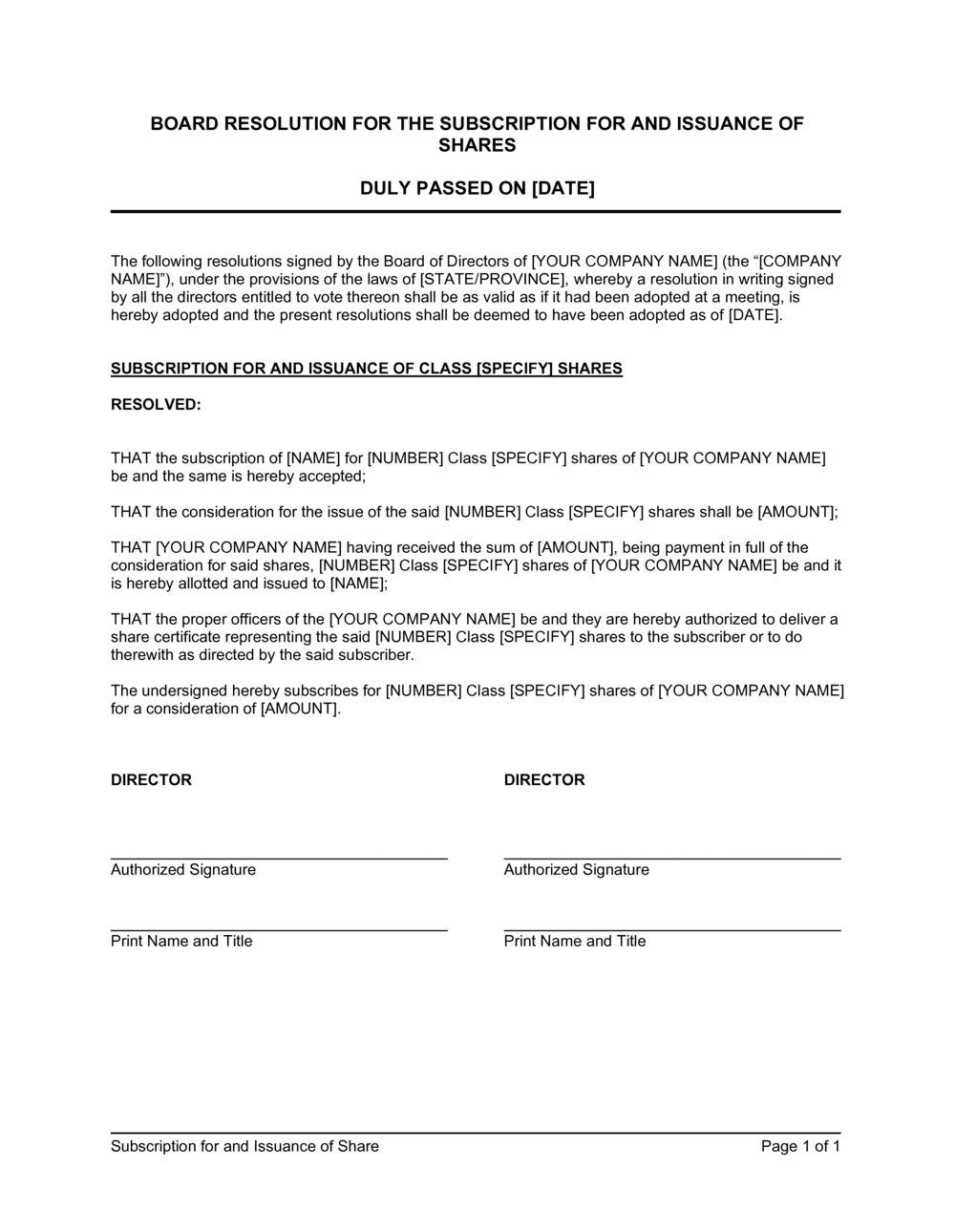
Review the company's articles of incorporation or certificate of incorporation to confirm the number of authorized shares available in the relevant class. Calculate how many shares are currently issued and whether sufficient authorized but unissued shares remain.
💡 If the proposed issuance would exceed authorized capital, you must amend the articles first — file that resolution before this one.
2
Identify the subscriber with full legal details
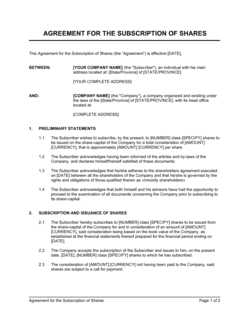
Enter the subscriber's complete registered legal name, address, and — for corporate subscribers — the jurisdiction of formation and registration number. Cross-reference against the subscription agreement or term sheet.
💡 For trust or nominee arrangements, record the beneficial owner in a side letter and note the nominee arrangement in the cap table even if not in the resolution itself.
3
Specify the share class, number, and par value
State the exact share class as it appears in the articles (e.g., 'Class A Common Stock' — not just 'common shares'), the precise number of shares, and the par value per share. Verify these against the authorized classes in the articles.
💡 For no-par-value shares, delete the par value reference and note the shares are issued for stated capital as determined by the board.
4
Set the subscription price and record the total consideration
Enter the agreed price per share and calculate the aggregate consideration. For non-cash consideration (services or property), describe the assets being transferred and state the board's determined fair market value.
💡 Document the basis for the price per share — a 409A valuation, board determination, or arm's-length negotiation — in a board minute or recital. Undocumented pricing invites IRS or CRA scrutiny.
5
Define the payment method and deadline
Specify whether payment is by wire, cheque, or in-kind transfer, and set a firm deadline by which the consideration must be received before shares are issued. Include the company's wire transfer details or escrow instructions if applicable.
💡 Build in at least three business days between the payment deadline and the planned registry update date to allow for banking delays.
6
Address pre-emption rights
Review the articles and any existing shareholder agreements to determine whether pre-emption rights apply. Choose the correct pre-emption language — waiver confirmation, exemption reliance, or process completion — and insert it into the resolution.
💡 Collect pre-emption waivers from existing shareholders in writing before signing this resolution, and attach them as exhibits to the minute book.
7
Confirm the securities law exemption
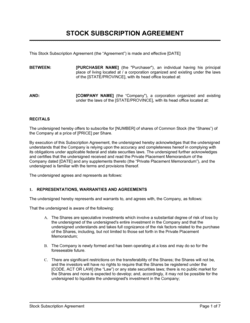
Identify the applicable registration exemption — Regulation D Rule 506(b) or 506(c), a provincial private placement exemption, or another applicable carve-out. Insert the exemption name and confirm the subscriber's qualifying status (e.g., accredited investor, sophisticated investor).
💡 For US issuances to more than 35 non-accredited investors, Rule 506(b) has additional disclosure requirements — confirm compliance before relying on this exemption.
8
Obtain director signatures and secretary's certification
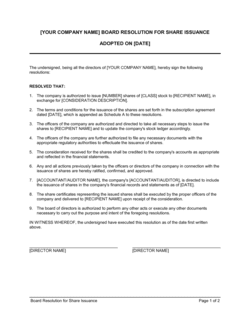
Circulate the resolution for signature by the required number of directors — or all directors if adopting by written consent without a meeting. Once signed, have the corporate secretary certify it and file it in the company's minute book.
💡 Date the resolution on the day the last required signature is obtained, not the day it was drafted. Backdating corporate resolutions carries serious legal and regulatory risk.