Acknowledgment Of Obligations Contract Template

Free Word download β€’ Edit online β€’ Save & share with Drive β€’ Export to PDF

1 pageβ€’15–20 min to fillβ€’Difficulty: Standard
Learn more ↓
FreeAcknowledgment Of Obligations Contract Template

At a glance

What it is
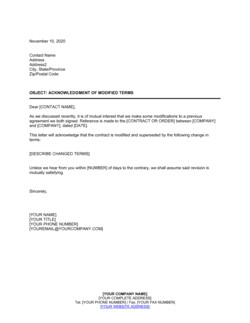
An Acknowledgment of Obligations Contract is a formal written notice that confirms one party has been informed of β€” and explicitly accepts β€” a defined set of duties, responsibilities, or pre-existing contractual obligations. This free Word download gives you a ready-to-edit template you can tailor to your situation and export as PDF in minutes.
When you need it
Use it when onboarding a new employee, vendor, or partner who must confirm awareness of existing policies, agreements, or operational rules before beginning work. It is also appropriate when transferring a contract or account to a new responsible party and a documented acknowledgment is needed.
What's inside
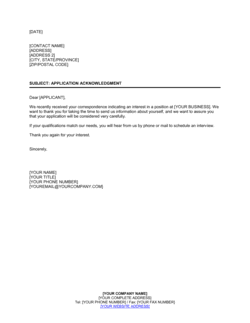
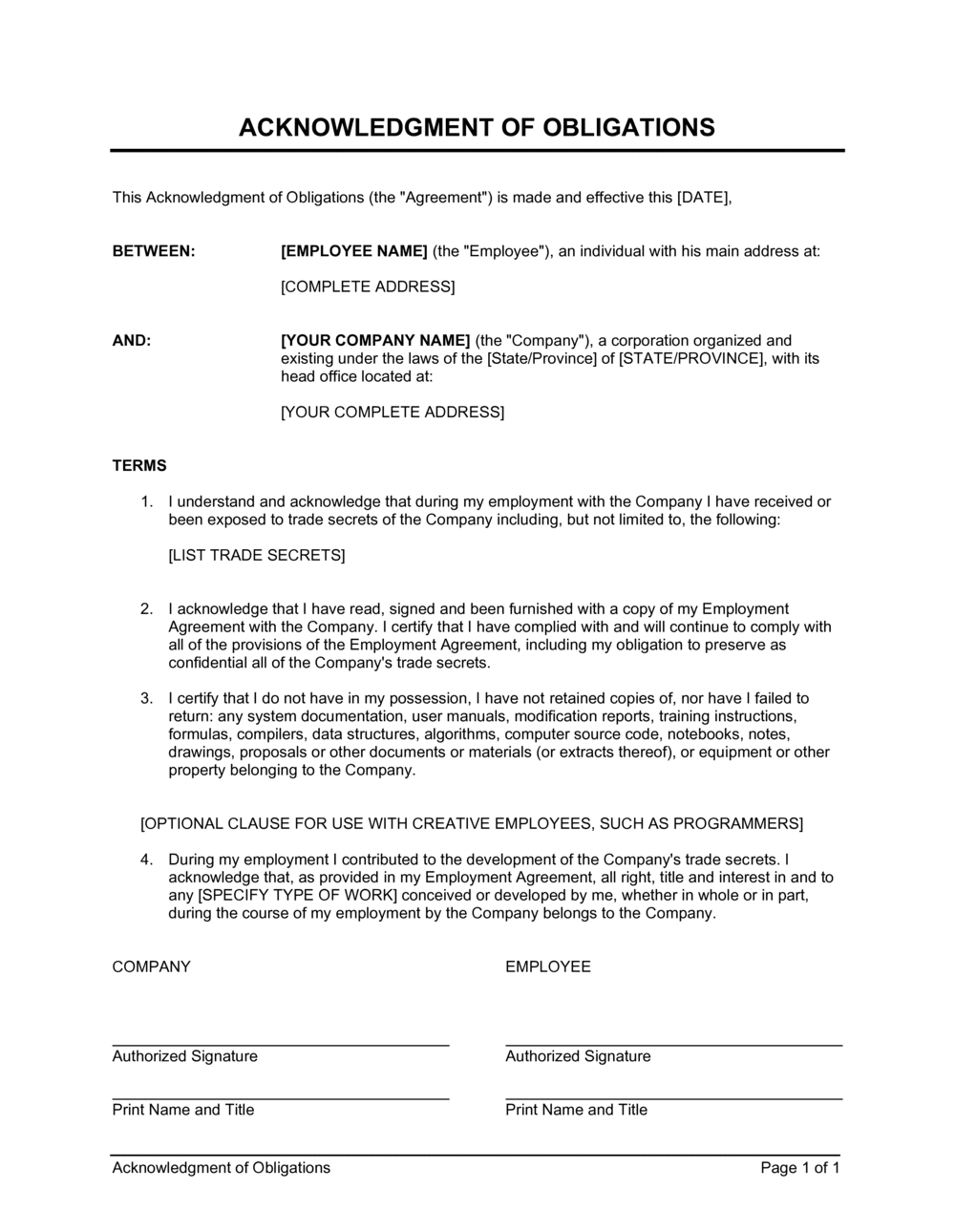
The template includes an opening identification of the parties, a clear recitation of the obligations being acknowledged, a confirmation statement from the acknowledging party, and a closing with date and contact details. Each component is written in plain, professional language suitable for business correspondence.

What is an Acknowledgment of Obligations Contract?

An Acknowledgment of Obligations Contract is a formal written notice in which one party confirms they have been informed of β€” and explicitly accept β€” a defined set of pre-existing duties or responsibilities. Unlike a contract that creates new obligations, this document serves as a documented record that specific requirements were communicated clearly and received by the relevant party. It references an underlying agreement, policy, or legal requirement and records the acknowledging party's confirmation in plain, professional language that can be retained for audit, compliance, or dispute-resolution purposes.

Why You Need This Document

Operating without a documented acknowledgment of obligations leaves critical gaps in your compliance and HR records. When an employee later claims they were unaware of a policy, or a contractor disputes that a specific requirement was ever communicated, an undocumented disclosure gives you nothing to rely on. This template closes that gap by creating a dated, specific record that the relevant party was informed of each obligation before work began or a change took effect. For HR teams managing policy rollouts, operations managers handing off responsibilities to new parties, and compliance officers maintaining audit trails, a clear and consistently used acknowledgment form is a low-effort, high-value safeguard that takes minutes to complete and can save significant time and cost if a dispute arises.

Which variant fits your situation?

If your situation is…Use this template
Employee must confirm awareness of a company code of conductCode of Conduct Acknowledgment
Contractor acknowledges project deliverables and deadlinesContractor Obligations Acknowledgment
New party assuming obligations under an existing agreementAssignment and Assumption Agreement
Party confirming receipt of a formal legal noticeAcknowledgment of Receipt Letter
Employee acknowledging confidentiality obligations specificallyNon-Disclosure Agreement
Vendor confirming acceptance of procurement termsVendor Acknowledgment Letter
Party confirming awareness of safety and compliance rulesSafety Policy Acknowledgment Form

Common mistakes to avoid

❌ Vague obligation language

Why it matters: Listing obligations in general terms β€” such as 'all duties under the contract' β€” gives the acknowledging party grounds to claim they were not clearly informed of a specific requirement, weakening the document's evidentiary value.

Fix: List each obligation as a discrete, specific item. If the underlying contract has numbered clauses, reference them by clause number alongside the plain-language description.
❌ Using passive receipt language instead of active acceptance

Why it matters: A statement that the recipient 'received' the document does not establish that they understood or agreed to the obligations β€” courts and auditors distinguish between the two.

Fix: Replace 'I acknowledge receipt of' with 'I confirm I have read, understood, and agree to comply with each obligation listed herein.'

❌ Omitting the effective date

Why it matters: Without a specific effective date, it becomes impossible to determine exactly when the obligations took effect β€” which matters when investigating a compliance failure or a missed deadline.

Fix: Always enter a specific calendar date. If obligations begin immediately, write today's date rather than 'upon receipt' or 'as of signing.'

❌ Sending without retaining a timestamped delivery record

Why it matters: If the acknowledging party later disputes receiving the notice, an undocumented delivery leaves you with no evidence the acknowledgment was properly communicated.

Fix: Send via email with a delivery and read receipt, or use a document portal that records when the file was opened. Archive the confirmation alongside the document itself.

The 8 key clauses, explained

Header and party identification

In plain language: Opens the document with the full legal names and roles of both the issuing party and the acknowledging party, plus the date.

Sample language
This Acknowledgment of Obligations is issued on [DATE] by [ISSUING PARTY NAME] ('Company') to [ACKNOWLEDGING PARTY NAME] ('Recipient').

Common mistake: Using a trade name or informal identifier instead of the full legal entity name β€” this can make the document difficult to enforce or reference in a later dispute.

Background and purpose

In plain language: A brief statement explaining why the acknowledgment is being issued β€” what agreement, policy, or role gives rise to the obligations.

Sample language
This acknowledgment is issued in connection with Recipient's engagement as [ROLE/POSITION] under the agreement dated [DATE] ('Agreement').

Common mistake: Omitting the background context entirely, which leaves the reader without the foundation needed to understand which obligations are being acknowledged.

Recitation of obligations

In plain language: The substantive core of the document β€” lists the specific duties, responsibilities, or rules the acknowledging party is confirming they are aware of.

Sample language
Recipient acknowledges the following obligations: (a) [OBLIGATION 1]; (b) [OBLIGATION 2]; (c) [OBLIGATION 3], as more fully described in [REFERENCED DOCUMENT].

Common mistake: Listing obligations too vaguely β€” phrases like 'all duties under the agreement' without specifics give the recipient grounds to claim they were not clearly informed of a particular item.

Confirmation and acceptance statement

In plain language: A direct declaration by the acknowledging party that they have read, understood, and accept each obligation listed above.

Sample language
Recipient confirms that they have read and understood each obligation listed herein and agree to comply with each requirement effective [EFFECTIVE DATE].

Common mistake: Framing the confirmation as passive receipt rather than active acceptance β€” 'I received this document' is not the same as 'I accept these obligations.'

Reference to source documents

In plain language: Cites the underlying agreements, policies, or regulations that give rise to the obligations, so the reader can locate the full terms.

Sample language
The obligations listed herein arise from and are governed by the [AGREEMENT NAME] dated [DATE], a copy of which has been provided to Recipient.

Common mistake: Referencing a document by an informal nickname instead of its full title and date β€” this creates ambiguity about which version of the document applies.

Consequences of non-compliance

In plain language: A brief, factual statement of what may occur if the acknowledging party fails to meet the stated obligations.

Sample language
Failure to comply with the obligations set out herein may result in [SPECIFIC CONSEQUENCE], as provided under Section [X] of the Agreement.

Common mistake: Threatening disproportionate or unenforceable consequences β€” stating penalties that are not actually backed by the underlying agreement undermines the document's credibility.

Contact and escalation information

In plain language: Names the person or department the acknowledging party should contact with questions, concerns, or to report a compliance issue.

Sample language
Questions regarding these obligations should be directed to [CONTACT NAME], [TITLE], at [EMAIL] or [PHONE NUMBER].

Common mistake: Omitting a contact entirely, which leaves the acknowledging party with no clear path to seek clarification β€” increasing the risk of uninformed non-compliance.

Date and closing

In plain language: Records the date the acknowledgment is being issued or accepted, and closes with the name and title of the issuing party's representative.

Sample language
Issued by: [AUTHORIZED REPRESENTATIVE NAME], [TITLE], [COMPANY NAME] | Date: [DATE]

Common mistake: Leaving the date field blank or using 'as of the date signed' without a specific date β€” this makes the effective date of the obligations impossible to determine with certainty.

How to fill it out

  1. 1

    Enter the full legal names of both parties

    Replace the placeholders with the issuing party's registered business name and the acknowledging party's full legal name. Include the party's role or title next to their name.

    πŸ’‘ Cross-check the acknowledging party's name against any existing contract or employment record to ensure it matches exactly.

  2. 2

    Set the effective date

    Enter the specific calendar date from which the obligations take effect. This should align with the start of employment, the commencement of a contract, or the date of a policy update.

    πŸ’‘ If the acknowledgment relates to a transition of responsibility, set the effective date to the handover date β€” not the date the letter is drafted.

  3. 3

    Write a clear background statement

    In one to two sentences, explain the relationship or event that gives rise to the obligations β€” the job, contract, or policy change being referenced.

    πŸ’‘ Cite the original agreement by full title and date so there is no ambiguity about which document the acknowledgment covers.

  4. 4

    List each obligation specifically

    Replace the placeholder obligations with itemized, specific duties. Use clear language: what must be done, by when, and how frequently if applicable.

    πŸ’‘ Limit each listed item to a single obligation. Combining two duties into one bullet creates ambiguity about which part was acknowledged.

  5. 5

    Include the confirmation statement

    Ensure the confirmation paragraph uses active acceptance language β€” the recipient must confirm they have read, understood, and agree to comply β€” not merely that they received the document.

    πŸ’‘ If you need a signed copy for your records, add a signature line below the confirmation statement even though signature is not required for the letter to be valid.

  6. 6

    Add the contact information for questions

    Enter the name, title, email, and phone number of the person the acknowledging party should contact with questions about any obligation.

    πŸ’‘ Use a role-based email address (e.g., compliance@company.com) rather than a personal one so the contact remains valid if staff changes.

  7. 7

    Export as PDF and deliver

    Save the completed document as PDF and deliver it via email or in person. Retain the editable Word file and a timestamped copy of the sent communication for your records.

    πŸ’‘ Send via a channel that generates a delivery confirmation β€” email with a read receipt, or a tracked document portal β€” so you can demonstrate the recipient received it.

Frequently asked questions

What is an acknowledgment of obligations contract?

An acknowledgment of obligations contract is a formal written notice that confirms one party has been informed of β€” and accepts β€” a defined set of duties or responsibilities. It does not create new obligations; it documents that pre-existing duties have been communicated and understood. Businesses use it to build an auditable record that key requirements were properly disclosed.

Is an acknowledgment of obligations legally binding?

An acknowledgment letter is generally not a standalone binding contract in the same way a signed agreement is, because it typically lacks mutual consideration. However, it creates a strong evidentiary record that a party was informed of specific obligations β€” which is significant in disputes, audits, and regulatory proceedings. For obligations that require full contractual enforceability, pair this document with the underlying signed agreement.

Does this document need to be signed?

A signature is not required for this type of letter to serve its primary purpose as a formal notice. However, adding a signature line and requesting a countersignature significantly strengthens the document as evidence that the acknowledging party confirmed acceptance. For high-stakes situations β€” such as compliance obligations or sensitive IP matters β€” always request a signed copy.

When should I use an acknowledgment of obligations instead of a new contract?

Use an acknowledgment when the underlying obligations already exist in a prior contract, policy, or legal requirement and you simply need to document that the relevant party is aware of them. Use a new contract when you are creating obligations for the first time or materially modifying existing terms. The acknowledgment supplements and references the original document rather than replacing it.

Can I use this document for employee onboarding?

Yes β€” an acknowledgment of obligations is commonly used during onboarding to confirm that a new employee has read and understood workplace policies, codes of conduct, confidentiality requirements, or safety rules. It creates a dated record that the employee was informed of each requirement before starting work, which is useful in disciplinary proceedings or compliance audits.

How specific do the listed obligations need to be?

Each listed obligation should be specific enough that a third party β€” an auditor, a manager, or a court β€” could determine exactly what was required and whether it was met. Reference the relevant clause number of the underlying agreement alongside a plain-language description. Avoid catch-all phrases like 'all duties under the agreement' without also listing the primary ones individually.
How long should I retain an acknowledgment of obligations?

Retain the document for at least as long as the underlying relationship continues, plus any applicable statute-of-limitations period β€” typically 3–7 years depending on jurisdiction and the nature of the obligation. For employment-related acknowledgments, align retention with your jurisdiction's employment records requirements. Store a timestamped delivery confirmation alongside the document itself.

Can one acknowledgment cover multiple parties?

Yes β€” you can issue a single acknowledgment to multiple recipients by listing each party by name in the header and requesting individual signatures or confirmations from each. Alternatively, issue separate copies to each party so each person has their own dated record. Separate copies are preferable when obligations differ between recipients even slightly.

How this compares to alternatives

vs Acknowledgment of Receipt Letter

An acknowledgment of receipt letter confirms only that a document or communication was received β€” it says nothing about the content or any obligations it contains. An acknowledgment of obligations goes further by explicitly listing the duties the recipient is confirming awareness of. Use the receipt letter for simple delivery confirmation; use this template when you need a record of informed acceptance.

vs Non-Disclosure Agreement

An NDA is a binding bilateral contract that creates new confidentiality obligations and provides remedies for breach. An acknowledgment of obligations simply records that a party is aware of duties that already exist β€” including confidentiality obligations that may already appear in a separate agreement. The NDA is the source document; the acknowledgment is the confirmation that the party was informed of it.

vs Employment Contract

An employment contract creates the full terms of an employment relationship β€” compensation, duties, IP assignment, and termination β€” and is a binding legal agreement. An acknowledgment of obligations does not create new terms; it confirms the employee has been informed of duties that arise from the employment contract or company policy. Both documents serve different purposes and are often used together.

vs Letter of Undertaking

A letter of undertaking is a forward-looking promise by one party to perform a specific action or fulfill a future obligation. An acknowledgment of obligations is backward-looking β€” it confirms awareness of duties that already exist. Use an undertaking when you need a commitment to future performance; use this acknowledgment when you need a record that existing obligations were properly communicated.

Industry-specific considerations

Human Resources and Staffing

Used during onboarding to confirm employee awareness of conduct policies, confidentiality rules, and safety requirements before the first day of work.

Construction and Trades

Subcontractors acknowledge site safety obligations, scope-of-work boundaries, and insurance requirements before mobilizing on a project.

Financial Services

Clients and advisors confirm awareness of regulatory disclosure obligations, suitability requirements, and account terms at onboarding and at each material change.

Property Management

Tenants and property managers acknowledge maintenance responsibilities, building rules, and lease obligations at the start of a tenancy or following a policy update.

Template vs pro β€” what fits your needs?

PathBest forCostTime
Use the templateHR teams, small business owners, and operations managers documenting routine obligation disclosuresFree10–15 minutes per document
Template + professional reviewCompliance officers or managers issuing acknowledgments that reference regulated obligations or sensitive contractual duties$100–$300 for a brief legal or compliance review1–2 business days
Custom draftedHigh-stakes situations involving executive obligations, regulated industries, or obligations that will be relied upon in litigation$500–$1,500+3–5 business days

Glossary

Acknowledging Party
The individual or entity signing the document to confirm they have been informed of and accept the stated obligations.
Issuing Party
The business or individual presenting the acknowledgment β€” typically the employer, client, or contract holder.
Pre-existing Obligation
A duty or responsibility that already exists under a prior contract, policy, or legal requirement, which the acknowledging party is now confirming awareness of.
Effective Date
The specific date from which the acknowledgment is considered active and the obligations are formally accepted.
Recitation of Obligations
The portion of the document that lists or summarizes the specific duties the acknowledging party is confirming β€” the factual core of the letter.
Confirmation Statement
A plain-language declaration by the acknowledging party that they have read, understood, and accepted the obligations described.
Counterpart
A duplicate original of the same document signed by a different party β€” each copy holds equal legal weight when acknowledgment is needed from multiple parties.
Audit Trail
A documented record β€” dates, names, signatures, and the content of communications β€” that demonstrates an obligation was properly communicated and accepted.

Part of your Business Operating System

This document is one of 3,000+ business & legal templates included in Business in a Box.

  • Fill-in-the-blanks β€” ready in minutes
  • 100% customizable Word document
  • Compatible with all office suites
  • Export to PDF and share electronically

Create your document in 3 simple steps.

From template to signed document β€” all inside one Business Operating System.
1
Download or open template

Access over 3,000+ business and legal templates for any business task, project or initiative.

2
Edit and fill in the blanks with AI

Customize your ready-made business document template and save it in the cloud.

3
Save, Share, Send, Sign

Share your files and folders with your team. Create a space of seamless collaboration.

Save time, save money, and create top-quality documents.

β˜…β˜…β˜…β˜…β˜…

"Fantastic value! I'm not sure how I'd do without it. It's worth its weight in gold and paid back for itself many times."

Managing Director Β· Mall Farm
Robert Whalley
Managing Director, Mall Farm Proprietary Limited
β˜…β˜…β˜…β˜…β˜…

"I have been using Business in a Box for years. It has been the most useful source of templates I have encountered. I recommend it to anyone."

Business Owner Β· 4+ years
Dr Michael John Freestone
Business Owner
β˜…β˜…β˜…β˜…β˜…

"It has been a life saver so many times I have lost count. Business in a Box has saved me so much time and as you know, time is money."

Owner Β· Upstate Web
David G. Moore Jr.
Owner, Upstate Web

Run your business with a system β€” not scattered tools

Stop downloading documents. Start operating with clarity. Business in a Box gives you the Business Operating System used by over 250,000 companies worldwide to structure, run, and grow their business.

Start freeΒ Β·Β No credit card required